Dealing with a broken air conditioner, a leaking ceiling, or no hot water in a Texas rental can make your home feel unlivable fast. Most tenants know they should “tell the landlord.” Far fewer know that the way you ask for repairs often decides whether you keep your rights or lose them.
That's the part that causes real trouble. Tenants often have a valid complaint, but they text instead of sending formal notice, hire the wrong repair person, or deduct money from rent too soon. Then the case shifts from “the landlord didn't repair” to “the tenant didn't follow the Texas Property Code.”
If you're searching for answers about texas tenant rights repairs, the safest approach is to think in two tracks at once. First, identify whether the problem is serious enough to trigger the landlord's legal duty. Second, build proof from day one. If you do both, you give yourself options. If you skip either one, you make a hard situation harder.
Your Fundamental Right to a Safe and Habitable Home
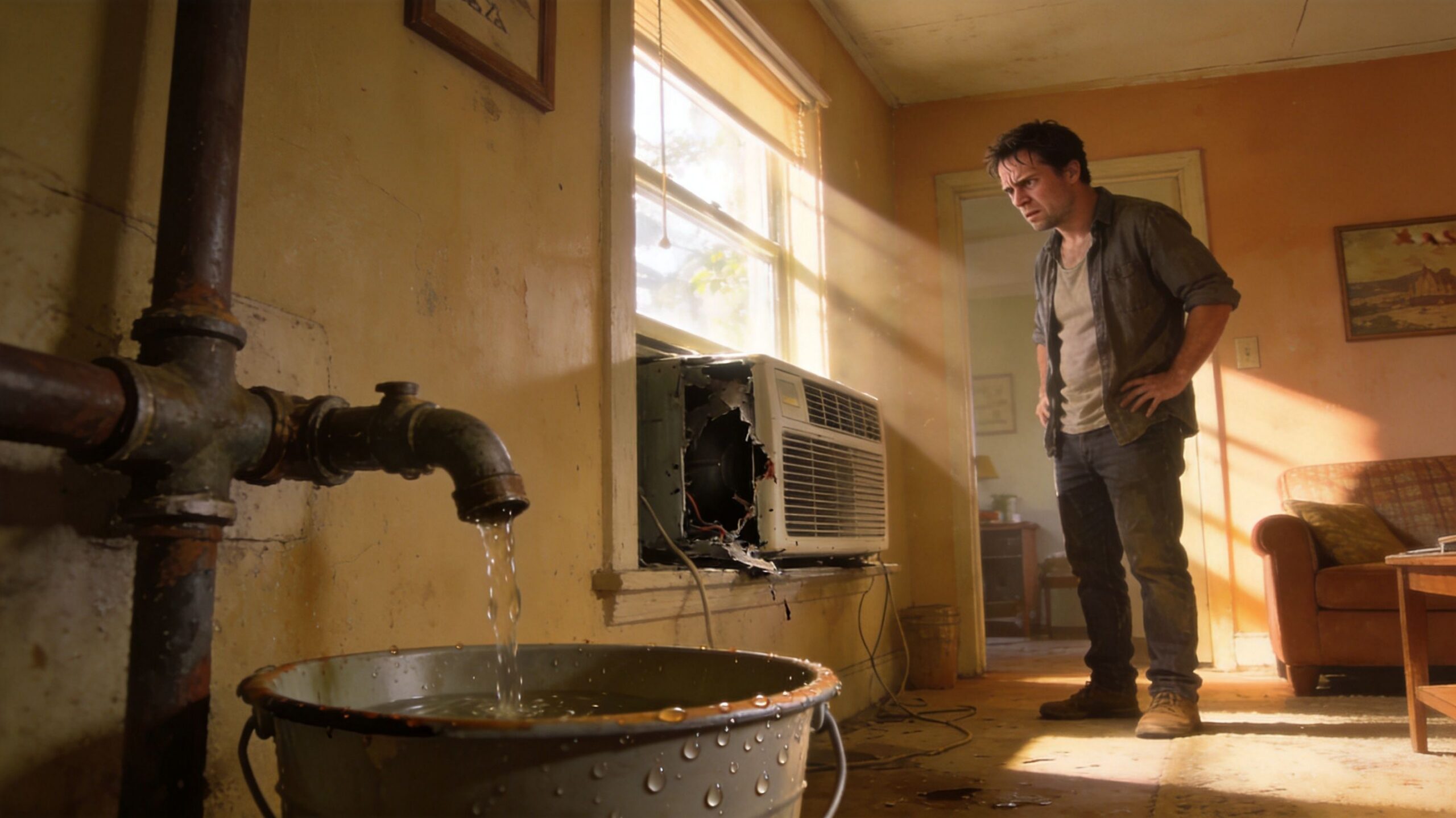
A Texas landlord doesn't have to fix every annoyance in a rental. But the law does require repairs when a condition materially affects the physical health or safety of an ordinary tenant.
That repair duty has deep roots. The landlord's statutory duty to repair conditions materially affecting health or safety came out of a landmark Texas Supreme Court case in 1978 initiated by the Texas Tenants' Union, and it was codified in 1979 under Section 92.052 of the Texas Property Code, as described by the Texas Tenants' Union history of tenant repair rights. If you want a direct overview of the statute itself, this guide to Texas Property Code Section 92 is a useful starting point.
What usually qualifies
Think about problems that create real risk, not just inconvenience. A sewage backup, unsafe wiring, no hot water, or a major roof leak can affect health and safety. So can conditions that make the property structurally unsafe.
Sometimes the line is less obvious. A crack in a wall may be cosmetic, or it may point to a larger structural problem. In those situations, context matters. A practical primer on the dangers of ignoring foundation cracks helps explain why some “small” issues deserve closer attention before they become larger hazards.
What usually does not qualify
Texas law doesn't turn every maintenance dispute into a legal repair claim. Cosmetic issues often fall outside the strongest tenant remedies. Examples can include worn finishes, minor appearance defects, or problems that don't create a meaningful health or safety risk.
That distinction matters because many tenants lump everything into one complaint. If your notice mixes serious hazards with cosmetic items, the landlord may respond as if the whole request is optional. A stronger approach is to separate true habitability issues from ordinary maintenance complaints.
Practical rule: Ask one simple question. “Would an ordinary tenant say this condition puts physical health or safety at risk?” If the honest answer is yes, treat it like a formal legal issue from the start.
A common real-world example
Take a Texas summer AC problem. If the air conditioning stops working, tenants understandably feel desperate. But the legal analysis still comes back to health and safety, the facts of the unit, and how the issue is documented. If the failure is creating dangerous living conditions, your paper trail becomes critical.
By contrast, a chipped countertop may be irritating and unfair, but it usually won't support the same remedies. That's why the first job isn't getting angry. It's classifying the problem correctly, then documenting it like a case that might end up in court.
The Critical First Step Giving Proper Legal Notice
Most repair claims are won or lost at the notice stage. Talking to the leasing office, texting maintenance, or mentioning the issue in passing might help you get a repair. It often won't help you enforce your rights.
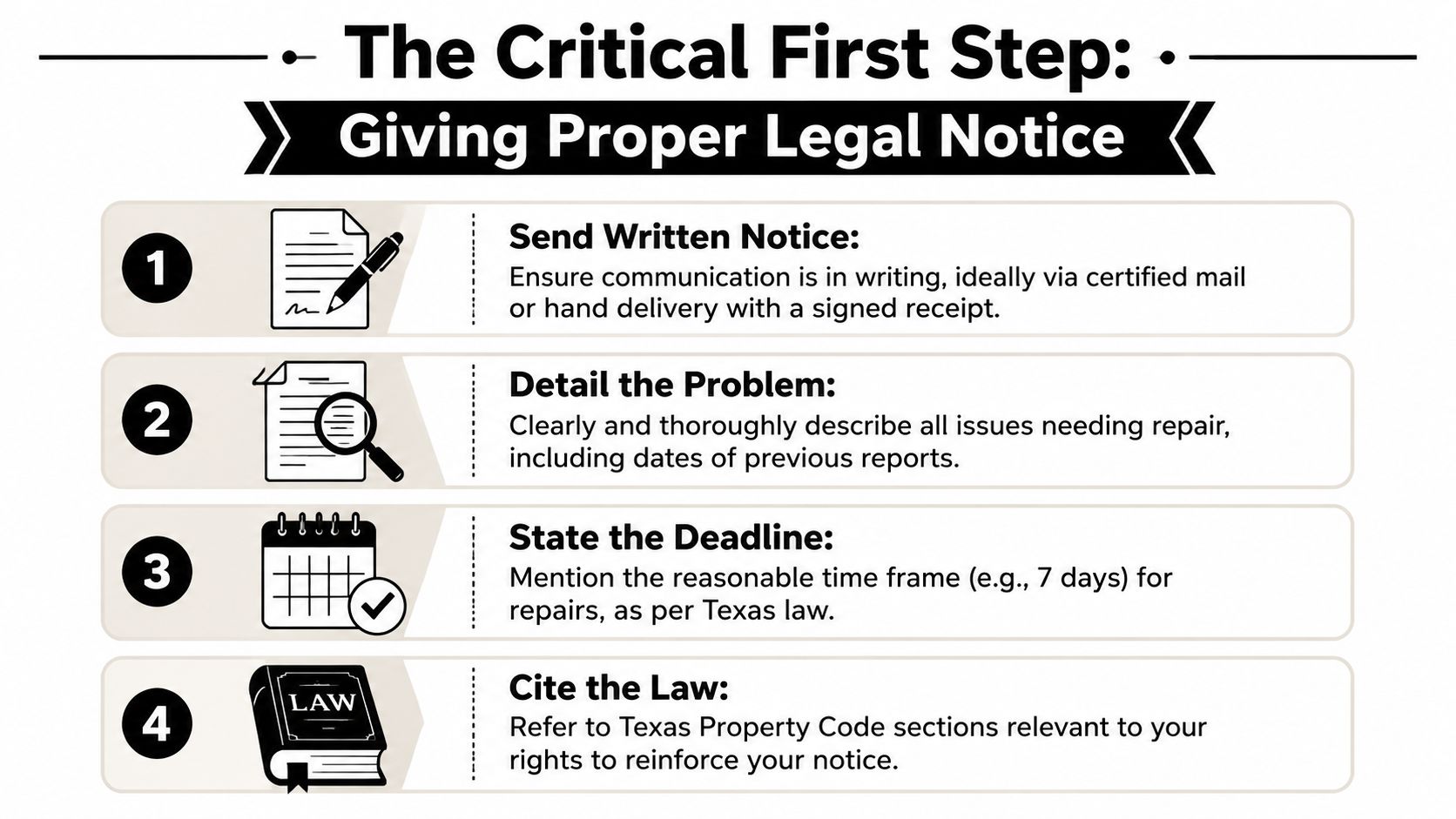
Under Texas repair law, written notice is what gives your claim structure. According to the UNT Dallas guide to tenant repair rights, using certified mail for your repair notice requires only one notice, while regular mail or hand delivery requires a second notice after a reasonable time has passed. That same source states that tenants with documented proof of notice win their cases about 75% of the time, while verbal notices fail over 90% of the time.
Why certified mail is usually the best move
Certified mail creates a clean record. It shows that you sent the notice, when you sent it, and where it went. That matters if the landlord later says, “We never got it,” or “No one told us this was serious.”
Hand delivery and regular mail can still work. They just create more room for dispute and usually require another written notice. In practice, that means more waiting and more chances for the facts to get messy.
If you need a practical companion piece, this step-by-step guide on how to request repairs from your landlord pairs well with the legal rules.
What your notice should say
Don't write an emotional rant. Write a usable record.
Include these points:
The exact problem
Describe the condition in plain English. “Kitchen sink sewage backup” is better than “serious issue.”Why it affects health or safety
Connect the facts. “Water leak is causing mold growth and unsafe flooring” is stronger than “please fix ASAP.”The location in the unit
Be specific. Name the bathroom, bedroom, hallway, or appliance involved.The date of the notice
Dates matter because Texas repair remedies depend on timing.A request for prompt repair
You don't need dramatic language. You do need a clear request.
A simple notice template
You can adapt this for your situation:
Date: [insert date]
To: [landlord or property manager name and address]I am requesting repair of the following condition in my rental unit: [describe issue].
This condition affects health or safety because [brief explanation].
The issue is located at [specific location in unit].
Please make diligent efforts to repair this condition within a reasonable time.Sincerely,
[your name]
[property address]
[contact information]
What works and what doesn't
What works
- Photos taken the same day: Save them with visible dates if possible.
- Copies of every notice: Keep paper and digital versions.
- A delivery record: Certified mail receipts, tracking, or signed hand-delivery receipt.
- Rent paid on time: If you're behind, your remedies can collapse.
What doesn't
- Phone calls without follow-up in writing
- Texts with no screenshots saved
- Vague descriptions like “the place is unsafe”
- Waiting too long to formalize the problem
A repair dispute is usually a proof dispute in disguise. The tenant with organized records starts in a much stronger position.
What to Expect After You Send a Repair Request
Once notice is sent, most tenants want to know one thing. How long does the landlord get?
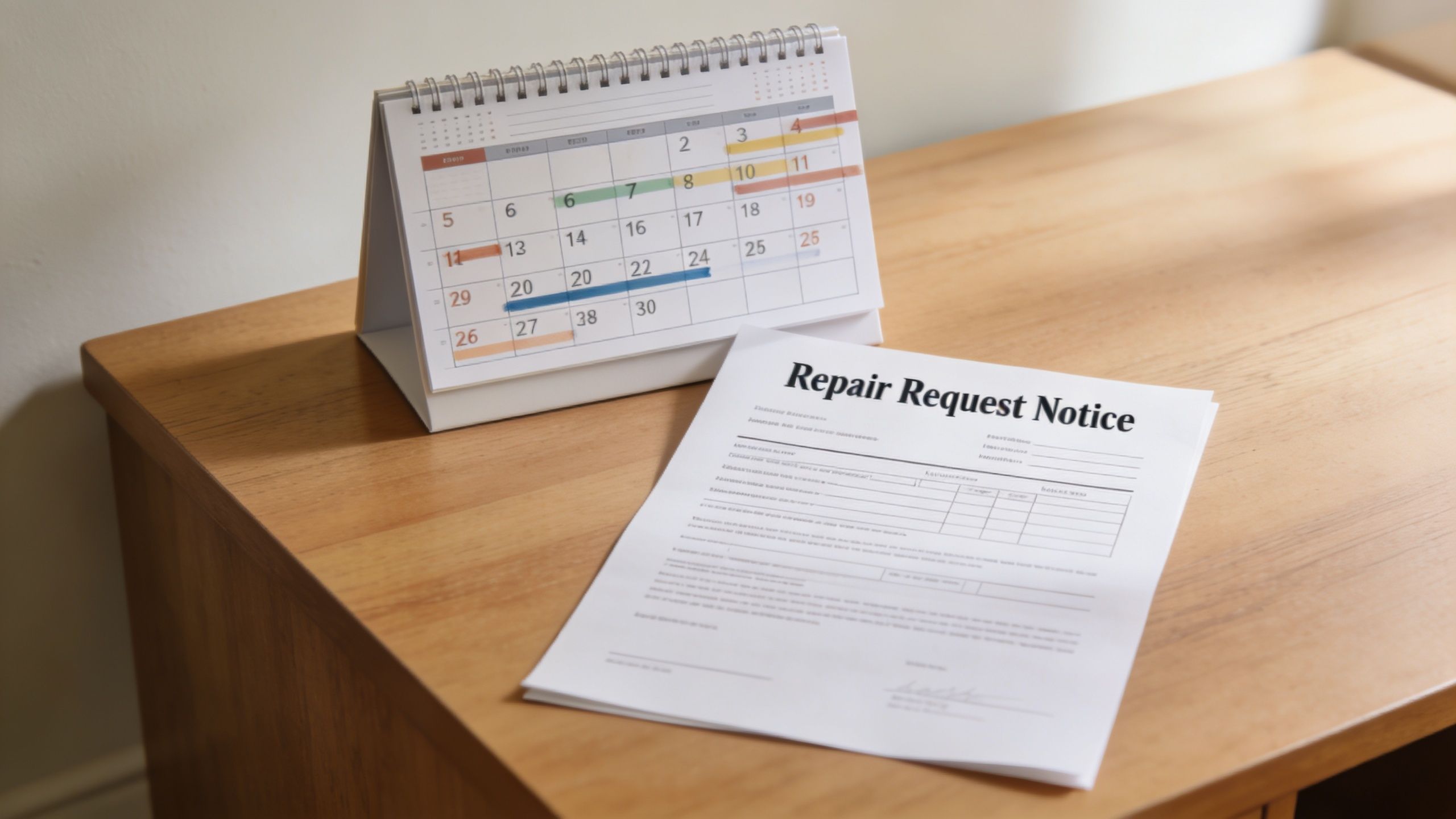
Texas law relies on the concepts of a reasonable time and a diligent effort to repair. In many situations, people use a week as a practical benchmark, but the answer depends on the condition, the severity, and whether the landlord is moving the repair forward.
Signs the landlord is acting diligently
A landlord doesn't always have to complete the repair immediately to show compliance. If management inspects the issue, schedules a licensed vendor, orders needed parts, or communicates clearly about access and timing, that can support an argument that they are acting diligently.
A delay is more suspicious when the landlord ignores the notice, gives shifting excuses, or keeps sending unqualified handymen who don't solve the problem. Tenants often focus only on the calendar. Courts also look at conduct.
When delay may be legally justified
One important exception catches many renters off guard. Texas law provides that when the condition results from an insured casualty, such as a fire or flood, the landlord's repair clock doesn't start until the insurance proceeds are received, as explained in the Texas legislative summary of SB 1802.
That doesn't mean every delay is proper. It means storm, fire, or flood losses can follow a different timeline than ordinary maintenance failures.
If the landlord says insurance is the reason for delay, ask for written updates and keep documenting the condition. A lawful delay is still easier to evaluate when the facts are organized.
Two contrasting examples
A water heater failure is usually treated very differently from a cracked cabinet door. If you have no hot water, the urgency is obvious. If the landlord responds quickly, lines up a plumber, and keeps you informed, that often looks reasonable even if the repair isn't completed the same day.
Now compare that with a roof leak that has been reported repeatedly, keeps damaging drywall, and still hasn't been addressed in any meaningful way. That pattern can point toward unlawful inaction, especially when the tenant can prove notice and continued damage.
What tenants should do during the waiting period
Use the waiting period well. Keep a dated log of calls, emails, vendor visits, and worsening conditions. Update photos. Save any promises made by management. If they attempt a repair that fails, document that too.
The goal isn't to be dramatic. The goal is to be credible.
When Your Landlord Fails to Act Your Legal Remedies
If proper notice was given, rent is current, and the landlord still doesn't make diligent repair efforts, Texas law gives tenants several possible remedies. The safest option depends on the seriousness of the condition, your housing alternatives, and how strong your records are.
Remedy comparison at a glance
| Remedy | Best For | Primary Risk | Key Requirement |
|---|---|---|---|
| Lease termination | Serious conditions when staying isn't workable | Moving costs and timing pressure | Proper notice, current rent, and a qualifying health or safety issue |
| Justice Court lawsuit | Tenants who want a court order or damages | Time, preparation, and appearing in court | Good documentation of notice, condition, and landlord inaction |
| Repair and deduct | Specific repairs that can be handled within the legal cap | Mistakes can trigger eviction or liability | Strict compliance, cost limit, and proper documentation |
Terminating the lease
Sometimes the most practical answer is leaving. If the condition is serious and the landlord still hasn't repaired after proper notice and a reasonable opportunity, lease termination may be the cleanest path.
This option often makes sense when the property has become unsafe to live in or when trust between landlord and tenant has broken down completely. It also avoids the problem of staying in a unit that is actively harming your daily life.
The trade-off is practical, not just legal. Moving is disruptive. You may need replacement housing fast. You also want your move-out records to be as careful as your repair records, because deposit disputes often follow.
Filing a repair case in Justice Court
Court is often the right choice when the tenant wants an order forcing repair, a rent reduction, or damages tied to the landlord's failure to act. This route can also help when the landlord keeps denying there is a problem at all.
The strength of a court case usually comes down to three categories of proof:
- Notice proof: Certified mail receipt, delivery confirmation, or signed delivery acknowledgment
- Condition proof: Photos, videos, inspection records, invoices, and witness statements
- Response proof: Missed appointments, incomplete repairs, and written landlord replies
A tenant with a neat file often looks much more credible than a tenant who “knows what happened” but can't show it.
Court rewards timelines. If you can show notice, waiting period, follow-up, and continuing harm in order, your position is much stronger.
Using repair and deduct
This is the remedy tenants talk about most and misuse most. Texas law allows repair and deduct in limited circumstances, but it is not a free-form right to hire someone and subtract the bill from rent.
The cap is the greater of $500 or one month's rent, according to the Texas tenant repair overview discussing repair-and-deduct limits. That same source states that tenants who present proper bids and receipts succeed in court 82% of the time, while 65% of failures involve unlicensed workers or costs above the limit.
Those numbers tell the story. Repair and deduct can work, but only when the tenant treats it like a formal legal remedy rather than a DIY shortcut.
What usually goes wrong with repair and deduct
The common mistakes are predictable:
- Hiring the wrong person: If the worker isn't properly qualified, the deduction becomes harder to defend.
- Spending too much: Going over the legal cap can hand the landlord an argument for nonpayment.
- Skipping records: No invoice, no receipt, no clear photos, no paper trail.
- Fixing a non-qualifying issue: Cosmetic work won't support the same remedy.
For many tenants, repair and deduct provides a feeling of agency. Legally, it's the highest-risk path because one error can turn the case around.
Which option fits which situation
If your unit has a dangerous condition and you can relocate, termination may be the cleanest remedy. If the issue is substantial and you want formal enforcement, court may be safer than self-help. If the repair is clearly covered, within the cap, and fully documented, repair and deduct may be worth considering.
The hard truth is that the “fastest” option isn't always the safest one. In Texas landlord-tenant disputes, precision usually beats speed.
Protecting Yourself From Landlord Retaliation
Many tenants stay quiet because they worry the landlord will punish them for speaking up. That fear is understandable. It's also one reason documentation matters so much.
Texas law protects tenants from retaliation when they properly exercise legal rights, including asking for repairs that affect health or safety. In plain terms, a landlord generally can't respond to a valid repair request by trying to force you out, slash services, or otherwise pressure you for asserting your rights.
What retaliation can look like
Retaliation isn't always dramatic. Sometimes it's obvious, such as an eviction notice shortly after a formal repair complaint. Other times it appears as smaller pressure tactics, like sudden hostility from management, threats, selective enforcement of lease rules, or withdrawal of normal services.
The stronger your records, the easier it is to show cause and effect. If your file shows timely rent payments, proper written notice, and a sharp change in the landlord's behavior after that, your defense gets stronger.
Why strict compliance matters
Protection against retaliation doesn't mean every tenant action is automatically safe. If you misuse a legal remedy, you can undermine your own position. For example, under Texas Property Code §92.0561(c), a tenant who improperly uses repair and deduct can be liable for one month's rent plus $500, attorney's fees, and face eviction, as explained by TexasLawHelp's repair rights article.
That risk changes the conversation. A tenant may feel morally justified, but courts will still ask whether the statute was followed.
Follow the rules before you rely on the protections. Retaliation claims are strongest when the tenant's own conduct is clean.
How to protect yourself
If you believe the landlord is retaliating, focus on preserving evidence instead of arguing in the hallway or by phone.
Use a simple file system:
- Keep lease records together: Lease, renewals, notices, and payment confirmations
- Save every repair document: Letters, receipts, tracking records, and photos
- Preserve all landlord communications: Emails, texts, portal messages, and posted notices
- Write a timeline: Dates of complaint, responses, inspections, threats, and any adverse action
That record does two things. It helps your lawyer evaluate the case quickly, and it makes it harder for the landlord to rewrite the story later.
When You Need a Texas Landlord-Tenant Lawyer
Some repair disputes are straightforward. Many aren't. The legal standard sounds simple, but an actual case often turns on timing, wording, proof, and whether the tenant chose the wrong remedy at the wrong moment.
That's where a Texas landlord tenant lawyer can make a real difference. A lawyer can review whether the condition likely qualifies under the Texas Property Code, whether notice was sent correctly, and whether the next move should be negotiation, a court filing, lease termination, or a carefully handled repair-and-deduct strategy. If you need broader help evaluating your position, this page about working with a Texas rental lawyer is a good place to start.
This kind of guidance helps tenants and landlords alike. Tenants need to avoid accidental missteps that lead to eviction exposure. Landlords need to know when a complaint creates a real statutory duty and when a response has to be documented more carefully to avoid liability.
A good legal review is often less about escalating conflict and more about choosing the cleanest path. In many cases, one well-written notice or one correctly framed response does more than weeks of informal arguing.
If you're dealing with texas tenant rights repairs, don't assume the facts alone will carry the day. In landlord-tenant law, the side with the better paperwork often has the stronger case.
If you need help with an eviction, lease issue, or rental dispute, contact The Law Office of Bryan Fagan, PLLC for a free consultation today.