A repair problem usually starts small, then takes over your routine. The air conditioner stops cooling in Texas heat. A leak under the sink turns one cabinet into a warped mess. Mold starts showing up around a vent, and every day you wait feels like another day you’re paying full rent for a place that isn’t functioning the way it should.
If you’re trying to figure out how to request repairs from landlord the right way, Texas law gives you a process. It also expects you to follow it carefully. That matters for tenants who need repairs done, and it matters for landlords and property managers who want to avoid turning a maintenance issue into a legal dispute.
The good news is that the process is manageable when you handle it in the right order. The stronger your paper trail, the greater your advantage. The more precise your notice, the harder it is for the other side to deny what happened.
Your Right to a Safe and Habitable Home in Texas
At 10 p.m. in August, the air conditioning fails, the apartment is climbing past comfortable, and your landlord says they will “look into it next week.” In Texas, that is not just frustrating. It can become a legal issue if the condition materially affects an ordinary tenant’s health or safety.
The starting point is Texas Property Code § 92.052. That statute does not promise perfect housing, and it does not require a landlord to fix every minor annoyance. It does require a landlord to make a diligent effort to repair or remedy conditions that materially affect health or safety, once the legal requirements are met. Texas lawyers and courts often treat about 7 to 14 days as a common benchmark for a reasonable time in many repair cases, but that is a guideline based on the statute’s “reasonable time” standard, not a fixed deadline written into § 92.052 for every problem.
The details matter. A tenant usually needs to be current on rent. The repair notice must be sent to the person or place where rent is normally paid. The problem must be serious enough to qualify under the statute, such as dangerous electrical issues, sewage backups, some plumbing failures, roof leaks, or mold conditions that create a real health concern. If mold is part of the dispute, Eagle Restoration's apartment mold guide can help you identify what to document before the argument turns into a credibility fight.
One mistake I see often is assuming a text message alone will protect you. Sometimes it helps. Sometimes it becomes a factual mess, especially when the landlord denies receiving it, claims the issue sounded minor, or says the tenant never followed the lease procedure. Good tenants protect themselves with clear written notice. Good landlords protect themselves by acknowledging the complaint, inspecting promptly, and creating a paper trail that shows diligence instead of delay.
Texas law also builds in trade-offs. Tenants have repair rights, but those rights are strongest when the tenant follows the statute carefully. Landlords have duties, but they are not insurers against every inconvenience in the property. That balance is why process matters so much in repair disputes.
For a broader explanation of Texas tenant rights under the Texas Property Code, start there. It gives useful context for the repair rules that apply when a housing problem stops being minor and starts threatening your health, safety, or stability.
Before You Write the Letter Document Everything
Your repair request is only as strong as the evidence behind it. Before you send anything, build a record that shows what is wrong, when it started, and how it affects the property.

What good documentation looks like
The best documentation is specific, dated, and easy for a third party to understand. The guidance summarized by Obie’s repair documentation article states that photographic documentation with clear labeling, supplemented by inspection reports or maintenance logs, constitutes the highest-evidence tier for repair disputes. That same guidance says repair requests with photos and dated documentation reduce disputes, while vague requests can create 5-7 day delays as managers ask for clarification.
That tracks with what works in real cases. “My bathroom is leaking” is weak. “Water is dripping from the ceiling above the shower, mostly after the upstairs unit uses water, and I first saw it on Monday at about 8 a.m.” is much stronger.
Start with these basics:
- Take wide and close photos: Show the full room first, then the specific damage.
- Use video when movement matters: Dripping pipes, sparking outlets, or a heater that won’t start are easier to prove on video.
- Write down dates: Note when you first noticed the issue and whether it’s getting worse.
- Track impact on daily living: If the leak makes part of the kitchen unusable or the stove won’t turn on, say that plainly.
- Save prior messages: Keep texts, emails, portal messages, and voicemail screenshots.
Build a clean timeline
A simple log helps more than people expect. Use your phone’s notes app, a Google Doc, or even a paper notebook. The format doesn’t matter as much as consistency.
Include:
- Date problem started
- What you observed
- Who you told
- How you told them
- What response you received
- Whether the issue changed
A mold complaint is a good example. Don’t just say you think mold is present. Describe where it appears, whether there is an ongoing moisture source, and whether the area smells musty or stays damp. If you’re trying to assess whether discoloration may be mold, Eagle Restoration's apartment mold guide gives a practical checklist you can use before sending your written request.
The more specific your evidence is, the less room the other side has to call the problem “minor,” “unclear,” or “not reported.”
Tenants and landlords both need records
This isn’t just a tenant tool. Landlords and property managers should also keep maintenance logs, inspection notes, vendor communications, and copies of all responses. When a dispute lands in court, the side with the cleaner record usually has the stronger position.
If you’re a tenant, document as if no one will remember the facts later.
If you’re a landlord, respond as if your records will need to show that you acted reasonably and promptly.
How to Formally Notify Your Landlord About Repairs
Documentation strengthens your position. Formal written notice is what protects your legal position.
A lot of tenants think a phone call, a text, or a maintenance portal request is enough. Sometimes that will get the repair done. But if the landlord delays, denies, or ignores the issue, informal communication often leaves you arguing over whether notice was ever properly given.
Early in the process, it helps to visualize the order of operations.
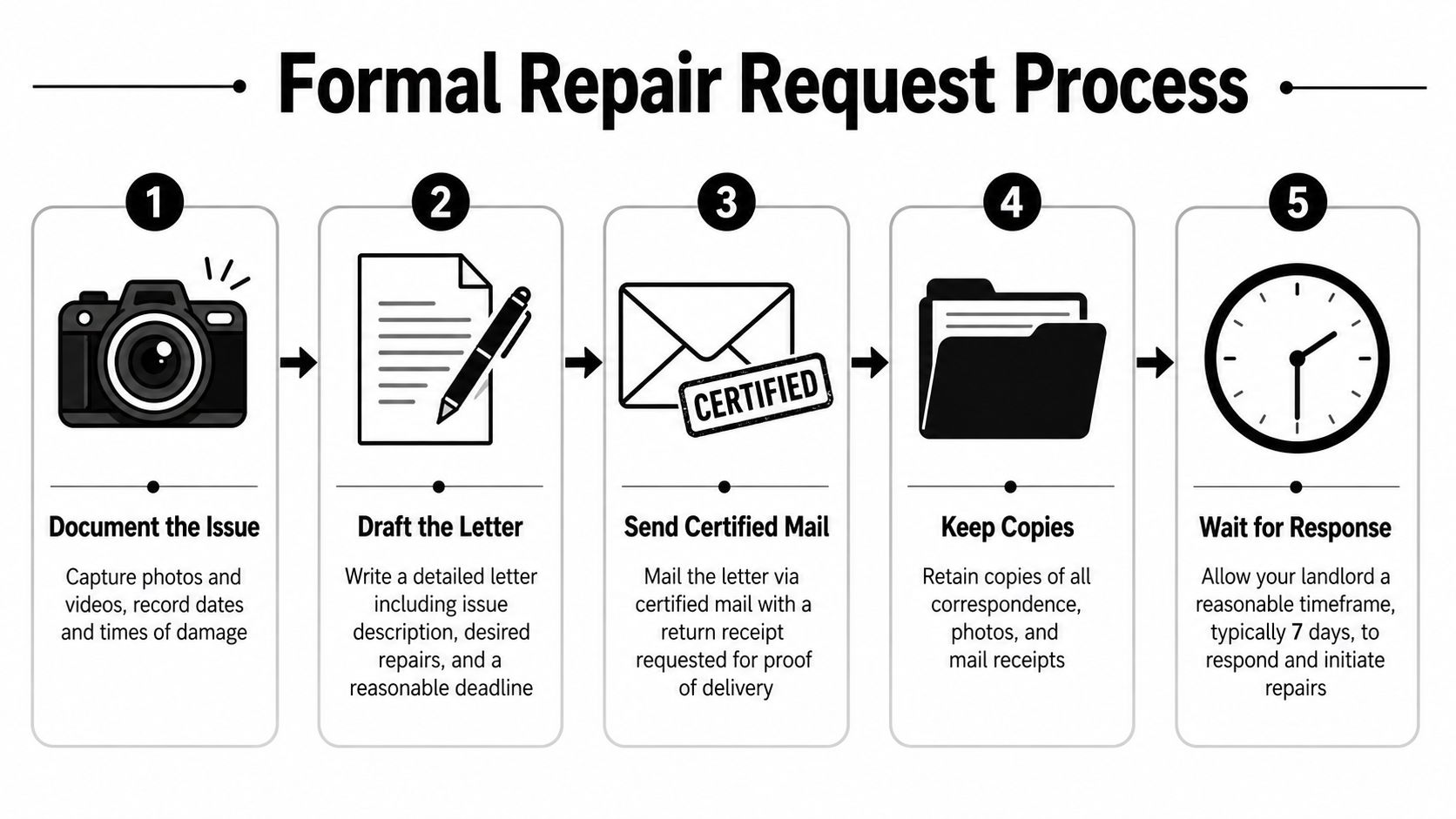
What the notice needs to say
Your repair notice doesn’t need fancy legal language. It needs clarity. A solid written notice should include:
- Your full name and rental address
- The date of the letter
- A direct description of the repair issue
- Where the problem is located
- How the problem affects health or safety
- A request that the landlord make repairs
- A statement that you are keeping a copy for your records
If you have photos, mention that they are attached or available. If you sent prior informal messages, you can note that too, but don’t rely on them as your only proof.
Why certified mail changes the case
Under Texas Property Code Section 92.056(b)(3), a tenant can secure statutory remedies with a single written notice sent by certified mail with return receipt requested, while in-person delivery or regular mail may require two separate notices. Certified mail matters because it creates proof of delivery and triggers the legal repair framework more cleanly, as summarized by Texas Tenant Advisor’s repair notice explanation.
This is one of the most important practical decisions you’ll make.
If you hand a letter to the front office, someone may later say it was never received. If you send regular mail, you may still need another notice. If you send certified mail with return receipt requested, you create a paper trail that is much harder to dispute.
Best practice: Send the notice by certified mail even if you also email it and upload it to a tenant portal.
Landlords should take the same point seriously from the other side. If you receive a certified repair notice, treat it as the start of a legal timeline, not just a maintenance inconvenience.
Here is the related guide on using a demand letter in Texas if you need a stronger formal communication strategy.
A simple repair letter template
You can adapt this template to your situation:
Date: [Insert date]
To: [Landlord or property manager name]
Address: [Address where rent is normally paid or official management address]I am a tenant at [your full rental address]. I am requesting repairs to a condition that affects the health or safety of the property.
The problem is: [describe the issue clearly].
The issue is located at: [room or area].
I first noticed this condition on: [date].
The condition affects the home in the following ways: [brief explanation].
Please make the necessary repairs as soon as possible. I am keeping a copy of this notice for my records. I can provide access to the property for inspection and repair with appropriate notice.
Sincerely,
[Your full name]
[Phone number]
[Email address]
If you send a fax in addition to certified mail, presentation matters. A clear cover page helps your notice reach the right desk and not get buried in general office traffic. If that’s part of your process, this short guide on how to ensure your fax gets noticed is practical.
A short explainer can also help if you want a visual walkthrough of the notice process.
What doesn’t work well
These approaches create problems fast:
- Verbal-only complaints: Hard to prove later.
- Vague descriptions: “The bathroom is bad” doesn’t tell anyone what must be fixed.
- Angry messages without facts: Strong emotion doesn’t replace a legal record.
- Sending notice to the wrong place: Texas law ties notice to the place where rent is normally paid.
- Failing to keep copies: If you can’t prove what you sent, you weaken your position.
A good repair notice is calm, factual, and detailed. It doesn’t threaten for the sake of threatening. It makes the issue undeniable.
Understanding Repair Timelines and Landlord Duties
A tenant sends proper written notice about a failed air conditioner in August. A landlord gets the letter, reads it, and cannot sit on it for two weeks hoping the problem resolves itself. Under Texas law, the question is whether the landlord acted within a reasonable time after notice, and whether the condition materially affects the tenant’s physical health or safety.
For many serious repair issues, Texas practice often treats about seven days as a useful benchmark, but the statute does not create a one-size-fits-all deadline for every problem. The analysis comes from Texas Property Code Sections 92.052 and 92.056, which focus on habitability, proper notice, and whether the landlord made a diligent effort to repair. If you want a plain-English breakdown of how those rules work in actual disputes, this guide on a Texas landlord refusing to make repairs explains the legal framework clearly.
Why the type of repair matters
Texas does not treat every maintenance complaint the same way. A loose cabinet hinge usually belongs in the normal maintenance queue. Raw sewage, exposed wiring, no heat in winter, or a dangerous plumbing failure can trigger much faster action because those conditions threaten health or safety.
That distinction protects both sides.
Tenants should frame the problem accurately instead of labeling every inconvenience an emergency. Landlords should triage based on actual risk, not just order of arrival. If a property manager handles a dripping faucet before a live electrical hazard, that is poor judgment and it creates legal exposure.
Here is the practical way to sort these issues:
| Issue Example | Classification | What It Affects | Expected Landlord Action |
|---|---|---|---|
| Sewage backup into unit | Emergency | Health and safety | Immediate attention and prompt repair efforts |
| Major roof leak causing active water intrusion | Emergency | Health and safety, property damage | Fast inspection and repair coordination |
| No safe hot water | Serious covered issue | Habitability and daily living | Prompt response and repair scheduling |
| Faulty electrical issue creating hazard | Emergency | Health and safety | Urgent evaluation by qualified professional |
| Running toilet | Routine unless severe | Convenience, water usage | Repair within a reasonable maintenance window |
| Broken interior cabinet hinge | Routine | Convenience | Schedule through normal maintenance process |
What landlords are expected to do
Texas law expects diligence, not perfection. A landlord does not violate the statute just because a part is backordered or a licensed plumber cannot come the same day. A landlord does create trouble by ignoring the notice, failing to inspect, sending unqualified workers for dangerous conditions, or refusing to communicate at all.
Good conduct leaves a paper trail. The landlord confirms receipt, evaluates the condition, schedules a qualified vendor, follows up if the first appointment fails, and keeps records of each step. Tenants should pay attention to that difference. A delayed repair with documented effort is not the same as silence and excuses.
Communication matters because courts and city inspectors often look at conduct, not just promises. “We’re working on it” means very little if nobody has been dispatched and no inspection has occurred.
For landlords and property managers, the safest approach is simple. Prioritize health and safety repairs first, document every call and work order, and give realistic access windows. For tenants, keep tracking dates, missed appointments, and messages. Those details often decide whether a landlord acted reasonably.
For an operations-focused perspective on how owners and managers should handle repair duties, Edinhart property management repair advice is a useful reference.
Your Legal Options When Your Landlord Refuses to Make Repairs
At this stage, many tenants make the costliest mistake in Texas landlord-tenant law. They stop paying rent and assume the bad conditions will protect them. In Texas, that is usually the move that puts you on a path toward eviction.
Texas does offer remedies, but they are procedural. If you skip the process, you can lose a strong repair claim and still face lease enforcement.

Repair and deduct is narrow, not casual
The repair-and-deduct remedy under Texas Property Code Section 92.056(b) allows tenants to hire professionals and deduct the reasonable cost from rent, but only after proper written notice and a reasonable repair period. Improper use, including hiring unlicensed workers or withholding rent entirely, can expose a tenant to eviction because Texas does not allow general rent withholding for repair disputes, as explained by TexasLawHelp’s tenant repair remedy guide.
That means a tenant should slow down before trying to “handle it themselves.”
Use repair and deduct carefully
If you may need this remedy, protect yourself by doing the following:
- Confirm notice was proper: If the notice step was weak, everything after it becomes riskier.
- Use licensed professionals: Don’t hire a friend with tools if the law expects a qualified repair person.
- Get written estimates when available: Cost and reasonableness matter.
- Keep every receipt and invoice: Documentation is part of the remedy.
- Notify the landlord in writing about the deduction: Don’t surprise them when rent comes due.
A tenant who acts carefully can preserve rights. A tenant who improvises can turn a repair case into an eviction defense case.
Other remedies may fit better
Depending on the facts, a tenant may also consider lease termination or a court action. The best option depends on how serious the defect is, whether the tenant still wants to stay, and whether the record is strong enough to support the remedy.
Common decision points look like this:
| Situation | Possible response |
|---|---|
| Tenant wants to remain in the unit and the repair is fixable | Continue building the record and consider statutory remedies carefully |
| Unit has become unsafe and trust has broken down | Evaluate whether lease termination is the safer path |
| Landlord denies the problem exists | Consider inspection, code enforcement, or court-backed proof |
| Landlord threatens eviction after repair requests | Get legal advice quickly |
For a deeper look at this issue, review this guide on a landlord refusing to make repairs.
If you remember one rule, remember this. Don’t just stop paying rent because repairs aren’t getting done.
Landlords should treat refusal as a legal risk
From the landlord side, an ignored repair notice can become more expensive than the repair itself. Once a tenant has followed the statutory process, delay creates exposure. Even when the tenant’s request is overstated, the safer move is to inspect, document, and respond in writing.
A landlord doesn’t have to admit fault to act professionally. But doing nothing is usually the worst option.
When to Escalate Involving Code Enforcement or an Attorney
Some repair disputes can still be solved with direct communication. Others need outside pressure.
When code enforcement helps
Local code enforcement or a health department can be useful when the issue involves conditions that are bigger than a routine maintenance complaint. Think structural hazards, utility failures, sanitation issues, recurring water intrusion, or persistent conditions that may violate housing standards.
A city inspector won’t solve every landlord-tenant dispute. What an inspection often does well is create an independent record. That can matter a great deal when the landlord says the problem is minor, temporary, or exaggerated.
If you contact code enforcement, be ready with:
- Your written timeline
- Photos and videos
- Copies of your repair notice
- Any response from the landlord
- Access details for the inspector
That outside report can change the conversation because it moves the issue from “tenant complaint” to documented property condition.
When it’s time to call a lawyer
There’s a point where a repair issue stops being a maintenance matter and becomes a legal risk. That point often arrives when the landlord starts threatening, denying access to remedies, or taking action that feels retaliatory.
You should strongly consider speaking with a Texas landlord tenant lawyer or eviction attorney if:
- You’ve sent proper notice and the landlord still refuses to act
- The landlord serves eviction papers after repair complaints
- The condition caused personal injury or major property loss
- You’re considering repair-and-deduct or lease termination
- The landlord claims you caused the damage and wants to charge you
- You manage property and need to respond without violating the Texas Property Code
A repair dispute is still manageable when the facts are documented. It becomes dangerous when people start making legal moves without understanding the rules.
Escalation should be strategic
The smartest escalations are usually measured, not dramatic. A code complaint filed too early can harden positions. A lawyer brought in too late may be forced to clean up avoidable mistakes. The right timing depends on the paper trail, the condition itself, and whether the other side is still acting in good faith.
For tenants, the main goal is stability. For landlords, the goal is compliance and risk control. Both are easier to protect when the issue is escalated before the dispute turns into an emergency.
Your Texas Tenant Repair Request Checklist
Use this as a working checklist before you send anything and again if the dispute starts to escalate.
Before sending notice
- Confirm your rent is current: Texas repair rights depend in part on being current when you give notice.
- Photograph and video the condition: Capture the full area and the specific defect.
- Write down dates and symptoms: Note when the issue began and how it affects health or safety.
- Gather prior communications: Save texts, emails, portal messages, and call notes.
When preparing the request
- Use written notice: Don’t rely on oral complaints alone.
- Be specific: Name the room, fixture, damage, and effect on daily living.
- Send it to the proper place: Use the address or channel connected to rent payment and official management.
- Choose certified mail: That gives you the strongest proof of delivery under the Texas statutory process.
After sending it
- Keep copies of everything: Letter, photos, mailing receipt, and return receipt.
- Allow a reasonable repair period: Serious issues may justify faster action, but you still need to follow the legal process.
- Document every follow-up: Save responses, inspection dates, and contractor visits.
- Don’t withhold rent on your own: If you’re thinking about repair-and-deduct, lease termination, or court action, get advice first.
A checklist like this won’t fix the leak or restore the air conditioning by itself. What it does is protect your position while the problem gets addressed.
Don't Navigate a Repair Dispute Alone
A repair dispute can make you feel cornered fast. You’re paying rent, the property isn’t functioning properly, and every day without a fix makes home feel less stable. That pressure leads people to act out of frustration. In Texas, that’s where mistakes happen.
The safer path is procedural. Document the condition. Send a clear written notice. Use certified mail when you need to protect your rights. Keep records of every response and every delay. If the problem continues, evaluate your remedies carefully under the Texas Property Code instead of guessing.
That approach helps tenants protect tenant rights without stepping into avoidable eviction risk. It also helps landlords and property managers respond in a way that reduces conflict, controls liability, and keeps repair issues from becoming larger disputes.
If the landlord is ignoring your notice, threatening eviction, blaming you without evidence, or leaving you in unsafe conditions, it’s time to stop treating the matter as ordinary maintenance. Legal guidance is often the difference between a documented claim and a preventable setback.
If you need help with an eviction, lease issue, or rental dispute, contact The Law Office of Bryan Fagan, PLLC for a free consultation today.