Yes, you can rent a motel for a month, and monthly rates in the extended-stay sector can cut the nightly price by 40% to 50% compared to booking night by night. In Texas, though, the more important issue isn't just price. It's that a month-long stay can start to look less like a hotel visit and more like a tenancy, which changes your rights and the owner's obligations in serious ways.
A lot of people ask this question when life is already unsettled. Maybe you're leaving an apartment after getting a notice. Maybe your new place isn't ready. Maybe you're trying to get out of a bad living situation quickly and a motel feels like the fastest answer. That instinct makes sense. A motel can offer immediate shelter, fewer upfront barriers, and a simpler way to buy time.
But the legal label matters.
If you're treated as a guest, the property may think it can remove you quickly. If you're treated as a tenant, the Texas Property Code may require a formal process before you can be forced out. That difference affects lockouts, repairs, utility shutoffs, late payments, and what proof you'll need if a dispute starts.
I've seen this problem from both sides. Tenants assume "monthly" means they have rental protections. Owners assume "motel" means they can always rely on hotel rules. Both assumptions can fail when the stay becomes longer, more continuous, and more residential in nature.
If you're using a motel as a bridge to something more stable, it also helps to think ahead about what comes next. Practical moving resources, like this furnishing a new home checklist from Woodstock Furniture & Mattress Outlet, can help you plan for the transition instead of living in crisis mode.
For readers comparing a motel stay to other temporary arrangements, it's also worth understanding how a month-to-month tenancy works in Texas. That framework often helps people spot when a "temporary" setup has started to carry longer-term legal consequences.
Introduction Navigating Your Housing Options in Texas
Take a common Texas scenario. A worker relocates to Houston for a short assignment. The apartment search takes longer than expected, so he checks into a budget motel and negotiates a monthly rate at the front desk. A parent in Dallas leaves a difficult household and pays for four weeks at an extended-stay property because it feels safer than sleeping in a car. A family in San Antonio gets displaced after sudden home repairs and needs somewhere furnished, fast.
All of them are asking the same practical question. Can you rent a motel for a month? Yes. In many cases, you can.
What most cost-focused guides miss is what happens next.
A monthly motel stay can solve one problem while creating another. The longer you remain in one room, the more likely the arrangement starts to look like housing instead of travel. That matters because Texas law doesn't only care what the building is called. It also cares about the actual nature of the occupancy.
Practical rule: If you're staying long enough to rely on the motel as your home, you should start acting like documentation matters, because it does.
People often get caught off guard. The desk clerk may speak in hotel language. The receipt may look informal. The monthly rate may have been worked out in a conversation instead of a signed contract. Then a disagreement starts over payment, utilities, repairs, or whether you have to leave. At that point, every missing detail becomes a problem.
For tenants, the risk is losing housing without understanding your rights. For owners and managers, the risk is treating a resident like a short-term guest when Texas law may require a landlord-tenant response instead.
The safest way to approach a month-long motel stay in Texas is to treat it as a housing decision, not just a booking decision.
Transient Guest or Tenant Understanding Your Legal Status
The first question isn't where you're staying. It's what legal status you have while you're staying there.
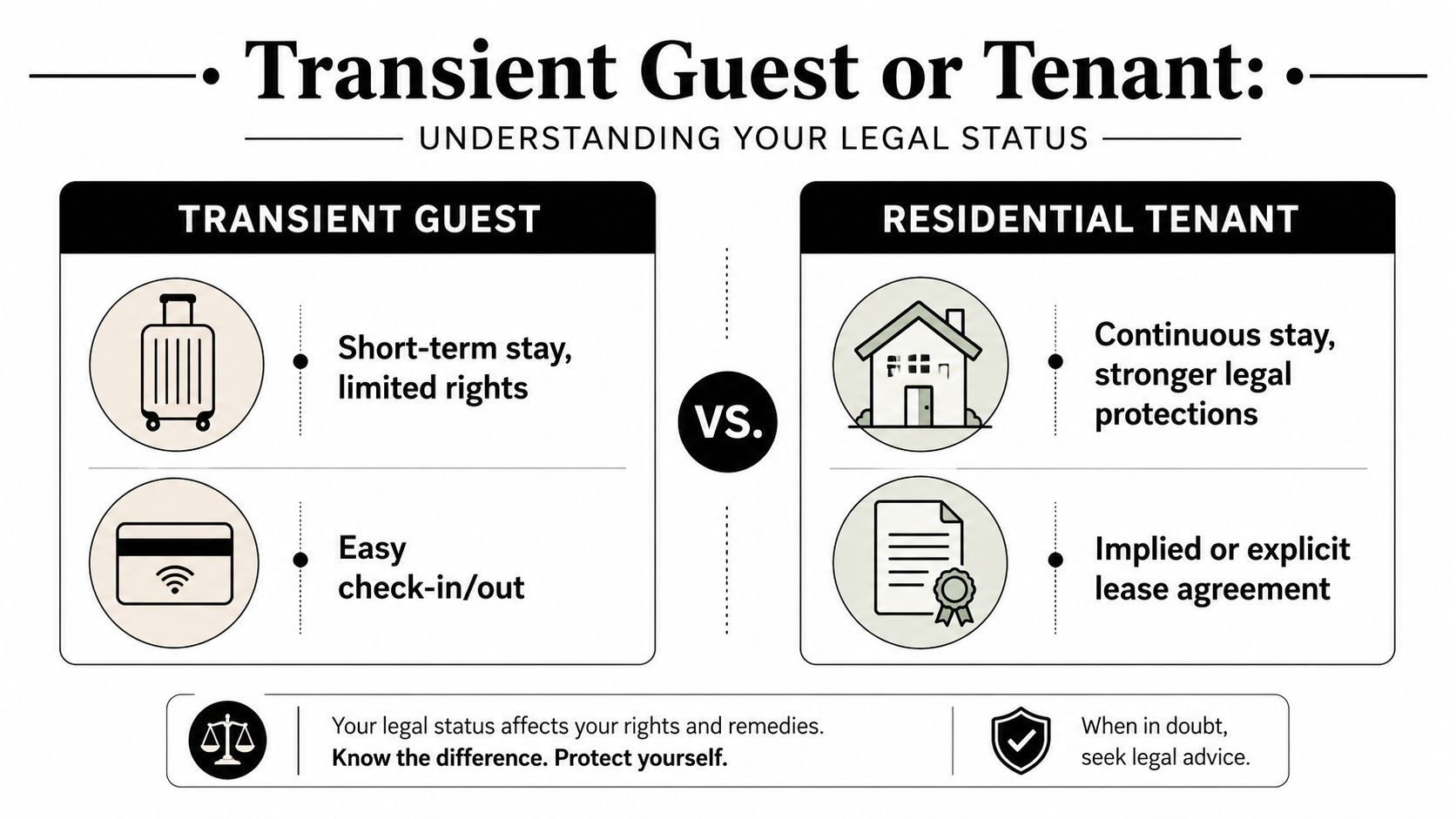
What a transient guest usually means
A transient guest is a short-term occupant. Think of someone passing through town, checking in with a keycard, and staying briefly for travel, work, or convenience. That person usually doesn't expect the room to function as a true residence.
In plain terms, a transient guest relationship looks more like hospitality than housing.
The property controls the room in a way that is different from a residential rental. House rules tend to dominate. The stay is usually temporary by design. If the guest violates hotel rules, the property often believes it can end the arrangement quickly.
What a residential tenant usually means
A residential tenant is different. A tenant is using the space as a place to live, not just a place to sleep for a few days. Once an arrangement functions like housing, the Texas Property Code starts to matter much more than front-desk policy.
If you need a broader legal framework, this overview of Texas Property Code Chapter 92 helps explain the rules that commonly govern repairs, notices, and landlord duties in residential settings.
Here is the practical comparison:
| Right / Process | Motel Guest (Transient Occupant) | Residential Tenant |
|---|---|---|
| Nature of stay | Short-term, travel-style occupancy | Continuous use as a home |
| Main rules | Property policies and booking terms | Texas landlord-tenant rules may apply |
| Removal from property | Often treated as a hotel matter | Usually requires legal eviction steps if tenancy exists |
| Repairs and habitability | More limited leverage as a guest | Stronger tenant protections may apply |
| Utility issues | Framed as service problems | Can become legal violations if tied to tenancy |
| Proof of terms | Often receipts and verbal promises | Lease terms, messages, receipts, and conduct all matter |
Why status can change over time
The important point is that status isn't always fixed on day one.
Someone can check in as a guest and, through a continuous long-term stay, begin to look more like a tenant. That shift doesn't happen because of one magic phrase at the desk. It happens because the arrangement starts to function like a residence.
A simple analogy helps. A guest is visiting a place. A tenant is living there.
That distinction becomes more important when the occupant receives mail there, keeps most belongings there, pays on a repeating schedule, or relies on the room as the center of daily life. Even if the property still uses hotel paperwork, the facts may point in another direction.
A motel label doesn't automatically decide the legal outcome. The real use of the room often matters more.
When the facts get messy, a neutral legal review can help both sides evaluate risk. A resource like When to Consult a Texas Landlord-Tenant Attorney is useful for either a landlord or a tenant trying to understand whether the arrangement is still temporary or has crossed into tenancy.
The Critical Shift When a Motel Stay Triggers Tenant Rights
The legal danger zone in Texas often appears when a stay becomes continuous for about a month.
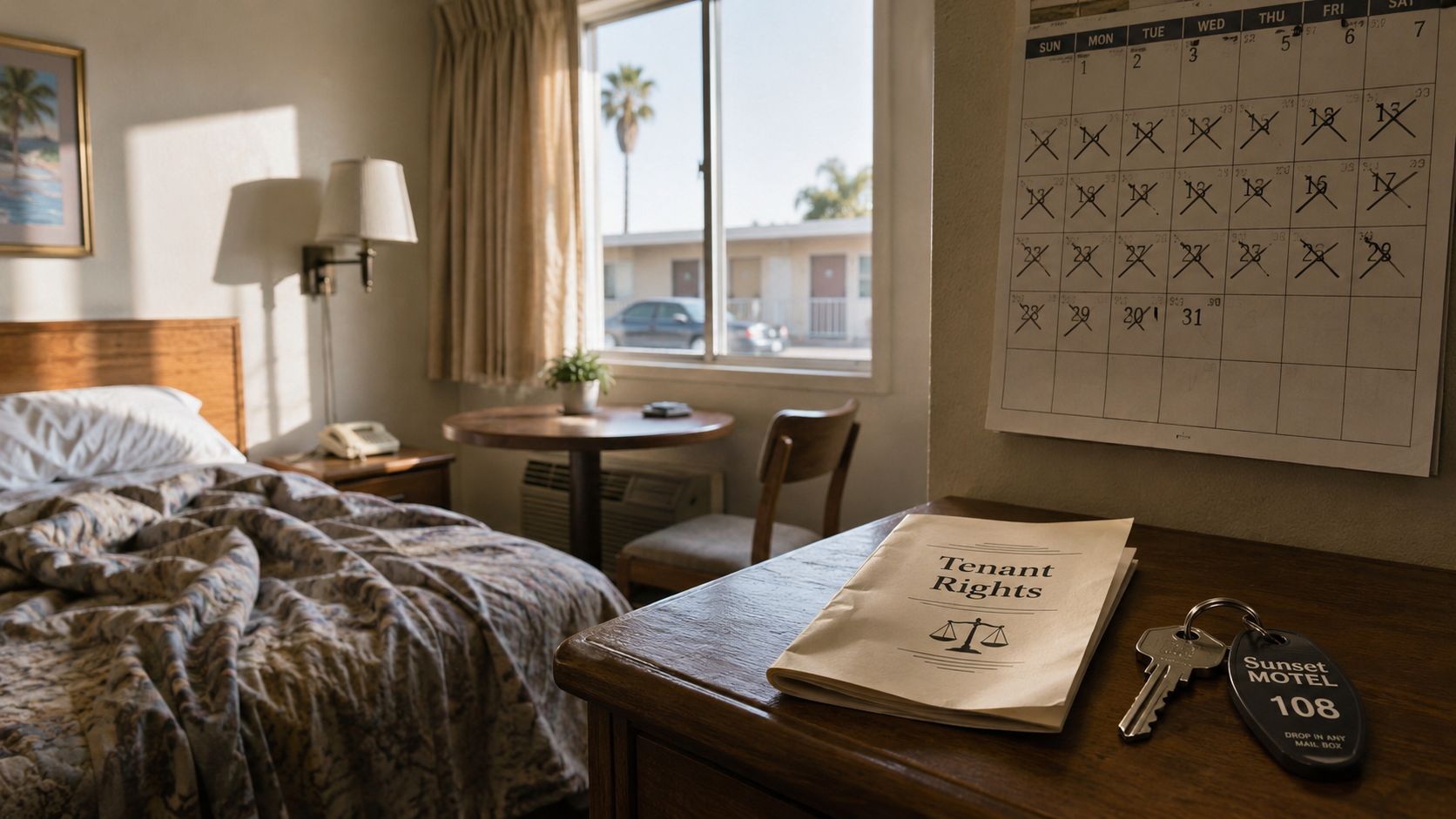
A lot of people hear "no lease" and assume there are no tenant rights. That isn't always true. In Texas, staying 30+ consecutive days can create the argument that the occupant has become a tenant for legal purposes, even without a formal written lease. That's the hidden issue many people don't see until conflict starts.
How the shift happens in real life
Consider a few common examples:
- A room is rented for a full month upfront. The payment pattern looks less like a trip and more like housing.
- The occupant treats the room as home base. Clothing, food, daily routines, and personal property stay there continuously.
- Mail starts arriving there. That can support the idea that the person is using the room as a residence.
- The motel allows long-term occupancy informally. Staff may be fine with it until a payment dispute starts.
None of those facts alone decides the case. Together, they can matter a great deal.
The biggest practical risk is poor documentation. The lack of a formal lease for negotiated monthly motel rates is a major risk, as it leaves tenants unable to easily prove agreed-upon terms if a dispute arises. Data suggests 60-70% of such long-term rates are negotiated offline, creating a "hidden lease" liability gap where landlords may incorrectly claim "no tenant rights" exist, as discussed in this discussion of long-term hotel living price negotiations.
Why owners get this wrong
Many owners and managers still think in hotel terms. If a person misses payment or complains about conditions, the instinct may be to disable the key, remove belongings, or demand immediate departure. That approach can create serious legal exposure if the occupant has crossed into tenant status.
A property may still call the person a guest. A court may focus on the facts instead.
For readers dealing with a demand to leave, this guide on a notice to vacate in Texas is often the next place to look, because once tenancy is involved, formal notice becomes much more important.
A short explainer may also help if you're trying to picture how this dispute develops in practice.
What changes after the shift
Once the law starts treating the arrangement like a tenancy, the owner usually can't rely on simple hotel-style removal. The occupant may have protections tied to eviction procedure, habitability, and essential services.
That surprises tenants because they often don't realize they may have rights.
It also surprises motel operators because they often don't realize they may have landlord duties.
Your Rights Protections for Long-Term Motel Occupants
If your motel stay has crossed into tenant territory, your legal position changes in ways that matter immediately.
Protection from illegal utility shutoffs
One of the most important rules appears in Texas Property Code Section 92.008. Under that section, if a landlord illegally cuts off essential utilities like water or electricity, a tenant can sue to recover actual damages, one month's rent, plus a statutory penalty of $1,000, as explained in this summary of Texas Property Code Chapter 92 landlord duties.
That rule matters in motel disputes because utility pressure is a common tactic when an owner wants someone gone fast. If the occupant is legally a tenant, turning off water or power is not just aggressive. It may be unlawful.
If the room has become your residence, a utility shutoff may be more than bad service. It may be a landlord-tenant violation.
The right to repairs when conditions affect health or safety
Texas law also gives tenants remedies when a place becomes uninhabitable. Under Texas Property Code Section 92.056, a tenant may terminate a lease if a condition materially affects health or safety, the tenant gives written notice, and the landlord fails to repair within a reasonable time that is statutorily presumed to be 7 days, as outlined in this explanation of breaking a lease in Texas under repair-related rules.
This can matter in a long-term motel room with no working heat, unsafe electrical issues, plumbing failures, or other serious conditions. The key is written notice. Verbal complaints at the front desk are easy to deny later.
Late payment doesn't erase procedure
Texas law also has a separate rule many people miss. Under Texas Property Code Section 92.019(a), if any portion of rent remains unpaid for two full days after the due date, a landlord may enforce lease terms on late fees or move toward eviction procedures if the lease clearly discloses the late fee amount and the fee is reasonable, as explained in this summary of Texas rental laws and 2025 legal updates.
That doesn't mean a motel owner can skip legal steps. It means payment timing matters, and written terms matter.
What this looks like in practice
If you believe you have become a tenant in a motel, use this sequence:
- Put everything in writing. Report repair problems by text, email, or dated letter.
- Save proof of payment. Keep receipts, screenshots, bank records, and confirmations.
- Document any shutoff or lockout. Take photos and note dates, times, and who said what.
- Do not assume front-desk statements are final. Staff often speak from policy, not from the Texas Property Code.
- Get legal guidance quickly if you're being pushed out without process.
For landlords, the practical lesson is just as important. Once occupancy starts to look residential, self-help methods become dangerous.
If you're dealing with another state's property rules during a move or investment issue, a comparative resource on how to navigate California landlord regulations can help show how much these rules vary by jurisdiction. But Texas disputes should always be analyzed under Texas law.
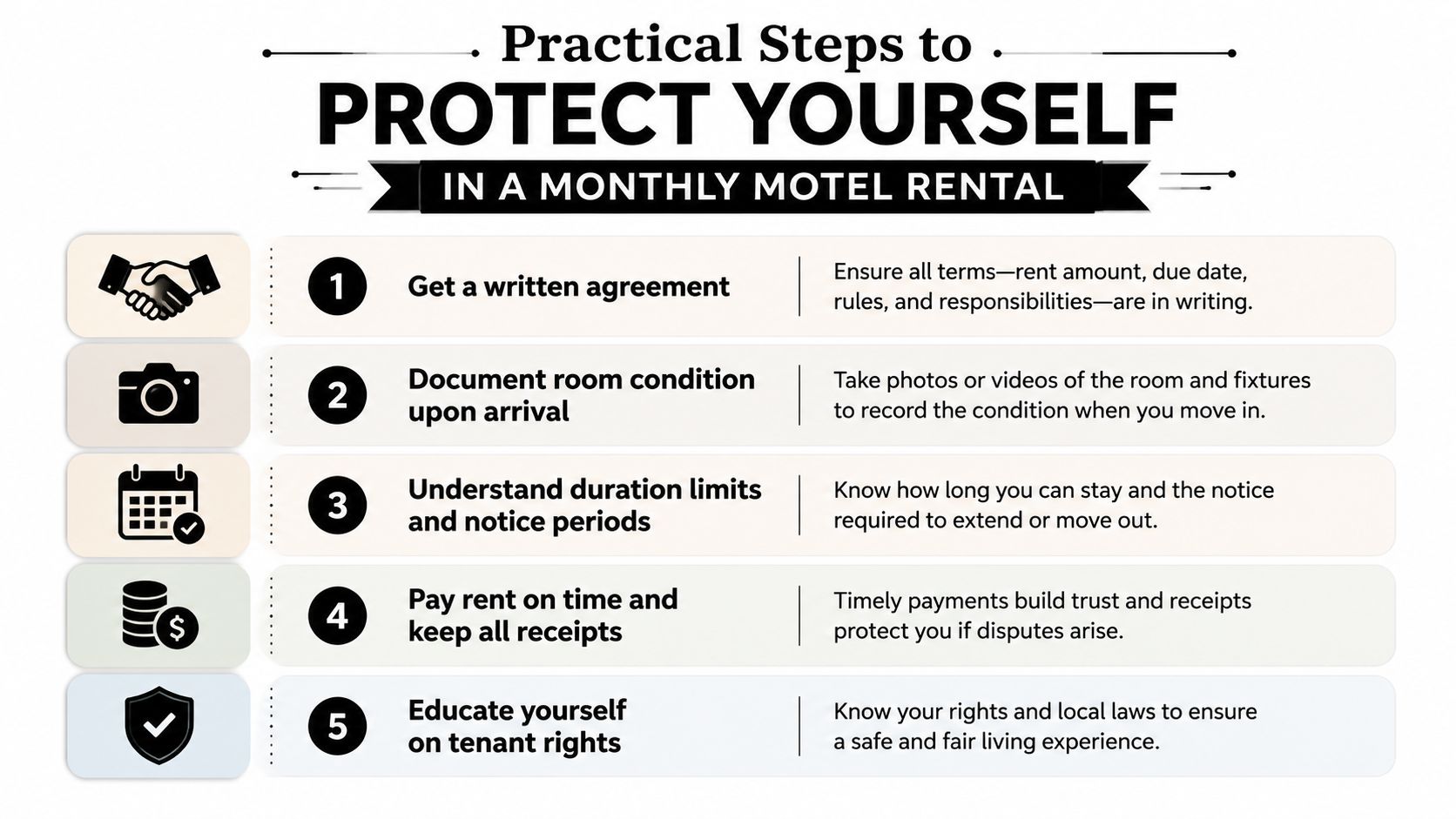
Practical Steps to Protect Yourself in a Monthly Motel Rental
A monthly motel stay can be useful. It can also become expensive, confusing, and hard to prove if you don't document the arrangement carefully.
Renting a motel monthly can offer per-night savings of 40-50% compared to daily rates. A typical $89/night room can drop to around $49-$59/night for a monthly stay, but these savings are only secure if the terms are documented in writing, according to this breakdown of weekly versus monthly stay pricing.
Before you agree to stay
Start with the terms, not the room.
- Get the rate in writing. If the front desk offers a monthly discount, ask for a written confirmation that states the amount due, when it is due, and how long that rate lasts.
- Clarify what's included. Ask whether electricity, water, internet, parking, and housekeeping are included, and ask the property to write that down.
- Ask about maximum stay rules. Some accommodations impose maximum stay limits ranging from 3 months to 6 months, and one-month stays are typically permitted without triggering a traditional lease structure, as described in this overview of the extended-stay hotel market and operating model.
On move-in day
Treat the check-in like a residential move-in, not a casual booking.
Take photos of the room condition. Save the first receipt. If staff tell you something important, send a follow-up text or email repeating what you understood.
Best practice: A written message sent the same day can turn a disputed conversation into usable evidence.
During the stay
Problems usually develop after the first week, when everyone stops paying attention to details.
Use this working checklist:
- Track every payment. Keep paper receipts and digital copies.
- Report repairs in writing. If the air conditioning fails, don't rely on a spoken complaint.
- Save communication with staff. Screenshots can matter later.
- Know your due date. If payment is late, legal consequences can start quickly under written terms.
- Watch for status drift. If the room has become your actual home, stop assuming hotel rules are the only rules that apply.
For either side of the dispute, a legal review may help identify risk before the situation gets worse. The Law Office of Bryan Fagan, PLLC handles Texas landlord-tenant disputes involving evictions, lease enforcement, repairs, and related property conflicts.
If a dispute starts
Don't wait for a blowup in the parking lot or at the front desk.
Do these four things first:
- Organize your documents by date. Put receipts, photos, texts, and notices in one folder.
- Write a short timeline. Include when you moved in, what you paid, and when any problem began.
- Ask for written clarification. If the property claims you must leave, ask why and on what date.
- Avoid self-help. Tenants shouldn't stop paying without legal advice, and owners shouldn't try lockouts because they are frustrated.
A lot of monthly motel disputes turn on proof, not principle. The side with the clearer paper trail usually has the stronger starting position.
When to Call a Texas Landlord-Tenant Lawyer
Some motel disputes are too risky to handle alone.
Call a Texas landlord tenant lawyer or eviction attorney if any of these red flags show up:
- You get a lockout threat. If management says they'll remove you without court process, your status needs immediate review.
- Utilities are cut or threatened. Water and electricity disputes can trigger serious remedies under the Texas Property Code.
- You asked for repairs and then got pressure to leave. That can raise retaliation concerns.
- The property says you have no rights because there is no lease. That statement is often too simple for a long-term motel stay.
- You're a landlord or manager and the occupant has been there continuously for weeks. A wrong move can create avoidable liability.
Why early legal advice matters
These cases often move fast. By the time police are called or belongings are outside, the facts are already harder to sort out. Early legal advice helps preserve evidence, evaluate whether the occupant is a guest or tenant, and choose the right next step under Texas law.
For tenants, that may mean stopping an illegal lockout or documenting a habitability claim correctly. For landlords, it may mean using the right notice and court process instead of creating a larger dispute.
If you need help with an eviction, lease issue, or rental dispute, contact The Law Office of Bryan Fagan, PLLC for a free consultation today.
If you're dealing with a motel stay that has turned into a housing dispute, don't guess about your rights. The facts matter, the paperwork matters, and timing matters. Contact The Law Office of Bryan Fagan, PLLC to schedule a free consultation and get practical guidance on your eviction, lease issue, or rental dispute in Texas.