Dealing with a landlord dispute or eviction can be stressful—but understanding your rights under Texas law can make all the difference. When you find yourself in a disagreement, the situation can feel overwhelming. A Texas rental lawyer is an expert who can guide you through the maze of the state's property laws, fighting to protect your home and financial interests, whether you're a tenant or a landlord.
Your Guide to Navigating Texas Landlord-Tenant Law

The Texas Property Code is the official rulebook for every rental agreement in the state. It clearly lays out what landlords and tenants must do—and what they absolutely cannot do. However, this legal text can be dense and confusing. A small mistake or misunderstanding of the code can cost you your housing, security deposit, or thousands of dollars.
That's where a skilled Texas rental lawyer makes all the difference.
Whether you are a tenant facing a wrongful eviction or a landlord dealing with a tenant who refuses to pay rent, an attorney provides clarity and a strategic plan. They don't just represent you in court; they work to resolve problems before they escalate and handle them quickly when they do.
Why Legal Guidance Is Crucial
Handling a rental dispute on your own is a gamble. The legal system is filled with strict deadlines and procedural rules. If you miss one, your case could be dismissed before it even starts. A lawyer ensures every detail is handled correctly, from sending a formal demand letter to filing the right motions in court.
Here’s a real-world scenario: a tenant has the right to have major repairs made, but that right is only legally protected if they provide the landlord with proper written notice. A quick phone call or text message is often not enough to stand up in court. On the other hand, a landlord must follow a precise legal process to evict a tenant. Illegally changing the locks or shutting off utilities can result in severe penalties.
"A common mistake we see is clients acting on emotion rather than following legal procedure. Understanding the Texas Property Code isn't just about knowing your rights—it's about knowing how to correctly enforce them."
The Foundation of Your Rights: The Lease Agreement
The entire landlord-tenant relationship is built on one document: the lease. It is the cornerstone of your legal rights and responsibilities. Understanding what is in your lease is non-negotiable for both tenants and landlords. To see what a standard agreement looks like, this free rental agreement template is a good place to start.
This guide will walk you through the most common conflicts, explain Texas law in clear terms, and show you exactly when getting professional legal help is necessary.
What a Texas Rental Lawyer Actually Does

When you're facing a landlord-tenant dispute, the stress can feel overwhelming. Hiring a Texas rental lawyer isn’t about starting a fight; it’s about having a strategic expert in your corner to turn legal chaos into a clear path forward.
Many people think you only call a lawyer for a full-blown courtroom battle. In reality, an attorney’s most valuable work often happens long before things escalate, stopping problems before they start or resolving them quickly. They act as your negotiator, strategist, and guide through the maze of legal procedures.
Think of it this way: your lease and the Texas Property Code are the rulebook for your rental. A lawyer is the professional who has that rulebook memorized. They ensure no one bends the rules or misinterprets a critical step to take advantage of you.
What the Texas Property Code Says About Tenant Rights
As a tenant, it's easy to feel powerless in a dispute. A lawyer’s job is to step in and balance the scales, enforcing the rights you are guaranteed under the law.
A tenant rights lawyer gives you leverage when it matters most:
- Halting Wrongful Evictions: Did your landlord change the locks without a court order? Did you receive an improper "Notice to Vacate"? A lawyer can spot these illegal shortcuts immediately and use them to stop an eviction in its tracks.
- Forcing Essential Repairs: If your AC is out in the middle of a Texas summer or a leaky roof is ruining your belongings, an attorney can send a formal demand letter that meets the strict requirements of Texas Property Code § 92.056. This legal pressure often gets landlords to act when your calls and emails have been ignored.
- Recovering Your Security Deposit: In Texas, landlords have 30 days to either return your deposit or provide a detailed list of deductions. If they fail to do so, a lawyer can help you sue them for up to three times the deposit amount, plus attorney's fees, under Texas Property Code § 92.109.
- Fighting Landlord Retaliation: It is illegal for your landlord to evict you simply because you requested a necessary repair. An attorney knows how to prove retaliation in court and protect your right to a safe home.
How Lawyers Protect Landlords
For landlords, a Texas rental lawyer is a vital partner in protecting your investment. A single procedural mistake can cost you thousands in lost rent and legal battles. An attorney ensures you follow the law perfectly, saving you time, money, and headaches.
A landlord's biggest risk isn't a bad tenant—it's a procedural error. A lawyer ensures every step you take is legally sound, minimizing your liability and achieving a fast, proper resolution.
Here's how we help landlords protect their assets:
- Ironclad Lease Agreements: The best way to win a dispute is to prevent it. A lawyer can draft or review your lease to ensure it is fully compliant with Texas law and protects your interests.
- Efficient Eviction Processes: From serving the legally correct "Notice to Vacate" to representing you in Justice Court, a lawyer manages the entire eviction to ensure it's done quickly and by the book.
- Managing Non-Payment of Rent: When a tenant falls behind, an attorney can take the proper legal steps to either collect the rent owed or regain possession of your property without delay.
- Addressing Property Damage: If a tenant causes damage beyond normal wear and tear, a lawyer can help you properly document everything, legally withhold costs from the security deposit, and sue for any remaining damages if necessary.
Common Disputes Where You Need a Lawyer on Your Side
Most small issues with a landlord or tenant can be resolved with a quick phone call or email. But some disputes are bigger, more complicated, and have serious financial and personal stakes.
These are the moments when a simple disagreement can turn into a legal battle. In these situations, trying to handle it yourself is a huge risk. Having an experienced Texas rental lawyer is crucial for protecting your home, your money, and your rights.
Most landlord-tenant disputes boil down to a misunderstanding or violation of the Texas Property Code. Let's walk through the conflicts we see most often and show you exactly how a lawyer can change the outcome.
How to Legally Handle Evictions in Texas
An eviction is the most powerful tool a landlord has, and Texas law is incredibly strict about how it must be used. There is a mandatory legal process that must be followed perfectly.
A landlord cannot simply change the locks, cut off your power, or throw your belongings on the curb. This is called an illegal "self-help" eviction and comes with severe penalties for the landlord.
For example, imagine you are a week late on rent and come home to find the locks have been changed with a note on the door telling you to get out. This is a wrongful eviction. A tenant rights lawyer can take immediate legal action to get you back into your home and sue the landlord for damages.
For landlords, an attorney ensures you follow every step, from the "Notice to Vacate" to the court filing, protecting you from a costly mistake. For tenants, we scrutinize every document and action from the landlord, looking for procedural errors that can get an eviction case thrown out.
What the Texas Property Code Says About Security Deposits
Security deposit disputes are one of the most common fights in the landlord-tenant world. Texas law is crystal clear on how security deposits must be handled.
According to Texas Property Code § 92.109, a landlord has exactly 30 days after you move out to either return your full security deposit or give you a written, itemized list of deductions.
If they miss that 30-day deadline or withhold your deposit in "bad faith," you can sue them for up to three times the deposit amount, plus your attorney's fees and court costs. The law presumes "bad faith" if they fail to return the deposit or provide the itemized list on time.
Here's a real-world scenario: you move out and leave the apartment spotless, aside from normal wear and tear. A month and a half goes by, and you still haven't received your $1,500 deposit or any explanation. A lawyer can send a demand letter that gets their attention. If they still don't pay up, we can take them to court to recover not just the $1,500, but potentially $4,500 plus our fees.
Texas Rental Conflicts and Legal Solutions
This table breaks down common Texas rental disputes and the legal avenues available, showing what issues typically look like from both the tenant's and the landlord's perspective, along with the specific law that governs the situation.
| Dispute Type | Common Tenant Issue | Common Landlord Issue | Key Texas Property Code Section |
|---|---|---|---|
| Eviction | Landlord changed the locks without a court order. | Tenant won't leave after receiving a Notice to Vacate. | § 24.005, § 92.0081 |
| Security Deposit | Landlord kept the deposit without providing an itemized list of deductions. | Tenant caused damage exceeding the deposit amount. | § 92.109 |
| Repairs | The A/C has been broken for weeks in the summer despite written requests to fix it. | Tenant is demanding cosmetic upgrades, not essential repairs. | § 92.056 |
| Retaliation | Landlord filed for eviction right after the tenant reported a code violation. | Tenant is falsely claiming retaliation to avoid a legitimate eviction for non-payment. | § 92.331 |
Understanding these specific codes is the first step, but applying them effectively in court is where an experienced attorney makes all the difference.
What the Texas Property Code Says About Repairs
You have a fundamental right to a safe and livable home. The Texas Property Code mandates that landlords must repair any condition that seriously threatens the physical health and safety of a tenant.
This doesn't mean minor cosmetic issues. We're talking about serious problems like:
- A broken A/C unit in the middle of a Texas summer.
- A major roof leak causing mold and water damage.
- No hot water for days.
- A serious pest infestation you didn't cause.
However, to enforce your rights, you must also follow the rules. You must be current on your rent and provide your landlord with proper written notice of the problem (sending it by certified mail is always the best proof). If the landlord still does nothing, a lawyer can help you pursue your legal options, whether it’s terminating the lease or filing a lawsuit to force the repairs. If a landlord's inaction causes further issues, you can learn more about a landlord's breach of lease obligations and what to do next.
Illegal Landlord Retaliation
Texas law protects you from being punished for exercising your legal rights. A landlord is not allowed to evict you, raise your rent, or cut services just because you made a good-faith request for a necessary repair.
In fact, if your landlord files for eviction within six months of you making a repair request, the law automatically presumes their motive is retaliation. An experienced Texas rental lawyer can use this powerful legal presumption as a shield to stop the eviction and hold your landlord accountable.
Understanding the Legal Process for Rental Disputes
Trying to navigate the legal system on your own can feel like being dropped in a maze without a map. However, when it comes to landlord-tenant disputes in Texas, there is a clear path from start to finish. Once you know the steps, you can stop guessing and start making smart decisions.
This is where an experienced Texas rental lawyer becomes your most important asset. We don't just file paperwork; we manage every deadline, handle every communication, and build a strategy designed to get results.
Step-by-Step: From Demand Letter to Resolution
1. The First Move: A Demand Letter
Before anyone steps into a courthouse, the process almost always begins with a formal demand letter. This is a tactical legal document prepared by your attorney that shows you mean business. A proper demand letter:
- Spells out the exact problem.
- Cites the specific parts of your lease or the Texas Property Code that back up your claim.
- Makes a clear, specific demand (e.g., pay a specific amount or fix an issue).
- Sets a firm deadline for a response.
Often, a professional demand letter is all it takes to bring the other party to the negotiating table.
2. When a Letter Isn't Enough: Filing a Petition
If the deadline passes with no resolution, the next step is to file a lawsuit, which begins by filing a Petition with the court. For most evictions and rental disputes, this happens in the local Justice Court (or JP court). The Petition formally tells the court and the other party what your legal complaints are and what you are asking the judge to do. For a complete breakdown, our guide on the eviction process in Texas covers these initial stages in detail.
This flowchart shows the typical path a dispute takes:
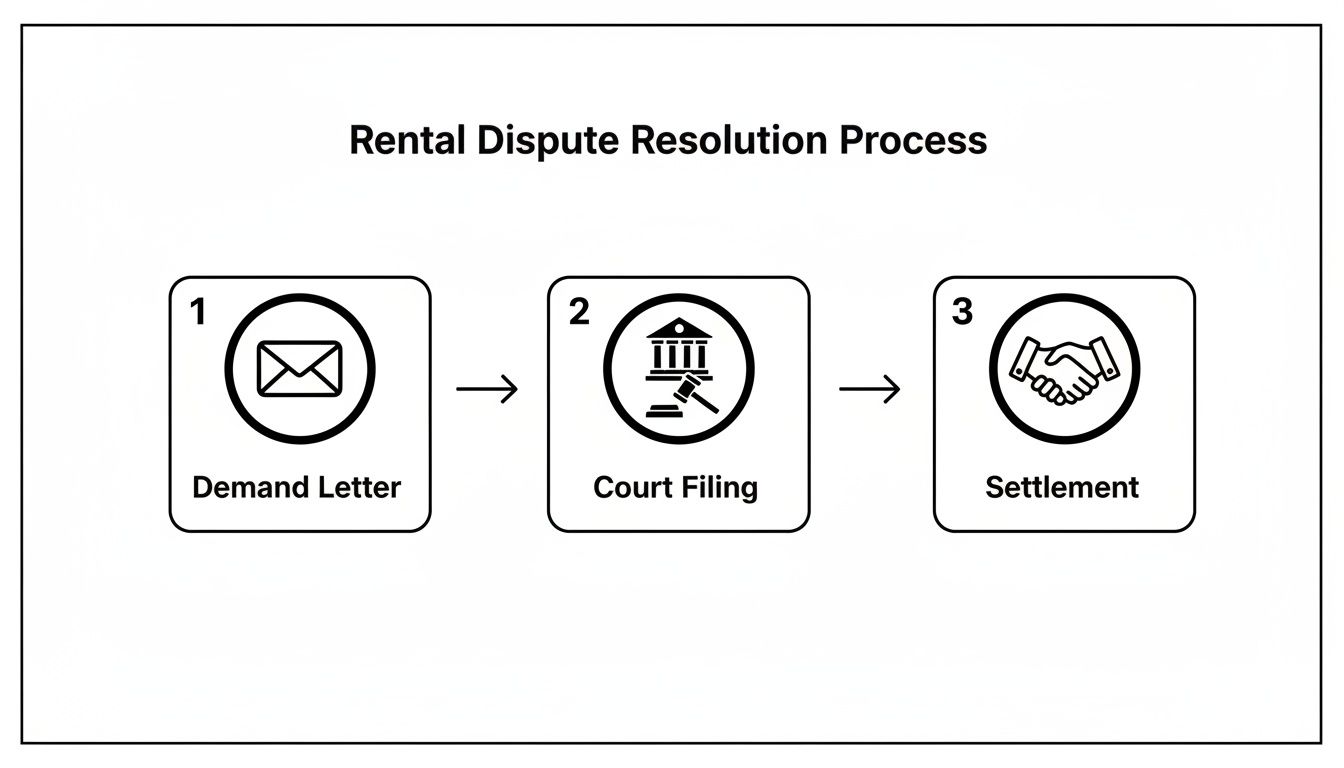
3. Gathering Evidence and Negotiating a Settlement
After the lawsuit is filed, we move into discovery, the formal process where both sides exchange information and gather evidence. A skilled eviction attorney uses this evidence as leverage to push for a favorable settlement out of court. However, if the other side refuses to be reasonable, we are always prepared to go to trial to fight for you.
How to Choose the Right Texas Rental Lawyer for You
When you're stuck in a dispute, picking the wrong lawyer can create more stress. Not all attorneys are equipped to handle the unique, fast-moving world of Texas rental law. You need a strategic partner who understands the Texas Property Code inside and out and can give you a clear path forward.
Look for Specialized Experience
Landlord-tenant law is a specialized field. A general practice attorney might know about contracts, but do they know the specific procedures for a Justice Court eviction appeal or the nuances of "bad faith" withholding of a security deposit under Texas Property Code § 92.109?
A lawyer who lives and breathes landlord-tenant cases has seen it all. They know the common tricks the other side might use and understand how judges in your specific county tend to rule.
When speaking to a potential attorney, ask them directly how much of their caseload is dedicated to rental disputes. A true specialist will have a deep track record. A dedicated eviction attorney won't just know the law; they'll know how to make it work for you. For more localized advice, it's worth exploring how to find an eviction attorney near you.
Questions to Ask a Potential Rental Lawyer
Your free consultation is an interview. A good attorney expects and welcomes tough questions and should provide straight answers without confusing legal jargon.
Use this checklist during your initial consultation:
| Question Category | Specific Question to Ask | Why This Question Is Important |
|---|---|---|
| Experience & Focus | "What percentage of your cases are landlord-tenant disputes?quot; | This confirms they are a specialist, not a generalist. You need an expert. |
| Case Strategy | "Based on what I've told you, what would be your initial strategy?quot; | This shows if they are thinking strategically and can provide a proactive plan. |
| Communication | "How will I be kept updated on my case, and who will be my main point of contact?quot; | This sets clear expectations so you won't be left wondering about your case. |
| Fees & Costs | "Can you explain your fee structure? Do you offer flat fees for services like evictions?quot; | You deserve total transparency on costs to avoid surprise bills. |
The right lawyer will appreciate that you are taking this seriously—because they are, too.
Red Flags to Watch Out For
Knowing what to avoid is just as critical as knowing what to look for. Be wary of any lawyer who:
- Guarantees a win. No ethical attorney can promise a specific outcome. Honest lawyers talk about strategy and probabilities, not guarantees.
- Talks over your head with legal jargon. A great lawyer makes complex things simple. If they can't explain your options in plain English, how can you trust them to represent you effectively?
- Is impossible to get ahold of. If they are unresponsive before you've hired them, it will only get worse.
Your goal is to find an advocate who doesn’t just understand the law, but who also understands you.
Don't Let a Rental Dispute Control Your Life
You shouldn't have to face a law-breaking landlord or a non-paying tenant alone. Trying to navigate the Texas legal system by yourself is a huge gamble that can cost you your home, your investment, and your peace of mind.
Throughout this guide, we've shown what an experienced Texas rental lawyer does: enforce your rights, protect your property, and handle the court system for you. We’ve shown how the Texas Property Code is the rulebook—and how an attorney uses it to build a winning strategy.
It's Time to Get a Clear Plan of Action
Feeling overwhelmed by a lease dispute is normal, but staying stuck in uncertainty gives the other side more power. The first step toward a fair resolution is taking decisive action. Hiring a lawyer isn't just about getting legal advice; it's about taking back control.
- For Tenants: It means having a strong advocate to stop a wrongful eviction, force essential repairs, or fight to get your security deposit back.
- For Landlords: It means having a strategic partner to handle an eviction legally, enforce your lease, and protect your investment from costly mistakes.
One wrong move or missed deadline in a rental dispute can set you back for months. Having a legal professional who knows the system can be the difference between a nightmare and a fast, favorable outcome.
Now is the time to take the next step. You have the right to get professional legal help that cuts through the confusion and fights for you.
If you need help with an eviction, lease issue, or rental dispute, contact The Law Office of Bryan Fagan, PLLC for a free consultation today.
Frequently Asked Questions About Texas Rental Law
The world of Texas rental law is complex. It's natural to have questions. Here are answers to some of the most common ones we hear from both tenants and landlords.
How Much Does It Cost to Hire a Rental Lawyer in Texas?
The cost depends on the complexity of your situation. At The Law Office of Bryan Fagan, PLLC, we believe in being upfront and transparent about our fees.
For straightforward issues like sending a demand letter or handling an uncontested eviction, we often work on a flat fee, so you'll know the exact cost from day one. For more complicated disputes that might require extensive negotiation or a court battle, we typically use an hourly rate.
Your first step is a free consultation. We’ll listen to your situation, outline your options, and provide a clear estimate of potential costs with no obligation to hire us.
Can I Handle an Eviction Myself Without a Lawyer?
Technically, yes, a landlord can manage an eviction on their own, but it's incredibly risky. The Texas Property Code has strict, non-negotiable rules for everything from the wording of a "Notice to Vacate" to its delivery.
One small mistake—like a wrong date on a notice or improper service of court papers—can get your case thrown out. This means you're back to square one, losing more rent and wasting weeks or months. An experienced eviction attorney ensures it’s done right the first time to protect your property and finances.
What Basic Rights Do I Have as a Tenant in Texas?
As a tenant in Texas, the law gives you several powerful rights, including:
- The Right to a Habitable Home: Your landlord must fix any problem that seriously threatens your physical health or safety.
- The Right to Quiet Enjoyment: You have the right to live in your rental without unreasonable disturbances from your landlord.
- Protection from Retaliation: Your landlord cannot legally punish you for exercising your rights, like requesting a necessary repair.
- Rights to Your Security Deposit: Your landlord must return your deposit or provide an itemized list of deductions within 30 days after you move out.
My Landlord Is Trying to Evict Me for Requesting Repairs. Is That Legal?
Absolutely not. This is a classic case of illegal retaliation, one of the strongest protections for tenants under Texas law.
According to Texas Property Code § 92.331, a landlord is prohibited from retaliating against a tenant for using their legal rights in good faith, such as requesting critical repairs.
If your landlord tries to evict you within six months of your formal repair request, the court automatically presumes the eviction is retaliatory. This gives you a massive legal advantage. A skilled Texas rental lawyer can use this presumption to build a defense, stop the eviction, and hold your landlord accountable.
If you're dealing with an eviction, a broken lease, or any other rental dispute, don't try to navigate it alone. Contact The Law Office of Bryan Fagan, PLLC for a free consultation today.