Dealing with a landlord dispute or eviction can be stressful, but understanding your rights under Texas law can make all the difference.
Most tenants who ask, “Is there a way to get around an eviction?” are not looking for a trick. They're looking for time, advantage, and a legal path that keeps them housed or at least keeps an eviction judgment off their record. In Texas, that path sometimes exists. But it usually depends on what stage you're in, what paperwork the landlord used, and how quickly you respond.
A common situation looks like this. You come home, see a Notice to Vacate taped to the door, and assume you have to be out immediately. That isn't how the process works. Under the Texas Property Code, an eviction is a court process. A notice is serious, but it is not the same as a court order.
For both tenants and landlords, the practical answer is this: the best way around an eviction is usually not denial or delay for delay's sake. It's using the correct legal defenses, identifying notice problems early, making smart written proposals, and knowing when a repair issue or statutory cure right changes the case. A Texas landlord tenant lawyer or eviction attorney can often spot options that people miss when they're panicking.
Your Rights When Facing an Eviction in Texas
When a tenant receives a notice, fear takes over fast. People worry about their children, their job, their belongings, and whether a constable could show up the next day. In most cases, that fear is ahead of the law. Texas requires steps before a landlord can legally remove a tenant.
The first thing to understand is that a Notice to Vacate starts a process. It doesn't end one. A landlord still has to file an eviction case, serve court papers, and appear in justice court. Until that happens, you still have rights, and those rights can create room to solve the problem.
What getting around an eviction really means
In practice, “getting around” an eviction usually means one of these outcomes:
- Stopping the filing altogether by fixing the issue before suit is filed
- Forcing the landlord to restart because the notice or procedure was defective
- Settling the case through a payment plan or move-out agreement
- Using a defense tied to repairs, retaliation, or improper procedure
- Appealing a bad ruling to keep possession while the next court reviews the case
That's a legal strategy, not a loophole.
Practical rule: If you're still in the notice stage, you usually have more options than you will after a judgment is entered.
The process matters as much as the rent
Texas eviction law is procedural. That means details matter. The wording of the notice matters. The timing matters. The landlord's reason matters. The court paperwork matters. If the landlord skips a required step, the case can fail even if the tenant owes money.
That's why calm action beats panic. If you're a tenant, start gathering documents and saving every message. If you're a landlord, follow the Texas Property Code carefully and document each step. Sloppy procedure creates avoidable disputes for everyone.
Responding to a Notice to Vacate Before a Lawsuit
The period between a notice and a court filing is often where the case can still be redirected. Many people waste that window because they assume they have no power. You do.
Under Texas Property Code §24.005, a landlord must give written notice before filing an eviction lawsuit. For nonpayment of rent, the notice period is a strict three days, while some other lease violations may allow longer periods, including 30 days, depending on the issue and the lease terms, as summarized by this discussion of Texas eviction notice requirements.
What to do first
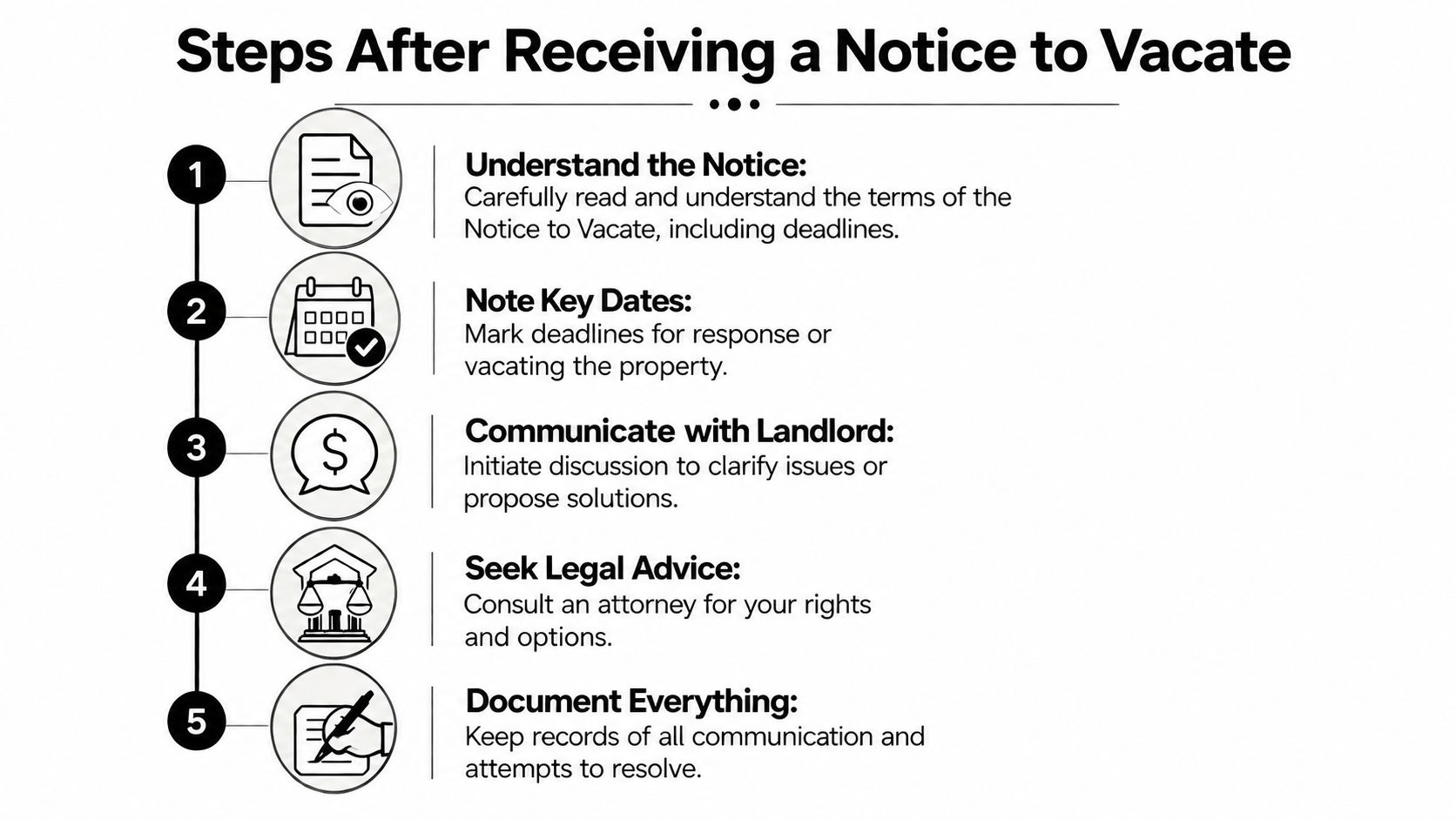
If you've been served with a notice, take these steps in order:
- Read every line of the notice. Check the reason given, the date, the address, and the deadline.
- Compare it to your lease. Some leases modify notice terms, but the landlord still has to comply with applicable Texas rules.
- Save the envelope, photo, or posting evidence. If service becomes disputed later, this can matter.
- Write down the timeline. Mark the day you received it and the day the landlord says you must leave.
- Gather your records. Pull rent receipts, repair requests, texts, emails, and photos.
A useful reference is The Notice to Vacate: Requirements and Timing, which focuses on what a valid Texas Notice to Vacate must contain before an eviction can be filed.
Don't move out just because a notice was posted
A notice is not a writ. A landlord can demand possession in writing, but that alone doesn't authorize lockout, physical removal, or a same-day forced move in an ordinary case. If you leave too quickly, you may give up an advantage you could have used to negotiate or defend yourself.
Here's a typical example. A tenant gets a paper on the door saying they have 24 hours to leave for unpaid rent. But for nonpayment, the rule discussed above is a three-day notice. If the tenant responds in writing, points out the defect, and keeps a copy, the landlord may need to start over with proper notice instead of filing immediately.
A bad notice doesn't erase the underlying dispute, but it can change the timing and create room to resolve it correctly.
Use the notice period to create leverage
The strongest pre-lawsuit moves are practical, not dramatic.
- Ask for an exact ledger. Request the amount the landlord claims is due, including any late fees or utilities.
- State any dispute in writing. If the amount is wrong, say why and attach proof.
- Raise repair issues carefully. If major health or safety problems exist, document them instead of making vague complaints.
- Offer a realistic proposal. A landlord is more likely to listen if your plan is concrete and dated.
- Preserve your tone. Hostile texts rarely help. Direct, businesslike communication often does.
Here's the key point. The notice stage is your chance to slow assumptions down. Many landlords file because they think the tenant won't respond, won't document, or won't appear. Once you start creating a paper trail, the case changes.
Negotiating Payment Plans and Settlement Agreements
A common Texas eviction case starts the same way. The tenant can pay something, but not everything, and the landlord assumes a lawsuit is the only next step. That is often the moment where a careful written proposal can stop the case before it starts.

Good negotiation is specific. State the amount you can pay now, the date the money will be delivered, the source of the funds, and what you expect in return. Ask the landlord to confirm that they will hold off on filing, dismiss a filed case after payment, or agree to a move-out date that keeps an eviction judgment off your record.
This works best when your message does more than ask for mercy. It should also show the landlord where their case has friction. If the ledger looks inflated, say so and attach proof. If the notice was defective, point that out without turning the exchange into an argument. If serious repair problems affected the unit, mention that you have already documented them and want those issues addressed as part of any agreement. That changes the conversation from "pay or leave" to "let's resolve the whole dispute on paper."
What a workable agreement should cover
A verbal promise does not protect you. Get the terms in writing, signed or at least confirmed in a traceable email or text thread.
A settlement should answer these questions:
| Issue | What should be clear |
|---|---|
| Amount owed | The total rent, utilities, and any late charges being addressed |
| Payment schedule | Exact due dates and amounts |
| Case status | Whether the landlord will delay filing, dismiss a filed case, or nonsuit it after payment |
| Possession | Whether you stay if you comply, or move out by agreement |
| Fees | Whether additional fees are waived, included, or still disputed |
For a practical model, this guide on how to negotiate with a landlord before eviction in Texas shows how to write the proposal in a way landlords and property managers are more likely to answer.
Texas also had a formal version of this idea. The Texas Eviction and Diversion Program, described on the Texas courts eviction program page, was built to resolve nonpayment cases through documented assistance and dismissal agreements. The program is no longer taking applications, but the lesson remains useful. Landlords often become more flexible when the payment plan is documented, time-limited, and tied to a clear dismissal term.
Sometimes the honest answer is that keeping the unit is no longer realistic. In that situation, a negotiated move-out can be better than fighting to the end and taking an eviction judgment. Compare the long-term effect of a judgment with the cost of breaking a lease and leaving under an agreement you can control.
A short explainer can also help if you're trying to understand how lawyers frame these conversations:
When counsel changes the conversation
Lawyers often improve these negotiations because they pin the deal down to actual terms. The agreement should say what happens if payment is late, whether partial payments waive the default, whether the landlord will report a balance as still owed, and whether the tenant can stay if every payment is made on time. Those details decide whether the agreement solves the problem or just delays it.
The Law Office of Bryan Fagan, PLLC handles Texas landlord tenant disputes, including pre-suit negotiation, lease issues, and eviction defense.
Using Your Right to a Safe and Habitable Home
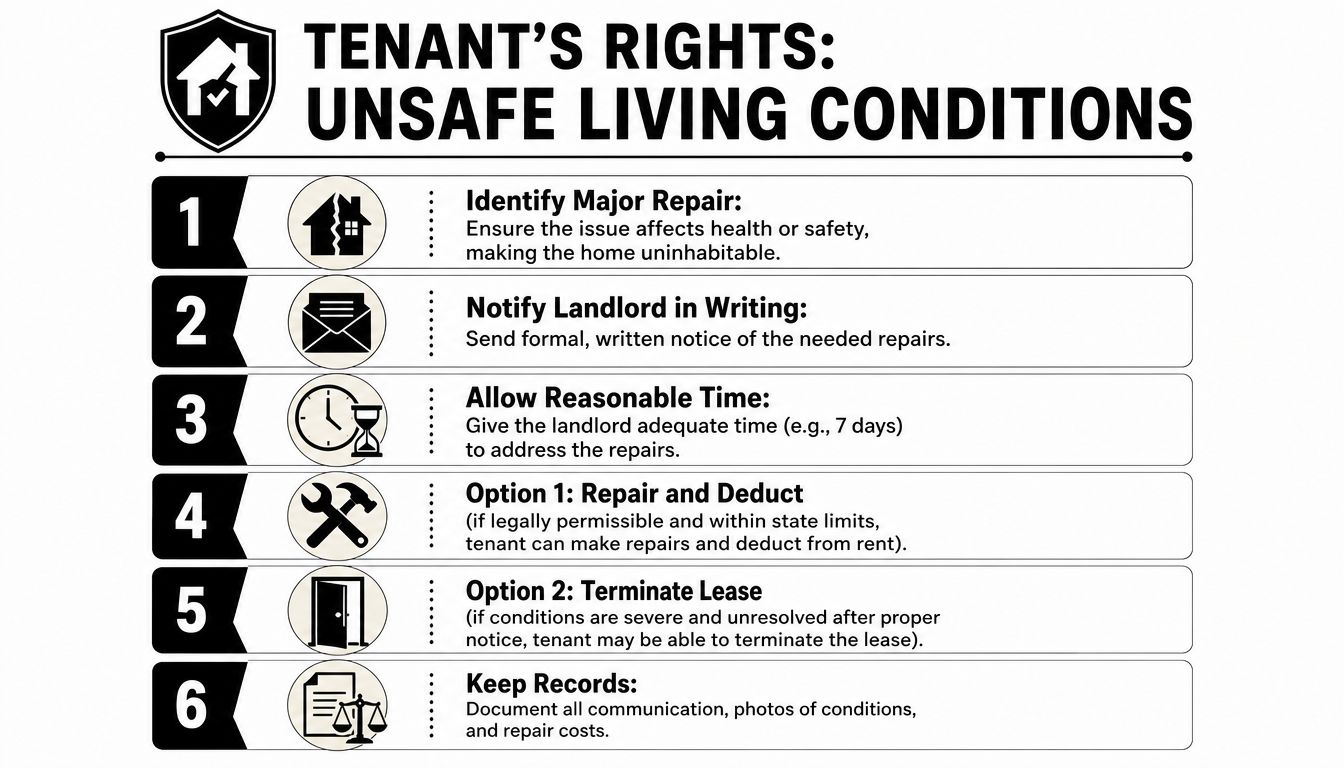
A lot of tenants assume repairs and rent are separate issues, so they stay silent about bad conditions until the eviction starts. That's often a mistake. Under Texas law, habitability issues can matter, but only if you document them correctly and act within the rules of the Texas Property Code.
If the property has serious health or safety problems, your written repair requests can strengthen your position before a lawsuit is filed and can support a defense if one is filed anyway. This is especially important under Chapter 92 issues involving repairs and landlord duties.
Repair requests are strongest when they're boring and specific
Tenants hurt their own position when they send emotional texts like “this place is disgusting” without identifying the actual issue. Better notice sounds like this: the AC has failed, the leak is spreading, mold is visible near the vent, the outlet sparks, the toilet has overflowed repeatedly. Date it. Send it in writing. Keep copies.
For a plain-English overview of landlord duties, this habitability laws in Texas article is a useful starting point.
A real-world example of leverage
Consider a tenant in summer without functioning air conditioning. The tenant sends written requests, keeps photos, and gives the landlord time to respond. Instead of fixing the problem, the landlord posts for nonpayment. That doesn't automatically defeat the eviction, but it may support arguments about habitability, retaliation, or the actual reason the dispute escalated.
The same principle applies to dangerous wiring, sewage problems, major water intrusion, or other conditions that affect health or safety. The cleaner your paper trail, the stronger your position.
Keep your repair evidence as if a judge will read it. Because one might.
If you're evaluating whether self-help is permitted, The Repair-and-Deduct Remedy in Texas explains how the 92.0561 repair-and-deduct process works and its strict requirements.
Don't miss the newer right many tenants overlook
There is also an emerging defense that can directly stop some nonpayment cases. In Texas, tenants who have missed exactly one rent payment now have a statutory Right to Cure, meaning there is a legal window to pay the back rent and have the eviction case dismissed, even if the landlord has already filed suit.
That is a narrow tool, but it's powerful. Many tenants wrongly assume that once the citation arrives, the case is over. For the single missed payment situation, that may not be true.
What doesn't work
Some tenants stop paying rent altogether because conditions are bad and assume that alone protects them. Usually, it doesn't. Texas repair remedies are technical. If you skip the notice steps or don't fit the statute, the landlord may still move forward.
Use habitability rights carefully. They are real. They're also strongest when you follow the process.
Common Defenses in a Texas Eviction Lawsuit
Once the case reaches justice court, the focus shifts from negotiation to proof. At this stage, tenants often ask whether they must file a formal response right away. In most eviction cases in Texas justice court, they do not.
According to the Texas State Law Library guide on the eviction process, tenants are typically not required to file a written answer to an eviction suit and can appear at the hearing to present their case. A written response becomes mandatory if the landlord uses summary disposition to claim the occupant is a squatter, and in that setting the tenant must respond within four days of receiving the papers.
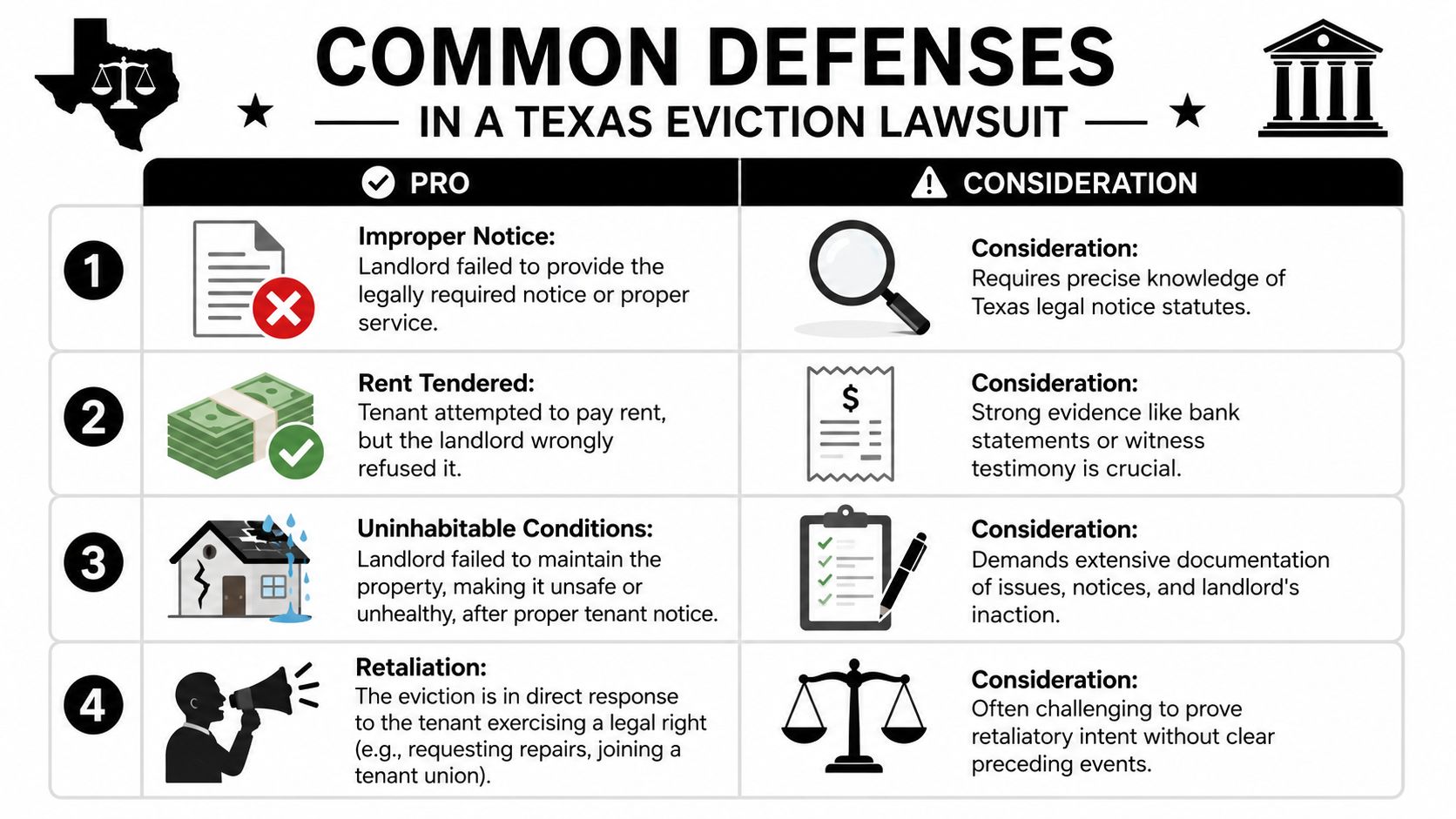
Procedural defenses that often matter
Eviction cases are fast. That makes procedural mistakes common. A few examples:
Defective notice
If the notice period, property description, or basis for termination was wrong, the landlord may have filed too early or on faulty notice.Service problems
If court papers weren't served correctly, that can affect whether the case should proceed.Wrong theory of removal
Some landlords misuse “summary disposition” language against actual tenants or lawful occupants. That procedure is meant for alleged squatters, not ordinary tenants in a standard nonpayment case.Wrong court details
Filing errors, precinct problems, or inconsistent allegations can weaken the landlord's position.
One practical reason to read every document closely is that rushed filings often contain small contradictions. Those details can matter more than people think.
Substantive defenses that can change the result
Some defenses go to the heart of the dispute, not just the paperwork.
| Defense | How it can help | What proof helps |
|---|---|---|
| Rent tendered | The tenant tried to pay, and the landlord refused | Receipts, screenshots, money order records |
| Waiver | The landlord accepted conduct inconsistent with immediate eviction | Payment records, messages, ledger entries |
| Retaliation | The filing followed repair requests or other protected conduct | Dated notices, inspection records, texts |
| Habitability | The unit had serious health or safety defects after proper notice | Photos, written requests, repair history |
For a more detailed evidence checklist, this article on what evidence helps tenants win eviction cases in Texas is a practical companion.
Show up with a timeline, not a stack of loose papers. Judges need the story in order.
A less obvious defense to illegal fast removals
One of the more misunderstood issues involves landlords or property managers acting like they can remove a tenant in a day by labeling them a squatter. Ordinary tenants should pay close attention to that. A normal landlord-tenant dispute usually still requires the regular court process.
If the landlord is trying to use a squatter-style procedure against a real tenant, the response deadline matters. In that summary disposition setting, the tenant must file a written response within the four-day window noted in the Texas State Law Library guidance linked above. Missing that can create a default problem very quickly.
That's especially important in roommate, family, and no-lease situations where the landlord or primary tenant tries to rewrite the history of the occupancy. The legal label matters less than the facts of how the person came to live there and whether permission existed.
Courtroom habits that help
You do not need a polished legal speech. You do need discipline.
- Bring a clean packet with the lease, notice, payment records, photos, and messages.
- Stick to dates instead of arguing emotionally.
- Answer the judge directly and stop when the question is answered.
- Ask for dismissal clearly if the notice or filing was defective.
- Request enough time to state your defense if the landlord introduces new claims at the hearing.
If you want a broader walkthrough of how these cases move through Chapter 24, The Texas Eviction Process Explained gives the step-by-step structure.
What to Do If You Lose Your Eviction Case
A loss in justice court isn't always the end. Texas allows an appeal, and that appeal can stop the immediate eviction if you meet the requirements on time.
Under the process summarized by Texas Law Help's eviction appeal guide, a tenant can halt an eviction by filing an appeal within five days of the justice court judgment. To keep possession, the tenant must secure a bond, file the notice of appeal, and deposit one month's rent into the court registry, then continue making monthly registry payments during the appeal.
What the appeal really involves
This is not a casual extension request. It is a formal process with deadlines and money requirements. If you miss the deadline, fail to post what is required, or stop making registry payments, the stay can collapse.
The basic sequence looks like this:
- Act immediately after judgment
- File the appeal paperwork within the five-day deadline
- Address the bond or other required security
- Deposit the required rent into the registry
- Keep paying rent into the registry while the appeal is pending
The case then moves up to county court, where the dispute continues under a new schedule.
Be honest about the trade-offs
Appeals can be powerful, but they aren't easy. They require organization, fast action, and the ability to maintain payments while the case is pending. For some tenants, an appeal is the right move because the judgment was legally wrong. For others, it's useful because it creates time to negotiate a move-out, protect possessions, or avoid a rushed lockout.
If you're at this stage, get legal advice quickly. Appeal deadlines in eviction cases are short, and small mistakes can cost you the stay.
The larger point is simple. There often is a way to get around an eviction in Texas, but it usually comes from using the process correctly. Check the notice. Document repairs. Negotiate in writing. Raise the right defense. Appeal quickly if necessary. Those are real options under Texas law, and they work far better than waiting and hoping the case goes away.
If you need help with an eviction, lease issue, or rental dispute, contact The Law Office of Bryan Fagan, PLLC for a free consultation today.