Yes, someone can often take over your lease in Texas, but only with your landlord's explicit written permission as required by Texas law. That process is usually called a lease assignment or a sublease, and the rules are stricter than many renters expect.
A lot of Texans end up here for the same reason. You accepted a new job in another city, a family situation changed, your roommate moved out, or your budget no longer matches your rent. You want a practical answer to one question: Can someone take over your lease?
The short answer is yes, sometimes. But this is not a casual deal where you hand the keys to a friend and move on. A lease transfer affects who owes rent, who answers for property damage, and who a landlord can pursue if something goes wrong. That's why it helps to understand the legal path before you act.
Introduction: Needing to End Your Lease Early
Ending a lease early can feel like you're trapped between bad options. You may want to avoid a lease-break dispute, avoid an eviction filing, and protect your rental history at the same time. If that's where you are, start with the lease itself and the rules under the Texas Property Code.
Some tenants are looking for a full replacement. Others only need someone to cover the unit for a short period. Those are not the same arrangement. In Texas, the difference matters because your legal and financial risk can change a lot depending on which path you choose.
If your move is already underway, practical planning helps too. Many renters find it useful to simplify your house move with storage while they sort out timing, paperwork, and possession of the unit. That kind of logistics planning won't solve the legal issue by itself, but it can buy you breathing room while you handle the lease correctly.
Why renters get confused
People often use “take over my lease,” “sublet,” and “transfer my lease” as if they mean the same thing. They don't.
One option transfers the lease itself. Another creates a separate rental arrangement while leaving you on the hook to the landlord. If you're also weighing whether ending the lease outright makes more sense, this guide on breaking a lease early in Texas can help you compare the risks.
Practical rule: Before you promise the unit to anyone, check your lease and get the landlord's position in writing.
Landlords should pay attention here too. If a tenant asks for a takeover, the question isn't just whether to say yes or no. It's whether the transfer is documented clearly enough to avoid later disputes about rent, deposits, repairs, and possession.
Lease Assignment vs Subleasing in Texas
The biggest mistake tenants make is treating lease assignment and subleasing as interchangeable. They aren't. The structure of the deal changes who has rights, who has duties, and who may still be liable later.
What a lease assignment means
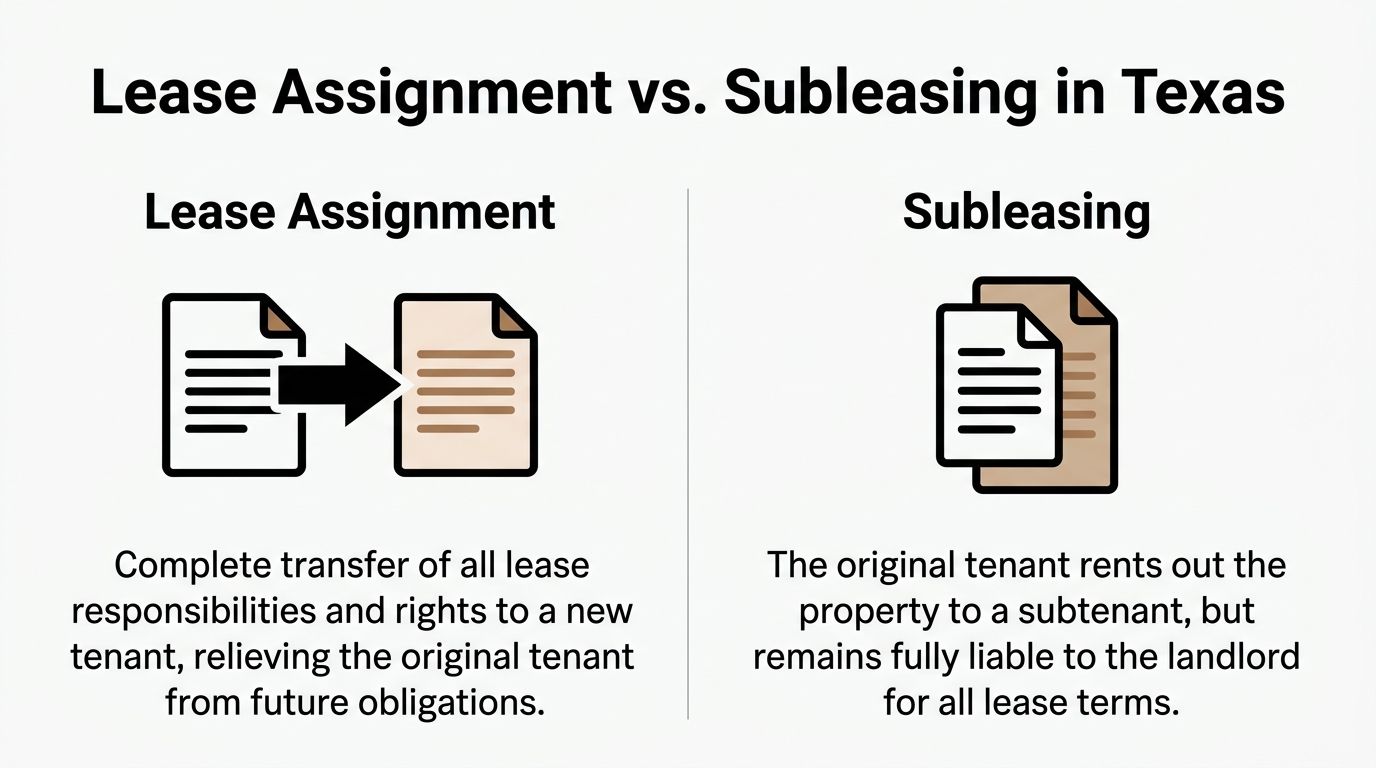
A lease assignment is a full transfer of the remaining lease term to a new tenant. The incoming person steps into your place under the existing lease. According to this explanation of lease takeovers in Texas, the assignee takes on the rights and responsibilities under the original contract, and a formal assignment agreement should be signed by the original tenant, the new tenant, and the landlord.
This involves transferring your position within the contract itself. After a proper assignment, the new tenant usually deals directly with the landlord under the same lease terms.
What a sublease means
A sublease is different. You remain the original tenant under the main lease, and you create a separate agreement with the person moving in. That new occupant is usually called a subtenant.
A simple way to picture it is this:
| Arrangement | Who has the direct lease with the landlord? | Who usually remains responsible to the landlord? |
|---|---|---|
| Assignment | The incoming tenant | Often the incoming tenant, if the release is written clearly |
| Sublease | The original tenant | The original tenant |
If you sublease, your landlord may still expect rent, compliance, and repair responsibility from you, not the subtenant.
A real-world example
Suppose Maria signs a lease in Austin and then has to move to Houston for work.
- With an assignment, Maria finds Jordan, the landlord approves Jordan, and the lease is formally transferred.
- With a sublease, Maria rents the apartment to Jordan for a period, but Maria still remains between Jordan and the landlord.
That means if Jordan violates the lease in a sublease arrangement, the landlord may still hold Maria responsible.
Assignment is usually the cleaner exit. Subleasing is often the riskier option for the original tenant.
Consent is required for both
Under Texas rules on sublease and assignment, Texas Property Code § 91.005 requires the landlord's explicit written consent before a tenant assigns a lease or subleases during the lease term, and courts have treated that rule as applying to both full assignments and partial subleases.
That's why your lease language matters so much. If you want to understand the core terms and disclosures that often appear in residential rental contracts, What a Texas Lease Should Include is a useful starting point. If you're comparing these two transfer methods more closely, this guide on lease vs. sublease also helps clarify the legal relationship in each setup.
The Law Governing Lease Transfers in Texas
Texas law gives landlords substantial control over whether a lease transfer can happen. Many renters assume that if they find a qualified replacement, the landlord has to accept that person. That is not how the law works.

What Section 91.005 means in plain English
The plain-English takeaway is straightforward. You can't assign your lease or sublease the property on your own and hope to sort it out later. Texas law requires landlord consent first.
That rule matters because some tenants accidentally create bigger problems by moving out, handing possession to someone else, and assuming rent payments alone will satisfy the landlord. They won't if the transfer itself violates the lease or the statute.
Why lease language still matters
Texas law also allows a landlord to go further and prohibit assignment or subleasing in the written lease. Under Texas Property Code § 94.057, a landlord may enforce a written clause that prohibits a tenant from assigning the lease or subleasing the premises.
In practice, that means you should look for headings like these in your lease:
- Assignment
- Subletting
- Transfer of possession
- Occupancy limits
- Written consent requirements
If the lease contains a clear no-assignment or no-subletting clause, that clause can control the outcome.
Why landlords insist on screening
From a landlord's side, this is about risk management. The landlord screened the original tenant for income, employment, and reliability. A replacement tenant changes that risk profile.
Here's the practical result:
- The landlord may want a written request.
- The landlord may want to screen the incoming occupant.
- The landlord may require specific transfer paperwork.
- The landlord may approve, deny, or condition approval based on the lease terms.
A tenant's private arrangement with a replacement occupant doesn't override the lease or the Texas Property Code.
If you're trying to read these rules in broader context, this overview of the Texas Property Code and landlord-tenant rules can help you place lease-transfer issues alongside repairs, entry, security deposits, and other common disputes.
Navigating Landlord Consent and Lease Clauses
Once you know consent is required, the next question is how to ask for it in a way that gives you the best chance of getting a clear answer. The safest approach is organized, polite, and documented.
Start with your lease
Read your lease line by line before contacting the landlord. Don't just search for the word “sublease.” Many contracts use different wording.
Look for clauses covering:
- Transfer rights: Whether assignment or subleasing is allowed at all
- Approval process: Whether consent must be written and who gives it
- Application rules: Whether the replacement tenant must complete screening
- Fees or administrative steps: Whether paperwork or internal approval is required
- Deposit handling: Whether the landlord addresses how deposits transfer or stay in place
Make a written request, not a casual phone call
A text message saying “My friend can take over” is usually not enough. A written request should identify your unit, your intended move date, and whether you're seeking an assignment or a sublease.
You'll usually strengthen your request if you provide the landlord with useful facts upfront, such as the proposed occupant's employment information, expected move-in date, and willingness to follow the existing lease terms.
According to the Texas State Law Library's explanation of ending a lease, Texas law prohibits renting your place to someone else or allowing a lease takeover without the landlord's explicit prior consent, and an unauthorized transfer can expose a tenant to remedies for lease violations, including eviction.
A practical approach for tenants
Try this order of operations:
- Review the lease first.
- Write to the landlord clearly.
- State the type of transfer you want.
- Offer a qualified replacement, if you have one.
- Ask for written approval and required documents.
That sequence shows the landlord you're trying to solve the issue responsibly rather than force a fait accompli.
If the landlord says yes verbally but won't confirm in writing, you should assume the issue is still unresolved.
What landlords should do
Landlords should avoid informal approvals too. If you manage property, your best protection is a written process that confirms who is staying, who is leaving, and who remains liable after the transfer.
This is one situation where legal review can prevent a much larger dispute later. Firms such as The Law Office of Bryan Fagan, PLLC handle Texas landlord-tenant matters involving leases, possession disputes, and transfer-related questions when the paperwork is unclear.
Your Step-by-Step Guide to a Lease Takeover
You found someone ready to move in, your landlord seems open to it, and it feels like the hard part is over. In practice, this process works more like handing off a relay baton. If the paperwork, timing, or approval steps are sloppy, the original tenant can still get pulled back into the race later.
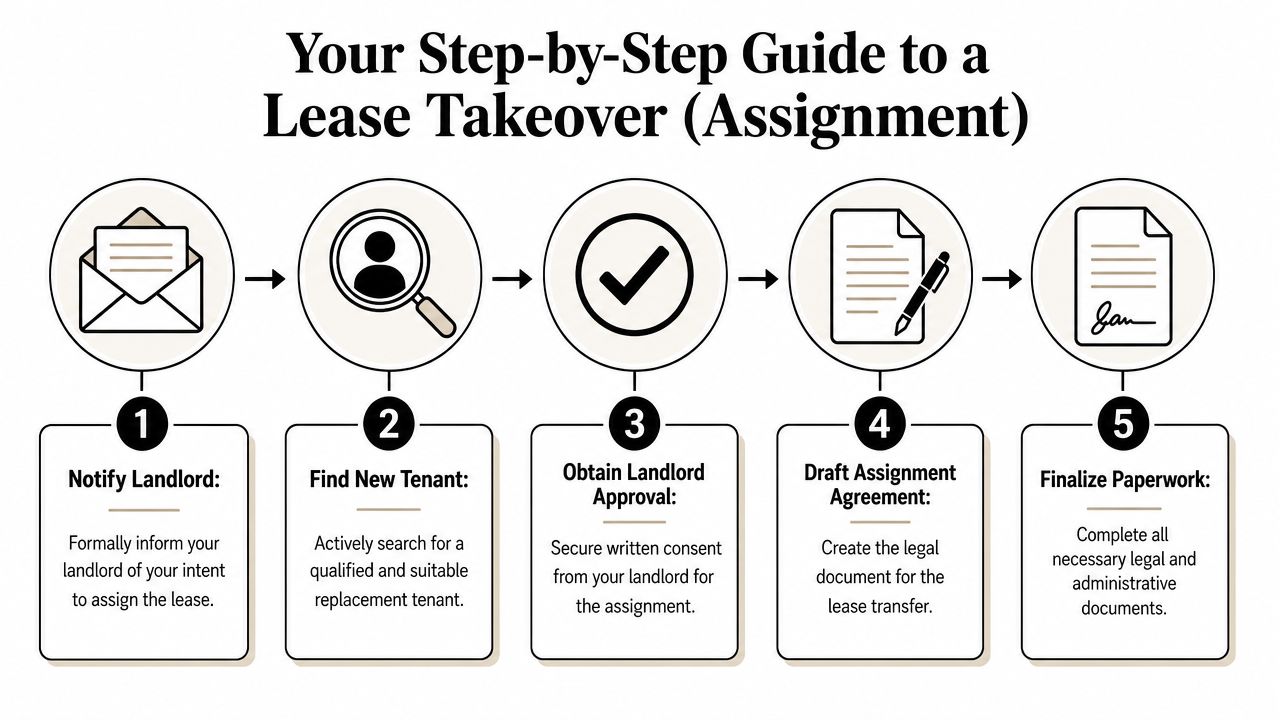
Step one: start a paper trail before you start packing
Send the landlord a written request that states exactly what you want. Include your name, the property address, your target move-out date, and whether you are asking for an assignment of the lease to a new tenant.
Keep it simple, but make it complete. A short, clear message does two jobs at once. It gives the landlord something concrete to respond to, and it creates a record in case there is confusion later about what you asked for.
If your landlord handles approvals through digital forms, review how electronic lease signing works before you sign transfer documents.
Step two: find a replacement who can actually make it through screening
A lease takeover succeeds or fails on the quality of the replacement tenant. Landlords are usually not looking for a volunteer. They are looking for someone who meets the same basic standards you had to meet at the beginning of the lease.
One practical guide on lease takeovers explains that outgoing tenants should do some front-end screening before sending a candidate to the landlord for formal review, including discussing rent, timing, and house rules with the prospective replacement in a Texas lease takeover overview.
Before you hand over a name, confirm a few basics:
- Income: Can the person reasonably cover the rent?
- Employment: Is their job current and verifiable?
- Timing: Can they move in when the unit needs to be filled?
- Rules: Do they understand pet limits, parking rules, guests, and occupancy caps?
That quick screening saves time. It also reduces the chance that your landlord rejects the first candidate and the calendar keeps running while you are still responsible for rent.
Step three: let the landlord do the landlord's job
Your screening is a first pass, not final approval. The landlord may require an application, background check, income documents, or an administrative fee before agreeing to any transfer.
This is the point where tenants often get tripped up. A replacement tenant saying, “I'm approved,” is not enough unless the landlord has approved them under the property's process. Get confirmation in writing, and keep copies of everything submitted.
For landlords, consistency matters here. Use the same screening standards you would use for any new applicant, and document the decision.
Step four: put every transfer term into one signed agreement
A lease takeover should end with one clean document, not a chain of texts and half-confirmed emails. The formal agreement should identify the outgoing tenant, the incoming tenant, the landlord, the rental address, and the date the transfer takes effect.
It should also spell out practical details that cause disputes later if nobody addresses them up front. For example, who gets the keys on what date? Is any furniture staying behind? Is the new tenant taking the unit as-is, or after an inspection and repair list?
As a rule, all three parties should sign the same transfer document. If one person is operating from a different version, you have a recipe for conflict.
Step five: deal with money separately and clearly
Many “successful” takeovers often go sideways on account of these details. Rent responsibility may transfer on one date, but the security deposit, cleaning deductions, pet charges, or unpaid utilities may follow a different path unless the agreement says otherwise.
Use a written checklist for the money issues:
| Issue | What to clarify |
|---|---|
| Security deposit | Does the landlord keep the original deposit on file, return it to the outgoing tenant, or require the incoming tenant to reimburse it? |
| Prorated rent | Who pays if the takeover happens in the middle of a month? |
| Utilities | When do utility accounts switch, and who pays any final balance? |
| Condition of unit | Will there be photos, a walk-through, or an inspection report at handoff? |
| Keys and access devices | Who returns keys, fobs, garage remotes, or parking permits? |
A good handoff works like closing out one account and opening another. If you blur those lines, people start arguing over who owed what.
Step six: ask one final question before you sign anything
After this transfer is complete, who is still on the hook if something goes wrong?
Do not assume the answer. Get it in writing.
A landlord can approve a replacement tenant and still leave the original tenant exposed if the documents do not clearly release that original tenant from future liability. The safest practice is to require direct language stating whether the outgoing tenant remains responsible for future rent, damage claims, fees, or lease violations after the transfer date.
A takeover is only half the job. The other half is confirming what liability ended and what liability, if any, survived.
If you are the tenant leaving, read that release line by line. If you are the landlord, decide the same issue deliberately and put it in plain English. That one paragraph often matters more than the rest of the form combined.
Understanding the Risks and Liabilities You Keep
Even a successful lease takeover can leave the original tenant with lingering risk.
A lot of renters hear "the landlord approved it" and assume the file is closed. Texas leases do not always work that way. A transfer can change who lives in the unit without fully ending the original tenant's legal and financial responsibility.
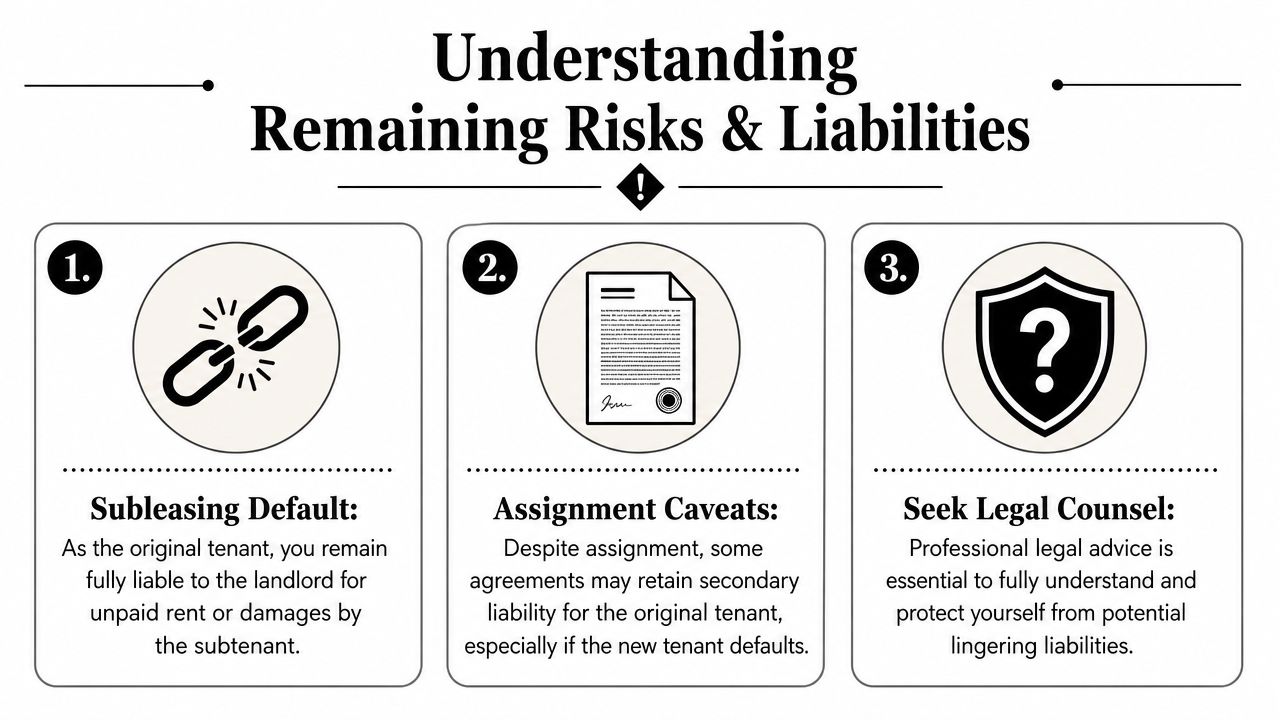
Subleasing usually leaves the original tenant on the hook
A sublease works like adding a second layer to the deal. The subtenant may promise to pay you, but you still owe the landlord under the original lease.
That means the landlord may still pursue the original tenant for unpaid rent, lease violations, cleaning charges, or property damage. If the subtenant breaks the rules about pets, guests, smoking, or occupancy limits, the problem can still come back to the person whose name remains on the main lease.
This catches tenants off guard. They may have done the hard part by finding a replacement and collecting a deposit, but their contract with the subtenant does not cancel their contract with the landlord.
Assignment can reduce risk, but only a clear release ends it
An assignment is often cleaner because the incoming tenant takes over the lease itself. Still, "assignment approved" does not always mean "original tenant released."
The key question is simple. Does the written agreement say the outgoing tenant is released from future liability as of a specific date?
If that release language is missing or vague, a later dispute may focus on whether the original tenant still owes future rent, repair costs, fees, or other charges tied to the lease. In plain terms, the transfer paperwork needs to do two jobs: move possession to the new tenant and state whether the old tenant is still responsible if trouble shows up later.
A short example shows why wording matters
A Dallas tenant finds a qualified replacement. The landlord signs off, everyone signs a one-page transfer form, and the new tenant moves in. A few months later, the account falls behind and the unit has damage beyond normal wear.
Now everyone pulls out the paperwork.
If the documents clearly released the original tenant, the answer is usually straightforward. If they did not, the outgoing tenant may end up arguing over charges they thought were gone the day they handed over the keys.
In a lease takeover, the transfer date matters. The release language matters more.
Check these liability points before you sign
For tenants and landlords alike, the safest approach is to read the transfer documents as if a dispute will happen later. Focus on a few practical questions:
- Is the original tenant released from future rent after the takeover date?
- Who pays for damage that existed before the handoff?
- Who is responsible for damage discovered after move-out but caused earlier?
- Does the security deposit stay with the landlord, return to the outgoing tenant, or transfer by private agreement between tenants?
- Are late fees, utility balances, reletting charges, or other unpaid amounts assigned to someone by name?
Those details are the difference between a clean exit and an expensive surprise.
When legal review makes sense
Some lease takeovers are routine. Others carry enough risk that a short legal review can prevent a bigger problem.
That is especially true if the lease restricts transfers, the landlord's consent is unclear, the assignment form is short or generic, or there is already a dispute over deposits or property condition. Landlords benefit from clear drafting too, because clear documents reduce fights over possession, damage claims, and collection rights.
If you need help with an eviction, lease issue, or rental dispute, contact The Law Office of Bryan Fagan, PLLC for a free consultation today. A Texas landlord tenant lawyer can help you review your lease, explain your tenant rights, and determine whether an assignment or sublease protects you best under the Texas Property Code.