You open your mail, or your email, and find a notice from the HOA. It says your property is out of compliance, a fine may be coming, or your account is delinquent. If you're a homeowner, that can feel personal fast. If you're a landlord, you're suddenly asking whether your tenant caused the problem and who has to fix it. If you're the tenant, you may not even know whether the HOA can contact you directly.
That uncertainty is what makes texas homeowners association law so important. HOA disputes usually aren't just about grass, paint, parking, or fees. They affect where you live, how you use your property, and in some cases whether your rental relationship stays stable.
The good news is that Texas law does give structure to this area. HOAs have authority, but they also have legal duties. Owners have responsibilities, but they also have rights to notice, process, and access to information. For landlords and tenants, the overlap with the Texas Property Code matters because HOA problems can turn into lease disputes, reimbursement fights, or even eviction-related issues if they aren't handled correctly.
Dealing with Your HOA Can Be Stressful But You Have Rights
A common pattern looks like this. A homeowner gets a violation letter for a fence, landscaping, or parking issue and assumes the HOA has the final word. A landlord receives a fine for something a tenant did and immediately wants to charge the tenant without first checking the lease or the HOA's written policy. A tenant gets caught in the middle, with a landlord demanding compliance and an HOA sending warnings that don't clearly explain the tenant's role.
That stress is real, but the law isn't supposed to work by surprise.
Texas courts and statutes treat HOA communities as regulated private communities, not as places where a board can make up enforcement rules on the fly. The association usually starts with governing documents such as declarations, bylaws, and rules. Then Texas statutes place limits on how those documents can be enforced. If you understand both layers, you can usually tell the difference between a valid demand and overreach.
Practical rule: Never respond to an HOA notice based on the tone of the letter alone. Respond based on the governing documents, the published enforcement policy, and the deadlines that apply.
That matters even more in rental property situations. The owner may owe duties to the HOA. The tenant may owe duties under the lease. Those aren't always the same thing. A landlord who reacts too quickly can create a separate dispute with the tenant. A tenant who ignores the issue because "it's the owner's problem" can still end up facing lease enforcement.
The first step is to slow down and identify three things: what rule the HOA says was violated, what the documents require, and who is legally responsible for fixing the issue. Once you do that, most disputes become more manageable.
The Foundation of Texas HOA Law Explained

The starting point is the Texas Property Code. Texas HOAs are primarily governed by Chapters 201 through 215, and Chapter 209, the Texas Residential Property Owners Protection Act, is a central part of that framework because it addresses board governance, voting, foreclosure limits, and homeowner disclosure rights. The Legislature is still actively revising this area, with over 100 HOA-related bills filed in the 2025 session, according to this Texas HOA laws guide.
Think of it as a layered rulebook
Most HOA disputes involve three layers of authority.
| Layer | What it usually does | Why it matters |
|---|---|---|
| State law | Sets baseline protections and limits | An HOA can't ignore statutory requirements |
| Governing documents | Creates the community's recorded rules | These often define maintenance duties, assessments, and architectural review |
| Board policies | Explains how the HOA carries out enforcement | These can become crucial in a fine dispute |
The declaration is often the strongest community document because it's recorded against the property. Bylaws usually address governance, meetings, and board operations. Rules and policies fill in day-to-day details, but they still have to fit the declaration and Texas law.
Why Chapter 209 matters in real life
For most single-family HOA disputes, Chapter 209 is where practical rights show up. It deals with how boards operate, how some notices must be given, and what process owners can expect before the HOA takes serious collection or enforcement steps.
That doesn't mean every dispute has a clean answer. It does mean the HOA has to work within a legal framework. When people say, "My HOA can do whatever it wants," that's usually wrong.
The most effective HOA defense is usually document-based, not emotion-based. Pull the declaration, bylaws, notices, account ledger, and written policy before you argue.
For landlords, this framework matters because the HOA relationship is with the owner, not usually the tenant. For tenants, it matters because the property you live in may be controlled by a contract you never signed, yet your lease may require you to follow it. That's where a Texas landlord tenant lawyer often has to look at both the HOA documents and the lease together, not separately.
Your Rights and Responsibilities as a Homeowner

If you own property in an HOA, you're not just subject to rules. You also have enforceable rights. That's important in Texas, where HOA communities affect a large share of residential property. As of 2021, over 6.1 million Texans live in HOA communities, nearly 21% of all homes in the state, and these associations collect about $7.96 billion in assessments annually, according to Texas HOA statistics.
Rights that matter in day-to-day disputes
Your rights often include the ability to insist on fair process, clear records, and consistent treatment.
- Notice before penalties: If the HOA claims you violated a rule, you should pay close attention to what the notice says, what rule it cites, and what deadline it gives you to respond.
- Access to information: Owners often need account records, governing documents, meeting information, or enforcement policies to evaluate whether the HOA is acting lawfully.
- A chance to be heard: If a fine or enforcement action is moving forward, a hearing right can be one of your most important protections.
- Participation in governance: Voting rights and meeting-related rights matter because poor governance often leads to selective enforcement disputes.
For many owners, the practical issue isn't whether rights exist. It's whether they've preserved them. Missing a hearing deadline, failing to request records in writing, or paying a disputed fine without objection can weaken your position.
Responsibilities owners shouldn't ignore
Owners also need to do their part. That includes paying assessments on time, following recorded restrictions, and making sure tenants understand the community rules before move-in.
A landlord should also make sure the lease clearly addresses HOA compliance. If your tenant gets repeated parking notices, leaves trash containers out, or installs something without approval, the HOA may pursue the owner first. Whether the owner can recover that cost from the tenant depends heavily on the lease language and the facts.
If you rent out HOA property, give the tenant the community rules in writing and keep proof you did it. That simple step prevents a lot of avoidable arguments later.
Some owners also overlook how HOA restrictions interact with broader property protections. If you're reviewing your overall rights in a primary residence, it's worth understanding Texas homestead laws alongside your HOA obligations because different parts of Texas property law can affect risk, exemptions, and long-term strategy.
Understanding Your HOA's Powers and Legal Duties
An HOA usually has three core powers. It can collect assessments, enforce restrictions, and review certain exterior changes. Those powers are real, but none of them are unlimited.
Assessments and collection authority
Associations depend on assessments to maintain common areas and operate the community. That means they generally can bill owners, pursue delinquent amounts, and escalate collection if the account isn't resolved.
But collection authority has limits. The HOA still has to follow the governing documents and applicable statutes. It also has to keep accurate records. In practice, many collection fights turn on accounting errors, improper notice, or fees that aren't well supported by the documents.
If a delinquency has already led to recorded claims against the property, owners often need to understand not just the debt itself but also the title impact. In that situation, a guide on how to release a lien on property can help frame the next steps.
Rule enforcement and fine authority
The HOA can usually enforce deed restrictions and adopted rules, but it can't enforce them however it wants. Consistency matters. Process matters. Documentation matters.
Selective enforcement claims often arise when one owner is cited and another owner with the same condition is ignored. Those disputes are rarely won by broad complaints alone. They are built with dated photos, prior notices, board communications, and proof of unequal treatment.
Architectural control and approval decisions
Architectural committees and boards often control changes to fences, paint, landscaping, additions, and visible exterior modifications. That's normal in HOA communities. The problem starts when the review process becomes vague or arbitrary.
A denial should match the recorded restrictions or adopted standards. If the HOA can't point to a clear basis for denying a request, the owner may have room to challenge the decision. The strongest submissions usually include plans, photos, product details, and written responses kept in one file.
Here is the trade-off. Communities need standards to preserve uniformity. Owners need a fair process so "community standards" doesn't become a moving target depending on who is on the board that month.
Common HOA Disputes and Strategic Responses
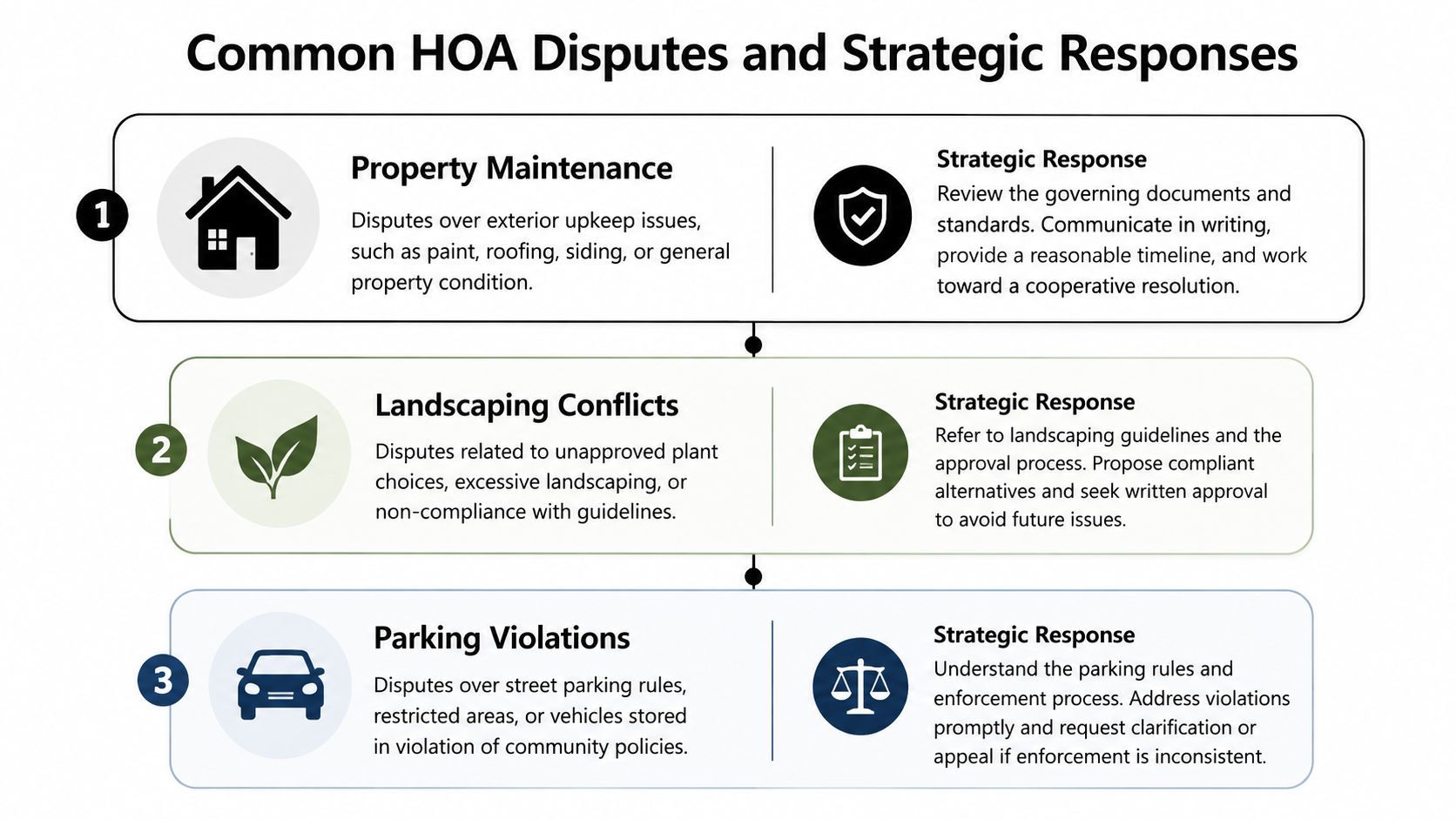
A common Texas rental-property dispute starts like this. The HOA sends the owner a fine for trash cans, parking, or yard conditions. The tenant says no one told them about the rule. The owner says the tenant caused the problem. The HOA says it will keep charging until the violation stops.
That pattern shows up often because HOA law and landlord-tenant law do not line up neatly. The HOA usually enforces against the owner. The owner then has to look to the lease, the notice history, and the actual facts on the ground.
Fines that don't match the written policy
Fine disputes are often won or lost on paperwork.
Texas law now requires many HOAs with fining authority to adopt and publish a written enforcement policy that identifies violation categories, lists scheduled fine amounts, and explains hearing procedures. If the amount in your notice does not match the published schedule, or if the HOA cannot show which policy was in effect on the violation date, that gives you a direct argument.
That does not erase the alleged violation. It does change the owner's position. A landlord, for example, may decide to cure the condition immediately to stop repeat charges while still disputing the fine amount and preserving a reimbursement claim against the tenant if the lease supports it.
Ask for the exact enforcement policy in effect on the date of the alleged violation, along with the board-adopted fine schedule and any hearing notice tied to your file.
Delinquent assessments and lien pressure
Assessment disputes create a different kind of risk because they can affect title, collections, and eventually possession.
Texas law added more structure to the pre-lien notice process for delinquent assessments. For owners, that means there are specific notice issues worth checking before an assessment lien is filed. For rental properties, the practical problem is sharper. A tenant may be paying rent on time and following the lease while the owner falls behind with the HOA, and the tenant usually has little control over the dispute even though the property they live in may be pulled into it.
In that situation, owners should act early. Waiting for the account to roll into attorney collections usually raises the balance and reduces room to negotiate. If the dispute is headed toward litigation affecting title, review what a notice of lis pendens means before you decide how to respond, because that filing can change refinancing, sale options, and settlement pressure.
Rental-property conflicts involving tenants
This is the area owners miss most often.
The HOA's documents may bind the property, but the lease controls the relationship between landlord and tenant. If those two sets of rules do not fit together, small violations become expensive ones. I see this with parking restrictions, pool access, pet rules, holiday decorations, short-term guest issues, and exterior upkeep on single-family rentals.
The first question is not who is angry. The first question is who has legal responsibility at each step.
Use that framework:
- What rule was allegedly violated
- Whether the HOA can enforce only against the owner or also suspend tenant access to amenities under the governing documents
- Whether the lease requires the tenant to comply with HOA rules and reimburse fines or costs
- Whether the owner gave the tenant the rules in a way that can be proved
- What fix is still available now, before more fines or legal fees accrue
A weak lease creates avoidable problems. If the lease says only that the tenant must follow "community rules," but never attaches those rules or explains who pays HOA fines, the owner may still owe the HOA while having a poor claim against the tenant.
For homeowners looking at general strategies for resolving HOA community issues, outside guidance can be helpful. In Texas rental disputes, though, the deciding documents are usually the declaration, the enforcement policy, the notice record, and the lease.
Your Step-by-Step Guide to Resolving an HOA Dispute

A common Texas rental dispute starts the same way. The HOA sends a violation notice to the owner, the tenant says nobody told them about the rule, and fines keep adding up while each side blames the other.
The fastest way to lose ground is to treat that first notice as an insult instead of a record request. HOA disputes are often won with dates, documents, and a timely hearing request, not with a long argument about fairness. For landlords, the immediate question is whether the problem should be cured first to stop more charges, then sorted out later under the lease. For tenants, the question is whether the HOA rule was provided and whether the landlord promised something the HOA does not allow.
Start with the paper trail
Before responding, build a file that answers four practical questions: what rule was cited, what deadline applies, who had the duty to comply, and what can still be fixed now.
Read the notice carefully
Identify the alleged violation, the date of the notice, the cure deadline, and any language about a hearing or appeal.Pull the governing documents
Review the declaration, current rules, and the association's written enforcement policy.Document the facts
Take current photos, save emails and text messages, keep envelopes, and make a short timeline of what happened.Decide whether to cure first
If the issue is easy to correct, such as trash container placement, lawn maintenance, or a visible exterior problem, fixing it quickly can stop the account from getting worse.Review the lease if the property is rented
Check whether the tenant agreed to follow HOA rules, whether the rules were attached or delivered, and who must pay fines, reinspection fees, or legal costs.
That last step matters more than many owners expect. The HOA usually pursues the owner, even when the tenant caused the violation. A lease may let the owner recover those costs from the tenant, but only if the lease language and notice record support it.
Put your position in writing
A short written response does two jobs. It preserves your position, and it forces the association to identify the rule and procedure it is relying on.
Sample dispute letter
Dear Board or Manager,I am writing to dispute the violation notice dated [date] regarding [issue]. Please provide the specific governing-document provision and the enforcement policy that applies to this allegation, including the fine schedule and hearing procedures. I also request any photographs, inspection notes, or account records the association relied on.
If a hearing is available, please treat this letter as my formal request. I reserve all rights and do not waive any objection by communicating to resolve this matter.
Sincerely,
[Name]
Keep the tone plain and professional. Do not admit a violation unless you are making a deliberate decision to cure and close the matter. If you are a landlord, send any necessary lease notice to the tenant at the same time so your HOA response and tenant enforcement record stay aligned.
Texas law now places more attention on published HOA fine procedures. As noted earlier, if an association has fining authority, its enforcement policy and fine schedule matter. If the notice, amount charged, or hearing process does not match the association's own policy, that may become part of your defense.
After you've gathered your records, this overview can help you think through the process before a hearing or formal response:
Know when to cure and when to fight
Some disputes should be solved in two tracks. Correct the condition now, then challenge the fine, the notice, or the process. That approach often makes sense for maintenance issues and other obvious violations where delay only increases cost.
Other cases call for a direct challenge from the start. That includes situations where the HOA cited the wrong property, relied on an outdated rule, treated similar owners differently, suspended tenant amenity access without document support, or charged a fine that does not match its written policy.
Stay focused on proof. If a tenant is involved, gather the lease, move-in emails, rule acknowledgments, and any prior warnings. If you own the rental, your goal is to control the HOA account first and preserve your reimbursement claim second. If you are the tenant, your goal is to determine whether the landlord failed to disclose a rule that now affects your use of the property.
When to Stop DIY and Consult a Texas Property Lawyer
Some HOA problems are manageable without legal help. A simple notice about lawn care, an architectural application that needs more detail, or a first-time parking warning can often be handled with records, a calm response, and a timely cure.
Other situations carry too much risk to guess your way through.
Red flags that usually justify legal advice
You should strongly consider speaking with counsel if any of these are happening:
- A lien or foreclosure threat is on the table: Once collection pressure reaches title or foreclosure territory, the cost of a mistake rises quickly.
- The fines keep escalating: Repeated notices, rolling charges, and attorney demand letters can outpace a homeowner's informal response.
- A tenant is involved and responsibility is unclear: Texas guidance offers little clarity on how HOAs must treat tenants versus owner-occupants, which creates risk for both landlords and renters, as discussed in this overview of Texas HOA law issues affecting tenants.
- You suspect discrimination, retaliation, or selective enforcement: These cases depend on evidence and timing. Early legal framing matters.
- Your lease and the HOA rules conflict: A landlord may have promised something in the lease that the HOA restrictions don't allow.
Why legal help can save money, not just trouble
A lawyer's role isn't only to file suit. In many HOA disputes, the most valuable work happens earlier. Reviewing the governing documents, spotting notice defects, preserving objections, and addressing landlord-tenant exposure can prevent a much bigger problem later.
That is especially true when a dispute touches both HOA enforcement and rental occupancy. A landlord may be trying to enforce a lease provision. A tenant may be worried about tenant rights or possible displacement. An HOA may be focused only on the owner of record. Those three positions don't line up automatically.
If you need help with an HOA dispute, lease issue, or potential eviction, getting clear legal advice early is often the safest move.
If you need help with an HOA dispute, lease issue, or rental conflict, contact The Law Office of Bryan Fagan, PLLC for a free consultation today. Whether you're a homeowner, landlord, or tenant dealing with Texas homeowners association law, a Texas landlord tenant lawyer can help you understand your rights under the Texas Property Code, respond strategically, and protect your property before the dispute gets worse.