Yes, you can get a low-income apartment in Texas without a job. What matters is whether you can document income or financial support from some source, because many programs and landlords look at verified resources, not employment by itself, and income-based housing often charges 30% of monthly adjusted income with a typical $25 minimum rent even when earned income is zero.
Losing work or searching for housing at the same time can feel overwhelming. A lot of Texans come to this question when they're between jobs, living off disability, relying on help from family, or trying to keep a roof over their children while everything else feels uncertain. The good news is that Texas law and affordable housing rules don't automatically shut you out because you're unemployed.
You still need a plan. Landlords want proof that rent will be paid. Housing authorities want complete paperwork. If you know how screening works, how affordable housing programs define income, and what your rights are under the Texas Property Code, you can put together a much stronger application and avoid mistakes that lead to denials.
Securing Housing in Texas Is Possible Even Without a Job
If you are trying to find a place in Texas after losing a job, the pressure is real. Rent deadlines do not wait for a new offer letter. I see this problem often. A tenant has money coming in from disability benefits, child support, retirement, family support, or savings, but assumes no employer means no chance of getting approved.
That assumption causes people to give up too early.
For Section 8 and public housing, eligibility depends on the income ceiling, not whether you are currently employed. Federal HUD rules focus on household income and program eligibility, and Texas housing authorities apply local income limits based on area median income. HUD publishes those limits each year through its income limits documentation. A person can qualify with little or no earned income if the household otherwise meets program rules.
Private rentals are different. A Texas landlord usually cares less about your job title than about whether your rent source is lawful, stable, and documented well enough to satisfy screening. That is the practical point many renters miss.
What Texas law means for you
The Texas Property Code does not say a private landlord can only rent to someone with W-2 wages. In residential leasing, Chapter 92 covers issues such as security deposits, repairs, notices, and retaliation. It gives tenants important protections, but it does not ban landlords from screening applicants for financial risk, past lease violations, or incomplete paperwork.
Texas law also does not give a landlord free rein to reject people for unlawful reasons. Screening standards still have to stay within fair housing rules. A landlord may deny an applicant because the file does not show an ability to pay. A landlord cannot use a protected characteristic as the actual reason for the denial.
If your funds are legitimate, consistent, and documented, being unemployed does not automatically disqualify you.
Where people get stuck
In practice, denials often come from proof problems. The money may be real, but the paper trail is weak. A relative may send cash without a written support letter. Bank deposits may appear irregular. An applicant may apply to a market-rate complex using the same approach that would work better for income-based housing.
Those problems can often be fixed before you submit the application. A cleaner file gives the landlord fewer reasons to say no.
Redefining Income What Landlords and Programs Accept
If you are out of work, the word "income" can feel like a door slamming shut before you even apply. In Texas, it is usually wider than that. Landlords and affordable housing programs often accept money that does not come from a paycheck, but they want to see that the source is lawful, recurring, and documented well enough to survive screening.
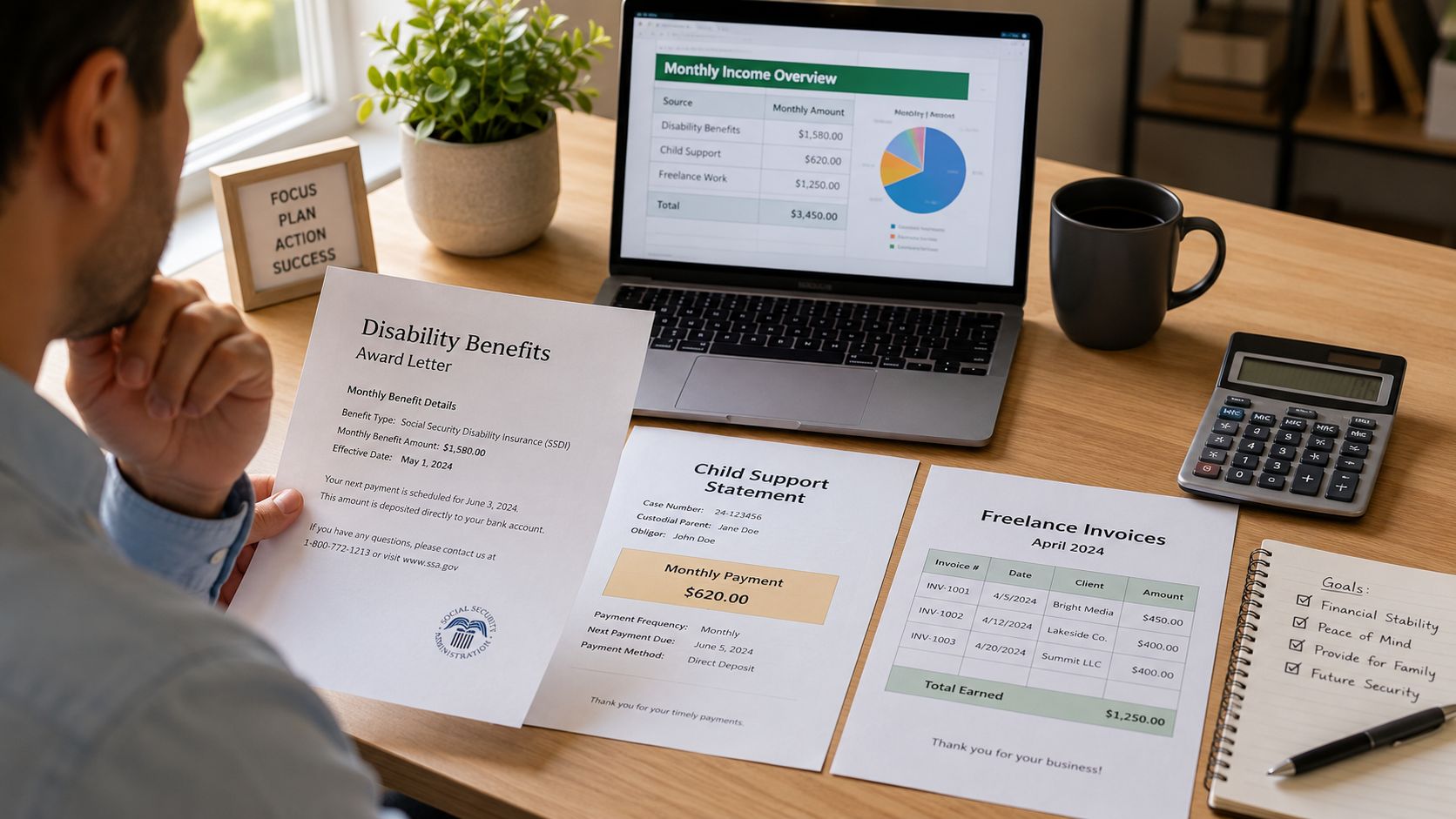
Income can come from more than a paycheck
For screening purposes, many properties look at whether rent can be paid on time, month after month. That can include several sources besides wages, as long as the paperwork is solid.
Examples commonly used in rental applications include:
- Government benefits supported by award letters or deposit records
- Court-ordered payments such as child support, backed by an order and payment history
- Retirement or pension income shown on benefit statements
- Freelance or gig work documented through Form 1040 returns or 1099s
- Investment income if statements show regular distributions
- Family support or gifts if the arrangement is reduced to writing
- Savings if account statements show enough reserves to cover rent and basic expenses
A leasing industry guide notes that applicants without traditional employment may still qualify by showing tax records, benefit income, investment distributions, court-ordered support, or substantial savings. The same guide explains that landlords often ask for recent bank statements and may require a notarized gift affidavit for recurring financial help from another person, as described in this guide to renting an apartment without a job.
Practical rule: Landlords value consistency over labels. The real question is whether your rent source will still be there next month.
Family help counts if you document it correctly
Applicants in Texas get denied here all the time. The money is real, but the proof is weak.
If a parent, sibling, or friend helps you every month, treat that support like part of your application file, not a side explanation you offer at the leasing desk. Many affordable housing operators want a written statement from the person providing support, and they often compare that statement to your bank records to see whether deposits have been arriving with some regularity.
The same issue comes up in subsidized housing. HUD's guidance for public housing and voucher programs allows housing providers to count regular cash contributions and gifts when calculating annual income, which means family support can matter if it is recurring and can be verified, as explained in HUD's Housing Choice Voucher Program guidebook.
One last-minute transfer usually does not solve the problem. A pattern does.
Why documentation beats explanation
I tell clients to assume the leasing office will review the file, not the story. "My family helps me out" is hard to underwrite. A signed affidavit, matching bank deposits, benefit letters, and organized records give the property manager something concrete to approve.
This short video gives a useful overview of the mindset you need before applying.
What usually works and what doesn't
What tends to work:
- Regular deposits with a paper trail
- Benefit letters paired with bank statements
- Savings shown over time instead of a sudden transfer
- Amounts on the application that match the supporting documents
What usually doesn't:
- Cash support with no record
- Conflicting numbers in different parts of the file
- Undocumented help from friends or relatives
- Trying to gather proof only after a denial
Your Guide to Low-Income Housing Options in Texas
If you are out of work and trying to find a place before your current housing falls apart, the options can feel blurry fast. In Texas, the three programs renters ask about most often are public housing, Section 8 vouchers, and income-restricted apartments financed through tax credits. They solve different problems, and knowing how each one works helps you spend your time where you have the best chance of getting housed.
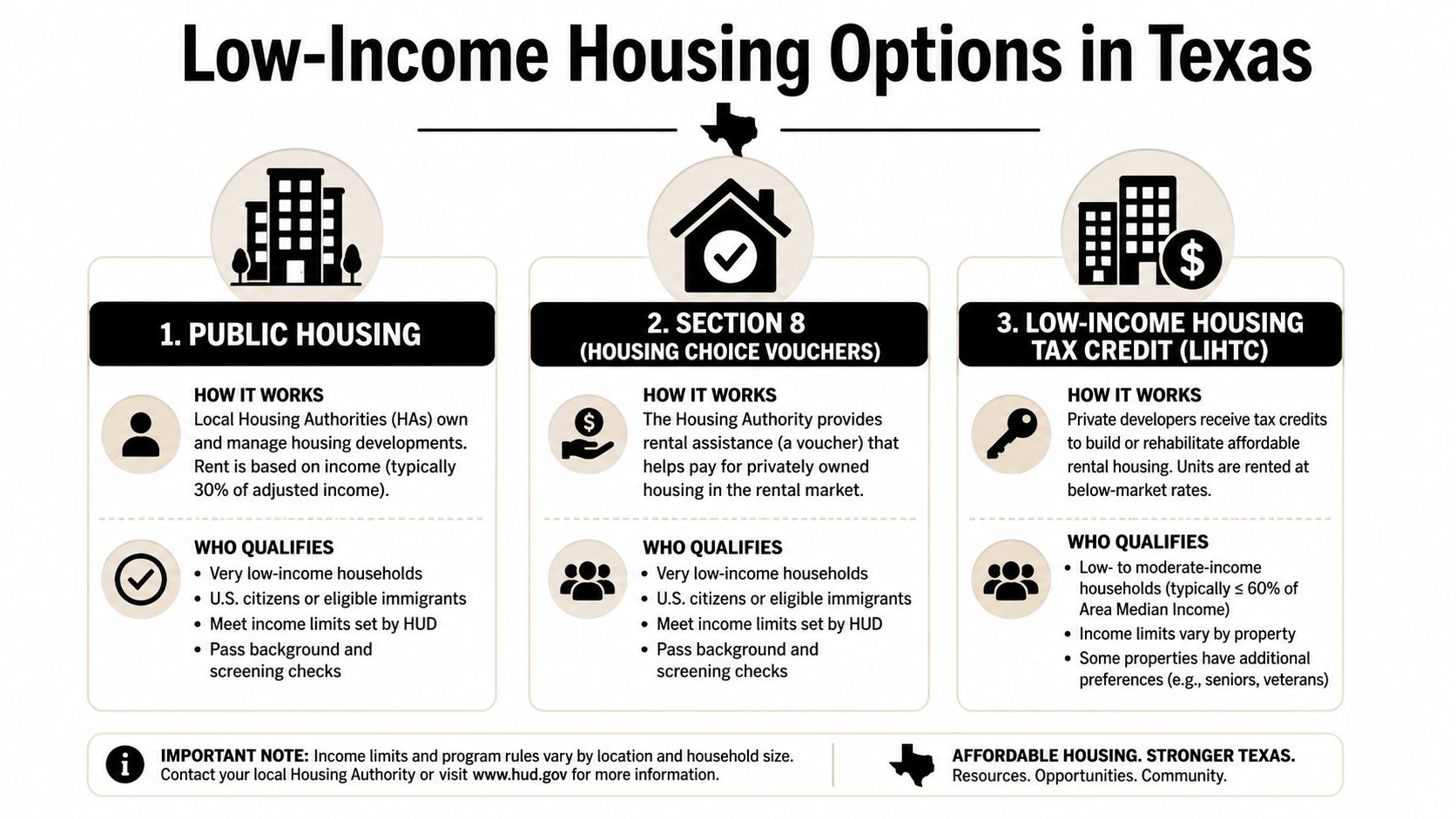
Public housing
Public housing is owned or operated by a local housing authority. No job does not automatically disqualify you. The housing authority is usually looking at your household income, who will live in the unit, and whether you can clear its screening requirements.
HUD explains that public housing is aimed at low-income families, older adults, and people with disabilities, and local housing authorities apply income limits tied to the area where you are applying. In practice, this can work well for renters who need a stable monthly rent and can stay in one location. The trade-off is control. You do not choose from the full private market, and availability can be tight.
Section 8 vouchers
The Housing Choice Voucher Program gives rental assistance you can use with a private landlord who accepts vouchers. That flexibility is the appeal. It can open more neighborhoods and more unit types than public housing.
For households with little or no income, the tenant portion of rent may be low, although local rules can still include a minimum tenant payment. Timing is often the hard part. Waitlists can stay closed for long stretches, and even after a list opens, approval and lease-up can take time. If you need a place soon, a voucher application usually works better as one track in your plan, not the whole plan.
A second issue comes up after approval. A voucher helps, but it does not erase screening. Private landlords can still review your application, and many use standard income and risk rules unless the property has a different policy. If you want context on how owners often evaluate affordability, this guide to the 3 times rent rule in Texas explains the screening standard many applicants run into.
LIHTC and other income-restricted apartments
Low-Income Housing Tax Credit properties are private apartment communities that reserve units for income-qualified renters. These are often the most misunderstood option because they can look like an ordinary apartment search while still requiring affordable-housing paperwork.
For an unemployed renter, LIHTC properties are often worth serious attention. They may accept documented benefits, ongoing family support, child support, disability income, or other verifiable funds, depending on the file and property rules. They also tend to move faster than voucher programs because you do not need a voucher in hand first.
That said, management still screens. Credit issues, prior evictions, incomplete records, and mismatched documents can sink an application even when the rent amount looks affordable. In shared-housing settings, screening can follow different operational rules, and this overview of compliant co-living tenant screening shows how some operators structure that review.
Many Texas renters are better served by applying on more than one track at the same time. Public housing may offer long-term stability, vouchers may help later, and tax credit properties may be the quickest realistic path to a move-in.
Comparing Low-Income Housing Programs in Texas
| Housing Type | How it Works | Who Manages It | Best For |
|---|---|---|---|
| Public Housing | Government-owned or managed units rented to eligible low-income households | Local public housing authority | Renters who want a direct affordable unit and can wait for availability |
| Section 8 Vouchers | Rental assistance that helps pay for approved private housing | Local public housing authority with private landlord participation | Renters who need flexibility to choose a private unit once assistance is available |
| LIHTC | Privately owned apartments with income restrictions | Private owners and managers under affordable housing rules | Renters who want an affordable private complex without waiting for a voucher |
A Texas law point many people miss
Residential and commercial leasing are treated differently in Texas. If you are considering a storefront, office, or live-work setup tied to self-employment, Commercial Lease Disputes in Texas explains how commercial tenancies fall under different rules, including Chapter 93.
Self-employed renters run into this problem more often than they expect. A place that seems like a housing fix can carry fewer residential protections if the lease is structured as commercial space.
The Landlord's Perspective on Screening in Texas
If you want a better shot at approval, it helps to think like the property manager reviewing your file. They're not judging you for being unemployed in the abstract. They're deciding whether your application shows low enough risk to hand over keys.
What a landlord is usually trying to verify
Most screening questions come back to a short list:
- Can you pay rent on time
- Will you follow the lease
- Did you take care of your last place
- Are there warning signs in your credit or background history
That's why landlords ask for bank statements, benefit letters, prior landlord references, and application details that match each other. In co-living or shared housing settings, screening can look slightly different, and this overview of compliant co-living tenant screening is a useful example of how managers evaluate risk while staying organized.
What Texas law allows and limits
Texas landlords generally may screen applicants using lawful criteria. They can set financial standards, review rental history, and run background checks if they follow applicable rules. They also need to be careful about how they handle application fees and notices. If you're trying to understand common income standards, this article on the 3 times rent rule in Texas helps explain a screening formula many renters hear about.
At the same time, landlords can't use screening as a cover for illegal discrimination. The federal Fair Housing Act bars discrimination based on protected characteristics such as race, color, religion, sex, national origin, familial status, and disability. If a disability affects how you document income or if you need equal treatment in the process, that legal framework matters.
Security deposits and risk
A landlord may also use the security deposit as one tool to reduce risk. Under the Texas Property Code, residential landlords have rules to follow on holding and returning deposits after move-out. That doesn't guarantee approval, but it explains why a landlord may be more comfortable with an applicant who has strong records, references, and funds available at the start of the lease.
A landlord doesn't need to love your work history. They need to trust your payment history and your paperwork.
When screening is handled fairly, an unemployed applicant with clean documentation can look safer than an employed applicant whose records are inconsistent.
How to Build a Strong Rental Application Without a Job
Strategy matters most. A weak file invites assumptions. A complete file answers questions before the landlord asks them.
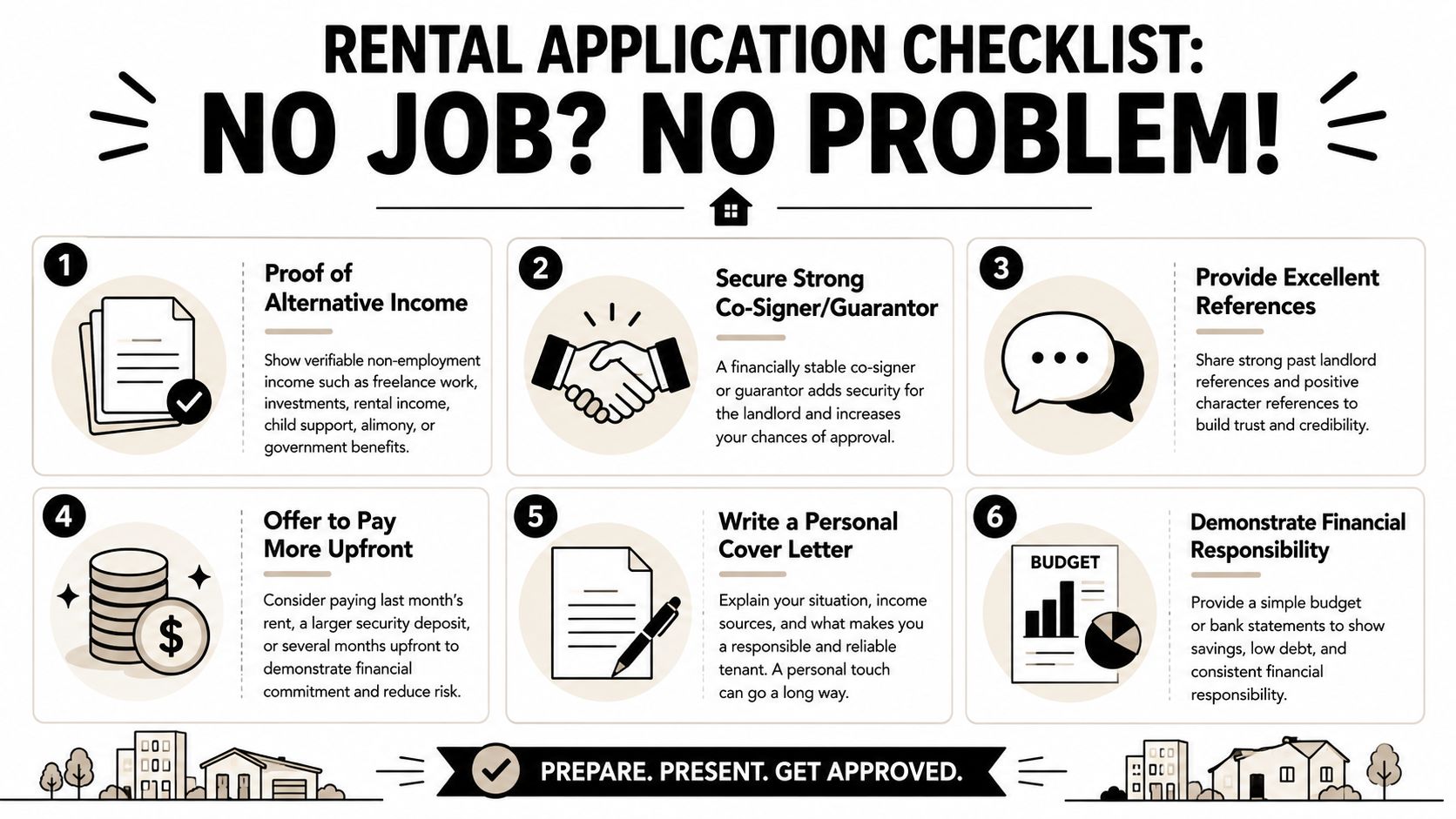
Start with a clean paper trail
Before you apply anywhere, gather the documents that prove how you live month to month.
Use a checklist like this:
Benefit and support records
Pull award letters, pension statements, child support records, tax returns, 1099s, and bank statements.Gift affidavit if family helps
If someone supports you regularly, get the affidavit notarized and make sure deposits appear in your account history.Savings proof
Show stable balances, not a last-minute transfer.Rental history
Include prior landlord contact information and proof you've paid reliably.Identification and application details
Make sure dates, addresses, and income entries are consistent across every form.
Write a short cover letter
A good cover letter can steady an application that might otherwise look uncertain. Keep it factual. Explain that you're between jobs or living on verified support. State the source of funds, how long it has been consistent, and why you're a reliable tenant.
Don't over-explain and don't sound defensive. The goal is to make the file easy to approve.
Know the rules on applications and fees
If you're applying to several properties, keep track of screening disclosures and fees. Texas law has rules in this area, and our page on Texas law on application fees for rentals can help you spot when a property has not handled the process correctly.
That matters because some renters lose money applying broadly without confirming what each property requires upfront.
Use the waitlist strategically
Some affordable housing opportunities reward speed more than perfection. A housing source focused on Texas notes an emerging waitlist-to-lease approach in major markets like San Antonio and Houston, where 30% of properties were reported in 2024 to 2025 as accepting applications without pre-verification of income to secure a place on the waitlist. That can give jobless applicants a chance to apply first and verify later, as described in this Texas housing application guide.
That doesn't replace verification. It changes when verification happens.
Apply early when a waitlist opens, even if you're still finalizing every income document. In some settings, getting on the list first is the hard part.
Add strength from other parts of your file
A no-job application gets easier to approve when the rest of your profile is strong.
Consider adding:
- Good references from former landlords, caseworkers, clergy, or employers who can speak to reliability
- A co-signer or guarantor if the property allows one
- A household budget showing how rent fits within your available resources
- Proof of active job search, especially if you're in transition and expect income to resume
If you're rebuilding your work history too, this job search without experience guide may help you strengthen that side of the picture while your housing search continues.
One example of a stronger application
Suppose a tenant has no current job, receives disability income, and also gets regular help from a sibling. A weak application says, "Family helps me with bills." A strong application includes benefit letters, bank statements, a notarized affidavit from the sibling, a prior landlord reference, and a brief cover letter explaining the arrangement.
Those two applicants may have the same finances on paper. Only one makes the manager's job easy.
For renters and landlords who need legal guidance on how screening should be handled, Tenant Screening and Application Rules in Texas addresses what Texas law permits in screening applicants and handling application fees.
Navigating Denials and Exploring Your Alternatives
Even a careful application can be denied. If that happens, don't assume the answer is final or lawful. Start by asking for the reason in writing if the property will provide it. A written denial helps you figure out whether the problem was missing documents, credit, rental history, or something that may point to discrimination.

What to do after a denial
Take these steps in order:
- Review the stated reason and compare it to the documents you submitted.
- Correct fixable issues such as missing bank statements, incomplete affidavits, or inconsistent entries.
- Watch for discrimination concerns if you believe the property treated you differently because of a protected status.
- Preserve paperwork including emails, application receipts, screening notices, and text messages.
If the unit won't work out, look at alternatives that solve the same problem more quickly. A guarantor may help. Shared housing may have looser standards. A temporary lease arrangement could buy time while you stabilize income. In some cases, a lease transfer is also worth exploring, and this page on whether someone can take over your lease explains part of that conversation under Texas leasing practice.
Keep moving on both tracks
Housing and employment often affect each other. If you're trying to improve your income options at the same time, a practical outside resource like this proven job search playbook may help you work both problems at once.
What doesn't help is silence, delay, or guessing. If you suspect an unlawful denial, if a landlord mishandled screening, or if you're dealing with a lease dispute after being approved conditionally, legal advice can make the next step much clearer.
If you need help with an eviction, lease issue, or rental dispute, contact The Law Office of Bryan Fagan, PLLC for a free consultation today. A Texas landlord tenant lawyer can help you understand your tenant rights, review screening problems, address unfair denials, and explain how the Texas Property Code applies to your situation before a housing problem turns into an eviction case.