Dealing with a landlord dispute or eviction can be stressful, but understanding your rights under Texas law can make all the difference.
If you've walked into a vacant house, duplex, rental unit, or commercial space and found someone living there without your permission, your first reaction is usually confusion mixed with urgency. Should you call the police? Start an eviction? Change the locks? Wait for a court order? In Texas, the answer depends on one key question: is this person an unauthorized squatter, a trespasser, or a tenant who once had permission to be there?
That distinction matters because squatters rights Texas cases no longer sit only in the civil-law world. The state of the law has changed. Property owners now have a faster path in some situations, while tenants with actual lease rights still keep important protections under the Texas Property Code. If you're a landlord, property manager, business owner, or renter trying to understand where the line is, the law becomes much easier once you break it into plain steps.
A Stranger in Your Property What to Do Next
You arrive at your property to check on it. There's furniture inside. Maybe lights are on. Maybe someone answers the door and says they live there now. In that moment, most owners make one of two mistakes. They either panic and try self-help, or they assume they have no immediate options.
Neither response helps.
Texas law gives you a path forward, but the first step is staying calm and identifying the person's legal status. The phrase “squatters rights” gets used loosely, and that causes a lot of confusion. In real legal terms, what people usually mean is adverse possession. That is not a quick loophole. It is a narrow doctrine with demanding requirements.
Start with the right first questions
Before you take action, ask yourself:
- Did this person ever have permission to be there? If yes, you may be dealing with a holdover tenant, guest, or former occupant rather than a true squatter.
- Is there any lease, deed, title, or family claim being asserted? Even a weak claim can affect procedure.
- Is the property residential or commercial? That can change your practical options.
- Do you have proof of ownership ready? Deeds, tax records, lease files, and identification documents matter.
Practical rule: Never remove an occupant by force, shut off utilities, or change locks while you're still figuring out whether Texas law treats the person as a tenant or an unauthorized occupant.
Why owners get tripped up
A person can be on your property unlawfully without having a realistic ownership claim. That happens all the time. A few days or even a few months of unauthorized occupancy does not automatically create ownership rights. The law does not reward someone for showing up.
The harder cases are the ones with mixed facts. For example, a person may say, “My cousin let me stay here,” or “I bought this from someone,” or “I've been fixing it up.” Those statements don't prove legal rights, but they do signal that you should slow down and choose the right removal process.
For tenants, this distinction matters too. If you have a valid lease, even an expired one, you are not automatically treated as a squatter. Texas still separates unauthorized squatters from renters who have landlord-tenant protections.
Your immediate checklist
- Document what you found. Take photos, note the date, and keep records of any statements made.
- Do not use self-help removal. That can create legal problems quickly.
- Gather ownership papers. You'll need them whether you pursue law enforcement help or a civil eviction.
- Decide whether this is trespassing, squatting, or a lease-related dispute.
That last step drives everything else.
Understanding Adverse Possession vs Trespassing in Texas
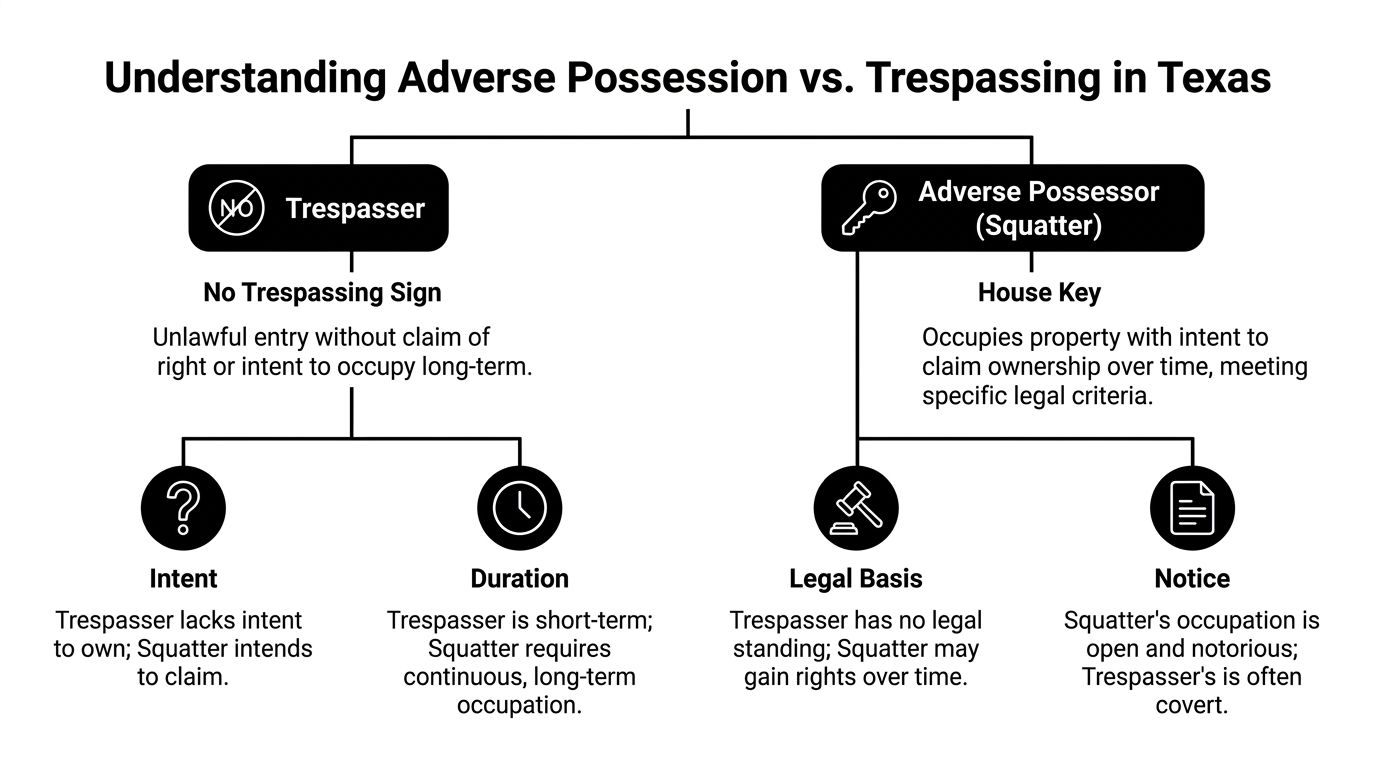
A trespasser and a squatter are not the same thing, even though people often use the terms interchangeably.
A trespasser enters property without permission. That is usually the cleaner fact pattern. They don't claim they own the property, they don't claim a legal right to stay, and they often enter secretly or briefly.
A squatter also occupies property without permission, but the legal issue becomes more complicated if that person later tries to claim ownership through adverse possession. For a plain-English breakdown of the core legal elements, see this guide on adverse possession elements in Texas.
What adverse possession actually means
Adverse possession is the doctrine that can allow a person to claim ownership of land they don't legally own, but only if strict conditions are met over time. Texas courts look for possession that is actual, open, notorious, exclusive, hostile, and continuous.
Here's what those words mean in normal language:
- Actual means the person is really using or occupying the property.
- Open and notorious means the occupancy isn't hidden.
- Exclusive means the person isn't sharing possession as if the true owner were still in control.
- Hostile doesn't mean violent. It means the person is there without the owner's permission.
- Continuous means the possession must continue without interruption for the required legal period.
A simple comparison
| Situation | Likely category | Why it matters |
|---|---|---|
| Someone sneaks into a vacant house for a short stay | Trespasser | Law enforcement may treat it as unlawful entry |
| A former tenant stays after permission ends | Holdover tenant | Usually requires civil eviction |
| A person occupies land long-term and later claims ownership | Adverse possession claim | Requires close legal review |
A person who breaks into a vacant home for a week is not suddenly on the path to ownership. Time alone doesn't do the work. The legal elements do.
Where clients often get confused
People hear “squatters rights” and assume the law favors the occupant. That's usually not true. Texas adverse possession law is demanding, and the person claiming ownership carries a heavy burden.
The confusion gets worse when a person has some paperwork, even if it's faulty. That can raise questions about color of title, which means a document appears to support ownership but has a defect. That issue can affect the timeline for an adverse possession claim, which is why both landlords and tenants sometimes benefit from When to Consult a Texas Landlord-Tenant Attorney to evaluate what rights exist before anyone takes the wrong procedural step.
The Three Paths to Adverse Possession in Texas
Texas does not have one single adverse possession rule. It has multiple statutory paths, and each comes with its own requirements.
Under Texas Property Code §§ 16.024–16.026 as summarized here, a squatter can claim adverse possession if they meet one of three distinct time-based thresholds: 3 years with color of title, 5 years with a recorded deed plus tax payment and cultivation, or 10 years of continuous occupancy with land improvements, subject to acreage limits unless the land is enclosed.
Texas Adverse Possession Requirements at a Glance
| Requirement | 3-Year Statute | 5-Year Statute | 10-Year Statute |
|---|---|---|---|
| Time period | 3 years | 5 years | 10 years |
| Document requirement | Color of title | Recorded deed | No formal title required under this path |
| Tax payment | Not stated as the defining element in this path | Required | Not the defining element in this statutory summary |
| Land use | Possession under claimed title | Must cultivate the land | Continuous occupancy with land improvements |
| Other limit | Must satisfy adverse possession elements | Must satisfy adverse possession elements | Land under 160 acres unless enclosed |
What color of title means
Color of title is one of the most misunderstood phrases in this area of law. It does not mean valid ownership. It usually means the occupant has a document that looks like it supports ownership, but something is legally wrong with it.
A simple example is a deed that appears regular on its face, but was signed by someone who didn't have authority to transfer the property. That kind of paper can matter in adverse possession analysis, even though it doesn't make the person the true owner.
Why the timeline alone never decides the case
Many owners focus only on the number of years. That's understandable, but it's incomplete. Time matters, yet time by itself is not enough. The occupant must still prove the legal character of their possession.
Consider two examples:
- A person lives in a structure off and on, leaves for long stretches, and shares access with others. That weakens continuity and exclusivity.
- Another person has a defective deed, occupies the property openly, and acts like an owner over the statutory period. That presents a more serious legal issue.
If an occupant tries to turn long-term possession into a title claim, the dispute may move into a court action involving ownership records and possession history. That's where a quiet title action in Texas often enters the conversation.
Key point: A squatter does not become the owner automatically when a date on the calendar passes. Legal ownership still has to be established through a court process.
For landlords and property managers, the practical lesson is simple. Don't assume an unauthorized occupant has rights just because they've been there awhile. But don't dismiss the issue either if they are asserting a deed, title document, or long-term possession story.
The 2026 Game Changer How SB 1333 Affects Property Owners
For a long time, owners commonly heard that squatting was “just a civil matter.” That advice is no longer complete.
According to this summary of Texas squatter law changes tied to SB 1333, as of January 1, 2026, Senate Bill 1333 reclassifies squatting in Texas from a purely civil matter to a criminal act, allowing property owners to file a sworn complaint directly with the sheriff or constable for immediate removal of unauthorized occupants without waiting for traditional civil eviction proceedings, if the owner certifies under oath that the occupant has no lease, title, deed, or other legal right to occupy.
That is a major procedural shift.
What changed in practical terms
Before this change, many owners had to move through the usual civil eviction process even when the person inside had never rented the property and had no right to be there. SB 1333 creates a faster route in qualifying cases.
The key phrase is unauthorized occupants. If the person has no lease, no title, no deed, and no legal basis to remain, the owner may be able to seek direct law enforcement removal through a sworn complaint.
What did not change
This new process does not erase tenant protections. If someone is a tenant under a valid lease, or the dispute is really about a rental relationship, the normal eviction rules still matter. Texas landlord-tenant law still protects renters from being removed outside the legal process.
That matters under the Texas Property Code, especially for landlords deciding whether they need an eviction attorney or immediate law enforcement involvement. Using the wrong process can delay recovery of the property and create avoidable litigation.
The decision point owners should focus on
Ask one question first: Can you truthfully certify under oath that this occupant has no legal right to possession?
If the answer is clearly yes, SB 1333 may give you a direct route to the sheriff or constable.
If the answer is uncertain because the person is claiming a lease, former permission, family right, or some title-related paper, you may still need the civil court system to sort out possession.
The new law moves some squatter cases out of the slow civil-only lane, but it does not turn every occupancy dispute into a criminal case.
That distinction is where many property owners need calm legal judgment, not guesswork.
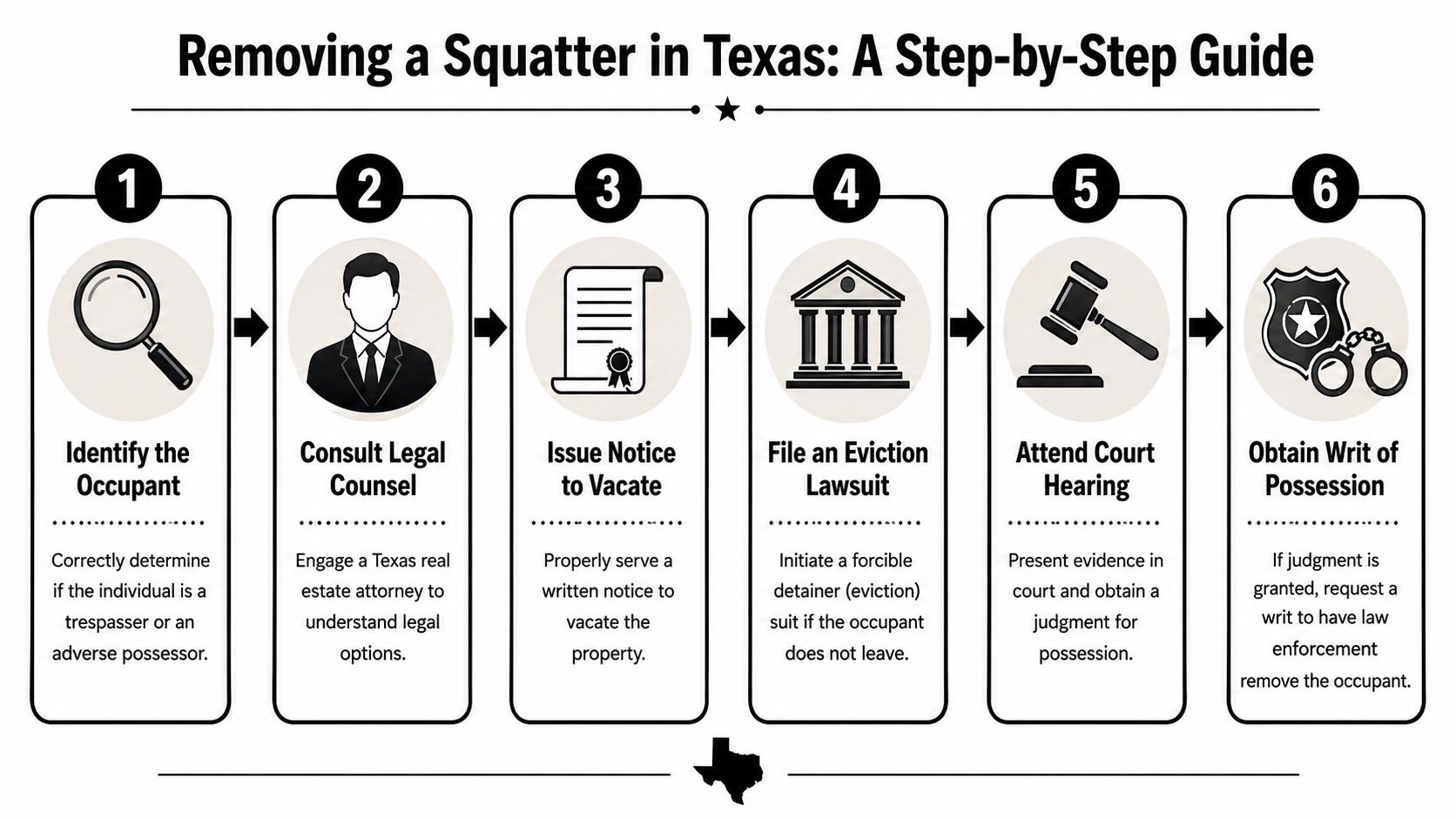
A Step-by-Step Guide to Removing a Squatter in Texas
When someone is in your property without permission, the right removal strategy depends on whether the person is a true unauthorized squatter or someone who once had lawful access.
Early in the process, many owners also review The Notice to Vacate: Requirements and Timing because a valid Texas Notice to Vacate must contain the information required before an eviction can be filed in cases that belong in civil court.
Here is the workflow property owners should follow.
Step one identifies the legal relationship
Start by sorting the occupant into one of these categories:
- Pure unauthorized occupant with no lease, deed, title, or permission.
- Former tenant or holdover tenant who once had permission.
- Claimant with paperwork who says they have ownership or family rights.
This step matters because category one may fit the new sworn-complaint process. Categories two and three often require more formal civil handling.
Step two gathers proof
Collect the documents that support your position:
- Ownership records such as deeds or title records
- Lease records if there was once a landlord-tenant relationship
- Tax records and correspondence showing who controls the property
- Photos and notes showing the condition of the property and occupancy
If you need to evaluate which path fits, The Law Office of Bryan Fagan, PLLC handles landlord-tenant and property dispute matters involving possession, lease issues, and eviction strategy under Texas law.
A video explanation can also help you visualize the process:
Step three chooses the correct path
Path A uses the SB 1333 sworn complaint
If the occupant has no lease, title, deed, or legal right, prepare the sworn complaint and contact the sheriff or constable. Be accurate. You are certifying facts under oath, so this is not the place for assumptions.
Path B uses the civil eviction process
If the person once had permission to occupy the property, or if the facts are disputed, start the traditional eviction route. That usually means serving the required notice, filing for possession in the proper court, and attending a hearing.
Don't treat a former tenant like a criminal trespasser just because the lease ended. That mistake can create its own legal dispute.
Step four follows through after judgment
If the case proceeds through civil court and you obtain a judgment for possession, the final removal tool is often a writ of possession in Texas. That document allows law enforcement to restore possession after the court has ruled.
For landlords, an eviction attorney can help keep paperwork, service, and hearing preparation on track. For tenants, this is also the stage to understand whether you still have defenses or appeal rights under the Texas rules that govern possession cases.
Proactive Measures How to Prevent Squatters on Your Property
The easiest squatter case is the one that never starts.
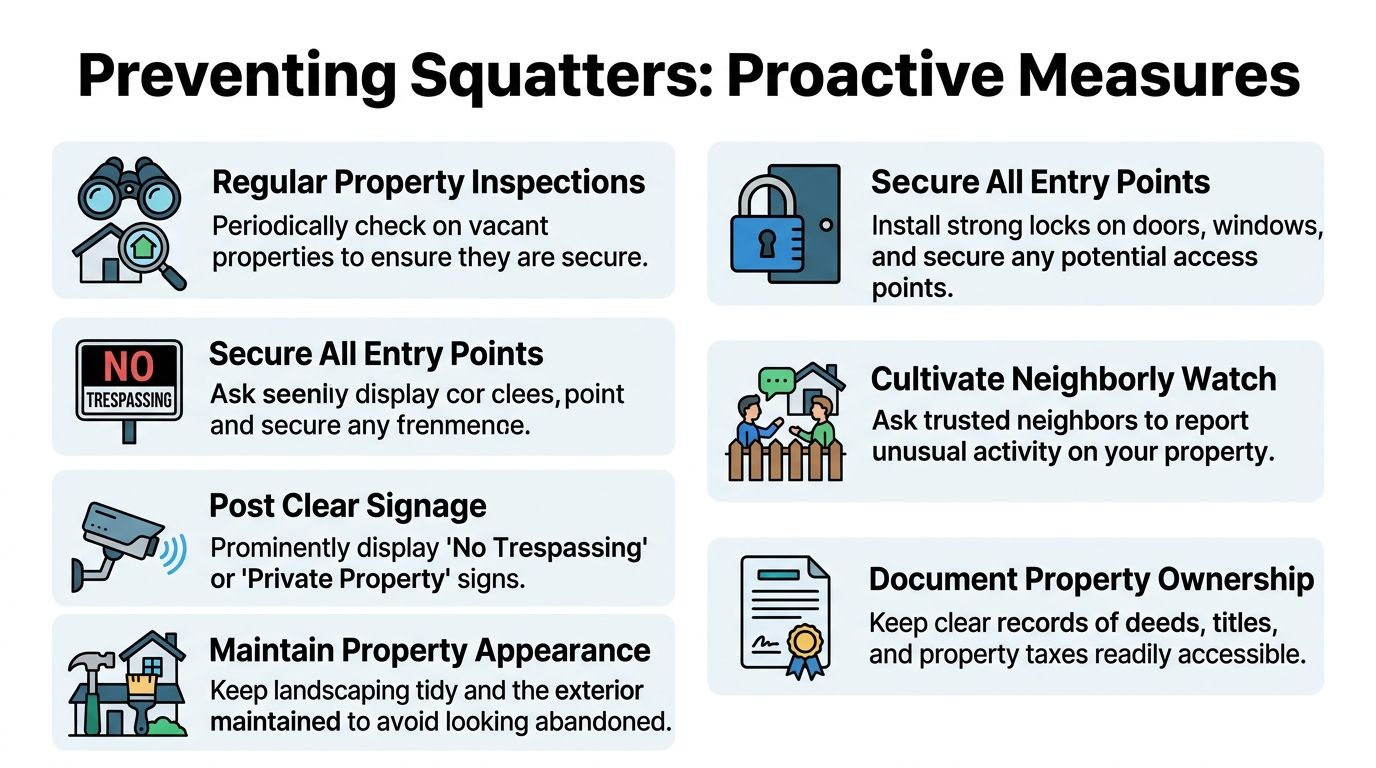
Vacant property attracts trouble when it looks ignored. Most squatters do not choose the property with the strongest owner presence. They choose the one that appears unmonitored. That's why prevention is usually cheaper, faster, and less disruptive than cleanup after the fact.
A practical prevention checklist
- Inspect regularly. Visit vacant houses, apartments, and commercial sites often enough to notice broken locks, moved items, or signs of occupancy.
- Secure every entry point. Doors, windows, gates, and secondary access points need working locks and prompt repair.
- Post visible signage. “No Trespassing” and “Private Property” signs help show that the property is not abandoned.
- Keep the exterior maintained. Cut grass, remove flyers, collect mail, and keep the property looking active.
- Use simple monitoring tools. Motion lights, cameras, and alarm signage can deter unauthorized entry.
- Ask neighbors to watch. Nearby owners and residents often notice unusual activity first.
- Keep ownership records organized. If a problem starts, quick access to deeds, tax records, and lease files helps you respond faster.
Why presentation matters
A neglected property invites stories. People begin to assume no one is watching, no one cares, and no one will act quickly. A maintained property sends the opposite message.
This same principle shows up in other professional settings too. Law firms, for example, often work to present clear signals of active service and responsive communication online. If you're interested in how firms think about visibility and trust-building, this discussion of strategies to convert law firm traffic gives useful context on why consistent presence matters.
A property that looks managed is harder to target. A property that looks forgotten is easier to test.
For landlords, these habits also support broader compliance under the Texas Property Code, because good records and regular inspections help with more than squatters. They also help with repair disputes, security deposit questions, and lease turnover issues.
Do You Have a Commercial Property Squatter
Commercial owners often feel left out of the public conversation about squatting. Most articles focus on houses, apartments, and single-family rentals. But office suites, retail spaces, warehouses, restaurants, and mixed-use properties can present the same possession problem with different legal wrinkles.
One of the biggest unresolved questions appears in this discussion of commercial property squatter issues in Texas: whether commercial property owners can use the new SB 1333 immediate-removal process, since current coverage emphasizes residential protections and offers little actionable guidance for commercial owners.
Why commercial cases can be trickier
Commercial occupancy disputes often come with more paperwork and more ambiguity. A person may claim to be a subtenant, an equipment contractor, a former operator, or someone with an agreement tied to the business. That can make it harder to determine whether the person is a true unauthorized occupant or someone whose dispute belongs in civil court.
Commercial landlords also need to pay attention to Chapter 93 of the Texas Property Code, which governs many commercial lease issues. Residential rules and commercial rules do not always line up, and that difference matters when you're deciding whether to call the sheriff, serve notice, or prepare for a possession lawsuit.
A practical decision guide for commercial owners
Ask these questions in order:
- Was there ever a commercial lease, license, or occupancy agreement? If yes, the case may not fit a fast unauthorized-occupant process.
- Is the person tied to a former tenant or business operator? That often creates factual disputes.
- Can you prove present ownership and lack of consent clearly? If not, you may need a court to sort it out.
- Is the space residential in use or clearly commercial in use? That distinction may affect how officials view the matter.
For business owners, the safest approach is usually to avoid assumptions. A warehouse occupier, for example, may look like a trespasser but still claim rights through a prior agreement with someone who once controlled the site. Even weak claims can alter procedure.
If you're a landlord, tenant, property manager, or business owner trying to sort out tenant rights, eviction strategy, or a possession dispute under the Texas Property Code, clear legal analysis at the start can save time and expense later.
If you need help with an eviction, lease issue, or rental dispute, contact The Law Office of Bryan Fagan, PLLC for a free consultation today. A Texas landlord tenant lawyer can help you determine whether your case belongs with the sheriff, in eviction court, or in a broader title or lease dispute, and give you a practical next step based on your facts.