Moving out is supposed to feel like a fresh start. Instead, many Texans end up watching the mailbox, checking their bank account, and wondering why a security deposit still hasn't shown up. Landlords feel a different kind of pressure. They know there was damage, unpaid cleaning, or a lease break, but they also know one mistake in the refund process can turn a routine move-out into a legal dispute.
That tension is exactly why texas security deposit law matters. The rules are not especially complicated once you see how they fit together, but a lot of online advice is incomplete, conflicting, or too vague to help when real money is on the line. Tenants need to know when a deduction crosses the line. Landlords need to know how to document charges and avoid a bad-faith claim under the Texas Property Code.
This guide is written the way a new client usually needs it. Plain English. Real examples. Clear steps. If you're comparing how Texas works against stricter states, this overview of California security deposit compliance for landlords is a useful contrast because California handles deposit limits very differently. For the Texas rules themselves, it also helps to keep Texas Property Code Chapter 92 in view, because that is where most residential security deposit disputes begin and end.

Your Guide to Navigating Texas Security Deposit Law
A common move-out dispute starts with a simple question. “Where is my deposit?” Sometimes the landlord already mailed it. Sometimes the landlord is still gathering invoices. Sometimes the tenant never gave a forwarding address. And sometimes the parties are arguing about whether a stained carpet, broken blind, or early move-out fee should have come out of the deposit at all.
The law gives both sides structure. It tells you what a deposit is, when it must be returned, when deductions are allowed, and what happens if someone handles the money in bad faith. It also leaves room for judgment, which is where many disputes arise. Reletting fees are a good example. The law recognizes them, but the central fight is often whether the amount was reasonable.
Practical rule: Most security deposit cases are won or lost on records, timing, and whether the parties can prove what actually happened at move-in and move-out.
For tenants, that means keeping the lease, photos, messages, and proof of your forwarding address. For landlords, it means written policies, inspection notes, receipts, and a system that keeps deposit accounting separate from day-to-day guesswork.
A strong understanding of texas security deposit law lowers stress on both sides. It also makes negotiations easier, because people tend to resolve disputes faster when they know what a judge would care about.
What a Security Deposit Is Under Texas Law
Under Section 92.102 of the Texas Property Code, a security deposit is any advance of money, other than a rental application deposit or an advance payment of rent, that is intended primarily to secure performance under a lease of a dwelling. That definition matters because landlords and tenants often use the word “deposit” loosely, even when the payment was really something else.
What counts and what does not
A security deposit is money held to protect the landlord if the tenant doesn't meet lease obligations. That can include unpaid amounts allowed by the lease or damage beyond normal wear and tear.
It is not the same thing as:
- Advance rent if you paid money for a future month of occupancy
- An application deposit tied to the rental application process
- An application fee used for screening costs
That distinction matters because different rules can apply to different types of payments. A tenant who thinks, “I already paid money up front, so that must be my deposit,” can get into trouble if the lease labels part of that payment as prepaid rent instead.
Texas does not cap the amount
Texas stands out here. Texas Property Code Chapter 92 imposes no maximum limit on the amount a landlord can charge as a residential security deposit, unlike many states that cap deposits at one to two months' rent, according to this summary of Texas security deposit law.
That doesn't mean every amount is smart. A landlord may have legal flexibility and still set a deposit so high that it scares off qualified applicants. A tenant may have the option to sign a lease with a very large deposit and still decide the deal is too risky.
What this means in practice
For tenants, the lesson is clear. Read the lease carefully before you pay anything. Confirm exactly which amounts are refundable, which are nonrefundable, and which are rent due before move-in.
For landlords, clarity on the front end prevents disputes later. Label each charge correctly. Don't mix deposit language with rent language. Don't leave handwritten changes unexplained.
A simple comparison helps:
| Payment type | Main purpose |
|---|---|
| Security deposit | Secures lease performance |
| Advance rent | Pays for occupancy |
| Application-related payment | Handles screening or application processing |
If the lease paperwork is sloppy at move-in, the move-out accounting usually becomes harder to defend.
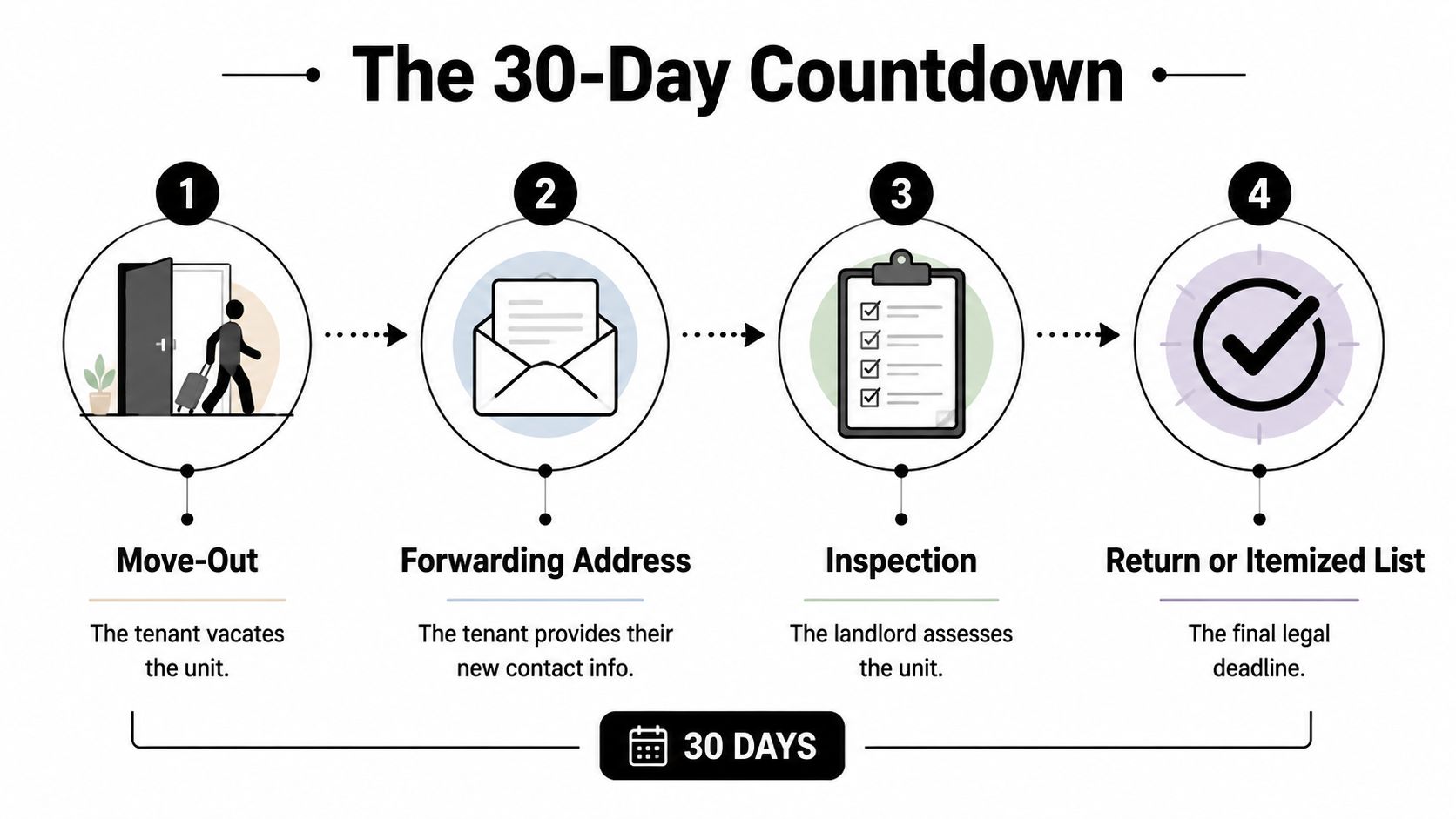
The 30-Day Countdown for Deposit Returns
A common dispute starts the same way. The tenant moves out, leaves the place clean, and waits for the deposit. The landlord believes the file is still incomplete because no forwarding address was provided in writing. Under Texas law, that missing step can change the timing of what must be sent and when.
When the clock starts
The 30-day period is tied to surrender of the premises, but tenants should not stop the analysis there. Texas law also requires the tenant to give the landlord a written forwarding address for returning the deposit.
That is one of the most misunderstood parts of Texas security deposit law. Clients often ask whether a text message, a verbal update, or a postal forwarding order is enough. Sometimes those facts help prove notice, but they are poor substitutes for a clear written forwarding address sent directly to the landlord or property manager.
For tenants, the practical rule is simple. Do not create an argument where none needs to exist.
What tenants should do before and at move-out
A tenant who wants the best chance of a prompt return should create a clean record:
- State the move-out date in writing.
- Provide the forwarding address in writing.
- Return keys and document surrender clearly.
- Keep proof of delivery, such as email confirmation, certified mail receipt, or a signed acknowledgment.
- Save photos and videos showing condition at move-out.
That record matters if the dispute later shifts from timing to deductions. For example, if there is water intrusion or flooding damage, repair costs can climb quickly, and both sides may want to compare water damage cleanup rates against the charges claimed.
What landlords should do during the 30 days
Landlords should treat this deadline as a file management issue, not a casual back-office task. Waiting until the last few days invites preventable mistakes.
A sound process usually includes confirming the date possession was surrendered, logging the forwarding address exactly as received, inspecting promptly, collecting photos and invoices, and preparing the refund or itemized accounting early. If deductions are claimed, the description should be specific enough that a tenant can tell what was charged and why.
Texas also gives landlords a useful mailing rule. If the refund or itemized description is sent by the deadline and the envelope is postmarked on or before day 30, that creates a rebuttable presumption that the landlord complied on time, as explained by the Texas Apartment Association's summary of security deposit rules.
A practical example
Assume a tenant vacates on June 1, returns the keys, and leaves the unit in good shape. The tenant never sends a forwarding address in writing, then starts asking for the deposit on June 20. The landlord may still owe the deposit, but the tenant has made the timing issue harder than it needed to be.
Change one fact. The tenant emails or mails a dated forwarding address on June 1 and keeps proof. Now the dispute is much cleaner. If the landlord misses the deadline, the tenant has a stronger record. If the landlord sends an itemized accounting by day 30, the landlord has a better defense.
That is the significant trade-off. Clear paperwork reduces room for argument.
What helps and what creates trouble
| Action | Better practice |
|---|---|
| Verbal forwarding address only | No |
| Written forwarding address with proof | Yes |
| Unclear surrender date | No |
| Documented key return and move-out date | Yes |
| Waiting until the end of the month to inspect | No |
| Prompt inspection with photos | Yes |
| Mailing without keeping proof of postmark | No |
| Sending by day 30 and keeping mailing records | Yes |
The 30-day rule sounds straightforward. In practice, the fights usually center on three details: when surrender happened, whether the forwarding address was properly given, and whether the landlord can prove timely mailing. Those are the points to lock down first.
Permissible Deductions From Your Security Deposit
Most arguments over a security deposit come down to one question. Was this a legitimate charge, or was it part of ordinary living in the property?
Texas law allows deductions for damages and charges for which the tenant is legally liable under the lease or because of a breach of the lease. It does not allow a landlord to keep part of the deposit for normal wear and tear. That line is easy to state and often hard to apply.
Normal wear and tear versus actual damage
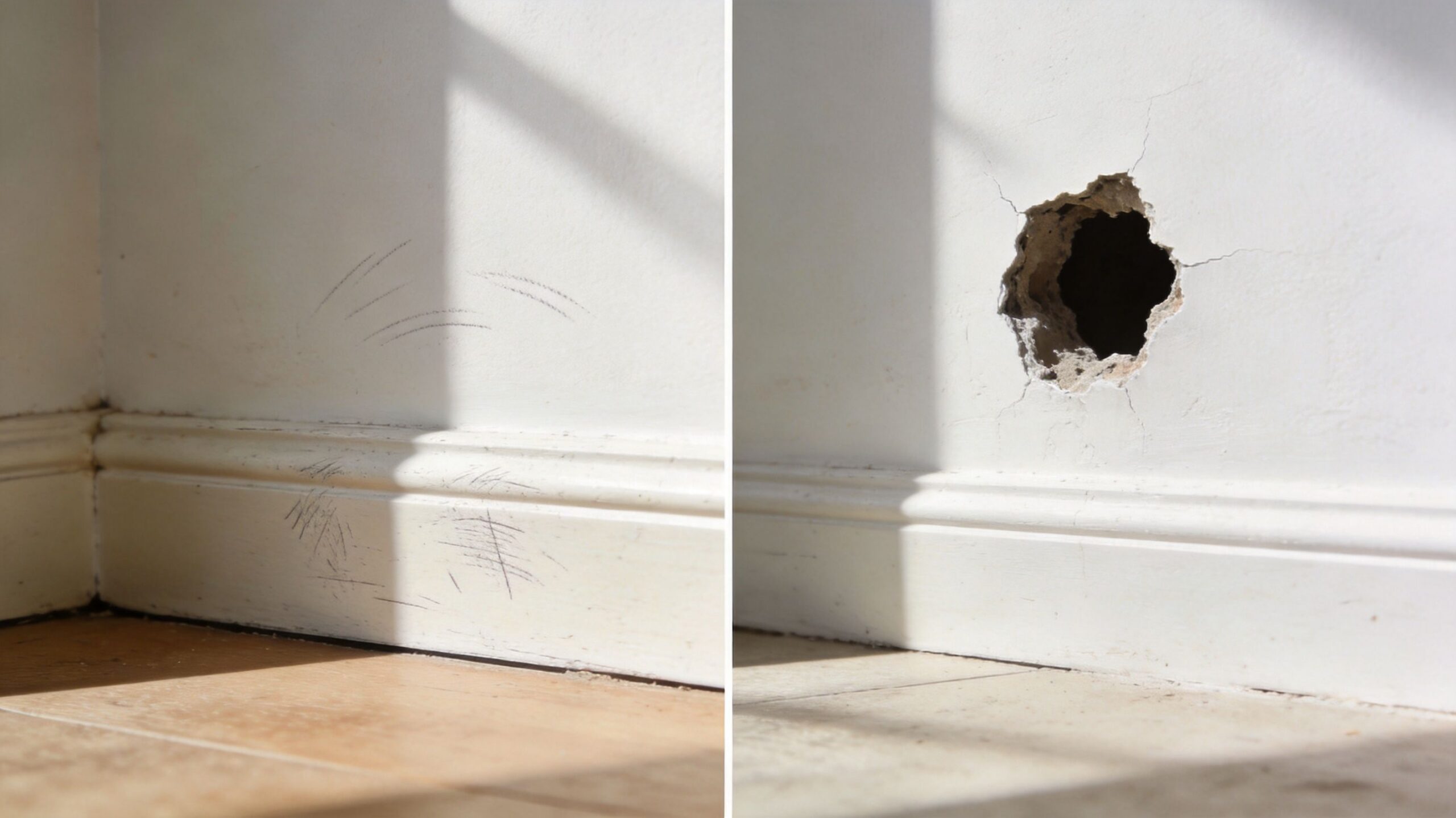
Normal wear and tear is the kind of deterioration that happens through ordinary use. Think faded paint, minor carpet wear in walking paths, loose door handles from age, or blinds that have aged over time.
Damage is different. A large hole in the wall, broken doors, heavy pet staining, missing fixtures, or burned counters point to negligence, carelessness, accident, or abuse rather than normal use.
Here is a practical comparison:
| Condition | Usually viewed as |
|---|---|
| Light scuffs on paint | Wear and tear |
| Large hole in drywall | Damage |
| Carpet flattening from normal use | Wear and tear |
| Major stains or burns on carpet | Damage |
| Aging appliance parts | Wear and tear |
| Broken shelf from overload | Damage |
The itemization issue
A lawful deduction should tell a story that makes sense. If a landlord withholds money for wall repair, there should be move-in evidence, move-out evidence, and some basis for the amount charged. If the amount looks inflated or disconnected from the condition, the deduction becomes much harder to defend.
Tenants should ask themselves:
- Was this condition already documented at move-in
- Does the charge match actual repair work
- Is the landlord charging for replacement when repair would have solved it
- Does the itemized list say enough to understand the claim
Landlords should ask the same questions before sending the accounting.
Reletting fees are allowed, but they must be reasonable
Texas introduces a separate area of confusion when a tenant breaks a lease early. A landlord may deduct a reletting fee, but the law requires the fee to be reasonable. If a court finds the amount unreasonable, the fee may be illegal, as explained by TexasLawHelp's discussion of security deposits and reletting fees.
Many landlords make avoidable mistakes here. They write a lease with a flat reletting fee, assume the contract language settles the issue, and then fail to keep any records showing why that number is justified in actual practice.
A reletting fee is easiest to defend when it looks tied to actual turnover work, actual leasing effort, and the actual cost of replacing a tenant.
For landlords, documentation should include the lease term that authorizes the charge, records of advertising, staff time, vendor invoices, and turnover expenses connected to the early departure. For tenants, warning signs include a fee that appears arbitrary, duplicate charges for the same turnover task, or a deduction that reads more like a penalty than a reimbursement.
Cleaning, repairs, and proof
Some disputes turn on what cleaning and repair costs look like. When a landlord claims substantial restoration work was required after a leak, appliance overflow, or tenant-caused water event, it helps to understand what those services typically involve. This resource to compare water damage cleanup rates can give readers general context about the kinds of line items restoration companies often use. It doesn't decide a Texas deposit case, but it can help you spot whether an invoice looks detailed and grounded or vague and inflated.
What usually works best
For tenants:
- Document move-in condition with photos and a written checklist
- Clean thoroughly before surrender
- Take move-out photos after everything is empty
- Request clarity if a deduction list is too vague
For landlords:
- Use a detailed move-in inventory
- Take date-stamped photos
- Match each deduction to a lease obligation or actual damage
- Avoid charging for ordinary aging
The strongest deposit accounting is the one a neutral reader can understand without guesswork.
A Landlord's Guide to Handling Deposits Correctly
Landlords regularly find conflicting advice online about whether Texas requires a separate bank account for security deposits. That confusion is real, and it matters because poor handling can turn a manageable dispute into a bad-faith claim.
Texas does not require a separate escrow account
Texas law does not require landlords to keep residential security deposits in a separate escrow account. It also does not require residential deposits to earn interest. That legal flexibility is one reason Texas is often seen as landlord-friendly.
But that is only the starting point. The practical question is not just, “Can I commingle the funds?” The better question is, “Can I prove I handled the deposit responsibly if the tenant challenges me?”
Why commingling creates risk
Even though separate accounts are not mandatory, commingling deposit money with operating funds can create a presumption of bad faith in a dispute if the landlord cannot prove the deposit remained available for refund. That risk is discussed in this overview of Texas deposit handling and commingling.
The problem is evidence. If the landlord's records are loose, the property changed hands, repairs were paid from multiple accounts, or the tenant's file is incomplete, the landlord may struggle to show where the money went and why the withholding was reasonable.
What prudent landlords do anyway
A separate deposit account is often the better business practice even if Texas does not force it. It reduces accounting confusion, simplifies ownership transfers, and makes refunds easier to trace.
Good deposit handling usually includes:
- Dedicated tracking for each unit and tenant
- Written move-in and move-out records
- Photos before occupancy and after surrender
- A standard deduction worksheet
- Proof of mailing for any refund or itemized statement
A property manager handling multiple units should be especially careful. The more units involved, the easier it is for records to blur together.
Ownership transfers create another pressure point
When a property is sold or management changes, the deposit still has to be accounted for. If prior records are weak, the new owner may inherit a dispute without a clean paper trail. That is one reason detailed turnover files matter even when everything seems routine.
Online advice often stops at “Texas doesn't require escrow.” In practice, that answer is incomplete. The safer question is whether your records will survive scrutiny if the tenant files suit.
A workable system
Landlords who want fewer disputes should build a process, not just rely on memory:
- Collect and label the deposit correctly at move-in
- Store lease documents and photos in one file
- Use a written inspection form at surrender
- Prepare deductions with backup documents attached
- Mail the accounting with proof and keep a copy
A strong property inspection checklist for landlords can make this much easier because it turns vague impressions into written observations tied to specific rooms, fixtures, and surfaces.
This approach also helps tenants, even though it is designed for landlords. Better records usually produce more accurate deductions and fewer surprise charges.
When Things Go Wrong Your Legal Remedies
A common deposit dispute starts the same way. The tenant moves out, leaves a forwarding address, and hears nothing. Then a partial refund arrives late, or an itemized list appears with broad labels like “cleaning,” “repairs,” or “damages” but no real explanation. That is the point where rights and deadlines start to matter.

Texas Property Code § 92.109 gives this section real force. If a landlord retains a security deposit in bad faith, the tenant can pursue the amount wrongfully withheld, a statutory penalty, and attorney's fees. The statute also puts the burden on the landlord to show the withholding was reasonable. You can review the statutory language directly in the Texas Legislature's text of Property Code § 92.109.
That bad-faith issue is where online advice often gets muddy. Missing the 30-day deadline can create serious problems for a landlord, but the larger fight is often about intent and proof. In practice, courts look closely at whether the landlord had a legitimate, documented basis for keeping the money or whether the deductions were inflated, vague, or unsupported.
Start with a demand letter
A well-written demand letter often resolves a deposit dispute faster than a heated exchange by text or phone. It also sets up the case properly if payment does not come.
The letter should state the facts in a way a judge can follow in two minutes:
- Your name and the rental address
- The date you surrendered possession
- The forwarding address you provided
- The deposit amount in dispute
- The specific reason the withholding appears improper
- A deadline for payment or a corrected accounting
Keep it plain and professional. A short, organized letter usually does more work than a long emotional one.
What evidence tends to decide these cases
In my experience, deposit cases are won with paper, photos, and timing. Broad accusations rarely carry much weight without records behind them.
| Helpful proof | Why it matters |
|---|---|
| Lease agreement | Shows deposit terms and any relevant fee language |
| Move-in and move-out photos | Helps separate actual damage from ordinary wear |
| Written forwarding address notice | Matters for the landlord's duty to send the refund or accounting |
| Itemized deduction list | Shows exactly what the landlord is claiming |
| Invoices, receipts, or repair estimates | Tests whether the deductions are real and reasonable |
If you expect the dispute to end up in justice court, this guide to small claims court for a landlord deposit dispute shows how these cases are usually organized and presented.
Here is a short video that gives more context on landlord-tenant dispute issues:
When a lawyer helps
Some deposit disputes should be handled quickly with a demand letter and a clear file of supporting documents. Others need counsel early.
Legal help becomes more useful when the landlord claims major damage without photos or invoices, when the accounting mixes several charges together so you cannot tell what was deducted, or when the deposit dispute overlaps with an early move-out, unpaid rent claim, or reletting fee. Those combined disputes raise a recurring Texas problem. A charge may appear in the lease, but the central question is whether the amount can be defended as reasonable and tied to actual facts.
For landlords, early legal review can prevent a small dispute from turning into a bad-faith claim. For tenants, legal counsel can sharpen the demand, identify which deductions are legally weak, and focus the case on the records that matter most.
The strongest position usually belongs to the party who can show dates, documents, and a consistent explanation from start to finish.
Frequently Asked Questions About Texas Security Deposits
Can a tenant use the security deposit as the last month's rent
Usually, no. A security deposit and rent serve different purposes. Unless the lease clearly allows the deposit to be applied to the last month's rent, a tenant who makes that assumption can create a new dispute and invite lawful deductions tied to unpaid rent.
What if the tenant never gave a forwarding address
That creates a timing problem, not a permanent loss of rights. A landlord is not obligated to send the refund or accounting in the usual way until the tenant provides a written forwarding address for that purpose. Even so, the tenant does not give up the right to pursue the deposit later. The better practice is to provide the address in writing at move-out and keep proof.
What counts as normal wear and tear
Think ordinary aging from ordinary use. Light paint wear, minor carpet flattening, or aging fixtures usually fit that category. Damage involves something more, such as abuse, negligence, accidents, or clear misuse. A charge is easier to question when it looks like the landlord is shifting routine maintenance onto the tenant.
Can a landlord charge a reletting fee after an early move-out
Possibly, if the lease allows it and the fee is reasonable. The legal issue is rarely just whether the fee appears in the lease. The issue is whether the amount can be defended as a fair charge rather than an improper penalty. Records matter.
What happens if the property is sold
A change in ownership does not make the deposit disappear. The deposit still needs to be accounted for, and poor records during a transfer often cause disputes. Tenants should keep copies of the lease and payment proof. Landlords and property managers should maintain clear transfer records so everyone knows who is responsible for the funds.
Does Texas require a separate bank account for deposits
No, not as a general residential rule. But a separate account is still a smart practice because it makes accounting cleaner and helps defeat claims that the money was mishandled.
Does every deduction require perfect receipts
Not every case rises or falls on a single invoice, but vague charges are risky. A landlord is in a much stronger position when each deduction is tied to a lease term, inspection record, photos, and a clear basis for the amount claimed.
Need Help With a Security Deposit Dispute
Security deposit disputes feel personal because they usually arise at the end of an already stressful landlord-tenant relationship. The good news is that texas security deposit law gives both sides a workable framework. Tenants have rights when money is withheld unfairly. Landlords have room to protect their property if they document the file and follow the Texas Property Code carefully.
The biggest mistakes are usually avoidable. Tenants often fail to provide a written forwarding address or preserve move-out proof. Landlords often rely on vague deductions, weak records, or informal accounting that won't hold up if challenged.
If you are facing a deposit fight, act early. Save your lease, photos, letters, invoices, and move-out records. Put your position in writing. If the dispute involves a questionable deduction, a missed deadline, or a bad-faith withholding claim, legal advice can save time and reduce risk.
If you need help with an eviction, lease issue, or rental dispute, contact The Law Office of Bryan Fagan, PLLC for a free consultation today.