If your landlord sells your rental home in Texas, the sale usually does not end your lease. If you have a fixed-term lease, you can generally stay until it ends, and if you rent month to month, the new owner can usually end the tenancy with proper written notice, often 30 days.
That matters because the moment a tenant hears, “We're putting the house on the market,” the same worries usually show up fast. Do you have to move? Who gets your rent? What happens to your security deposit? Can strangers start walking through your home every day?
Those are real concerns, and most disputes during a sale don't start with the closing itself. They start with confusion. One person says rent now goes to the buyer. Another says keep paying the old owner. A real estate agent wants access at inconvenient times. Nobody puts anything in writing. Then a manageable transition turns into a lease dispute, a deposit fight, or an illegal eviction problem.
Texas landlord-tenant law gives you more protection than many people realize, but those protections work best when you understand what changes, what doesn't, and what needs to be documented immediately. If you're searching for what happens if landlord sells rental property texas tenant, the short answer is reassuring. A sale usually changes who your landlord is, not whether your lease still exists.
Your Landlord Is Selling What Does That Mean for You
A common call to a Texas landlord tenant lawyer starts like this: “My landlord says the house is being sold, and I need to know if I'm about to be forced out.” Usually, the answer is no, not just because the property is listed or even because a contract has been signed.
What changes first is practical, not legal. You may start getting requests for showings, inspection access, repair touchups, or updated communication from a property manager or real estate agent. That can feel unsettling, especially if different people are contacting you and none of them seem to agree on the rules.
Practical rule: Before you follow any new instruction, confirm who actually owns the property or has authority to act for the owner. If ownership is unclear, ask for written proof and review how to confirm proof of ownership in Texas rental disputes.
A tenant in this situation often makes one of two mistakes. The first is panicking and assuming a sale equals eviction. The second is ignoring the process entirely and failing to keep records. Neither approach helps.
Instead, slow the situation down. Ask for written notice of who is selling, whether the sale has closed, where rent should be paid, and who is responsible for lease issues during the transition. Landlords should do the same in reverse. Clear written instructions reduce conflict more effectively than verbal promises ever will.
Does Your Lease Survive the Sale in Texas
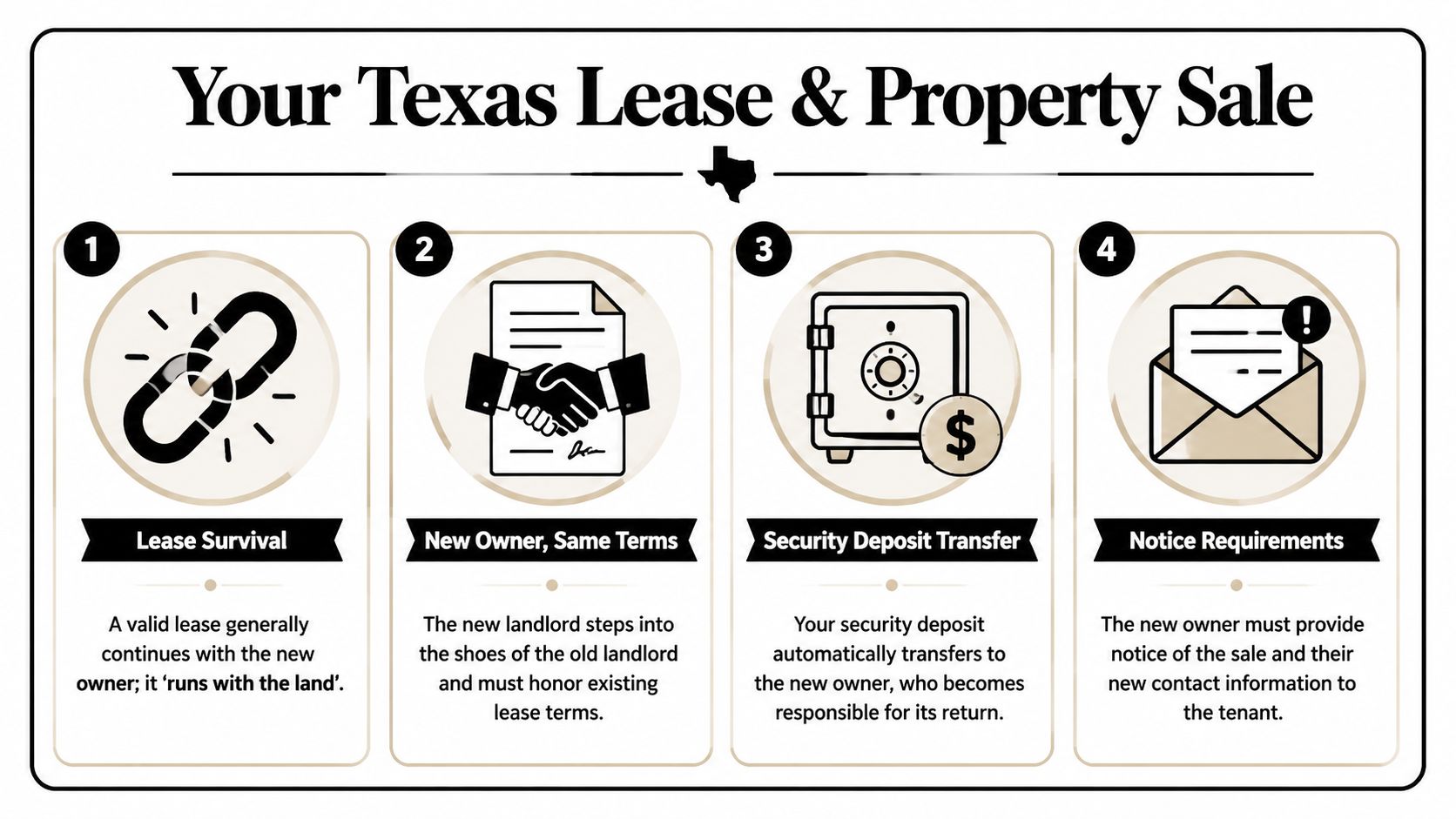
The starting point in Texas is simple. A sale does not automatically terminate a lease. The Texas State Law Library explains that the new owner must honor the existing lease unless the lease itself says it ends upon sale. It also explains the principle that a lease “runs with the land,” meaning the buyer steps into the prior landlord's position and takes on the remaining lease obligations under that agreement. You can review that rule through the Texas State Law Library's explanation of property sales and leases.
That rule fits with the practical structure of the Texas Property Code Chapter 92 overview. In plain English, the lease stays tied to the property, not just to the seller as a person. When ownership changes, the lease usually stays in place.
What lease runs with the land means in real life
Think of the lease as attached to the house. The seller can transfer ownership of the house, but the buyer usually receives it subject to the lease that already exists. The buyer doesn't get to pretend the lease disappeared just because the deed changed hands.
A simple example makes this easier to see. If you signed a 12-month lease on January 1, 2026, and the landlord sells in June, you generally keep the right to stay through the end of that lease term unless your contract has a specific sale-termination clause. The buyer takes the place of the old landlord for the rest of the lease.
The most important question is not “Was the house sold?” It's “What does the lease actually say about a sale, termination, and notice?”
The exception tenants and landlords often miss
There is an important exception. Some leases contain language allowing termination or changes if the property is sold. Those clauses aren't the default rule, but if they are written into the lease, they can control the outcome.
That is why both sides should review the agreement closely, not rely on memory. Look for terms dealing with:
- Sale clauses that mention early termination if ownership changes
- Notice language explaining how written notice must be delivered
- Move-out provisions that address timing, obligations, and final inspections
- Addenda or renewals that may have changed the original lease terms
Landlords sometimes assume a standard sales contract overrides the lease. It usually doesn't. Tenants sometimes assume every lease survives unchanged no matter what. That also isn't always true. The lease itself, plus Texas law, controls the answer.
Fixed-Term vs Month-to-Month Leases During a Sale
The type of tenancy you have changes the timeline more than anything else. A fixed-term tenant and a month-to-month tenant may live in the same duplex, hear about the same sale on the same day, and still have very different rights after closing.
The clearest side-by-side explanation comes from this Texas guide on selling a leased property. It notes that fixed-term leases usually survive the sale, while month-to-month tenancies can generally be ended with proper written notice, often 30 days. It also explains a special foreclosure situation where, if the purchaser intends to occupy the residence, termination may require 90-day notice.
Lease Type Protections During a Property Sale
| Scenario | Fixed-Term Lease | Month-to-Month Lease |
|---|---|---|
| Ordinary sale during tenancy | Usually remains in effect through the lease term | Can usually be ended with proper written notice |
| Buyer wants the property vacant | Buyer generally must wait unless the lease allows earlier termination | Buyer can usually end tenancy by following notice rules |
| Timing focus | Lease end date controls | Notice period controls |
| What the tenant should review first | Sale clause, early termination clause, written notices | Written notice terms, rent period, move-out date |
| Common mistake | Assuming a buyer can cancel the lease immediately | Assuming a sale gives no notice rights at all |
If you have a fixed-term lease
A fixed-term lease gives the most stability during a standard sale. If your lease runs for a defined period, the new owner usually takes the property subject to that lease. For a tenant, that means you should keep paying rent, following the lease, and documenting all communications. For a buyer, it means due diligence before closing is critical because you may be buying an occupied property with enforceable lease obligations.
What usually works here is precision. Get written confirmation of who the new landlord is, where rent goes, and where maintenance requests should be sent. What usually does not work is accepting a casual verbal statement like, “You'll probably need to be out soon.”
If you are month to month
A month-to-month tenant has less predictability after a sale. The new owner can generally end the tenancy with proper written notice, often measured in 30-day increments under Texas practice and the lease terms.
That doesn't mean the tenant can be forced out overnight. It means the owner still has to follow the legal notice process. The exact wording of the notice, the delivery method, and the move-out timing all matter.
A practical checklist for month-to-month tenants:
- Check the notice date: Make sure the written notice clearly states when the tenancy ends.
- Match the lease terms: Some leases spell out how notice must be delivered and when it becomes effective.
- Keep paying rent correctly: Don't assume notice means rent obligations vanish immediately.
- Preserve all messages: Save emails, texts, and letters in case the timeline is later disputed.
Foreclosure changes the analysis
Foreclosure sales follow different rules from ordinary sales. In that setting, if the purchaser intends to occupy the home, the tenant may be entitled to 90-day notice to vacate. That's a major reason not to treat every “sale” as legally identical.
A tenant's rights often turn on one detail people skip over in conversation: was this a normal sale, or was it a foreclosure?
Handling Rent Security Deposits and Notices
The biggest fights after a sale usually involve money and mixed instructions. A tenant gets told to pay the old owner “for now,” then gets a late notice from the new owner. Or the tenant moves out months later and hears that the security deposit was never transferred. Those are avoidable problems if everyone documents the handoff correctly.
Texas guidance is clear that after a sale, the new owner becomes responsible for the tenant's security deposit, even if the old owner failed to transfer the funds. It also makes clear that written notice of the new owner's contact information and deposit responsibility matters because poor recordkeeping is where these disputes tend to grow. You can read that explanation in this Texas discussion of tenant rights during a property sale.
For related deposit rules, tenants and landlords should also review Texas security deposit law.
What tenants should do right away
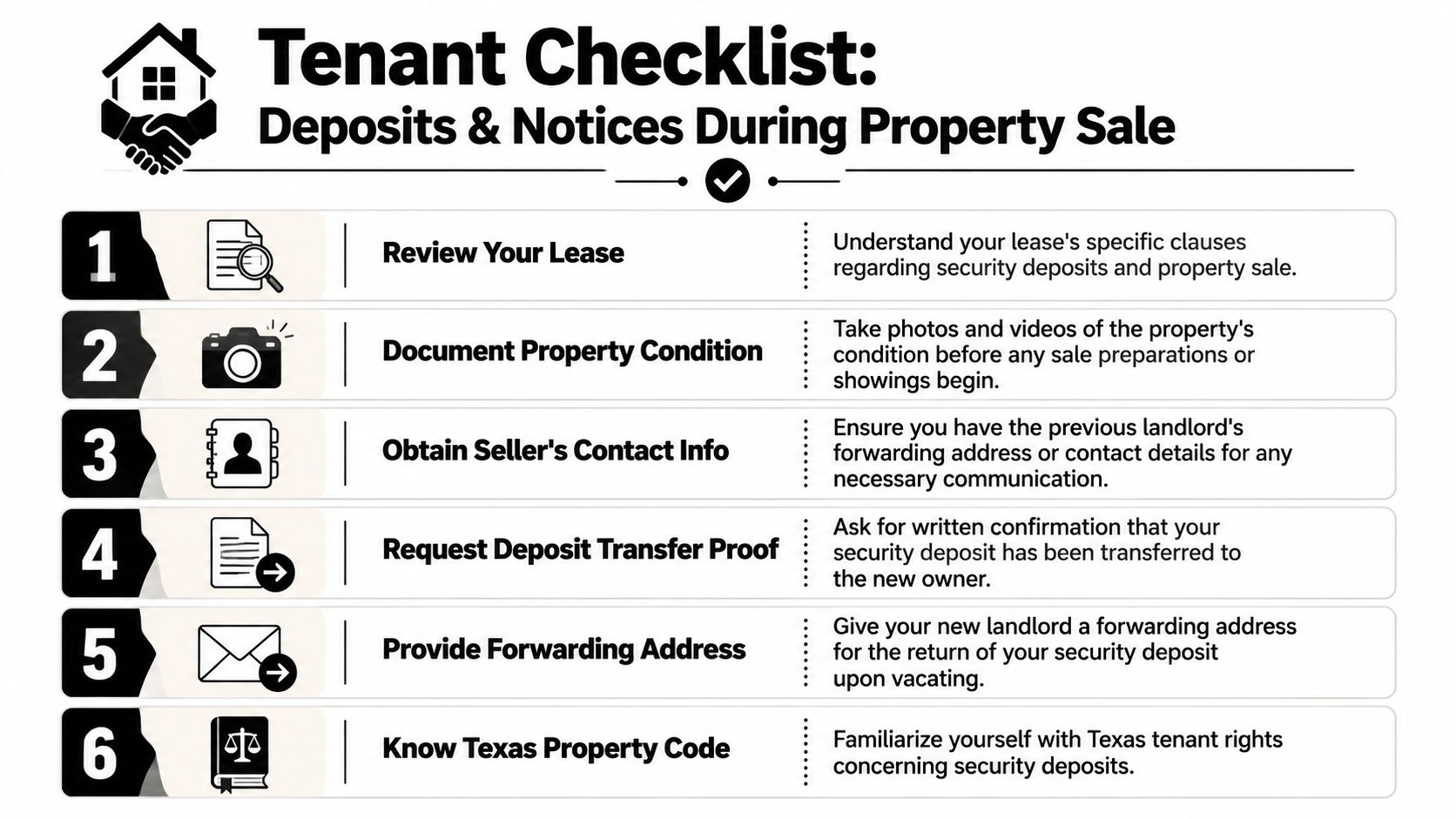
When ownership changes, don't wait for problems to appear. Build your paper trail immediately.
Review your current lease
Look for deposit terms, notice requirements, and any language about sale or transfer.Ask where rent should be paid now
Get the new payment instructions in writing before sending money anywhere.Request the new owner's full contact information
You need a name, mailing address, and a reliable way to send formal notice.Keep proof of every payment
Save bank confirmations, screenshots, receipts, and any written rent ledger.Preserve move-in records
Keep your original lease, deposit receipt, photos, and condition forms.
What landlords and buyers should not overlook
The seller, buyer, and property manager need to treat the lease transition like a file transfer, not a handshake. That means rent records, deposit records, repair history, notices, and contact information should be passed over cleanly.
A practical handoff should include:
- The exact closing date so the tenant knows when ownership changed
- Written rent instructions so the tenant doesn't accidentally pay the wrong party
- Deposit documentation showing the amount collected and any existing deductions claimed
- Open maintenance issues so the new owner knows what has already been reported
Client advice I give often: Never pay rent based on a phone call alone when a property has just changed hands. Wait for written instructions tied to the actual owner or authorized manager.
The dispute that shows up later
Many deposit disputes after a sale aren't really about the deposit itself. They are recordkeeping disputes. The old owner says the buyer received the file. The buyer says no deposit money came over. The tenant is stuck in the middle.
That's why tenants should save every document from the start of the tenancy through move-out. Landlords should do the same. The side with organized records usually has a much easier time resolving the conflict.
Navigating Property Showings and Your Right to Privacy
A home sale creates tension between two legitimate interests. The owner wants to market the property. The tenant still has a right to live there without constant disruption. Most conflicts happen when people stop respecting that balance.

Quiet enjoyment still matters during a sale
Selling the property does not give the landlord or real estate agent unlimited access to the home. Tenants still have privacy rights and the right to peaceful use of the property. In practice, the lease often controls how entry works, including notice requirements, permitted reasons for entry, and whether an agent may enter on the landlord's behalf.
The legal phrase many tenants hear is quiet enjoyment. In everyday terms, it means you rented a place to live in, not a place where people can come and go whenever a listing appointment appears on someone's calendar.
What works best is a written showing plan. Set preferred time windows. Require advance notice in the method required by the lease. Confirm who will attend. That protects the sale process and reduces the sense that the tenant has lost control of the home.
What reasonable notice looks like
Texas law does not give one single universal script for every showing situation, so the lease language matters. Reasonable notice usually depends on the contract and the facts. A landlord who texts the tenant before each showing and keeps appointments within agreed hours is in a stronger position than one who provides entry to the agent when they arrive.
Tenants should not block every reasonable showing. Landlords should not schedule showings as if the tenant's daily life is irrelevant.
A balanced approach usually includes:
- Advance written notice using the method the lease allows
- Reasonable hours rather than repeated surprise requests
- Limited frequency so the property does not feel like a revolving door
- Clear supervision over agents, inspectors, and contractors entering the unit
If the sale process is becoming disruptive, this explainer may help put the entry issue in context:
When entry crosses the line
A landlord or agent who enters without proper notice, shows up repeatedly outside agreed times, or pressures the tenant to leave for every showing is asking for trouble. So is a tenant who refuses all access no matter what the lease says.
If there's no written showing protocol, create one before the relationship gets worse.
When disputes start, document each incident. Save the text messages. Note the date and time of each entry. Take photos if property is disturbed. Written records matter much more than competing memories later.
When to Get Help from a Texas Landlord-Tenant Lawyer
Some sale-related problems can be solved with better communication. Others shouldn't be handled informally because the risk is too high. If the issue involves a threatened lockout, a bad-faith notice to vacate, withheld deposit funds, repeated illegal entry, or confusion about whether a foreclosure rule applies, legal guidance can save you from making the wrong move at the wrong time.
One area where people often need help is foreclosure. In that setting, a tenant on a fixed-term lease may be entitled to 90-day notice to vacate if the purchaser intends to occupy the residence. That protection is different from the ordinary sale rules discussed earlier, which is why the type of transaction matters so much.
Warning signs that need legal review
You should strongly consider speaking with counsel if any of these are happening:
- You received a notice to vacate that doesn't match your lease and nobody can explain why.
- The new owner demands immediate move-out even though you believe the lease is still in effect.
- Rent instructions changed more than once and you're worried about being accused of nonpayment.
- Your security deposit records are missing or disputed after the sale.
- Showings or entries have become intrusive and your written objections are being ignored.
- Repairs are being deferred because of the sale and basic living conditions are affected.
Why self-help often backfires
Tenants sometimes stop paying rent to “wait until ownership is sorted out.” That can create a separate default issue. Landlords sometimes try to pressure a tenant out early because the buyer wants vacant possession. That can lead to claims for wrongful conduct.
The safer route is to evaluate the documents first. Review the lease, the notices, the ownership timeline, and the payment history. If necessary, have a lawyer send a clear demand letter or assess whether a court filing is needed.
For people trying to resolve these issues efficiently, one option is to speak with The Law Office of Bryan Fagan, PLLC about lease enforcement, notice disputes, deposit claims, or sale-related landlord-tenant conflicts under the Texas Property Code.
A practical decision rule
If the dispute affects your housing stability or your money, and the other side is already acting as if the answer is obvious, get the documents reviewed before you react. The early stages of a sale dispute are where preventable mistakes happen most often.
A tenant who understands the lease, tracks the notices, and preserves records is in a much stronger position. A landlord or buyer who documents the transition carefully is less likely to end up defending a dispute that could have been avoided.
If you need help with a lease issue, property sale dispute, notice to vacate, illegal entry problem, or security deposit conflict, contact The Law Office of Bryan Fagan, PLLC for a free consultation today. A Texas landlord tenant lawyer can review your lease, explain your tenant rights under the Texas Property Code, and help you protect your home and finances before a sale turns into a larger legal problem.