A broken lock. No hot water. Water spreading under the sink. You've called, texted, emailed, and maybe even stopped by the office. Still nothing.
That's where many Texas tenants get stuck. They know something is wrong, but they don't know what counts as a legal repair issue, what kind of notice matters, or whether pushing harder will just make the landlord angry.
If you're searching for what to do if landlord ignores repair requests texas, the most important thing to know is this: Texas law gives tenants real remedies, but only if you follow the process carefully. This isn't just a customer service problem. It's a legal issue governed by the Texas Property Code.
The good news is that a calm, organized paper trail often changes the situation fast. And if it doesn't, that same paper trail puts you in a much stronger position to enforce your tenant rights.
Your Landlord Is Ignoring You What Now
When a landlord stops responding, tenants often make one understandable mistake. They keep trying the same informal approach.
A text message feels fast. A phone call feels personal. But if the dispute ends up in court, those methods often create avoidable problems. Texts get deleted. Calls turn into “he said, she said.” A landlord can claim they never got the message, or that your message didn't clearly explain how serious the condition was.
The first shift is mental. Stop treating this like an argument. Treat it like a record.
If your child's bedroom window won't lock and you send “please fix ASAP,” that may show frustration, but it may not clearly show the exact condition, when you reported it, and how it affects health or safety. A written repair notice does that. A tracked delivery method does even more. It creates proof that's hard to dispute later.
Practical rule: If you may need a judge to care about the problem later, start documenting it now.
That means saving photos, keeping copies of every message, and writing down dates. It also means continuing to pay rent if you want to preserve the strongest repair remedies available under Texas law. Many tenants hurt their own case by withholding rent too early.
You have more influence than you may think, but Texas makes you earn that influence by following the rules. Once you understand the steps, the situation becomes much less chaotic.
The First Step The Power of Proper Notice
Texas repair cases often turn on one question. Did the tenant give proper notice in a way the law recognizes?
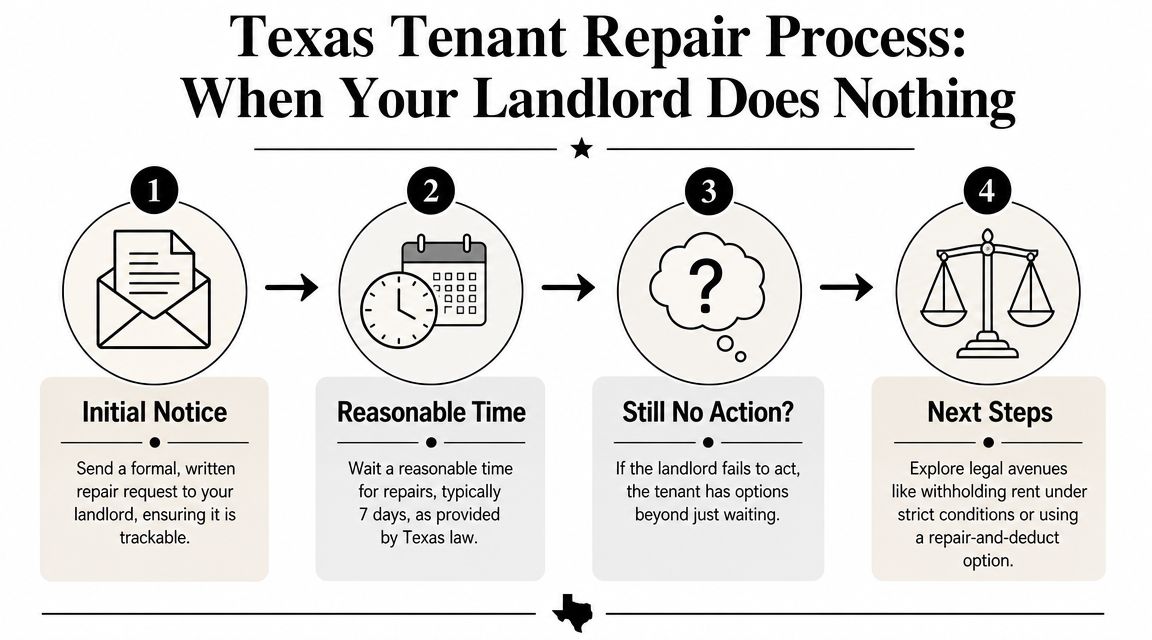
Texas tenants generally must be current on rent, must give written notice of the defect to the person or place where rent is normally paid, and must be dealing with a condition that materially affects health or safety before statutory repair remedies activate. Using a trackable first notice like certified mail can remove the need for a second notice and reduce delay risk, as explained by Texas Law Help's guide to repair rights.

What proper notice should include
Your notice doesn't need fancy legal language. It does need to be clear.
Include these basics:
- Your full name and rental address so there's no confusion about the unit.
- The date of the notice so the timeline is easy to prove.
- A specific description of the problem such as “front door deadbolt does not lock” or “water leaking from ceiling in bedroom.”
- How the condition affects health or safety if it does.
- A request for prompt repair in writing.
Good notice sounds like this: the bathroom has no working hot water, the problem started on a certain date, it affects the family's ability to bathe safely, and you are requesting repair immediately.
Bad notice sounds like this: “stuff in apartment still broken.”
What counts and what usually doesn't
The law is focused on conditions that materially affect health or safety. In plain English, that usually means problems that create a real risk to an ordinary tenant living in the unit.
A broken lock is different from a chipped countertop. A sewage leak is different from a cabinet door that won't close. A serious electrical hazard is different from a cosmetic paint issue.
Here's a simple comparison:
| Condition | More likely to support a repair remedy | Less likely to support a repair remedy |
|---|---|---|
| Security issue | Broken locks | Loose interior doorknob with no safety impact |
| Water issue | No usable water or dangerous leak | Minor drip with no meaningful safety effect |
| Heat or electricity | Electrical hazard or no heat in winter | Nonessential outlet issue |
| Appearance | Condition causing unsafe living conditions | Cosmetic stains or worn finishes |
Why certified mail matters
A certified or otherwise trackable first notice can save time. If the first written notice is sent in a trackable way, Texas practice often allows you to avoid the second-notice step that otherwise slows the process.
That's why I usually tell tenants to think like this: don't send the cheapest notice. Send the notice you may later need to prove.
If you want a practical walkthrough of how to prepare that request, this guide on how to request repairs from landlord is a useful starting point.
Understanding Your Rights Under the Texas Property Code
Texas repair rights are narrower than many tenants expect. Chapter 92 of the Property Code protects you when three things line up: you are current on rent, you gave notice to the place or person who normally receives rent, and the condition materially affects health or safety.
That framework matters for a second reason. It also determines whether a landlord can later argue you were just complaining, not invoking a legal repair duty.
A common example shows the difference. If your front door lock fails and you promptly give written notice, you are dealing with a condition tied to personal safety. If the landlord ignores that notice, the risk is not just inconvenience. It can become a stronger repair claim, and if the landlord suddenly starts pressuring you after you complain, your written record helps connect the timing.
By contrast, a torn window screen or worn cabinet hinge may still deserve repair, but those issues usually do not carry the same legal weight under Chapter 92. The statute is aimed at unsafe living conditions, not every maintenance frustration in a rental.
What “reasonable time” means in practice
Texas law uses a reasonableness standard, not one universal deadline. The right question is whether the landlord acted promptly for the kind of problem involved.
Serious conditions call for fast action. Broken locks, dangerous wiring, no water, or no heat during cold weather should get immediate attention and repair efforts beginning quickly. Less urgent problems can take longer, especially if a part must be ordered or a vendor is unavailable. Still, delay has limits. A landlord cannot stall for weeks by sending vague texts like “working on it” while the condition continues.
Tenants often make costly mistakes at this stage. Some stop paying rent out of frustration. Some rely on phone calls they cannot prove. Some wait too long to document worsening conditions, then face a lease violation notice that appears right after a repair complaint. In practice, retaliation and repair disputes often overlap.
Why the statute matters beyond the repair itself
Chapter 92 gives tenants a legal path, but it also creates a paper trail that can protect you if the landlord changes tactics after you complain. Keep copies of every notice, photo, text, email, work order, and rent receipt. If management raises rent, threatens eviction, refuses to renew, or starts issuing sudden rule violations after a serious repair request, those dates matter.
Courts and lawyers look for sequence and proof. A tenant who followed the statute usually has a better position than a tenant who only has a verbal complaint and a vague memory of when the problem started.
For a plain-English breakdown of the statute, review this guide to Texas Property Code Chapter 92 landlord repair and notice rules. Landlords who handle their own properties should also understand the compliance side, and Texas rental compliance for DIY landlords gives a useful outside overview.
What to Do When Your Landlord Still Does Nothing
Some landlords answer quickly and still fail to act. Others go silent. Others keep saying a vendor is “coming next week.” At that point, the issue is no longer just the repair. It's whether you're building a case or losing ground.
First decide whether the problem is urgent
Urgency changes what a reasonable wait looks like.
Use this practical lens:
- Emergency conditions include no heat in winter, no water, broken locks, or electrical hazards. These should trigger immediate attention and work beginning within hours or by the next business day under the Texas attorney guidance discussed earlier.
- Non-emergency conditions still matter, but they usually require patience and careful follow-up.
- Cosmetic or convenience issues may justify a request, but they don't always support the strongest legal remedies.
If your landlord has done nothing after a reasonable time, send a second written notice unless your first notice was already sent by certified mail, registered mail, or another trackable method.
What the second notice does
The second notice serves two jobs. It tells the landlord the problem remains unresolved, and it shows a court that you gave another chance before escalating.
That notice should be short and direct. State the date of your first notice, confirm the condition still exists, and request immediate action. Attach updated photos if the problem has worsened.
Don't rewrite the story every time. Keep the facts consistent, chronological, and easy to follow.
What works and what usually backfires
Tenants often ask whether they should just stop paying rent. In most cases, that's the wrong move. Texas Law Help warns that withholding rent is not a safe substitute for the statutory repair process, and it can expose you to landlord claims if you do it outside the statute.
A better framework is this:
| Option | Potential benefit | Real risk |
|---|---|---|
| Send second notice | Strengthens your record | Takes more time |
| Keep documenting conditions | Preserves evidence | Doesn't force action by itself |
| Threaten legal action carefully | May prompt response | Empty threats can weaken credibility |
| Stop paying rent on your own | Feels like leverage | Can trigger eviction or counterclaims |
The strongest cases are rarely the loudest. They are the most organized.
Your Legal Options for Forcing Repairs in Texas
Once you have given proper notice, waited the required time, and the landlord still has not fixed a condition that affects health or safety, the question changes. It is no longer just, "How do I get this repaired?" It becomes, "Which remedy solves the repair problem without creating a bigger housing problem for me?"
That choice matters.
A tenant who pushes for repairs often gets results eventually. The risk is what follows. Some landlords fix the issue and then start looking for reasons to make the tenancy uncomfortable. That is why I tell tenants to choose a remedy based on both the repair itself and the likely reaction afterward. If you plan to stay, your recordkeeping needs to be even tighter.
Option one is ending the lease
Texas law may allow you to terminate the lease if the legal requirements are met and the landlord still refuses to repair a qualifying condition. This is often the most practical choice when the unit is unsafe, the relationship has broken down, or you no longer trust the landlord to address the next serious problem.
The benefit is straightforward. You get out.
The cost is also real. Moving on short notice can strain your budget, replacement housing may be limited, and some landlords dispute whether the termination was proper. Before you leave, keep copies of every notice, every photo, proof of rent payments, and your move-out communication. If the landlord later claims you broke the lease without cause, those documents are your defense.
Option two is filing suit for repairs, rent reduction, and damages
If you want to remain in the property, court may be the better option. Under the Texas tenant repair remedies discussed earlier in the article, a tenant may be able to ask the court to order repairs, reduce rent, and award damages, court costs, and attorney's fees when the statutory requirements are met.
This route takes more effort, but it can put the dispute on a record the landlord cannot ignore. It also changes the posture of the case. You are no longer sending requests into a void. You are asking a judge to review what the landlord knew, when the landlord knew it, and what happened after notice.
If you are close to that point, a well-organized Texas demand letter for landlord disputes can help pull your timeline, evidence, and requested relief into one clear document before filing suit.
Option three is using self-help remedies only with extreme caution
Tenants often ask whether they can hire someone, fix the problem, and deduct the cost from rent. In Texas, that can go badly if the statute does not clearly permit what you are doing or if you miss a required step.
The legal risk is only part of it. There is also a practical risk. If your contractor makes the condition worse, causes damage, or repairs the wrong thing, the original dispute can turn into an argument about unauthorized work, access, or property damage. A step that feels satisfying in the moment can hand the landlord a new claim.
A hard truth: the option that feels strongest under stress is not always the option that protects you best under Texas law.
This video gives a useful general overview of how landlord-tenant disputes can escalate and why process matters:
Choose a remedy with retaliation in mind
Repair cases do not always end when the repair is made or the lawsuit is filed. In practice, many of the hardest cases become two cases at once. First, the repair dispute. Second, the landlord's response after the tenant forced the issue.
Watch what changes after you escalate. Save inspection notices, emails, texts, lease violation warnings, rent ledger entries, and maintenance updates. If the landlord suddenly becomes aggressive, those records help show whether the conduct is ordinary management or something more targeted.
That is the practical trade-off. Forcing repairs may solve the immediate hazard, but it can also expose a pattern of pressure that matters later. Tenants who keep calm, stay organized, and document the aftermath usually stand in a much stronger position than tenants who only focus on the broken condition itself.
Protecting Yourself from Landlord Retaliation
Many tenants stay quiet because they're afraid the landlord will punish them for speaking up. That fear is real, and Texas law addresses it.
Section 92.331 of the Texas Property Code describes unlawful landlord retaliation. The Texas State Law Library notes that examples can include rent increases, lease non-renewal, or harassing inspections within six months of a repair request, and tenants can sue for damages if they prove retaliation, as discussed in the Texas State Law Library repairs guide.

What retaliation can look like
Retaliation isn't always dramatic. Sometimes it's a clear threat. Sometimes it looks like a pattern that starts right after a repair complaint.
Watch for signs such as:
- A sudden rent increase that appears tied to your complaint rather than ordinary lease terms.
- A refusal to renew that arrives right after you pressed for health or safety repairs.
- Repeated inspections or entries that feel designed to intimidate rather than address a real management need.
- Service reductions or pressure tactics that begin after your written request.
Not every unpleasant landlord action is illegal retaliation. A landlord may still enforce a lease for legitimate reasons. The question is whether the action appears to punish you for making a good-faith repair request.
How to document retaliation the right way
Retaliation claims are won with chronology.
Create a file that includes:
- Your repair requests with dates and delivery proof.
- Photos and videos of the condition.
- All landlord responses, including texts, emails, notices, and voicemail summaries.
- A timeline showing what changed after the complaint.
- Witness names if neighbors, roommates, or contractors saw the problem or the landlord's reaction.
A simple timeline is powerful. If you requested repairs in writing, then received a rent increase notice, then began getting repeated inspection notices, a judge can evaluate that sequence much more easily than a stack of unsorted screenshots.
Save the small things. Retaliation cases often turn on patterns, not one dramatic event.
How to respond without making things worse
Stay factual. Don't threaten. Don't stop paying rent unless a lawyer tells you the statute clearly allows your next step.
Instead, answer in writing. If the landlord sends a suspicious notice, ask for the business reason behind it. If there is one, they may say so. If there isn't, their silence may matter later.
This is also the point where contacting a Texas landlord tenant lawyer or, in some cases, an eviction attorney can be especially helpful. Repair disputes are stressful. Retaliation layered on top of them can turn a manageable case into a fast-moving one.
Get Help from a Texas Landlord-Tenant Lawyer
Repair disputes in Texas are winnable, but they're procedural. The law can protect you when a landlord ignores serious conditions, but only if you've preserved the right evidence, used the right notice, and chosen the right remedy at the right time.
That's true whether you live in Houston, Dallas-Fort Worth, Austin, San Antonio, or a smaller Texas community. A local dispute still turns on the same core issues under the Texas Property Code. Was the condition serious enough? Was notice delivered correctly? Did the landlord get a reasonable chance to act? Did retaliation follow?
If the facts are getting messy, don't guess. A Texas landlord tenant lawyer can help you avoid the mistakes that often weaken otherwise strong claims.
If you need help with a repair dispute, lease issue, retaliation claim, or eviction matter, contact The Law Office of Bryan Fagan, PLLC for a free consultation today. The firm helps tenants and landlords across Texas understand their rights, evaluate their options, and take practical action with confidence.