Dealing with a landlord dispute can turn your home into a source of stress fast. You ask for a serious repair, report a code issue, or speak up about lease rights, and then the landlord suddenly raises the rent, cuts off an amenity, or sends a notice to vacate. If that sounds familiar, you're not overreacting. In many situations, Texas law treats that kind of conduct as unlawful retaliation.
Landlord retaliation texas tenant rights explained becomes more than a search phrase. It becomes a practical question about timing, proof, and what you should do next. Texas tenants have meaningful protections under the Texas Property Code, but those protections work best when you understand exactly what counts as a protected action, what landlord behavior crosses the line, and how to document your case before the paper trail disappears.
Are You Facing Unfair Landlord Retaliation
A common pattern looks like this. A tenant reports a broken lock, leaking ceiling, or mold concern. The request is reasonable, and it's made in good faith. Instead of fixing the problem, the landlord becomes hostile. A few weeks later, the tenant gets a rent increase, loses access to a parking space, or receives a notice that the lease won't continue.
That feels personal because it often is. The tenant did something the law allows, and the landlord answered with pressure. Many renters freeze at that point. They worry that speaking up again will make things worse, especially if they're already dealing with unsafe conditions, children in the home, or the threat of eviction.
What retaliation often looks like in real life
Sometimes the landlord never says, “I'm doing this because you complained.” Most retaliation cases are subtler than that.
- Repair request followed by pressure: You ask for repairs, then the landlord starts threatening move-out.
- Complaint followed by new restrictions: You report a code issue, then suddenly you're told you can't use part of the property you previously used.
- Protected conduct followed by nonrenewal tactics: You assert your rights, and the landlord starts building a record designed to push you out.
For many tenants, retaliation also overlaps with harassment. If your landlord is using threats, intimidation, or repeated interference to force you out, this guide on landlord harassment in Texas may help you spot the larger pattern.
You don't need to guess whether something feels “bad enough.” If a landlord's behavior changed after you exercised a legal right, the timeline matters.
The good news is that Texas law doesn't leave tenants helpless. It gives you a framework to challenge retaliatory conduct, and that framework becomes especially important during the first several months after your protected action.
What Is Landlord Retaliation Under Texas Law
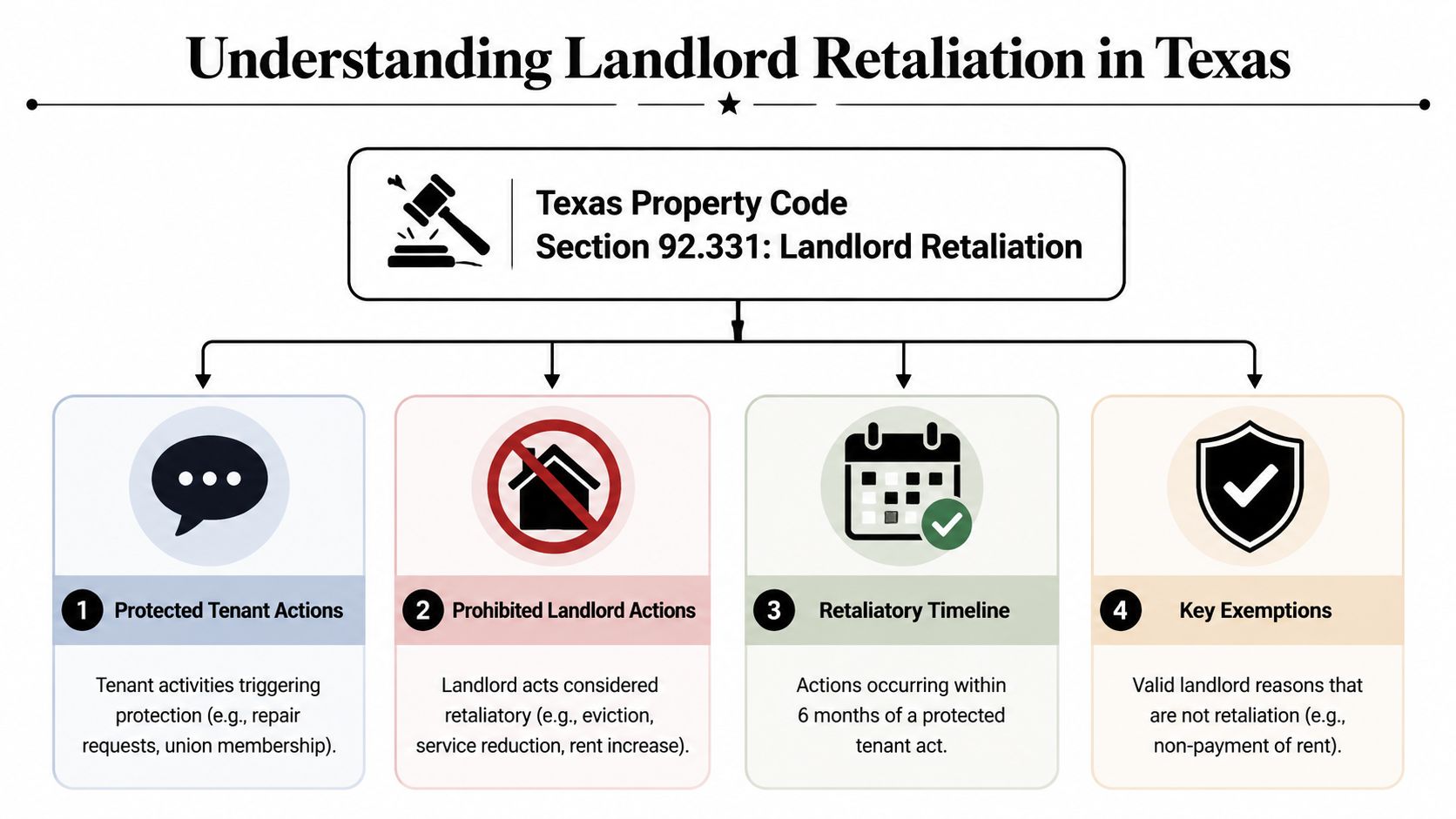
Under Texas Property Code Section 92.331, a landlord may not retaliate against a tenant for exercising rights under a lease, a municipal ordinance, or federal or state law, or for giving notice to repair under Chapter 92. Texas tenant guidance also explains that the presumption of retaliation lasts for 6 months from the tenant's protected act, and during that period the landlord is generally barred from evicting, denying use of the premises, decreasing services, increasing rent, ending the lease, or otherwise interfering with lease rights, according to the Texas State Law Library guide on retaliation.
What retaliation means in plain English
Retaliation is punishment for protected conduct. In landlord-tenant cases, that usually means a tenant did something lawful, then the landlord responded with an adverse action designed to pressure, punish, or remove that tenant.
The legal issue isn't whether the landlord seemed rude. The issue is whether the landlord took a step the law prohibits because the tenant exercised a right.
Examples of adverse action can include:
- Eviction activity: Filing or threatening an eviction after a protected complaint
- Rent changes: Raising rent in a targeted way after the tenant asserted rights
- Reduced services: Cutting back access, maintenance, or benefits tied to the tenancy
- Interference with possession: Blocking the tenant's use of the premises or lease rights
Why the 6 month window matters
The most important feature of this law is the 6-month presumption. That window gives tenants and landlords a defined period to evaluate conduct and evidence. If the landlord takes an adverse action within that time after the tenant's protected act, the law gives the tenant a strong starting point.
That doesn't mean the tenant wins automatically. It means the case starts from a place that requires the landlord to explain a legitimate, non-retaliatory reason.
Practical rule: In these cases, timing is often the first thing a court looks at. The closer the landlord's action is to your repair request or complaint, the more seriously the retaliation issue needs to be taken.
What this law does not do
This law doesn't make a tenant eviction-proof. A landlord can still try to act for valid reasons allowed by the lease or law. The key question becomes whether the landlord can separate that reason from your protected conduct.
That's why retaliation claims are rarely won by emotion alone. They're won with dates, documents, and a clear cause-and-effect story.
Which Tenant Actions Are Legally Protected
Many tenants suspect retaliation but aren't sure whether what they did counts as a protected act. That question matters. If your action falls within the statute, you may have a stronger legal position than you think.
Texas guidance on retaliation recognizes several categories of protected tenant conduct. A tenant's action must be in good faith, which means honest and genuine, not false or manufactured.
Protected actions that usually trigger legal protection
Here are the most common protected acts:
- Good-faith exercise of lease or legal rights: If you do something your lease allows, or something state, local, or federal law permits, that can be protected.
- A repair notice: Asking the landlord to fix a condition can be protected, especially when the request is documented.
- A housing code complaint: Reporting a problem to a government agency or a qualifying civic or nonprofit entity can qualify.
- Organizing or joining a tenant group: Collective tenant activity can also be protected.
If you're trying to understand the broader framework behind these protections, this overview of Texas Property Code tenant rights is a useful companion.
What tenants often get wrong
Some renters assume that any conflict with a landlord creates a retaliation claim. It doesn't. The law protects specific actions, and the details matter.
A few common problem areas:
- Improper rent withholding: Tenants often think stopping rent is a safe pressure tactic. In many cases, it creates more risk than an advantage.
- Verbal complaints with no record: A phone call may matter, but it's harder to prove later.
- Bad-faith accusations: If a tenant invents a condition or exaggerates a violation on purpose, that weakens the case sharply.
The strongest protected acts are the ones you can prove with a date, a written message, and a clear reason.
A practical checklist before you act
Before sending a complaint or repair request, pause and make the record stronger:
- Put it in writing. Email, text, portal message, or letter is better than a phone-only complaint.
- Describe the issue clearly. State what's wrong, where it is, and why it needs attention.
- Keep copies. Save screenshots, confirmations, and responses.
- Stay accurate. Don't overstate the problem.
- Think through related lease issues. If your situation may also involve moving out early, this guide on legal rights for early lease termination can help you evaluate that separate question.
A protected act is the starting point. The next issue is whether the landlord responded in a way the law treats as retaliation.
Common Examples of Landlord Retaliation
Retaliation doesn't always arrive as a dramatic lockout or a blunt threat. Often it shows up as a series of “coincidences” that begin right after the tenant complains.
One tenant reports a serious plumbing problem. A short time later, the landlord announces that this tenant's rent is going up, even though no similar change is being applied the same way to others. Another tenant contacts the city about unsafe wiring, and then suddenly loses access to assigned parking or laundry facilities. A third renter joins neighbors to complain about conditions, and the landlord responds by refusing to renew only their lease.
Protected Tenant Acts vs. Landlord Retaliation
| Protected Tenant Action (Your Legal Right) | Potential Landlord Retaliation (Illegal Action) |
|---|---|
| Requesting repairs in good faith | Filing or threatening eviction soon after |
| Reporting a housing code issue | Reducing services or access to the premises |
| Exercising rights under the lease or law | Interfering with lease rights |
| Organizing with other tenants | Ending or refusing to continue the lease in response |
Patterns that deserve a closer look
Some of the most common retaliation scenarios include:
- The sudden notice to vacate: The tenant asked for repairs, and the landlord moved quickly toward removal.
- The selective rent increase: Rent goes up right after a complaint, and the timing feels too convenient.
- The service squeeze: Pest control stops, parking access disappears, maintenance requests go unanswered, or common-area privileges get pulled.
- The paper campaign: The landlord starts issuing warnings over minor matters that were ignored before the protected conduct.
A retaliation claim usually becomes stronger when the landlord's conduct changed after the tenant spoke up, not before.
What doesn't automatically count as retaliation
Not every negative landlord action is illegal retaliation. If the tenant hasn't paid rent, violated the lease, damaged the property, or created another legitimate problem, the landlord may still have legal options.
That's the part many tenants miss. The law doesn't protect a tenant from all consequences. It protects the tenant from being punished for exercising a legal right.
The practical question is whether the landlord can show a real reason that stands on its own, separate from your complaint or repair request.
How to Prove Landlord Retaliation in Texas
Proving retaliation starts with one basic idea. Build the timeline before the landlord builds theirs.

Texas retaliation claims are time-bounded and causation-driven. Under Texas Property Code § 92.331, protected conduct includes the good-faith exercise of lease or statutory rights, a repair notice, a housing-code complaint to a government or qualifying civic or nonprofit entity, or organizing a tenant group. If the landlord then takes adverse action within six months, such as filing eviction, ending the lease, increasing rent, reducing services, or denying use of the premises, the law creates a rebuttable presumption of retaliation, as explained by Texas Law Help's retaliation article.
Start with the key documents
The best retaliation file is usually simple, organized, and dated. You're trying to show a sequence.
Gather these first:
- Your protected act: Repair requests, complaint emails, texts, portal submissions, letters, or tenant-group messages
- The landlord's response: Notices to vacate, rent increase notices, warning letters, lease termination notices, or messages cutting services
- Condition evidence: Photos, videos, inspection reports, or maintenance records
- Witness support: Statements from neighbors, roommates, or other people who saw the condition or the landlord's reaction
If you have a paper letter, keep the envelope. If you sent something through a portal, capture the confirmation screen. If the landlord called instead of writing, make a dated note of what was said right after the conversation.
Build a short, clear timeline
Courts and lawyers want dates, not a cloud of frustration. A clean timeline often does more work than a long narrative.
Try this format:
- Date of problem: What happened in the unit
- Date you complained or requested repair
- Date of any follow-up communication
- Date the landlord took adverse action
- What changed after that
Keep each line short. The point is to show cause and effect.
Case-building note: The strongest tenant proof package is often the repair request or complaint trail paired with the later adverse action notice.
Don't hand the landlord an easy defense
Landlords often answer retaliation claims by pointing to a different reason. Sometimes that reason is real. Sometimes it's a record created after the fact.
Be honest about weaknesses in your case:
- Were you late on rent?
- Did you violate a pet rule or occupancy limit?
- Did the landlord warn you about something before your complaint?
- Did other tenants receive the same rent notice?
If there's a valid non-retaliatory reason, that can change the analysis. If there isn't, the landlord may struggle to overcome the presumption.
This video gives a practical look at handling tenant-landlord conflict and documentation issues:
A workable next step
Many tenants start by sending a written demand that the retaliation stop. Others prepare for Justice Court if eviction is threatened. Some also consult a Texas landlord tenant lawyer, a tenant-rights clinic, or a local legal aid program to review the evidence file before the hearing. The right move depends on how urgent the threat is and whether the landlord has already filed suit.
Your Legal Remedies Against Retaliation
If a court finds that the landlord retaliated illegally, the law can provide more than just validation. It can provide actual relief.
Texas guidance explains that a successful tenant may be entitled to one month's rent plus $500, reasonable moving costs, attorney's fees and court costs, and injunctive relief that prevents the landlord from taking certain actions, according to the retaliation guidance already discussed above. Those remedies matter because retaliation often causes immediate disruption, not just legal frustration.

What these remedies mean in real life
A legal remedy sounds abstract until you attach it to a real problem.
- Actual damages: These can include losses caused by the retaliation, such as relocation-related harm if you had to move because of unlawful conduct.
- One month's rent plus $500: This is a statutory penalty recognized in the retaliation guidance.
- Moving costs: If retaliation forced a move, those costs can become part of the case.
- Attorney's fees and court costs: A tenant with a valid claim may be able to recover the cost of enforcing rights.
- Injunctive relief: A court may order the landlord to stop a specific retaliatory act, such as a rent increase or another interfering action.
Evidence affects remedies
The better your records, the easier it is to connect the landlord's conduct to your losses. That's why documenting the condition of your unit and your personal property matters. If retaliation disrupts your housing or damages your belongings during a forced move, a renter-friendly tool to track items in your rental can help you keep an inventory that supports a later claim.
If you're considering a formal complaint alongside court action, this guide on how to file a complaint against a landlord can help you think through that process.
Relief in a retaliation case isn't only about money. Sometimes the most urgent goal is stopping the landlord before the pressure campaign becomes a completed eviction.
What works and what usually doesn't
What works is disciplined, documented action. Written complaints. Saved notices. Organized timelines. Fast response to court papers. Credible testimony.
What usually doesn't work is self-help. Tenants who stop paying rent without legal grounds, damage the property, or answer retaliation with retaliation often make their own cases harder. A judge is more likely to focus on the clean record.
Protect Your Rights with a Texas Tenant Lawyer
Retaliation cases move on paper and deadlines. That's why tenants often lose good claims by waiting too long, throwing documents in a drawer, or assuming the landlord “wouldn't really go through with it.” Some landlords back down when challenged. Others file fast and force the tenant to respond in court.
When legal help becomes especially important
You should take the situation seriously if any of these are happening:
- You received a notice to vacate: Even if you believe the notice is retaliatory, don't ignore it.
- The landlord cut services or access: Changes to utilities, parking, laundry, gates, or other premises use can become part of the case.
- You're being accused of a lease violation after a complaint: This is a common landlord defense pattern.
- You need emergency strategy: Fast legal advice can help you decide whether to negotiate, defend, sue, or do both.
A practical action plan
If you think retaliation is happening, take these steps now:
- Preserve every document. Save notices, emails, texts, and screenshots.
- Write out the timeline. Keep it short and date-based.
- Stay compliant with your lease where possible. Don't make the landlord's defense easier.
- Respond to legal notices quickly. Silence is expensive in landlord-tenant court.
- Get your file reviewed. A tenant-rights attorney, legal aid organization, or a firm such as The Law Office of Bryan Fagan, PLLC can assess whether the timing and evidence support a retaliation defense or affirmative claim.
A good eviction attorney or Texas landlord tenant lawyer doesn't just quote the Texas Property Code. They look for the pressure points that matter in court. Was your repair request clear? Did the landlord act within the protected period? Is there a real non-retaliatory reason, or just a story built after the complaint?
You don't need to sort that out alone while also trying to keep a roof over your head. If your landlord is pushing back because you exercised your tenant rights, the safest move is usually to act early, not after the case has already turned against you.
If you need help with an eviction, lease issue, or rental dispute, contact The Law Office of Bryan Fagan, PLLC for a free consultation today.