You moved out. You cleaned. You returned the keys. You expected your deposit back, and instead you got silence or a deduction list that doesn’t make sense. Or you’re the landlord who walked into a unit and found damage, unpaid charges, or a tenant who now says every deduction is illegal.
Either way, the stress is real. Money is tied up, tempers rise fast, and bad internet advice makes it worse.
If you’re dealing with a small claims court landlord deposit problem in Texas, stop reading generic articles written for other states. Texas has its own rules, its own deadlines, and its own court system for these cases. That matters because the wrong move early can weaken a claim that should have been simple.
Your Guide to Navigating Security Deposit Disputes
You moved out, expected your money back, and got a deduction list that looks inflated. Or you are the landlord staring at photos, invoices, and a tenant who insists every charge is ordinary wear and tear. In Texas, both sides lose cases this way. They rely on assumptions instead of proof.
Security deposit disputes usually turn on a few practical points. What condition was the unit in at move-in and move-out? Was the tenant’s forwarding address provided in writing? Do the deductions reflect actual damage, unpaid rent, or other lawful charges under the lease and the Texas Property Code? Justice Court judges focus on documents and timing, not who sounds more offended.
Texas law is also harsher than many people realize, especially for landlords who withhold money without following the rules. A bad-faith withholding claim can turn a small deposit fight into a much larger judgment. Tenants need to understand that pressure point. Landlords need to respect it before a routine dispute becomes an expensive one.
Do not build your case from random advice written for other states. California rules do not decide a Texas deposit case, and internet forums are full of bad guidance. Start with a Texas-specific overview of security deposit laws in Texas so you know the actual deadlines, the proof that matters, and the remedies a Justice Court can award.
The fastest way to lose a deposit case is to argue from general fairness. In Texas Justice Court, the stronger side usually has the better paper trail.
The 30-Day Rule Your Rights and Duties Under Texas Law
A Texas deposit case often turns on one date. If you get that date wrong, you can lose even when the facts otherwise favor you.
Under Texas Property Code § 92.103, a landlord must either return the security deposit or send a written itemized list of deductions within 30 days after the tenant surrenders the premises and provides a written forwarding address. For tenants, that deadline is a pressure point. For landlords, it is a liability trap.
The bad-faith issue is what makes this section matter. If a landlord keeps money in bad faith, Texas law allows the tenant to seek the withheld amount, statutory damages, and attorney’s fees under Texas Property Code § 92.109. That can turn a routine deposit dispute into a much larger Justice Court claim.
What starts the 30-day clock
The written forwarding address matters more than tenants expect.
If you are a tenant and you moved out cleanly but never sent a forwarding address in writing, you gave the landlord an argument. Maybe not a winning argument, but an argument the judge now has to sort through. Do not create that problem for yourself. Send the address by email and certified mail if possible. Keep a copy. If you need a model, use a Texas demand letter for a security deposit dispute that clearly states your forwarding address and what you want returned.
If you are a landlord, do not play games with this requirement. Once you receive surrender and a written forwarding address, calendar the deadline that day. Thirty days passes fast. Judges hear excuses about bookkeeping delays, missing invoices, and staff turnover all the time. Those excuses do not override the statute.
Bad faith is the issue that changes the value of the case
Tenants often assume they only need to prove the landlord kept money. That is not enough if you want the stronger remedies. You want proof that the withholding was not just mistaken, but done in bad faith. Missed deadlines, vague charges, no itemization, and deductions that obviously look like normal wear and tear can all push the case in that direction.
Landlords should read that sentence twice.
A sloppy file can look like bad faith. A late accounting can look like bad faith. Charging to repaint an aging wall with minor scuffs can look like bad faith. In Justice Court, the judge usually decides this from documents, dates, and whether the deductions make sense on their face.
What Texas usually allows a landlord to deduct
Texas law permits deductions for unpaid rent, damage beyond normal wear and tear, and other charges allowed by the lease and supported by the facts. It does not permit a landlord to use the deposit to shift ordinary turnover costs to the tenant.
Here is the practical line judges look for:
| Item | Normal Wear and Tear (Not Deductible) | Actual Damage (Potentially Deductible) |
|---|---|---|
| Walls | Minor scuffs, fading, small nail holes if ordinary | Large holes, gouges, unauthorized painting, patched damage that requires repair |
| Carpet | Traffic wear, flattening from ordinary use | Burns, heavy stains, tears, pet damage beyond ordinary use |
| Fixtures | Aging, ordinary deterioration, mechanical failure from normal use | Broken fixtures caused by impact, misuse, neglect, or abuse |
| Cleaning | Routine turnover cleaning from ordinary occupancy | Unusual filth, trash removal, biohazard cleanup, or lease-based cleaning charges with support |
| Appliances | Wear from age and normal use | Broken shelves, cracked glass, missing parts, or misuse-related damage |
The same facts look different depending on which side prepared properly
Take a common dispute. The tenant lived there for two years. The paint is dull. The carpet is worn in the hallway. The stove needs ordinary cleaning. A landlord who deducts for full repainting, carpet replacement, and general cleaning without strong support is inviting a bad-faith argument.
Change the file, and the case changes. The landlord has move-in photos, move-out photos, a lease that allows specific charges, repair invoices, and a timely itemized accounting showing unpaid rent and clear tenant-caused damage. That landlord is in a far better position. The tenant may still dispute the amount, but the landlord no longer looks careless or punitive.
What each side should do now
If you are a tenant:
- Send your forwarding address in writing. Do it even if the landlord already has your new address.
- Count the 30 days carefully. Save proof of move-out, key return, and delivery of the forwarding address.
- Read the itemization like a judge would. Vague labels like “repairs” or “cleaning” are weak. Ask what was repaired, why, and what proof supports the charge.
- Focus on bad-faith facts. Late notice, no notice, inflated charges, and deductions for ordinary wear matter.
If you are a landlord:
- Treat the deadline as fixed. Prepare the accounting before the 30th day, not on it.
- Separate normal wear from damage. If you charge for both as one lump sum, you weaken your credibility.
- Support each deduction. Use photos, invoices, ledger entries, and lease language.
- Make the itemization readable. A judge should be able to understand it in under two minutes.
The 30-day rule is not a technicality. For tenants, it provides an advantage. For landlords, it sets the standard the court will use to judge whether the withholding was lawful or expensive.
Before You File Strategic Steps to Resolve Your Dispute
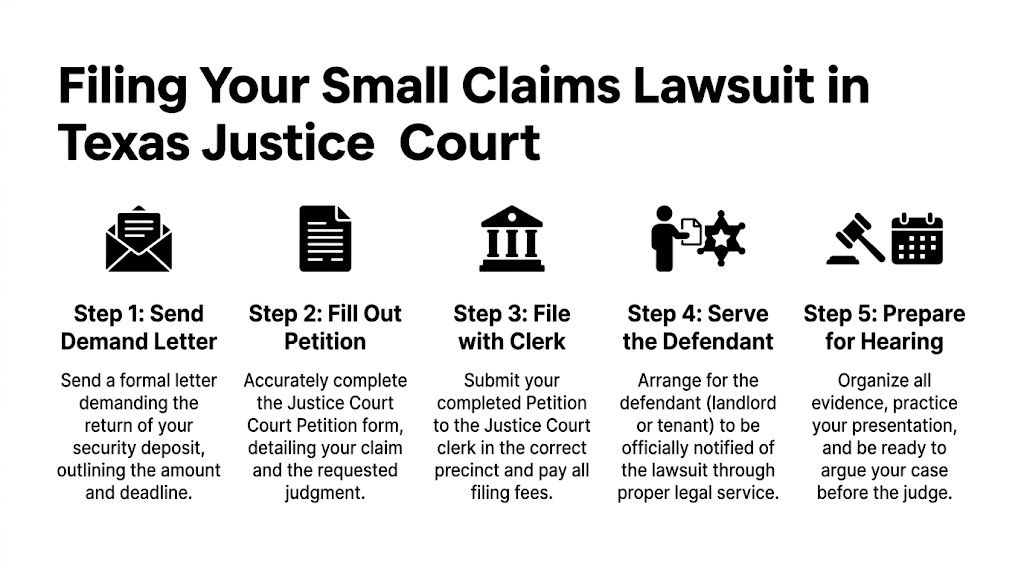
Most deposit disputes should start with one disciplined move. Send a written demand letter. Don’t rant. Don’t threaten nonsense. State the facts, cite the law, and give a firm deadline to fix the problem.

A good demand letter does two things at once. First, it gives the other side one last chance to resolve the matter without court. Second, it creates a clean paper trail that a judge can read in minutes.
If you’ve never written one before, use a structure like the one in this Texas demand letter guide, then tailor it to your facts.
What your demand letter should say
Keep it direct. A useful demand letter usually includes:
The basic timeline
State when the tenancy ended, when keys were returned, and when the forwarding address was provided.The amount in dispute
Identify the deposit amount and any amount already returned, if applicable.The legal issue
Cite Texas Property Code §§ 92.103 to 92.109 if the dispute involves failure to refund, failure to itemize, or withholding in bad faith.Your demand
Ask for the deposit, proper accounting, or correction of improper deductions.A firm response deadline
Give a specific date by which the issue must be resolved.Notice of next action
State that you’ll file in Texas Justice Court if the matter isn’t resolved.
What not to do
A bad letter can hurt you. Avoid these mistakes:
- Don’t exaggerate: If you overstate the law, you lose credibility.
- Don’t insult the other side: Judges notice when one party acted reasonably and the other acted emotionally.
- Don’t rely on phone calls only: Conversations disappear. Documents don’t.
For many people, this is the point where emotions are highest. That’s exactly why the letter should sound calm.
Ask for what the law supports. Nothing more, nothing less. That tone wins more often than anger does.
A short explainer can also help if you want to hear the process described in plain language:
When negotiation makes sense
Not every case belongs in court. Sometimes a tenant just wants the accounting corrected. Sometimes a landlord has legitimate deductions but presented them poorly. If the other side responds with documents, not excuses, negotiation may save everyone time.
That said, don’t negotiate against yourself. If the deadline passed and the other side still won’t produce a lawful explanation, move forward with filing. Endless back-and-forth usually helps the less organized party, not the stronger case.
A quick model for both sides
For a tenant, the letter might say the forwarding address was provided, the statutory deadline has passed, and the landlord must return the wrongfully withheld amount or face suit.
For a landlord, the response might attach the itemized deductions, receipts, photos, and lease provisions supporting each deduction. If part of the withholding was weak, fix it early. A partial concession before filing can prevent a much bigger problem later.
Filing Your Lawsuit in Texas Justice Court
You moved out, gave a forwarding address, and the 30 days passed. Or you kept part of the deposit for real damage, sent an itemized deduction list, and now the other side is threatening suit anyway. In Texas, both disputes usually land in the same place. Justice Court.
Texas calls its small claims venue Justice Court, usually before the local Justice of the Peace. For a security deposit case, that is often the right court because the process is designed for ordinary parties and the dollar limits fit most deposit fights. Nolo’s Texas Justice Court deposit overview explains the basic fit between deposit disputes and Justice Court procedure.
Choose the right court first
File in the correct Justice Court precinct. In many deposit cases, that will be the precinct tied to the rental property or the defendant’s location under the venue rules.
Get this wrong and you waste time. Clerks may reject the filing, or the defendant may challenge venue and slow the case down before the judge reaches the deposit issue.
Draft a petition that sounds like a case, not a rant
Your petition should read like a clean timeline.
State who the parties are, identify the property, give the move-out date, say when the forwarding address was provided, and explain what happened with the deposit. If you are a tenant, say whether the landlord failed to return the deposit, failed to send an itemized list, or withheld money in bad faith. If you are a landlord, say what deductions were made, why they were allowed under the lease, and when the accounting was sent.
Then state exactly what you want the court to award.
For tenants, that may include the deposit amount, any statutory damages allowed by Texas law, court costs, and other permitted relief. For landlords, it may mean a take-nothing judgment against the tenant or a counterclaim if the damage exceeded the deposit and you have proof.
File with the clerk and pay the required fees
Justice Court filing fees are usually manageable, but they vary by county and service method. Call the clerk or check the court’s posted fee schedule before you go. Budget for the filing fee and for service on the defendant.
Keep every receipt and a file-stamped copy of what you submitted.
Clerks can tell you how to file. They cannot tell you what to allege, what damages to request, or whether your bad-faith claim is strong enough. That part is your job.
Service decides whether your case can actually proceed
A filed petition does nothing until the other side is properly served.
Use an authorized method. Follow the court’s rules exactly. If service is defective, the hearing may be postponed, or the case may stall altogether. Tenants make this mistake by assuming a demand letter counts as service. Landlords make it by ignoring service and assuming they can explain everything at the hearing after the deadline has passed.
Do not treat service like paperwork trivia. It is what gives the court authority over the defendant.
Know the issue that changes the value of the case
Texas deposit cases often turn on one question. Was the withholding a good-faith dispute, or was it bad faith?
That matters to both sides. A tenant who proves bad faith can ask for far more than the deposit itself under Texas law. A landlord who cannot explain deductions with documents walks into that presumption problem. On the other hand, a landlord with a lease clause, photos, invoices, and a timely accounting is in a much safer position than a tenant who only says, “the place was clean.”
Justice Court judges see this pattern all the time. They want a short timeline, the lease, the notices, the accounting, and photos that match the deductions.
Prepare for a fast hearing
Justice Court moves faster than many people expect. Once the case is on file and service is complete, the hearing date can come up quickly.
Use that time well:
- Write a one-page timeline: Dates matter in deposit cases.
- List your exhibits in order: Lease, forwarding address notice, itemized deductions, photos, receipts, demand letters, text messages, and proof of payment.
- Calculate your request carefully: Tenants should not guess at damages. Landlords should not defend deductions they cannot support.
- Practice a two-minute explanation: Judges reward clarity.
The practical approach for tenants and landlords
If you are the tenant, file only after you can prove the forwarding address and the deposit violation. If you are the landlord, do not assume the judge will fill in the gaps for you because the tenant caused damage. You must prove the deductions were lawful and timely.
The party who treats Justice Court like a document case usually has the advantage. The party who treats it like a chance to vent usually does not.
Preparing Your Evidence for a Winning Case
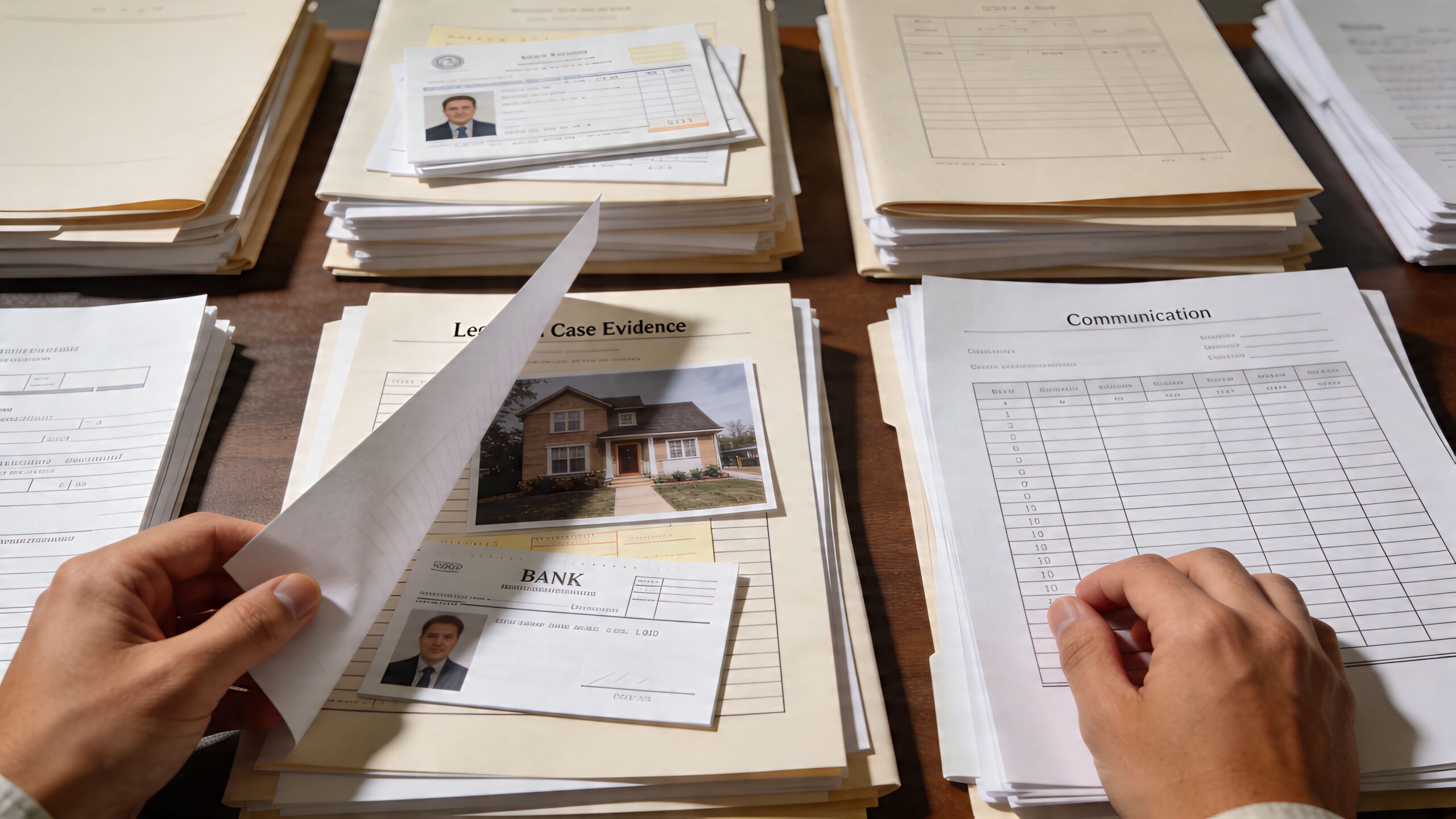
The party with the cleaner evidence usually controls the hearing. Not the louder party. Not the more offended party. The one with the timeline, the documents, and the photos.
One verified source notes that documentation is essential in Justice Court, tenants must provide a written forwarding address to trigger the clock, and success rates for well-documented cases often exceed 50%, according to this discussion of deposit dispute outcomes and documentation. That doesn’t mean a good file guarantees a win. It means proof moves the case.
If you’re the tenant
A strong tenant file tells one story. “I gave notice, moved out, provided my forwarding address, and the landlord either failed to comply or made improper deductions.”
Useful evidence usually includes:
- The signed lease: This shows the deposit terms and any move-out obligations.
- Move-in photos and move-out photos: Judges like visuals because they cut through argument.
- Written forwarding address notice: This is often the most important document in the file.
- Your demand letter and proof of delivery: It shows you tried to resolve the matter before filing.
- The landlord’s deduction list or lack of one: If the issue is bad faith, timing and completeness matter.
A tenant often loses a winnable case by showing only the move-out condition. If you want to prove a charge is unfair, move-in evidence matters too.
If you’re the landlord
A landlord’s winning story is different. “These were lawful deductions, supported by the lease, supported by the condition of the property, and documented in a timely written accounting.”
A landlord should gather:
- The lease and move-in condition records
- Move-out photos showing specific damage
- Receipts, invoices, or repair estimates
- The itemized deduction statement
- Proof of mailing or delivery of the accounting
If you’re a landlord, don’t show up with “the unit was a mess” and expect that to carry the day. Courts want details. Which room? What damage? What invoice? What date?
Judges don’t need a dramatic story. They need a documented one.
Build a timeline the judge can follow
I recommend a single-page timeline for either side. Keep it chronological and boring. Boring is good in court.
A basic timeline might include:
| Date | Event | Proof |
|---|---|---|
| Move-in | Lease begins and condition documented | Lease, photos |
| Move-out | Tenant vacates and returns possession | Messages, key return record |
| Forwarding address | Tenant sends written address | Letter, email, text copy |
| Deadline issue | Deposit or deductions not properly sent | Envelope, postmark, absence of notice |
| Pre-suit effort | Demand letter sent | Letter copy, mailing proof |
Calculating what you’re asking for
People often get messy. Your requested amount should be tied to the statute and your facts.
If you’re a tenant alleging wrongful withholding in bad faith, your claim may include:
- The wrongfully withheld deposit amount
- The $100 statutory penalty
- Three times the wrongfully withheld amount
- Any recoverable fees allowed by law
If you’re a landlord defending the case, be ready to explain each deduction line by line. If one deduction is weak, don’t let it contaminate the stronger ones.
Presentation matters more than people think
Bring paper copies. Label them. Put them in the order you’ll discuss them. If your evidence is trapped in your phone, your hearing gets harder.
Justice Court judges appreciate efficiency. If you hand the judge a neat packet instead of a pile, you immediately look more credible.
Navigating the Courtroom and Enforcing Your Judgment
The hearing itself is usually less dramatic than people expect. That’s good news. Justice Court is practical. The judge wants to know what happened, what the documents show, and what the law allows.
Dress neatly. Arrive early. Address the judge as Your Honor. When it’s your turn, lead with the timeline, not your frustration.
How to speak in the hearing
A simple structure works best:
State the relationship
“I was the tenant” or “I was the landlord.”State the dispute
“This case is about a security deposit and whether the deductions were lawful.”Walk through the dates
Move-out, forwarding address, response, deductions, demand letter, filing.Show the documents
Let the exhibits do the heavy lifting.
Don’t interrupt, even if the other side says something you think is ridiculous. Wait, take notes, and answer with the record.
Speak to the judge, not to the other side. That one habit changes the tone of the entire hearing.
Settlement can happen late
Many cases settle at the courthouse. That isn’t weakness. It’s often smart. Once both sides see the file, one party usually realizes the case isn’t as strong as they thought.
If you settle, make sure the terms are written down clearly before you leave. Oral hallway agreements create new fights.
If you win
Winning the judgment is one step. Collecting can be another project entirely. Depending on the facts, post-judgment tools may include things like an Abstract of Judgment or a Writ of Garnishment.
If the other side pays promptly, great. If not, keep records of the judgment, any payment demands, and any collection steps you take. A judgment only helps if you enforce it properly.
If you lose
A loss doesn’t always mean the judge thought you were lying. Sometimes it means you failed to prove one element cleanly enough. Review the ruling carefully and determine whether an appeal makes sense under the court’s rules and deadlines.
If you’re considering appeal, don’t guess. Procedure matters more after judgment, not less.
The courtroom mindset that helps most
People who do well in these cases usually share one trait. They stay disciplined. They don’t try to argue every grievance from the whole tenancy. They focus on the deposit dispute and the proof that decides it.
That’s the right approach whether you’re a tenant asserting tenant rights or a landlord defending your accounting under the Texas Property Code.
Protect Your Rights with a Texas Landlord Tenant Lawyer
Security deposit disputes feel personal, but Texas law treats them as proof problems. If you’re a tenant, your advantage comes from clean documentation and a sharp understanding of your rights. If you’re a landlord, your protection comes from strict compliance, accurate deductions, and records that hold up in court.
That’s why I’m opinionated about these cases. Don’t rely on vague advice. Don’t assume the judge will “figure it out.” Build the file, know the statute, and take the next step without delay.
If you like practical legal frameworks, this law firm playbook is a useful example of how legal information can be organized so people can act on it. And if your dispute involves higher stakes, messy facts, or a counterclaim, it’s worth speaking with a Texas rental lawyer before the hearing date arrives.
A good Texas landlord tenant lawyer can spot the issue that will decide the case. In deposit litigation, that’s often the difference between recovering money, preventing a penalty, or walking into court unprepared.
If you need help with a security deposit dispute, eviction issue, lease problem, or other rental conflict, contact The Law Office of Bryan Fagan, PLLC for a free consultation today.