Getting a notice that your lease won't be renewed can feel like the ground shifted under you. Tenants usually read that letter and immediately ask two questions: Can my landlord really do this? and How much time do I have?
In Texas, the short answer is usually yes. A landlord can often choose not to renew a lease when the term ends. But that doesn't mean the landlord can ignore the lease, skip notice rules, or use non-renewal to punish a tenant for asserting legal rights. The process matters, and the reason can matter too.
That's why the better question isn't only “can landlord refuse to renew lease texas.” It's whether the landlord followed the contract, followed the Texas Property Code, and avoided illegal retaliation or discrimination. For landlords, the same issue works in reverse. A non-renewal may be allowed, but sloppy paperwork or poor timing can create a dispute that should have been easy to avoid.
Your Lease Is Ending What Happens Next?
If your lease is close to ending, the first thing to do is slow down and read the paperwork. A non-renewal is not the same thing as an eviction. It usually means the landlord is choosing not to extend the tenancy into a new term. That distinction matters because the legal path is different.
Texas generally gives landlords broad freedom to decline renewal at the end of a fixed term. But a lease doesn't just disappear because one side wants it to. The written lease often controls how notice must be given, when it must be given, and what happens if neither side acts on time.
For tenants, that means you may still have room to challenge the timing, question the reason, or negotiate extra time. For landlords, it means a lawful business decision can become a problem if notice wasn't handled correctly.
A common point of confusion is what happens after the lease expires if the tenant stays and the landlord accepts rent. In many situations, the arrangement shifts into a month-to-month tenancy. If you need a simple primer on how that works, this overview of month-to-month tenancy in Texas is a useful place to start.
First practical rule: don't rely on verbal conversations about renewal. If the issue is important, put it in writing and keep a copy.
Most clients need two things right away. They need to know whether the notice is valid, and they need a plan. Both depend on the lease language, the dates, and any recent conflict between landlord and tenant.
The General Rule on Lease Renewals in Texas
A fixed-term lease works a lot like any other contract with an end date. When the term ends, the contract has done what it was supposed to do. Unless the lease says otherwise, neither side has an automatic right to force a new term.
That's the baseline rule in Texas. A landlord usually can refuse to renew when the lease expires. In most situations, the landlord doesn't need a court order just to decline renewal at the end of the term. The key is compliance with the lease and any notice rules that apply.
Why the lease language matters most
Many people look first for a statewide rule and skip the contract. That's often a mistake. With a fixed-term lease, the notice provision in the lease usually controls first. Some leases require advance written notice from the landlord, the tenant, or both. Some set out what happens if nobody gives notice.
Texas landlord guidance commonly notes that the renewal process often begins 30 to 60 days before expiration, so owners can review market rent, property condition, taxes, insurance, and tenant payment history. The same guidance also notes that national multifamily data from RealPage showed 53.3% of renters with leases expiring in July renewed and remained in place, which was reported as the highest July renewal rate on record at that time, according to this discussion of Texas lease renewals and timing.
That context matters. Non-renewal isn't rare, but it also isn't trivial. For many renters, staying put is the default. So when renewal doesn't happen, the paperwork and timing become a serious legal and practical issue.
Common lawful reasons landlords choose non-renewal
Texas sources commonly identify several business reasons landlords may decline renewal:
- Property sale: The owner plans to sell and wants the unit vacant.
- Owner occupancy: The landlord or owner intends to move in.
- Renovation plans: The property needs work that makes continued occupancy impractical.
- Tenant-related concerns: Repeated late rent, recurring lease violations, or similar issues can lead a landlord to end the relationship at lease expiration.
If you want a broader market-oriented comparison of how states approach rental regulation, this guide on state rental laws for wholesalers offers useful context for investors and owners thinking about risk across jurisdictions.
A non-renewal at the end of a lease is usually about contract rights, not fault. That's why the first legal document to review is the lease itself, along with the Texas Property Code Chapter 92 overview.
Illegal Reasons for a Landlord to Not Renew Your Lease
The general rule favors landlord discretion. The exceptions are where disputes usually live.
A landlord can't use non-renewal as cover for retaliation or discrimination. Those are the cases where a tenant should stop treating the matter as routine and start treating it as a legal issue.
Retaliation is a real risk area
Texas law specifically prohibits a landlord from retaliating against a tenant for exercising legal rights, such as requesting repairs. Under Texas Property Code Chapter 92, Subchapter H, if a landlord ends a lease for retaliatory reasons, a tenant may be entitled to a civil penalty of one month's rent plus $500, actual damages, court costs, and attorney's fees, as explained by the Texas State Law Library guidance on landlord retaliation and rent issues.
If you asked for repairs, reported code issues, or exercised another legal right, and a non-renewal followed soon after, don't assume the timing is meaningless.
A common example looks like this. The tenant sends written repair requests about a serious problem. The landlord ignores them. The tenant then contacts a city inspector or housing authority. Shortly after that, the landlord sends a notice saying the lease won't be renewed. That sequence doesn't automatically prove retaliation, but it raises the right questions.
Discrimination can also hide inside a non-renewal
A landlord also can't refuse renewal for discriminatory reasons. If the stated reason keeps changing, doesn't fit the facts, or appears tied to a protected characteristic, that deserves careful review. These cases often turn on documents, messages, witness statements, and whether other tenants were treated differently.
Legal vs Illegal Reasons for Lease Non-Renewal
| Legal Reasons for Non-Renewal | Illegal Reasons for Non-Renewal |
|---|---|
| Selling the property | Refusing renewal because a tenant requested repairs |
| Owner plans to move in | Punishing a tenant for complaining to a government agency |
| Renovation that requires vacancy | Ending the tenancy because a tenant joined a tenant organization |
| Repeated late rent or lease violations | Using non-renewal as a pretext for discrimination |
What helps prove the difference
The same words can sound neutral on paper but look very different when placed on a timeline. That's why I tell clients to build a simple file before they build an argument.
Keep these items together:
- Repair records: Emails, texts, portal submissions, photos, and maintenance requests.
- Government complaints: Any report to code enforcement or another agency.
- Lease history: Prior renewals, warnings, or notices.
- Communications: Screenshots and emails that show tone, timing, and reasons given.
- Witnesses: Roommates, neighbors, or managers who saw what happened.
If you're trying to understand whether your facts fit a retaliation claim, this page on Texas landlord retaliation and tenant rights is a helpful next read.
Understanding Notice Periods and Requirements
Even when a landlord has a lawful reason to end the relationship, the notice still has to be handled correctly. Fixed-term leases and month-to-month tenancies diverge on this point.
With a fixed-term lease, the lease usually controls the notice requirement first. With a month-to-month tenancy, Texas Property Code Section 91.001 supplies the baseline rule.
Fixed-term leases follow the contract first
Pull out the lease and look for any section titled renewal, termination, holdover, or notice. Those clauses often answer the most important questions. How many days of notice are required? Does the notice need to be in writing? Does it have to be mailed, hand-delivered, or sent some other way?
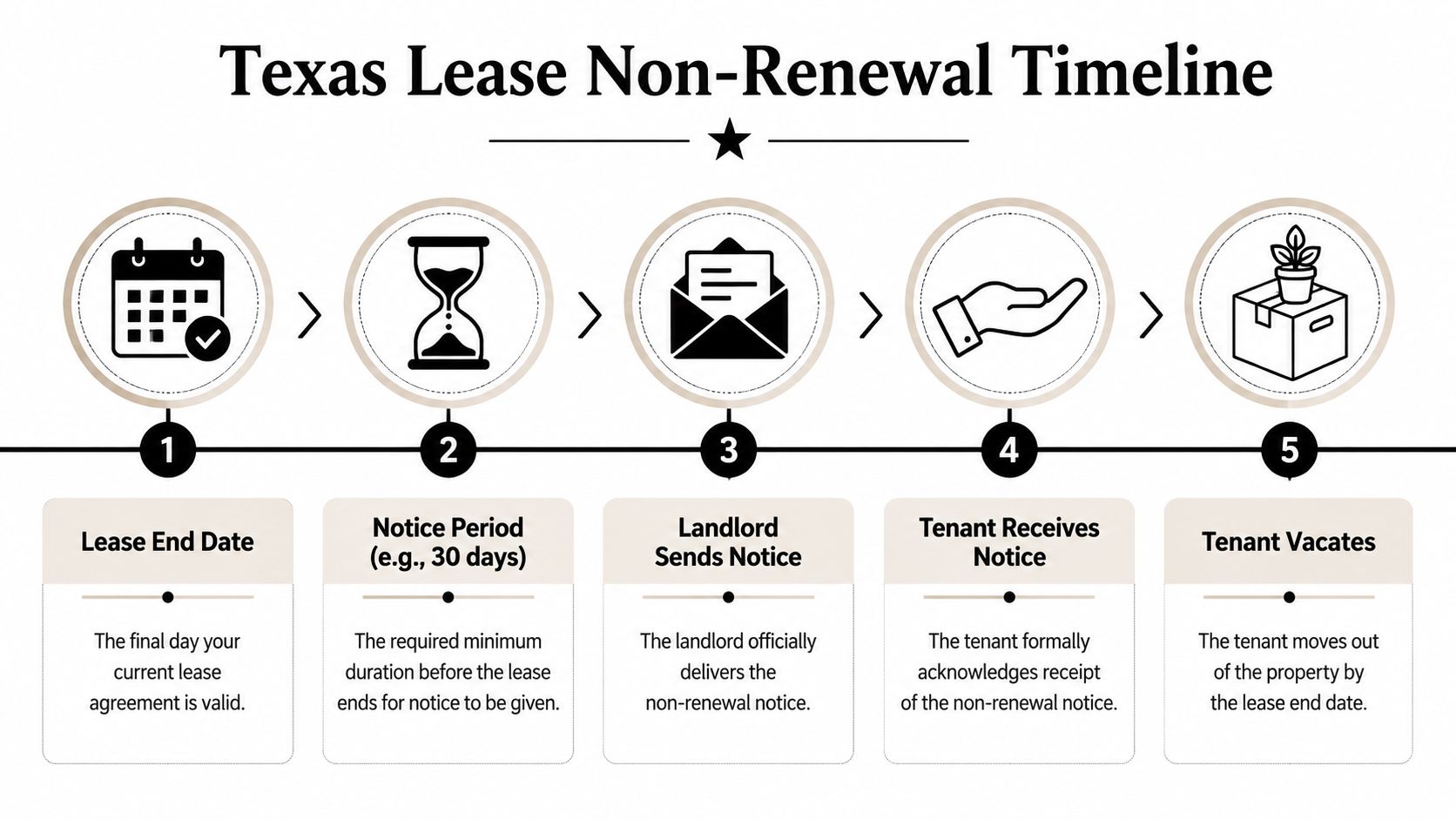
For example, if a lease ends on December 31 and the lease requires notice before non-renewal, the deadline must be counted backward from that end date. If the landlord misses the deadline set by the lease, that can affect whether the non-renewal is enforceable on the date claimed.
Month-to-month tenancies have a statutory rule
For month-to-month tenancies, Texas Property Code Section 91.001 requires at least 30 days' written notice to terminate. If a fixed-term lease expires and no new lease is signed, but the tenant stays and the landlord accepts rent, the tenancy often converts to month-to-month. At that point, the 30-day notice rule typically applies, as described in this discussion of Texas lease non-renewal and notice timing.
Watch the transition point: many disputes happen because one side thinks the lease simply ended, while the other side's conduct created a month-to-month tenancy.
A simple checklist for notice review
If you're evaluating a notice, check these issues in order:
- Lease type: Is this still a fixed-term lease, or has it become month-to-month?
- Notice clause: What does the written lease require?
- Delivery method: Did the sender use the method required by the lease?
- Deadline: Was the notice sent early enough?
- Proof: Can the sender prove the notice was delivered?
Small mistakes can have real consequences. A landlord may need to restart the process. A tenant may gain more time. In some cases, the notice defect creates an advantage for a negotiated move-out date instead of a rushed dispute.
A Tenant's Action Plan for a Non-Renewal Notice
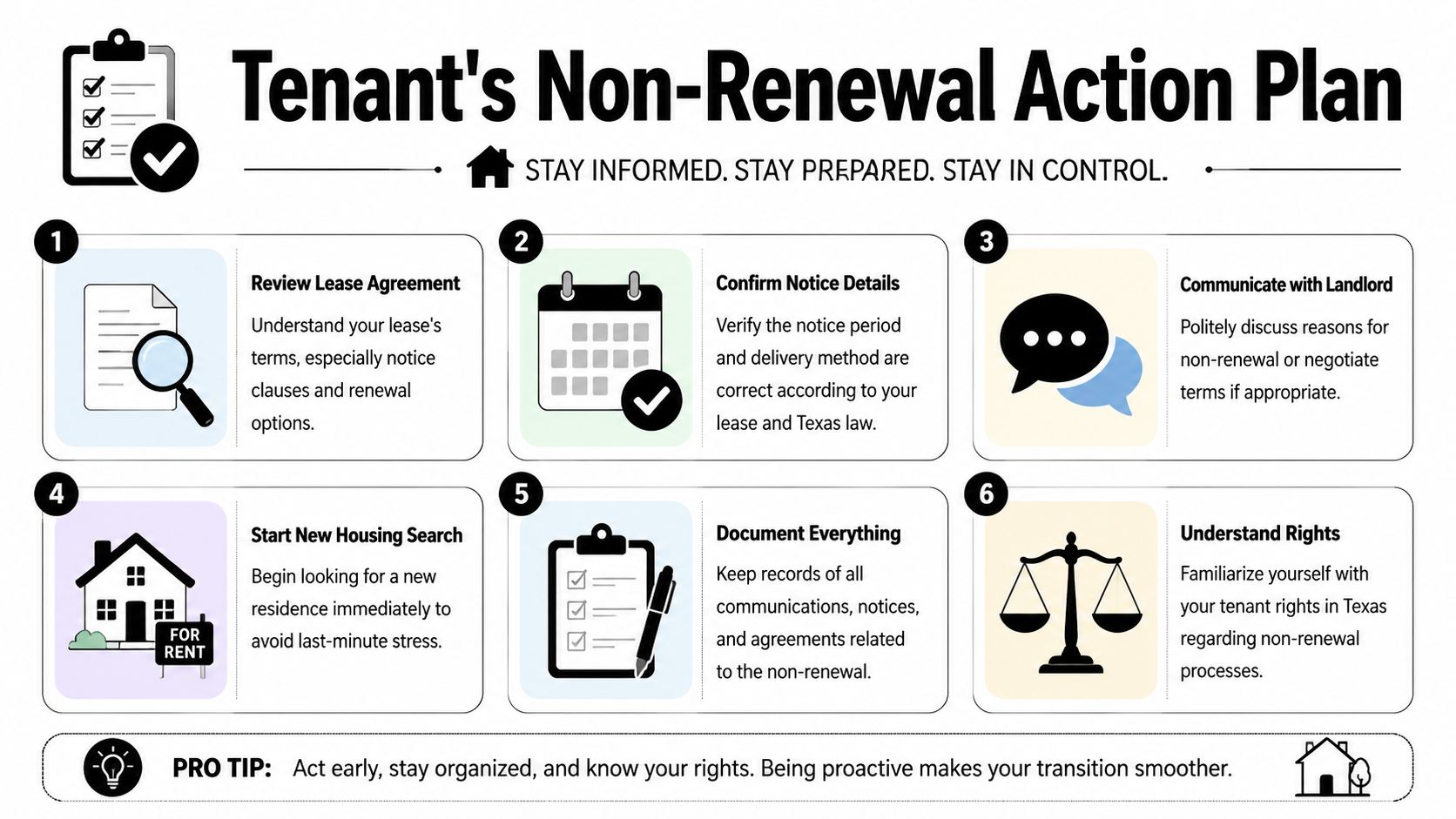
Once you receive the notice, don't guess. Build a record and make decisions in order. Panic leads tenants to miss the very facts that could help them.
Start with the documents
Your lease, the notice, and your recent communications should all be in one folder. Read the lease before responding to the landlord. Most tenants want to argue fairness first, but the stronger opening move is usually a date-and-language review.
Ask yourself:
- Does the lease require advance notice?
- Was the notice delivered the right way?
- Did the landlord use clear language about the end date?
- Did anything happen recently that suggests retaliation?
Put every communication in writing
If the landlord called you, send a short email confirming the conversation. If you spoke in person, do the same. Don't write an angry message. Write a clean one.
A useful format is simple:
- State receipt: Confirm you received the non-renewal notice.
- Ask for clarification: Request the stated move-out date and any inspection procedures.
- Preserve your position: If you believe notice is defective or retaliatory, say so calmly.
- Request records if needed: Ask for a copy of the lease provision being relied on.
Written communication does two jobs at once. It lowers the temperature, and it creates evidence.
Decide which lane you're in
Not every non-renewal should be fought. Some should be negotiated, and some should be treated as a move-out planning problem.
Here are the usual lanes:
Notice seems proper, no illegal motive appears likely
Focus on moving logistics, cleaning, a forwarding address, and security deposit issues.Notice timing looks wrong
Raise the defect in writing and ask the landlord to confirm the corrected deadline.Retaliation or discrimination is a concern
Gather records immediately and speak with a Texas landlord tenant lawyer or eviction attorney before making major concessions.You need more time
Ask for a written short extension, not a verbal promise.
Prepare for move-out without giving up your rights
Even while challenging a non-renewal, start planning as if you may need to leave. That protects you from a last-minute scramble. It also puts you in a stronger position if negotiations fail.
For practical move-out prep, including cleaning issues that often affect deposit disputes, these tips for renters moving out in Dallas can help you think through the final condition of the property.
A strong tenant file usually includes:
- Photos and video: Take them before you leave, especially of walls, floors, appliances, and bathrooms.
- Forwarding address: Give it in writing.
- Keys and possession: Return keys as instructed and keep proof.
- Final messages: Confirm the date you vacated and ask where future correspondence should be sent.
If you may challenge the non-renewal, don't wait until after move-out to start collecting evidence. By then, important texts, portal records, and timelines often get lost.
A Landlord's Guide to Proper Non-Renewal
A common mistake looks like this. The lease is about to end, the tenant has been frustrating, and the owner fires off a short text saying it is time to go. That is how routine non-renewals turn into retaliation claims, holdover disputes, and deposit fights.

The safer approach is disciplined and boring. That is a good thing. In Texas, landlords reduce risk by treating non-renewal as a file-building process, not a personal reaction to a difficult tenancy.
Build the file before you send the notice
Start with the lease. Confirm the notice period, the required delivery method, and any holdover clause. Then decide whether the non-renewal is based on a straightforward business reason such as sale plans, renovation, owner occupancy, rent strategy, or recurring lease violations. You may not need to explain that reason in the notice itself, but you should be able to explain it later if challenged.
A practical landlord checklist usually includes:
- Lease review: Check the exact non-renewal deadline and how notice must be delivered.
- Written notice: State that the lease will end, identify the property, and give the effective end date.
- Proof of delivery: Keep mailing records, email confirmations, portal screenshots, or signed acknowledgment, depending on what the lease allows.
- Internal notes: Save the neutral business reason for the decision in your file.
- Tenant history documents: Keep payment records, prior warnings, repair communications, and inspection notes if they help explain the decision.
- Move-out planning: Set a process for keys, possession, condition documentation, and the security deposit accounting.
That file matters most when the timing looks suspicious. If the tenant recently requested repairs, complained about conditions, or contacted a government agency, a thin paper trail creates risk even when the owner had a lawful reason to end the tenancy.
Keep the decision professional
Owners get into trouble when non-renewal follows an argument, a heated phone call, or a text sent out of frustration. Slow the process down. Review the timeline and ask one hard question: if a judge saw this file, would the reason look like legitimate business judgment or payback?
That is often the point to have counsel review the documents. The Law Office of Bryan Fagan, PLLC can review the lease language, timing, and notice form before notice goes out or before a holdover matter turns into an eviction case.
This video gives a useful overview for landlords thinking about process and risk:
Good landlords create a record that shows a lawful reason, proper notice, and professional handling from start to finish.
Plan for the last 30 days, not just the notice date
The notice is only the first half of the job. The last weeks of the tenancy create many of the disputes that later end up in court. Owners should decide in advance who will communicate with the tenant, when the property will be inspected, how possession will be confirmed, and how the security deposit file will be handled.
For landlords, the trade-off is simple. A rushed non-renewal may save a little time today but create larger costs later through delay, attorney fees, or a disputed eviction record. A careful process usually gives both sides a clearer exit and leaves far fewer openings for a retaliation or bad-faith claim.
When to Contact a Texas Landlord-Tenant Lawyer
Some lease endings are routine. Others aren't. You should speak with a Texas landlord tenant lawyer when the non-renewal comes right after repair requests, code complaints, or another protected action. The same is true if you suspect discrimination, the notice doesn't match the lease, or the landlord is making threats that sound more like self-help eviction than lawful process.
Landlords should get legal advice when a tenant refuses to leave after a proper non-renewal, when the tenant is accusing the owner of retaliation, or when the lease language is unclear enough to create risk. Early review usually costs less than fixing a preventable mistake later.
If you're dealing with a lease dispute, a holdover issue, questions about tenant rights, or the next steps after notice, getting a careful legal read on the timeline and documents can save a great deal of stress.
If you need help with an eviction, lease issue, or rental dispute, contact The Law Office of Bryan Fagan, PLLC for a free consultation today.