An apartment fire turns your life upside down fast. One minute you're thinking about dinner, work, school pickup, or whether the laundry is done. The next minute you're outside in the dark, holding your phone, trying to figure out where you'll sleep, whether your things are salvageable, and what your landlord is going to do.
If that's where you are right now, take a breath. Panic is normal. Staying stuck in panic is dangerous.
Texas law gives you a path forward. Your tenant rights after apartment fire texas depend on a few key questions: Is the unit still safe? Who caused the fire? Did you give proper written notice? Is your landlord acting quickly, or stalling? Once you answer those questions, the chaos starts to narrow into decisions.
This is the practical version. Not theory. Not vague advice. The first hours matter. The first week matters. The paper trail matters. If you handle those well, you put yourself in a much stronger position whether you need repairs, lease termination, rent relief, or a fight over blame.
Coping with the Aftermath of an Apartment Fire
The first legal problem after a fire usually isn't legal at all. It's shock.
Most tenants I talk to after a fire say the same things. They can't think clearly. They don't know whether they should go back inside. They don't know whether to keep paying rent. They don't know whether the landlord has to move them somewhere else. They don't know whether they're about to be blamed for something they didn't cause.
All of that uncertainty is real. But you need to get grounded in one basic truth. A fire does not erase your rights.
What matters first
If the apartment is burned, soaked from firefighting, full of smoke, or missing power, don't let anyone talk you into treating that like a minor inconvenience. Fire damage isn't just blackened walls. It often includes exposed wiring, blocked exits, structural damage, heavy smoke contamination, and water intrusion. Those are health and safety issues, not cosmetic complaints.
Practical rule: Stop arguing about labels like "small fire" or "contained fire." Focus on whether the unit is actually safe to live in.
A common real-world situation looks like this: the flames were limited to one room, but the entire unit smells like smoke, the electrical system is questionable, and parts of the ceiling or walls were opened up by firefighters. The landlord says repairs are coming. Meanwhile, you're expected to decide whether your children can sleep there tonight. That is exactly where clear Texas landlord-tenant analysis matters.
Your goal right now
Your goal isn't to win an argument today. Your goal is to protect your safety, your housing, your insurance claim, and your legal position all at once.
Start thinking in three timeframes:
- First 72 hours for safety, shelter, and evidence
- First week for written notices, insurance, and lease decisions
- Long term for repairs, rent disputes, deposit issues, or litigation if needed
If your landlord is responsible and organized, this may move quickly. If your landlord is defensive, missing, or trying to shift blame, your documentation becomes your shield.
Your Immediate Next Steps After the Fire
Right now, do the simple things in the right order. Don't overcomplicate this.
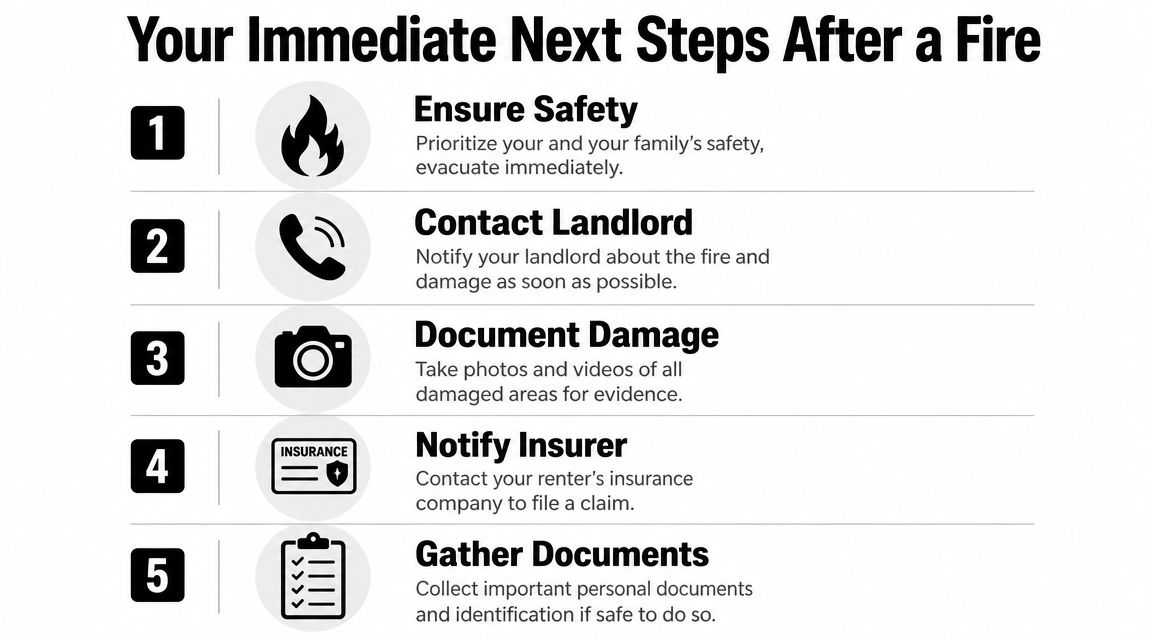
First 24 to 48 hours
Get yourself and your family somewhere safe.
If emergency personnel say stay out, stay out. Don't go back in to save clothes, papers, or electronics unless authorities say it's safe.Notify your landlord immediately.
Even if management already knows, send your own message. A text is fine for immediate notice, but don't stop there. Follow up in writing.Document everything before cleanup changes the scene.
Texas fire cases often turn on causation and control. If a tenant didn't cause the fire, the landlord typically must repair the unit, but liability can shift if the landlord proves the tenant was responsible. That's why immediate documentation matters so much. Photos, written descriptions, and official reports help preserve your rights and support insurance claims, as discussed in this Texas apartment fire liability overview.Call your renters insurance carrier.
Open the claim early. Personal property claims get harder when you wait.Secure essentials.
Gather medication, identification, bank cards, keys, chargers, and anything irreplaceable if it's safe to do so.
What to photograph and save
Don't just take wide shots. Build a record.
- Room-by-room damage including walls, ceilings, floors, doors, and windows
- Safety hazards such as burned outlets, exposed wiring, soot, standing water, and damaged exits
- Your belongings before disposal if possible
- Temporary housing costs like hotel receipts and meal receipts if your policy may cover them
- Communications with management, maintenance, and insurance adjusters
Save screenshots, emails, voicemails, and photos in more than one place. Your phone can be lost, damaged, or wiped.
One early mistake to avoid
Don't assume a phone call to the leasing office is enough. It isn't.
If the unit is unsafe, your next move should be a formal repair request in writing. If you need a model for that process, review this guide on how to request repairs from your landlord. Fire cases get messy when tenants rely on verbal promises like "we'll take care of it."
What the Texas Property Code Says About Your Landlord's Duties
Texas law doesn't require your landlord to provide perfection. It does require action when fire damage creates a condition that affects safety.

The legal trigger
Under Texas habitability law, the landlord's duty to repair is triggered when a condition "materially affects the physical health or safety of an ordinary tenant." After a fire, that can include exposed wiring, structural instability, severe smoke damage, or other code-related safety issues, as explained in the Texas repair guidance from the State Law Library.
That phrase matters. The law is focused on danger, not annoyance.
Smoke odor alone may be argued over. Smoke contamination tied to breathing concerns, burned electrical systems, missing utilities, or compromised walls is a different story. If the defect also violates a city building, health, or fire code, your demand for repairs gets stronger.
What that means in plain English
Your landlord generally handles the building. You handle your own property and your own paper trail.
You should also understand that lease terms still matter. Some leases address casualty loss, temporary relocation, rent obligations, or termination procedures. But lease language does not erase core habitability duties under the Texas Property Code.
For a broader understanding of these rules, review Texas Property Code Chapter 92 basics.
Landlord vs Tenant Responsibilities After a Fire
| Responsibility Area | Landlord's Duty | Tenant's Duty |
|---|---|---|
| Structural safety | Repair fire-related conditions that make the unit unsafe or uninhabitable | Report unsafe conditions promptly and clearly |
| Building systems | Address issues like damaged wiring, unsafe walls, compromised exits, or loss of essential services when safety is affected | Document the problem and avoid making unsafe DIY repairs |
| Code compliance | Correct defects that create likely building, health, or fire code issues | Preserve evidence such as inspection notes, photos, and notices |
| Personal belongings | Usually not responsible for replacing the tenant's clothing, furniture, electronics, or keepsakes | File renters insurance claims and inventory losses |
| Communication | Respond to proper notice and make a diligent repair effort | Give written notice in a trackable format and keep copies |
The strongest repair cases are specific. "My apartment had a fire" is weaker than "the bedroom outlet is burned, the hallway ceiling is open, and there is no safe power in half the unit."
Your Options Lease Termination or Landlord Repairs
At this stage, the question is no longer "What happened?" It is "Can you safely live there, and if not, how do you get out without making a legal mistake?"
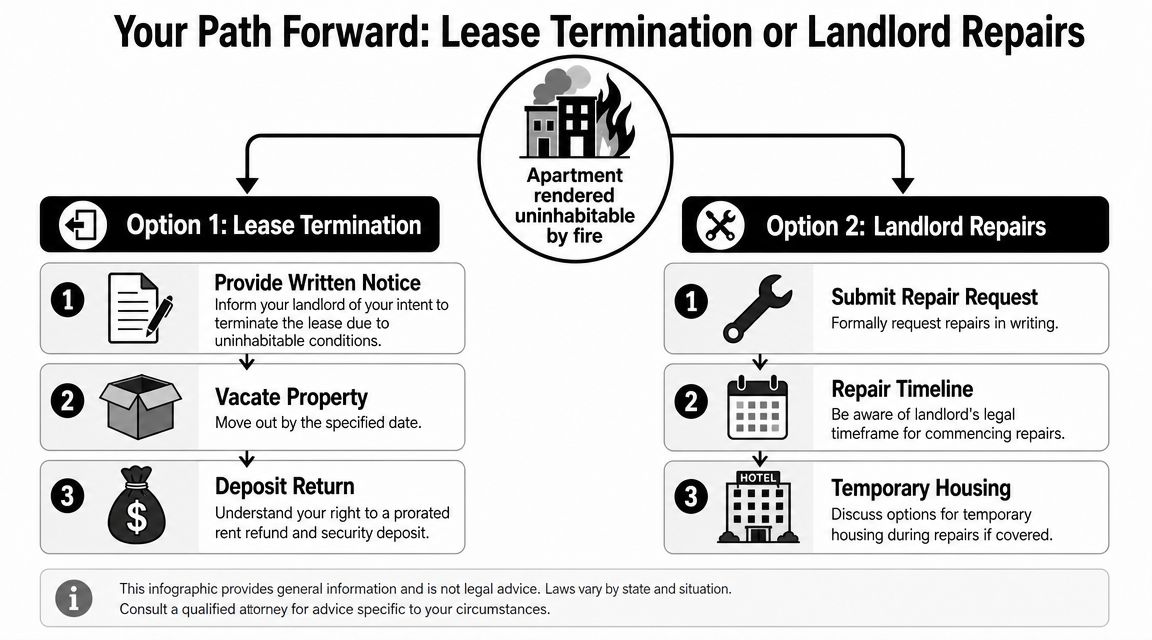
Treat this as a fork in the road. In the first 72 hours, focus on safety and evidence. During the first week, force a decision. Either the landlord is restoring a livable unit on a real timeline, or you start ending the tenancy in writing.
Option one: stay and demand repairs
Choose this path only if the apartment can be made safe within a reasonable time and you sincerely want to stay.
Texas Property Code § 92.056 gives tenants remedies when a landlord does not fix conditions that materially affect health or safety after proper written notice. Those remedies can include lease termination, a court order for repairs, or in some cases repair and deduct, as described in this explanation of Texas Property Code § 92.056 after an apartment fire.
Your advantage comes from paper. Send written notice that identifies the fire damage in specific terms. Burned outlets. Smoke contamination. Missing drywall. No working kitchen. Unsafe wiring. Loss of water or electricity. General complaints get ignored. Specific defects are harder to dodge.
Do not sit in limbo for weeks while the landlord makes vague promises. If the unit is repairable, ask for dates, contractor access, utility restoration timing, and whether rent will be reduced during the repair period. If money becomes part of that discussion, review Texas security deposit rules and tenant protections before you agree to anything in writing.
Option two: terminate the lease
If the apartment is not realistically livable, termination is usually the stronger move.
That is often true after major fire, smoke, or water damage, especially when basic living conditions are gone or the repair timeline is uncertain. Do not let the landlord keep you half-in and half-out of the lease while still expecting full rent. If you cannot safely sleep there, cook there, bathe there, or use basic utilities there, act on that reality.
Your written notice should say that the fire damage has made the unit uninhabitable, state whether you have vacated, and clearly demand written confirmation about lease termination and rent obligations. Keep the message short. Clear beats emotional.
A short video may help if you're trying to sort out which path fits your situation.
Partial damage cases are where landlords and tenants usually clash
These cases create the most conflict because the apartment is damaged, but not destroyed.
A landlord may say the unit is still usable because one bedroom survived or the bathroom still works. That is not the legal test you should use in practice. The pertinent question is whether the unit is safe and reasonably livable as a home, not whether you can physically step inside it. Smoke odor, exposed framing, wet walls, missing ceilings, shutoff utilities, blocked rooms, and ongoing demolition can make a unit unlivable even when part of it is still standing.
For a useful discussion of partial-loss tenancy problems, see this discussion of how a fire affects a tenancy.
Use a simple decision rule:
- Choose repairs if the unit will be safe soon, the landlord is acting promptly, and you have a written repair timeline.
- Choose termination if the apartment is not fit to live in now, repairs are open-ended, or the landlord keeps demanding rent without giving you a real plan.
One more point. If your personal property was damaged, start reading your policy before you choose a path. This guide to replacement cost insurance will help you understand how your carrier may value what you lost and what that means for your relocation decisions.
If you are sleeping somewhere else because the apartment is unsafe, put your position in writing now. Delay helps the landlord, not you.
Navigating Insurance Claims and Your Security Deposit
Insurance and deposit issues usually become the second wave of stress. First you're displaced. Then the money questions hit.
Whose insurance covers what
The landlord's property insurance usually covers the building. It typically does not cover your clothes, furniture, electronics, documents, or other personal items. Your renters insurance is the policy that usually matters most for your belongings and, depending on the policy, possible temporary living expenses.
If you don't know how your policy values damaged property, this guide to replacement cost insurance is a useful starting point before you speak in detail with the carrier. You need to understand what you're claiming before you accept a payment position.
Build your claim like a file, not a conversation
Treat your insurance claim like a case file.
- Make an inventory of damaged items by room
- Attach photos to each category if possible
- Keep receipts for hotels, emergency clothing, toiletries, and replacement necessities
- Request copies of fire reports, incident reports, or inspection records when available
If an adjuster asks broad questions, slow down and answer carefully. Guesses create problems. If you don't know whether something is repairable, say you don't know.
Security deposit fights turn on fault
Under Texas Property Code § 92.008, a tenant can be financially liable for fire damage caused by the tenant's negligence or intentional acts. That means the fire's cause can affect whether the landlord uses the security deposit for repairs and whether the tenant faces claims beyond the deposit, as explained in this Texas discussion of tenant liability for accidental fire damage.
That cuts both ways.
If you caused the fire through negligence, expect a deposit dispute. If you did not cause the fire, push back hard against any lazy attempt to dump all repair costs on you just because you were the occupant.
For a broader look at the rules governing deductions and returns, review this summary of Texas security deposit law.
A landlord doesn't get to treat every fire as tenant-caused damage. Fault has to be supported, not assumed.
How to Formally Communicate with Your Landlord
The morning after the fire, management may sound helpful on the phone. By day three, stories change, staff rotate, and nobody remembers what was promised. If you want repairs, rent relief, lease termination, relocation, or your deposit back, create a paper trail now.
Put every serious request in writing
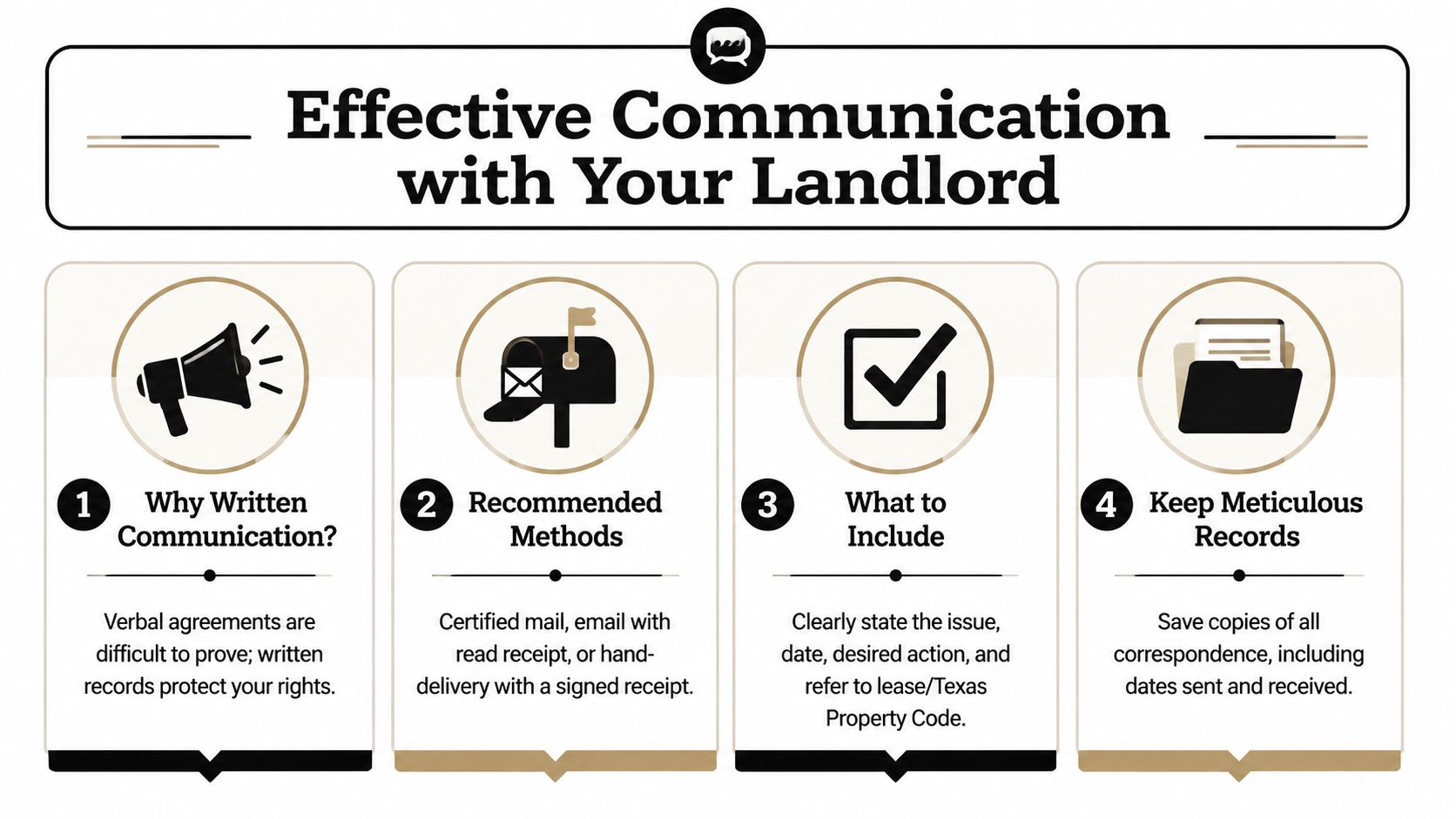
Oral updates are not enough after an apartment fire. You need written notice that identifies the unit, describes the fire damage, and states exactly what you are asking the landlord to do.
Send it through a method you can prove later. Certified mail works. Registered mail works. Email can help, but do not rely on a casual message thread if the stakes are high. Use at least one trackable method and keep copies of everything you send.
This matters most in the first 72 hours and the first week, when the key questions start forming. Is the unit safe? When will repairs start? Will rent still be charged? Will the landlord offer another unit or temporary housing? Ask those questions directly, in writing, and ask for a written response by a specific date.
A notice you can send today
Use plain language. Do not argue. Do not guess about the cause of the fire. State the facts and make your request.
Subject: Fire damage at [your address and unit number]
I am giving written notice that my apartment suffered fire-related damage on [date]. The current conditions include [list specific unsafe conditions]. These conditions affect health and safety and make the unit [uninhabitable / partially unusable].
I request written confirmation of your repair plan, expected timeline, and whether temporary housing or a comparable unit will be offered. If the unit cannot be made safe promptly, I request written confirmation regarding lease termination, rent adjustment, and return of my security deposit as required by Texas law.
Please respond in writing. I am keeping records of all communications, photos, receipts, and reports related to this loss.
That format does three jobs at once. It documents the problem, shows what you requested, and makes it harder for management to deny notice later.
What every message should include
- Date of the fire
- Your full property address and unit number
- The unsafe or unusable conditions such as smoke damage, no power, exposed wiring, water intrusion, or blocked access
- Your specific request such as repairs, relocation, rent reduction, lease termination, or a written decision on habitability
- A deadline for response
- Your temporary address, phone number, and email
Keep your tone controlled. Strong does not mean hostile. If you are angry, wait ten minutes and rewrite the message. The goal is to build a record that helps you, not a record the landlord can use to paint you as unreasonable.
If you are also speaking with an insurance adjuster, treat those conversations with the same discipline. Casual guesses about damage, fault, or what property can be saved can hurt your claim. Read this guide on protecting your fire claim settlement before you start explaining losses off the cuff.
When You Need a Texas Landlord-Tenant Lawyer
At some point, you stop sending polite follow-ups and start protecting your case.
If the first 72 hours were about safety and documentation, and the first week was about forcing clear answers, this is the point where legal help matters. Bring in a Texas landlord-tenant lawyer when the landlord stops acting like a housing provider and starts acting like an opponent.
Get counsel promptly if management blames you for the fire without showing any real basis, refuses to say whether the unit is habitable, demands full rent for a place you cannot safely live in, or treats fire damage as if it were ordinary tenant wear or misuse. You should also call a lawyer if the landlord threatens lockout, shutoff, removal of your property, or eviction outside the normal court process.
Clear red flags
I would stop trying to resolve it informally if any of this is happening:
- Management is accusing you without proof and will not share the report, photos, or facts behind the accusation
- Repairs are stalling even though the unit has obvious safety problems such as smoke contamination, no electricity, exposed wiring, water intrusion, or structural damage
- The lease position keeps changing and nobody will commit in writing on repairs, relocation, rent reduction, or lease termination
- Your deposit is being withheld for fire-related damage you likely did not cause
- You asked for repairs or asserted your rights, and the landlord responded with threats or pressure
A Texas landlord-tenant lawyer should review your lease, your notices, the fire reports, photos, inspection records, and rent ledger right away. Early review matters because apartment fire disputes usually turn on timing, written notice, habitability, causation, and whether the landlord followed the Texas Property Code. The right lawyer can tell you whether to press for repairs, push for lease termination, dispute rent charges, fight deposit deductions, or prepare for an eviction defense.
The Law Office of Bryan Fagan, PLLC handles landlord-tenant matters involving repairs, deposits, lease disputes, and Texas Property Code issues.
Do not wait for the landlord to file first. By then, records disappear, stories change, and bad paperwork hardens into the version of events the court sees.