Skip to content
Dealing with a landlord dispute can be stressful—but understanding your rights under Texas law can make all the difference. Finding mold in your apartment is more than just unsettling; it can feel like a violation of your home's safety. One minute you're living your life, the next you're staring at a dark stain spreading across the wall, worried about your health and what it means for your lease.
In Texas, you have rights. Knowing what to do next can make all the difference between a quick resolution and a legal nightmare. This guide will provide clear, practical steps to help you protect yourself.
What the Texas Property Code Says About Mold and Habitability
While Texas doesn't have a specific "mold law," that doesn't leave you unprotected. Your landlord has a legal duty to fix any condition that materially affects your physical health or safety. This isn't just a suggestion; it's a core part of your lease known as the “implied warranty of habitability.”
Think of it as the bedrock promise of your rental agreement: the landlord provides a safe and livable home in exchange for your rent. A significant mold infestation, especially if it's tied to a leak or persistent dampness, almost always falls into this category. It's a direct threat to your health.
However—and this is the part where many tenants stumble—asserting your rights isn't as simple as making a phone call. To legally hold your landlord accountable, you have to follow the rules set by the Texas Property Code.
Real-World Scenario: When Mold Becomes a Legal Issue
Imagine Sarah, a tenant in Houston, notices a musty smell and a large, dark patch of mold growing on her bedroom wall after a pipe in the wall started leaking. Her son, who has asthma, begins coughing more frequently. This is no longer a simple cleaning issue; it's a condition that "materially affects" her family's health and safety, triggering the landlord's legal duty to act under Texas law.
Your Step-by-Step Action Plan for Apartment Mold
Before you can take any legal action, you must follow a specific procedure. The law is very clear about what a tenant must do to trigger the landlord's obligation to make repairs. Overlook these steps, and you risk losing your legal standing entirely.
| Step | Action Required | Why It's Critical |
|---|---|---|
| 1. Pay Your Rent | Ensure you are 100% current on all rent payments. | The law only protects tenants who are not delinquent on rent when they give repair notices. |
| 2. Send Written Notice | Send a formal, written notice of the mold issue to your landlord via certified mail. | This creates a legal record and official timeline. A phone call, text, or email is not enough. |
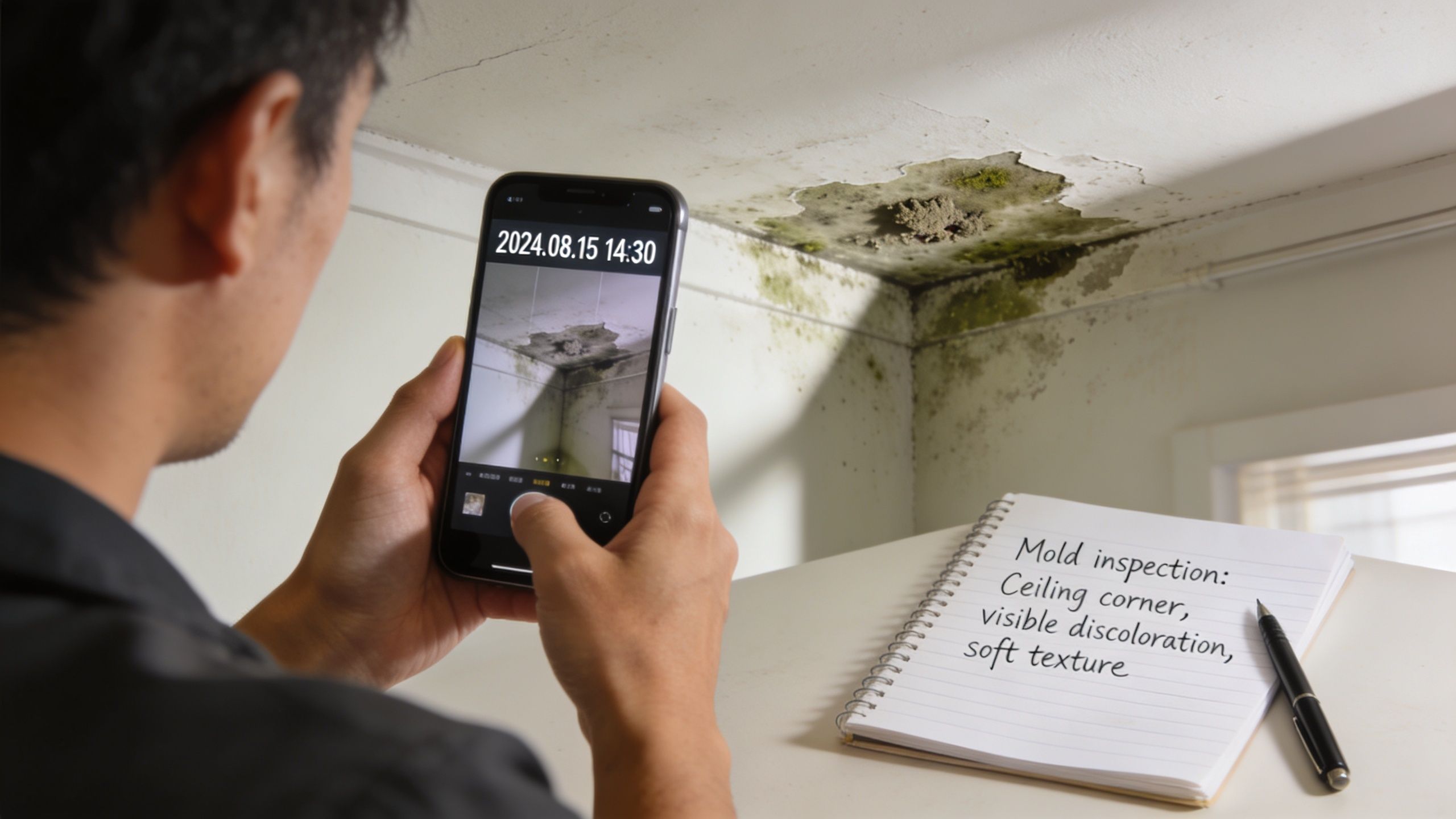
| 3. Document Everything | Take clear photos and videos of the mold, any water sources, and any property damage. | This is your evidence. It proves the condition existed and documents its severity. |
Following this initial plan is non-negotiable. It's the foundation upon which all your other rights are built.
Why Following Procedure is Critical
Let’s be clear: you have zero legal protections if you don't follow the proper procedure. Under the Texas Property Code, your rights are conditional on two things:
- You Must Be Current on Rent: If you’re behind on rent when you send your notice, your landlord has no legal duty to make the repair. It’s that simple.
- You Must Provide Proper Written Notice: A quick text or a frustrated phone call won't cut it in court. You need to send a formal letter, preferably by certified mail with a return receipt requested. This is your proof that you notified the landlord and the date the clock started ticking on their responsibility.
Of course, to report mold, you first have to be sure that's what you're seeing and smelling. It’s crucial to understand mold health symptoms and the visual signs.
The infographic below breaks down the exact procedure you need to follow.

Think of this process as a legal roadmap. Skipping a step is like taking a wrong turn—it can get you completely lost and weaken your entire case. Follow it precisely to protect your home and your health.
Understanding the "Implied Warranty of Habitability" in Texas
When you find mold creeping across your apartment wall, you might search for a specific "mold law" in Texas. But you won't find one. Your rights actually come from a much broader, more powerful legal concept: the implied warranty of habitability.
This isn't just a recommendation; it's a non-negotiable guarantee built into every Texas lease, whether it's written down or not. It means your landlord has a fundamental duty to provide a home that's safe and livable.
The legal muscle behind this guarantee is found in the Texas Property Code, specifically Section 92.052. This is where the law outlines a landlord's "duty to repair" any condition that materially affects the physical health and safety of an ordinary tenant. That one phrase is everything.
Defining a "Materially Affecting" Condition
So, what does “materially affect” really mean when it comes to mold? Think of it as the line between a minor annoyance and a real danger.
- Not Materially Affecting: A few specks of mildew around your shower drain that wipe away with a household cleaner. It's unsightly, but it probably doesn't legally threaten your health.
- Materially Affecting: A large, spreading patch of black mold in your child's bedroom, fed by a hidden pipe leak. This is a clear health hazard and absolutely triggers your landlord's duty to act.

The law uses the standard of an "ordinary tenant" for a reason. The issue must be something a typical person would consider a threat to their health, not just a cosmetic flaw or personal pet peeve. As the MG Drain Services LLC landlord advice on plumbing maintenance notes, figuring out the source of the moisture is often the first step in determining responsibility.
Key Takeaway: Your landlord isn't on the hook for every tiny imperfection. Their legal duty to repair kicks in when a problem like mold poses a genuine danger to your physical well-being.
Exceptions to the Landlord's Duty to Repair
Knowing your rights is only half the battle. You also have to understand when your landlord is not responsible for making a repair. Their duty to fix a mold problem disappears if:
- You, Your Family, or a Guest Caused It: If your actions—like repeatedly letting the tub overflow or failing to report a leak you caused—led to the mold, the responsibility shifts away from the landlord.
- You're Behind on Rent: You must be current on your rent payments when you send the repair notice and remain current while waiting for the fix. Don't give them an easy excuse to ignore you.
- You Didn't Give Proper Notice: You can’t just mention it in passing. Texas law requires a formal, written notice to start the clock on their repair obligations.
Understanding these rules is critical. If you get them wrong, you could lose your rights. For a deeper dive, you can learn more about landlord responsibilities under Texas Property Code Chapter 92. Getting these details right from the start is the key to building a strong case and getting the problem solved.
How to Properly Notify Your Landlord About Mold
Finding mold in your apartment is a serious threat to your health. But how you report it to your landlord is what truly matters under Texas law. Simply telling them about the problem won't cut it. To protect your rights, you have to follow a specific process.
A phone call, a text message, or even a face-to-face conversation is not a legal notice. While these might seem like the fastest way to get a response, they give you zero legal standing if your landlord ignores you. To unlock the powerful tenant remedies available in the Texas Property Code, like terminating your lease, your notice must be in writing.
Why Certified Mail Is Your Strongest Ally
The law is crystal clear on this point. To officially start the clock on your landlord's legal obligation to make repairs, you have to send a proper written request. Our strongest recommendation is to send this notice via certified mail with a return receipt requested.
This isn't just a suggestion; it's your best defense. This method creates an official paper trail that proves exactly when your landlord received your complaint. That little green postcard you get back in the mail? That's your golden ticket in court. It’s undeniable proof that you did your part and followed the law.
Don't underestimate how critical this is. Tenant disputes often get dismissed simply because the tenant failed to give proper written notice. You can find more insights on Texas state mold laws on moldcareer.com.
What to Include in Your Mold Notification Letter
Your letter doesn’t need to be full of legal jargon to be effective. It just needs to be clear, professional, and contain these key pieces of information:
- Today's Date: This establishes a clear timeline.
- Your Name and Address: Clearly identify yourself and the rental unit.
- A Clear Description: Describe the mold, its location, its size, and any related issues like a musty smell or a nearby water leak.
- A Formal Request: Explicitly state that you are requesting the condition be repaired under your rights as a tenant.
- A Reference to Your Health: Mention that the condition is a material threat to the health and safety of your household.
This formal approach is the foundation for successfully resolving a mold issue and holding your landlord accountable. You can learn more about the specifics of making repair requests by checking out our guide on how to request repairs from your landlord.
How to Document Mold Damage for Your Legal Case
When you’re up against a landlord over a mold problem, the strength of your case rests on one thing: your evidence. A detailed, undeniable paper trail can mean the difference between getting the repairs you deserve and getting ignored.
Think of yourself as a detective building a case. Your first job is to photograph and video everything. Get clear, dated shots of the mold itself. More importantly, connect the dots. Capture the leaky pipe under the sink, the water stain spreading from the upstairs unit, or the condensation on a poorly sealed window. You need to show that the mold is a direct result of the property's failure.
Creating an Undeniable Record
Your pictures are just the beginning. The real power comes from your communication log. Every single phone call, text, email, or conversation with your landlord or their property manager needs to be written down. You’re building a timeline that proves you did your part.
Your evidence file absolutely must include:
- A Detailed Log: Keep a simple journal. For every phone call or conversation, write down the date, time, and the name of the person you spoke with, along with a summary of what was said.
- Written Correspondence: Save everything. This means copies of every email and text you send and receive.
- The Certified Mail Receipt: This is non-negotiable. When you send your formal notice, that certified mail receipt and the green return card are your legal proof that the landlord received your complaint.

Documenting Health and Medical Impact
Finally, don’t forget the human cost. Is your child coughing constantly? Are you suddenly dealing with headaches or rashes? If you suspect a link between the mold and your family’s health, start documenting it immediately.
Keep a running log of symptoms, noting when they started and how severe they are. Hold on to all records of doctor’s visits, prescriptions, or any medical care you seek. This information is invaluable because it connects the landlord's failure to maintain the property directly to your family's health and well-being.
To document the mold effectively, you first have to know what you’re looking for. This guide to identifying mold in apartments is a great place to start. By building a thorough file with all this proof, you give yourself the power to negotiate effectively or take legal action.
What Are Your Legal Options If the Landlord Fails to Act?
You’ve done everything right. You sent the formal notice by certified mail, your rent is paid up, and you’ve documented everything. But the landlord is still ignoring your requests. Their inaction unlocks several powerful legal remedies for you under the Texas Property Code.
Be warned: you have to tread very carefully. Taking one of these next steps without following the law to the letter can backfire and even lead to your own eviction. You must understand the risks and strict requirements of each option before you act.
Option 1: Terminating Your Lease
If the mold materially affects your health and your landlord has ignored your proper notice, you may have the right to terminate your lease under Texas Property Code Section 92.056.
To do this legally, you must send the landlord a second written notice. This notice should state that because they have failed to make repairs, you are officially ending the lease. After sending this notice, you can move out. You are then entitled to a refund of your security deposit, minus any lawful deductions. A landlord might try to sue you for unpaid rent, so your documentation must be flawless.
Option 2: Using the "Repair and Deduct" Remedy
Another option, found in Texas Property Code Section 92.0561, is the "repair-and-deduct" remedy. This allows you to hire a professional to fix the mold and then deduct the cost from your next rent payment. This option is extremely risky and comes with tight restrictions.
You can only deduct an amount up to one month’s rent or $500, whichever is greater. You can’t just stop paying rent; you have to follow the procedure exactly. Because the rules are so complex and the financial cap is often too low for a serious mold issue, this isn't usually the best path forward.
Critical Warning: Simply withholding rent without a court order or without perfectly executing the "repair-and-deduct" steps is illegal in Texas. This is one of the fastest ways to find yourself facing an eviction lawsuit, which would destroy your leverage and your case.
Dealing with a landlord who won't make repairs is a common fight. You can find more strategies in our detailed guide on what to do when your landlord is refusing to make repairs. Because these remedies carry significant legal risks, we strongly recommend you consult a Texas landlord-tenant lawyer before taking any of these steps.
When It's Time to Call a Landlord-Tenant Lawyer
You’ve followed the rules. You sent the certified letters. But the mold is still there, and your landlord is either ignoring you or making things worse. This isn’t just about a pesky stain on the wall anymore; it’s about your health, your money, and your home.
Handling a mold dispute on your own is one thing, but going up against a negligent landlord is another. This is the point where a simple disagreement can turn into a legal minefield. Knowing when to call for professional backup is critical. An experienced Texas landlord-tenant lawyer is your shield, ensuring your landlord can’t bully you or ignore your rights.
Don't Go It Alone: Situations That Demand Legal Help
Some landlord problems are too complex or carry too much risk to face without a legal advocate in your corner. If you find yourself in any of these scenarios, it’s time to get help immediately:
- Your Landlord Is Retaliating: You reported the mold, and now your landlord is hitting you with an eviction notice, a sudden rent hike, or other punitive measures. This is illegal retaliation, and a lawyer can help you fight back.
- You or Your Family Are Sick: If the mold is causing serious health issues—asthma attacks, persistent respiratory problems, or worse—a lawyer can help you hold your landlord liable for the harm they’ve caused.
- The Landlord Denies Everything: Your landlord outright refuses to admit there's a mold problem or says "it's not my responsibility." You need a professional to force them to comply with Texas law.
- You Need to Sue or Break Your Lease: Taking your landlord to court or terminating your lease are powerful tools. But they require perfect legal execution. One mistake, and you could end up owing thousands in rent.
An experienced attorney from The Law Office of Bryan Fagan, PLLC, knows the Texas Property Code inside and out. We step in to shield you from illegal landlord tactics, handle all the stressful communication, and build a powerful case to protect your rights.
Trying to navigate these high-stakes situations alone is a gamble you can't afford to lose. A single misstep could leave you on the hook for rent on an apartment you can't even live in. A tenant rights lawyer makes sure every step you take is the right one. Your health and your home are not negotiable.
Frequently Asked Questions About Mold in Texas Apartments
Knowing your rights is one thing, but practical questions come up fast. Here are straight answers to the most common concerns we hear from Texas tenants.
Can I Withhold Rent for a Mold Problem in Texas?
Let's be blunt: No, you cannot simply stop paying rent. This is one of the biggest and most dangerous mistakes a tenant can make.
Withholding rent—even for a legitimate mold issue—puts you in immediate danger of eviction for non-payment. Under Texas law, your rent must be current before you can legally exercise your other remedies. It's a non-negotiable first step. If your landlord won't act, you have other powerful options, but you need to speak with a Texas tenant rights lawyer first to make sure you don't accidentally give your landlord grounds to evict you.
Is My Landlord Responsible for Mold After a Hurricane or Flood?
This is where things get complicated. After a natural disaster, a landlord’s duty to repair is often paused until their insurance company pays the claim. Your lease is the key here—it should have clauses that cover what happens in these situations.
If a flood makes your apartment completely unlivable, Texas law may allow either you or the landlord to terminate the lease with proper written notice. Don't guess. Have an attorney review your lease to understand exactly what your options are.
Does My Landlord Have to Pay for a Professional Mold Test?
The law doesn't force a landlord to order a professional mold test just because you ask for one. Their legal obligation is to fix the underlying condition—the leak, the high humidity—that’s causing the mold, provided it materially affects your health and safety.
That said, a professional mold assessment can be your most powerful piece of evidence. If your landlord is dragging their feet, an independent report gives you undeniable proof. If you end up in court and win, you can often recover the cost of that test.
What if the Mold Comes Back After a Repair?
If you see mold again after a supposed fix, it’s a giant red flag that the landlord didn't solve the real problem. They just painted over it.
You have to restart the notification process from square one to protect your rights. Send a new certified letter stating the first repair failed and the mold has returned. Take new, dated photos and videos. A documented history of failed repairs builds a much stronger case for lease termination or other legal action.
If you need help with an eviction, lease issue, or rental dispute, contact The Law Office of Bryan Fagan, PLLC for a free consultation today.