Dealing with a landlord who won't fix a serious problem can be stressful — but understanding your rights under Texas law can make all the difference. When your home is unsafe, it’s not just an inconvenience; it’s a violation of your legal protections as a tenant.
You are not powerless.
In Texas, the law requires landlords to repair any condition that affects your physical health and safety. This isn’t a suggestion—it’s their legal duty. If your landlord is refusing to make repairs, you have powerful options.
Your Right to a Safe and Habitable Home
Dealing with a landlord dispute can be incredibly frustrating. But understanding your rights under the Texas Property Code is your most powerful tool.
When your landlord ignores your pleas for essential repairs, it can feel like you’re trapped in a home that's falling apart. The good news is that Texas law is on your side. The law establishes that every tenant is entitled to a safe, sanitary, and secure home. This core principle is known as the "implied warranty of habitability."
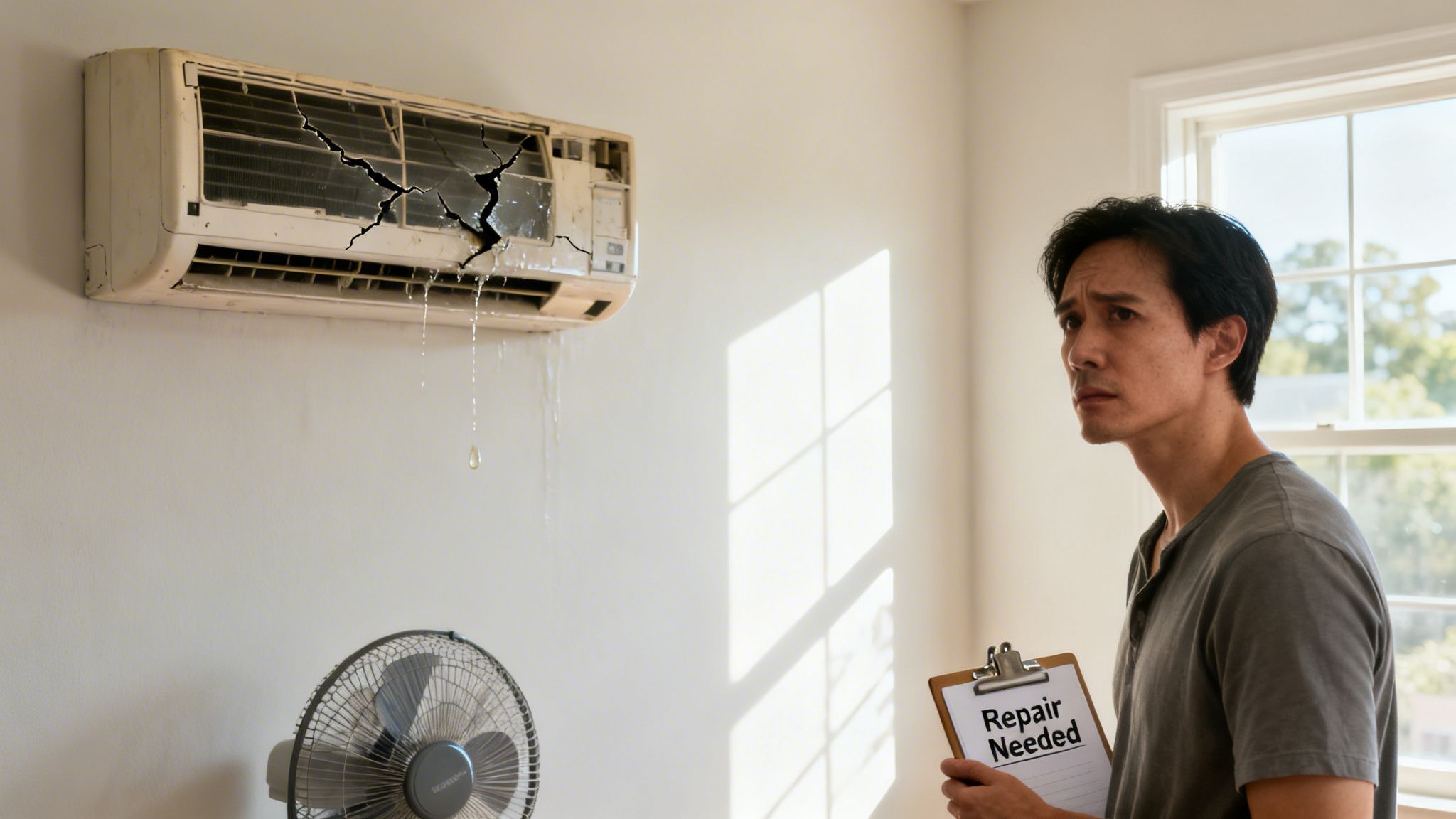
This isn't a vague legal theory; it's written directly into state law. Texas Property Code, Section 92.052, outlines a landlord's "duty to repair." This law requires your landlord to fix any condition that materially affects the physical health and safety of an ordinary tenant, as long as you didn't cause the damage yourself through negligence or misuse.
What the Texas Property Code Says About Repairs
The key phrase is “materially affects health and safety.” This doesn’t cover minor cosmetic issues like a scratch on the floor or a wobbly cabinet handle. It’s about the serious stuff—the problems that make your rental genuinely unsafe or unhealthy.
Here are a few real-world scenarios that almost always qualify:
- A broken air conditioner during a brutal Texas summer.
- A serious roof leak causing water damage and threatening mold growth.
- A busted water heater, leaving you with no hot water for days.
- A non-functioning furnace in the middle of a winter freeze.
- Raw sewage backing up into your sinks or tubs.
- A major infestation of pests like rats, mice, or roaches.
Your right to a safe home absolutely includes living free from a major pest problem. If you’re currently dealing with a pest problem in your rental property, it's critical to know that this can qualify as a condition your landlord must address.
A Frustratingly Common Problem for Renters
The fight to get a landlord to make basic repairs isn't just a Texas issue—it's a global one. But seeing the bigger picture helps you understand why knowing your local rights is so critical.
In the UK, for example, a shocking 4 in 10 renters are living in homes with serious issues because their landlords simply refuse to make repairs. A recent survey showed 39% of tenants can't get essential fixes done, which points to a massive failure of landlords to meet their basic legal duties.
That’s why you can’t afford to guess. Here in Texas, the law gives you a clear path to force your landlord to act. Before you do anything else, you need to understand the full scope of their obligations. Our detailed guide on landlord responsibilities in Texas is the perfect place to start.
Knowing what the law demands is your first step toward holding your landlord accountable and taking back your right to a safe home.
Step One: Why Formal, Written Notice Is Non-Negotiable
When the AC dies in the middle of a Texas summer or a leak starts staining your ceiling, your first instinct is probably to shoot your landlord a text or make a quick phone call. It’s fast, it’s easy, and it feels like you’ve done your part.
But in the eyes of Texas law, those informal messages carry almost no weight.
To truly protect yourself and force your landlord to act, you must send a formal, written notice. This isn't just a suggestion—it's the legal foundation for everything that comes next. Without it, your case is likely dead on arrival if you ever end up in court.

Think of this notice as your official, undeniable proof. It’s you, on the record, telling your landlord about a serious problem and formally requesting a repair.
The Gold Standard: Certified Mail
So, what kind of notice actually works? While you can use email or hand-delivery, the method that stands up best in court is certified mail with a return receipt requested.
Sending your letter this way does three critical things:
- It creates undeniable proof of delivery. The signed green card you get back from the post office is your silver bullet. It proves they received your notice and on what date.
- It officially starts the legal clock. Once that receipt is signed, the law says your landlord has a "reasonable time" to make the repair. That signature is the starting gun.
- It shows you mean business. A certified letter tells your landlord you know your rights and are prepared to enforce them. This simple step often turns a hesitant landlord into a responsive one.
If you send this first notice via certified mail, you have met your initial legal duty and put yourself in a powerful position. Choosing the right notification method isn't just about getting the message across; it's about building a legal case.
Comparing Notice Methods and Their Legal Strength
| Notification Method | Description | Legal Strength | Best For |
|---|---|---|---|
| Certified Mail (Return Receipt) | A formal letter sent via USPS that provides a signed receipt from the landlord upon delivery. | Highest | The first and most critical notice for any serious repair. This is your foundation for any legal action. |
| Email or Hand-Delivery | Sending a written notice digitally or dropping it off in person. You must be able to prove receipt. | Moderate | Follow-up communication, or if your lease specifically allows it. Always try to get a written acknowledgment of receipt. |
| Text Message or Phone Call | A quick, informal message or conversation with the landlord. | Very Low | Initial, informal follow-ups after you've already sent a formal notice. Never rely on this as your primary notice. |
Ultimately, while texts and emails are convenient, they leave too much room for your landlord to claim they "never saw it." Certified mail removes all doubt.
What to Write in Your Repair Notice
You don’t need to be a lawyer to write this letter. Just be clear, professional, and include key details. Think of it as the first piece of evidence for your case. Our article on how to write a demand letter in Texas offers more detailed guidance.
Make sure your letter includes:
- The Date
- Your Landlord's Full Name and Address (use the one on your lease)
- A Detailed Description of the Problem
- A Clear Request for Repair
- Your Name, Address, and Unit Number
Being specific is key. Don't just say "the AC is broken."
Instead, write something like: "This letter is a formal notice that the central air conditioning unit at 123 Oak Lane, Apt. 4B, is not functioning. As of July 10th, the unit no longer produces cool air, and the indoor temperature has become unsafe. I request that you make the necessary repairs immediately as required by Texas Property Code 92.052."
This transforms a simple complaint into a legal document and lays the groundwork for every remedy you're entitled to.
Step Two: How to Document Everything to Build Your Case
So you’ve sent the certified letter, and all you’re hearing back is silence. This isn’t the time to sit back and wait. It’s time to start building the proof you’ll need to protect yourself and your rights.
When a landlord is refusing to make repairs, solid documentation is the single most important tool you have. A judge won’t simply take your word for it. They need to see a clear, undeniable timeline of the problem, your communication, and your landlord’s failure to act.

Creating an Undeniable Paper Trail
Your goal is to build a file that tells the whole story so clearly that it can’t be argued. This record should leave no doubt about the severity of the repair issue, the dates you gave notice, and your landlord's refusal to do their job.
Here’s exactly what you need to gather:
- A Detailed Communication Log: Start a dedicated notebook or a digital document. Log every interaction—phone calls, texts, emails, conversations—with your landlord or their staff. Note the date, time, who you spoke with, and a summary of what was discussed.
- Copies of All Written Notices: This is non-negotiable. Keep perfect copies of your certified mail receipt and the signed green return card. Print out every email and text message exchange and put them all in a folder.
- Date-Stamped Photos and Videos: Document the problem every few days to show how it’s getting worse or simply not being fixed. Your phone automatically embeds date and time data into the file. For extra proof, you can hold up the day's newspaper in a photo next to the damage.
This is precisely the kind of evidence a Texas landlord tenant lawyer uses to build an airtight case in court.
Example: A Severe Mold Problem
Let's say you discover a serious mold outbreak behind your bathroom wall. You send a certified letter, but your landlord has gone radio silent.
Here is a step-by-step example of how you can turn this bad situation into a powerful legal position:
- Create a Visual Timeline: Take clear photos of the mold every couple of days to show its growth. A short video where you walk through the area, describe the smell, and show any related water damage can be incredibly effective.
- Get Official Reports: Contact your city’s code compliance or health department. An official report from a government inspector confirming the issue and citing health code violations is powerful, objective evidence.
- Bring in a Third-Party Expert: Consider hiring a licensed mold inspector. An independent report identifying the type and concentration of mold in your air makes your case even stronger.
- Document Health Impacts: If you or your family start experiencing respiratory issues or headaches, see a doctor. A physician's note connecting your health problems to the mold exposure adds another critical layer of proof.
A landlord's failure to maintain a safe property isn't just a local issue; courts are holding them accountable worldwide. In one 2023 case, a London tribunal ordered a landlord to pay tenants over £5,000 because he failed to fix a broken toilet for 58 days. The tenants were forced to use a bathtub or facilities at a nearby store. The tribunal called out the landlord’s blatant neglect of his legal duties—a principle that Texas courts also take very seriously. You can read more about how courts worldwide are holding landlords accountable.
By gathering this level of evidence, you are no longer just a tenant making a complaint. You are preparing a solid case that shows your landlord is refusing to make repairs, and you have the law—and the proof—on your side.
Step Three: What to Do When Your Landlord Still Won't Act
You’ve done everything by the book. You sent the formal notice by certified mail, documented the leaky roof or broken AC, and waited a reasonable amount of time.
And still, nothing.
At this point, you have legal grounds to take action. When a landlord ignores their duty to repair after you've given proper notice, Texas law gives you powerful options to force the issue.
Terminating Your Lease Without Penalty
One of your strongest tenant rights is the ability to end the lease and move on. This isn't the same as breaking your lease and forfeiting your deposit.
Under Texas Property Code Section 92.056, if your landlord fails to fix a problem that materially affects your physical health and safety, you can legally terminate the agreement.
To do this, you must have already given the required notice and be current on your rent. If those conditions are met, you can give your landlord a final written notice that you are terminating the lease. You are then entitled to a pro-rated refund of your rent and a full refund of your security deposit.
The "Repair and Deduct" Option
This remedy allows you to hire someone to fix the issue yourself and then subtract the cost from your next rent payment, but it’s very risky if not done perfectly.
Texas Property Code Section 92.0561 has strict limits. You can typically only deduct up to one month's rent or $500, whichever is greater. You must also give the landlord a reasonable chance to make the repair first.
Warning: This is the easiest remedy to get wrong. If you deduct rent without following every single step, your landlord can turn around and file an eviction for non-payment. We strongly recommend speaking with a Texas landlord tenant lawyer or eviction attorney before you consider this option.
Filing a Lawsuit in Justice Court
Often, the most effective way to get results is to sue your landlord in Justice Court (also known as a JP court). This is where you formally ask a judge to step in.
Filing a lawsuit can achieve several outcomes:
- A Court Order to Make the Repair: A judge can legally compel your landlord to fix the problem.
- A Rent Reduction: You can ask the judge to lower your rent for the period the unit was in disrepair.
- Monetary Damages: The court can award you a civil penalty of one month's rent plus $500, plus actual damages, court costs, and attorney's fees.
Real-World Scenario: A Broken Water Heater
Let's say your water heater breaks in the winter. You send a certified letter and pay your rent, but a week later, you still have no hot water. Here are your options:
- You could terminate the lease. You’d send a final notice stating that due to the landlord's failure, you're ending the lease, moving out, and demanding your deposit back plus a rent refund.
- Repair-and-deduct is a bad idea here. A new water heater costs more than the $500 or one month's rent limit, making this remedy a non-starter without legal advice.
- You could sue in Justice Court. You’d ask the judge to order an immediate replacement, reduce your rent for every day you went without hot water, and award you the statutory penalty.
Filing a formal complaint can feel like a big step, but it’s often the fastest path to getting the safe home you're legally entitled to. For a detailed walkthrough, check out our guide on how to file a complaint against your landlord in Texas.
A Landlord’s Guide to Avoiding Repair Disputes
As a landlord or property manager, repair requests are part of the business. But ignoring them is one of the fastest ways to end up in court with an eviction attorney.
Proactive maintenance isn’t just about avoiding legal trouble—it’s smart business. Taking care of your property protects your investment, keeps good tenants, and stops small problems from turning into five-figure disasters.
Refusing to make legitimate repairs is a massive business risk. You could face court-ordered damages, rent reductions, or lawsuits seeking penalties under the Texas Property Code. The best defense is a good offense, starting with a clear system for handling repair requests.
Create a Rock-Solid System for Repairs
Stop letting repair requests come in through random texts and voicemails. You need one official, easy-to-use way for tenants to submit requests, such as a dedicated email address or an online portal.
This system creates a bulletproof record. It should automatically track:
- The exact date and time of the tenant's request.
- The tenant's name and unit number.
- A clear description of the problem.
- Every email, phone call, and action you take in response.
This timestamped log is your best evidence if a dispute ever lands you in front of a judge. It proves you were responsive and organized.
Be Proactive with Inspections and Maintenance
Waiting for a tenant to call you with a problem is a losing strategy. Instead, get ahead of the game with regular property inspections. With proper notice, you can walk the property and catch issues early. A tiny leak under a sink is a quick fix; the water damage and mold it causes months later are not.
A proactive maintenance plan is your best defense against surprise, high-cost repairs. It shows tenants you care about their home, building the kind of goodwill that keeps them from calling a lawyer.
A huge source of conflict is plumbing. Knowing who's responsible for what before a pipe bursts is critical. This guide on Plumbing Maintenance and Repair in Your Rental Property: Who’s Responsible for What? is a must-read for landlords.
The flowchart below shows what a tenant can do when a landlord doesn't act. It's a powerful reminder of why responding quickly is always the right move.
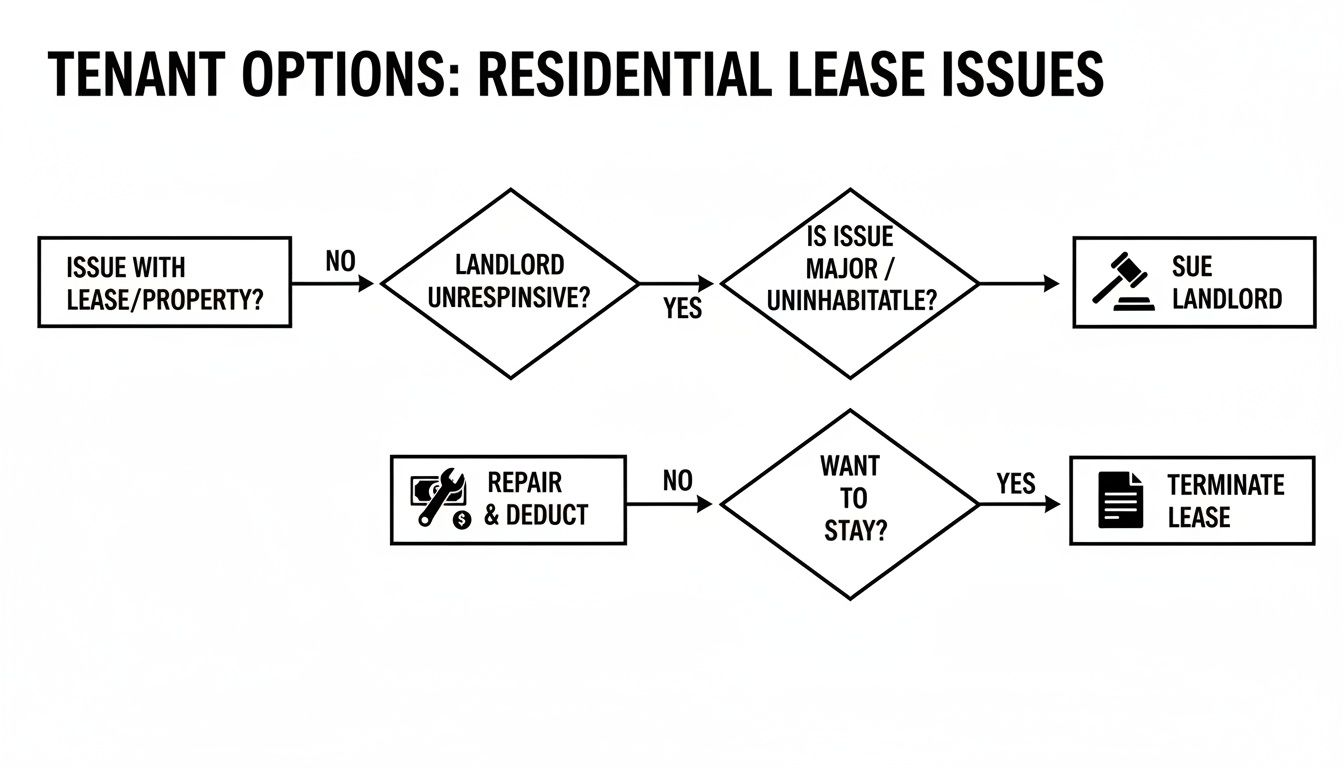
As you can see, once a tenant follows the formal notice process, the law gives them real leverage—including lease termination and suing for damages.
Understand the Bigger Picture of Tenant Rights
The fight over repairs is a global problem. In places like Germany, where 53.5% of people rent, landlords refusing to make repairs while hiking rents are a major social issue. While those countries have laws to protect tenants, actually enforcing them can be just as tough as it is here when landlords ignore their duties. You can read the full research about these global housing challenges.
Ultimately, your best protection is a well-drafted lease that spells out the repair process, combined with a reliable network of contractors and a commitment to clear communication.
When It’s Time to Call a Texas Landlord-Tenant Lawyer
You’ve sent the letters. You’ve documented the problem. You’ve waited. And still, your landlord refuses to make the necessary repairs.
Navigating a dispute like this is exhausting. While the Texas Property Code gives you rights, there comes a point when handling it alone isn't working. Knowing when to escalate—and bring in a professional Texas landlord tenant lawyer—is a critical step to protect your home and your sanity.
Certain situations are too high-stakes to handle on your own.
Red Flags That Scream "You Need a Lawyer"
Not every leaky faucet requires an attorney. But when the problem escalates, you need to recognize the warning signs.
You should contact a lawyer for help if:
- Your landlord is retaliating. If you request a repair and suddenly get hit with a rent increase, a bogus eviction notice, or other harassment, this is almost certainly illegal. An attorney can shut these tactics down immediately.
- The repair is huge or complicated. We're talking about major foundation problems, widespread mold, or serious structural damage. Landlords will fight hard to avoid the massive costs involved.
- You're ready to sue your landlord. Filing a lawsuit in Justice Court involves strict legal procedures, filing deadlines, and rules of evidence. A lawyer ensures your case is built to win.
- The landlord is trying to blame you. If your landlord falsely claims you caused the damage to dodge their responsibility, you need an advocate to set the record straight.
In any of these scenarios, a lawyer does more than just give advice. They take the weight off your shoulders, handle aggressive communication, and build a legal strategy designed to force a resolution.
How an Attorney Changes the Entire Game
Here's the truth: a letter from a tenant is a request. A letter from a law firm is a demand.
Hiring a lawyer immediately changes the dynamic. You're no longer just a tenant they can ignore; you are a tenant with legal representation ready to enforce your rights under the Texas Property Code. Suddenly, your landlord has a real incentive to listen.
A skilled Texas landlord tenant lawyer will:
- Review your case for free. A consultation gives you a clear understanding of your legal options without any upfront cost.
- Ensure every step is followed perfectly. Risky remedies like "repair and deduct" can backfire if done incorrectly. A lawyer can guide you through the process safely.
- Fight for your interests. Whether it's negotiating a settlement or arguing your case in court, an attorney is your dedicated advocate. They fight for the outcome you deserve—a court order for the repair, money for damages, or the right to terminate your lease without penalty.
Don't let a landlord's negligence make you feel powerless in your own home. You have rights, and you don't have to fight for them by yourself.
If you need help with a lease issue, rental dispute, or eviction, contact The Law Office of Bryan Fagan, PLLC for a free consultation today. Our experienced team is committed to protecting the property rights of Texans. Call us to discuss your situation and get a clear path forward.