In Texas, a landlord usually can't shut off utilities to force payment or push a tenant out. The main exception is master-metered electricity, and even then the landlord must follow narrow rules that include lease authorization, an unpaid bill past the 12th day, and specific written notice.
If you're reading this because the lights went out, the water stopped, or your landlord is threatening to “cut everything off,” you're probably dealing with more than a billing issue. You're dealing with stress, pressure, and a home that suddenly doesn't feel secure. Texas law takes that seriously.
The short version is simple. A utility shutoff is usually not a lawful collection tool. Landlords have legal remedies for unpaid rent and unpaid utility charges, but “self-help” tactics often create bigger problems for everyone involved. If you're a tenant, you need to know how to respond quickly. If you're a landlord, you need to know where the line is before a lease dispute turns into a lawsuit.
Your Rights When the Power Goes Out
A common version of this problem looks like this. A tenant falls behind, tries to catch up, and comes home to a dark apartment or no running water. The landlord may say it is temporary, call it “part of the process,” or insist the tenant has no right to complain because rent is overdue.
That confusion is exactly why utility shutoff disputes escalate so fast. When basic services stop, people worry about food, medicine, children, pets, work, and whether they can stay in the unit overnight. The legal issue matters, but the immediate problem is human.
What tenants often assume
Many tenants think a landlord can shut off service once an eviction has been filed. That's usually wrong. Filing an eviction case does not give a landlord permission to cut power, water, gas, or wastewater service as a way to force a tenant out.
Many landlords make the opposite mistake. They assume that because the tenant owes money, any pressure tactic is fair game. It isn't. Texas landlord-tenant law separates collection remedies from possession remedies, and a utility shutoff often crosses that line.
When utilities go out during a rent dispute, treat it as both a habitability issue and a legal issue. Move fast on both fronts.
What to do first that same day
Before you deal with the legal side, deal with safety and proof.
- Check whether the outage is broader: Ask neighbors if their unit is also out, and check the utility provider if you can.
- Preserve perishable items: Move medications and food if needed.
- Document conditions immediately: Take photos of breaker panels, faucets, thermostats, or any notice left on the door.
- Save every message: Texts, emails, portal notices, and voicemail all matter.
If the outage might be area-wide, practical preparation matters too. A simple guide on preparing for unexpected outages can help you handle the immediate disruption while you sort out the legal issue.
Why this article matters
The phrase can landlord shut off utilities in texas sounds like a yes-or-no question, but real cases often turn on details. Who pays the provider directly? Is the utility electricity or water? Is the building master-metered? Was proper notice given? Was this a repair, an emergency, or retaliation?
Those details decide whether a shutoff was legal, risky, or plainly unlawful.
What Texas Law Says About Utility Shutoffs
Texas gives tenants strong protection against utility shutoffs used as pressure tactics. The key rule appears in Texas Property Code § 92.008.
According to this explanation of Texas utility shutoff law, Texas Property Code § 92.008, enacted in 1989, explicitly prohibits landlords from interrupting utility services paid directly by tenants, except for bona fide repairs, construction, or emergencies. The same source notes that the law has been a tenant protection measure for over 35 years, and that courts issued over 1,200 Writs of Restoration of Utilities between 2010 and 2020.

The basic rule in plain English
If you pay the utility company directly, your landlord generally can't interrupt that service because you're behind on rent. That applies to the core services tenants usually worry about most, including electricity, water, gas, and wastewater, subject to the narrow exceptions built into the statute.
This law exists to stop self-help evictions. In plain terms, Texas wants landlords to use legal process, not pressure tactics that make a rental unit unlivable.
What the listed exceptions mean
The law doesn't forbid every interruption in every circumstance. It allows limited interruptions for:
- Bona fide repairs: Real repair work, not a made-up excuse
- Construction: Work that requires temporary interruption
- Emergencies: Situations that demand immediate action for safety or property protection
Those exceptions are not a blank check. A landlord cannot label a shutoff a “repair” if the actual goal is to force payment. Courts usually look at the facts, timing, communication, and whether the interruption fits a legitimate property issue.
Practical rule: If the service was cut off during a money dispute and not because of a real repair, construction need, or emergency, the landlord should expect scrutiny.
Why this matters for both sides
For tenants, the statute gives you a clear starting point. If utilities you pay directly were cut off, your rights may be stronger than you think.
For landlords, this is one of those areas where an impulsive decision creates legal exposure fast. A shutoff may feel like a way to exert pressure in the moment, but the safer path is usually formal notice, documentation, and court process. If you want a broader overview of these protections, this guide to Texas Property Code tenant rights is a helpful companion.
Understanding the Legal Exceptions for Landlords
Most online answers stop after saying “no, landlords can't do that.” That misses the part that causes the most confusion in real disputes. The most important exception involves master-metered electricity.

When electricity is billed through the landlord
Under Texas Tenant Advisor's discussion of utilities, Texas Property Code §92.008(c)-(h) allows a landlord to interrupt master-metered electricity only if all required conditions are met. The same source says over 20% of utility complaints involve master-meter disputes, and courts have ruled against landlords in 85% of challenged cases since 2020 because notice was improper.
That tells you something important. The legal exception exists, but landlords often execute it badly.
The required conditions for a lawful electricity shutoff
For a landlord to shut off master-metered electricity, several things must line up:
| Requirement | What it means in practice |
|---|---|
| Lease authority | The lease must expressly allow this remedy |
| Unpaid bill past the 12th day | The electricity bill must remain unpaid by the 12th day after issuance |
| Separate written notice | The tenant must receive a specific written notice, separate from routine rent demands |
| Required details in the notice | The notice must state the shutoff date, amount owed, and reconnection information |
| No health waiver | A qualifying health-related protection can block disconnection |
If any one of these pieces is missing, the shutoff becomes hard to defend.
What this exception does not cover
Many landlords get into trouble here. The master-meter exception is about electricity. It does not extend to water or gas.
So if a landlord says, “I bill all utilities through the property, so I can shut off water too,” that's the kind of shortcut that often leads to a claim. Older multifamily properties and informal billing systems are especially risky because management sometimes treats all utilities the same when the law does not.
A lawful utility plan on paper can still fail in court if the notice was sloppy, the lease language was vague, or the wrong utility was interrupted.
Two examples that show the difference
Example one: A Dallas apartment complex uses a master meter for electricity. The lease clearly authorizes interruption for nonpayment, the electric bill is unpaid past the required period, and management sends a separate notice with the shutoff date and amount due. That is the kind of case a landlord may be able to defend.
Example two: A landlord in San Antonio bundles water and electricity into monthly charges and sends one late-rent warning saying “all utilities will be disconnected if unpaid.” That approach is risky on several levels. It mixes utility categories, skips the specialized notice framework, and turns a collection dispute into a potential statutory claim.
Repairs and emergencies are different
There are also legitimate interruptions tied to property management, not collections. If an electrician must cut power to make a real repair, or if an emergency creates a safety threat, a temporary interruption may be lawful.
The difference is purpose. A repair-related interruption addresses the property. A pressure shutoff targets the tenant.
Consequences for Unlawful Shutoffs and Tenant Remedies
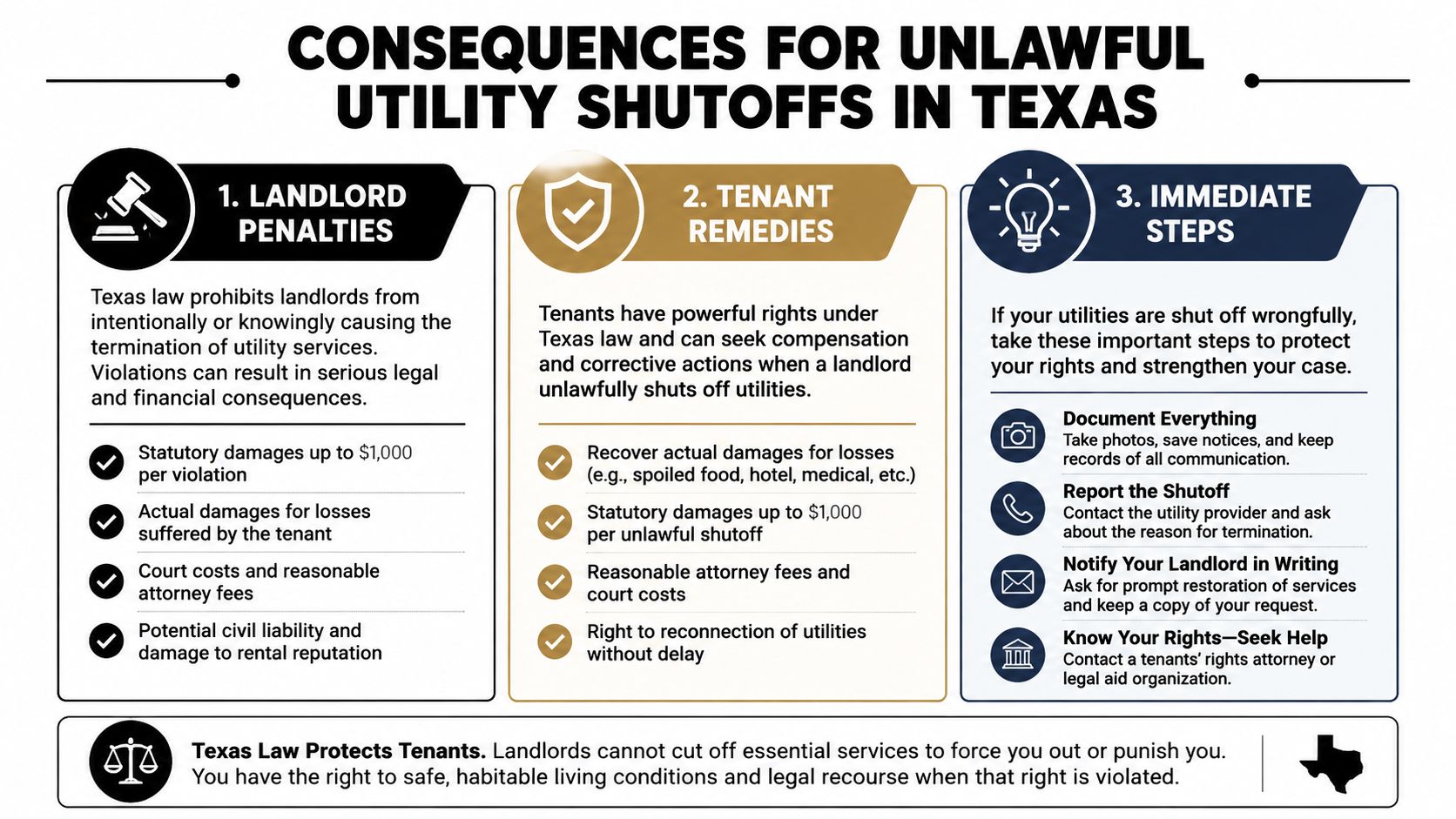
Illegal utility shutoffs can become expensive quickly. Texas gives tenants tools that are meant to restore service fast and punish misuse of utility interruptions.
According to this summary of Texas utility shutoff penalties, after the 2013 strengthening of § 92.008, tenants may recover actual losses, statutory penalties from $1,000 to $2,000, and attorney's fees. The same source reports that Texas courts awarded an estimated $1.7 million in damages and penalties across over 850 illegal shutoff cases from 2021 to 2023.
What tenants may be able to recover
A tenant's claim can include more than just “turn it back on.”
- Actual damages: Out-of-pocket losses tied to the shutoff, such as spoiled food, temporary lodging, or other provable costs
- Statutory penalties: The law allows recovery in the $1,000 to $2,000 range in the circumstances described above
- Attorney's fees: In the right case, legal fees may be recoverable too
This changes the economics of the dispute. What started as a short-term attempt to pressure a tenant can turn into a larger legal bill for the landlord.
The writ that gets attention fast
One of the strongest remedies is a Writ of Restoration of Utilities. This is a court order directing that utility service be restored.
That matters because tenants usually do not just need compensation later. They need the lights or water back now. When the facts support emergency relief, this remedy can shift the balance of power quickly.
If a tenant is facing an illegal shutoff, speed matters more than perfect paperwork. Good documentation filed promptly usually beats a delayed, polished complaint.
Why landlords should take this seriously
Some landlords focus only on whether they are “owed money.” Courts often focus first on whether the landlord used a forbidden collection tactic. Those are separate questions.
If the shutoff was retaliatory, aggressive, or poorly documented, the landlord may face more than a disagreement over rent. Conduct like that can overlap with broader claims involving pressure, interference, or harassment. For related issues, this page on landlord harassment in Texas gives useful context.
For Tenants Your Step-by-Step Guide to Taking Action
If your landlord cut off utilities, don't waste the first day arguing in circles. Build your record, protect yourself, and move toward relief.

Step 1 Gather proof before it disappears
Start with the basics. Write down the date and time the utility stopped working. Save screenshots of text messages, portal notices, emails, and payment receipts.
Take photos or short videos that show the problem. That may include a dark unit, a thermostat with no power, faucets with no water flow, or a breaker setup that appears unchanged. If neighbors tell you their service is still on, make a note of that conversation.
Step 2 Ask one direct question in writing
Send a short written message to the landlord or property manager. Keep the tone calm.
Ask:
- whether the shutoff was intentional,
- which utility was affected,
- why it was interrupted,
- and when service will be restored.
You are not trying to win the whole argument in one text. You are trying to pin down their explanation.
Step 3 Send a formal demand for immediate restoration
Once it appears the landlord caused the shutoff, send a more formal written demand. Email is useful because it preserves timing, and a printed letter can help too.
Your demand should include:
- The property address: Be precise about the unit
- The utility affected: Electricity, water, gas, or wastewater
- The shutoff timing: Date and approximate time
- Your request: Immediate restoration
- Your warning: State that you believe the shutoff violates the Texas Property Code and that you'll seek court relief if it isn't corrected
Keep emotion out of it. A clear demand reads better in court than a long argument.
Step 4 File for relief in Justice Court
If the landlord doesn't restore service promptly, go to the local Justice of the Peace court and ask about filing for a Writ of Restoration of Utilities. Bring your lease, notices, payment records, screenshots, photos, and your written demand.
If you need a starting point for reporting related conduct and organizing your complaint materials, this guide on how to file a complaint against your landlord can help you prepare your timeline and documents.
Bring paper copies even if you also have everything on your phone. Court staff and judges can review a clean packet much faster than a scrolling camera roll.
A short video overview may also help you think through the process before you go to court:
Step 5 Think about your immediate living situation
Legal action matters, but so does tonight. If there is no power, no water, or a health issue in the household, make a practical plan while the case moves forward.
Use this quick checklist:
- Protect medicine and food by moving them if needed.
- Notify your employer or school if the outage affects your schedule.
- Keep receipts for costs tied to the shutoff.
- Avoid self-help retaliation such as withholding access, damaging property, or changing locks.
Step 6 Know when to call a Texas landlord tenant lawyer
Some cases are straightforward. Others aren't. You should strongly consider legal help if the landlord claims the shutoff was authorized under a utility addendum, if the building uses master-metered electricity, if you have health-related concerns, or if an eviction case is already pending.
A Texas landlord tenant lawyer or eviction attorney can help you sort out whether the landlord's conduct was illegal, whether you need urgent court relief, and how to preserve damages claims without losing focus on getting service restored.
For Landlords The Right Way to Handle Unpaid Utility Bills
Landlords have a real problem when tenants don't pay utility reimbursements. The mistake is thinking the fastest pressure tactic is also the smartest one. In Texas, it often isn't.
According to the Texas State Law Library utility shutoff guide, Texas Justice Courts have seen a 35% increase in utility-related forcible detainer suits, and landlords have a 62% success rate when they properly document a 3-day notice for unpaid utilities as a lease violation. That should get every property manager's attention. Documentation and process work better than risky shutoffs.
What works better than cutting service
If the tenant owes for landlord-billed utilities, focus on the lease and the notice trail.
- Review the lease first: Confirm that unpaid utility reimbursements are clearly treated as amounts due under the lease.
- Serve the proper notice: A written 3-day notice tied to the lease violation is often the cleaner route when the facts support it.
- Keep records organized: Save ledgers, copies of bills, prior warnings, and proof of delivery.
- File for eviction if needed: If the tenant doesn't cure and the lease supports it, use the court process.
That approach may feel slower than a shutoff, but it usually puts the landlord in a stronger position.
High-risk landlord mistakes
Some errors show up again and again:
| Mistake | Why it causes trouble |
|---|---|
| Bundling all utilities together | The law treats some utility situations differently |
| Using one vague notice | Specialized electricity rules require precision |
| Treating water like electricity | The narrow master-meter exception does not broadly apply across utilities |
| Acting during a heated dispute | Retaliation arguments become more likely |
The practical trade-off
Landlords often ask whether a utility shutoff gets faster results. Sometimes it does in the short term. But if the shutoff is challenged, the landlord may lose time, money, and credibility in court.
The better strategy is boring on purpose. Clear lease drafting. Accurate billing. Proper notice. Court enforcement when necessary. That is how landlords usually protect both cash flow and legal position under the Texas Property Code.
If you need help with an eviction, lease issue, or rental dispute, contact The Law Office of Bryan Fagan, PLLC for a free consultation today. Whether you're a tenant dealing with an illegal utility shutoff or a landlord trying to enforce a lease the right way, the firm helps Texans understand their rights, reduce risk, and take the next step with confidence.