Skip to content
Paying rental application fees can feel like throwing money into a black hole. Tenants often pay several fees while trying to lock down a place before someone else gets it. Landlords and property managers have a different stress point. They need to screen applicants quickly, but one sloppy step in the process can create a legal dispute that was easy to avoid.
That's why the Texas law on application fees for rentals matters so much. In Texas, the biggest legal issue usually isn't the amount charged. It's whether the landlord handled the process correctly, especially whether the applicant got the required written screening criteria before paying.
If you're a tenant, that rule can protect your money. If you're a landlord, that same rule can protect you from refund claims and unnecessary litigation. The Texas Property Code gives both sides a framework. When people follow it, applications are straightforward. When they don't, small fee disputes can turn into larger legal problems.
Navigating Rental Applications in Texas
A common scenario goes like this. A renter finds a promising apartment on Monday, applies that afternoon, pays a fee, and hears nothing useful for days. Then the rejection arrives, with no clear explanation and no memory of ever receiving written screening standards. The renter's first question is simple. Was that fee supposed to be kept?
On the other side, a landlord may think the process is routine because the office has “always done it this way.” The manager collects the application, takes payment, and starts screening later. That approach works until an applicant asks for proof that the written tenant selection criteria were provided before money changed hands.
Texas law treats rental applications as a process with required steps, not just a payment screen. That's why paperwork matters so much. Before collecting a fee, landlords should have a clean, written system. If you're still building your leasing documents from scratch, it helps to create a residential lease document and related forms in a way that keeps the application process organized from the start.
Practical rule: In Texas, rental application disputes often turn on documents, timestamps, and consistent procedures, not on who feels more reasonable afterward.
The clients who handle this best are usually the ones who slow down at the front end. Tenants ask for the screening criteria before paying. Landlords make sure every applicant receives the same written standards in the same way, every time.
What the Texas Property Code Says About Application Fees
Texas does not set a statutory cap on rental application fees. Texas Law Help says the typical fee is between $15 and $50, but that range is guidance on what's common, not a legal ceiling. The more important rule is that an applicant has the right to review the landlord's written tenant selection criteria before paying any money, and if the landlord fails to provide that notice and then rejects the applicant, Texas law requires the return of both the application fee and any application deposit, as explained by Texas Law Help's overview of rental application fees.
Texas landlords and tenants should also understand that these rules sit within the broader Texas Property Code Section 92 framework, which governs many residential leasing rights and duties.
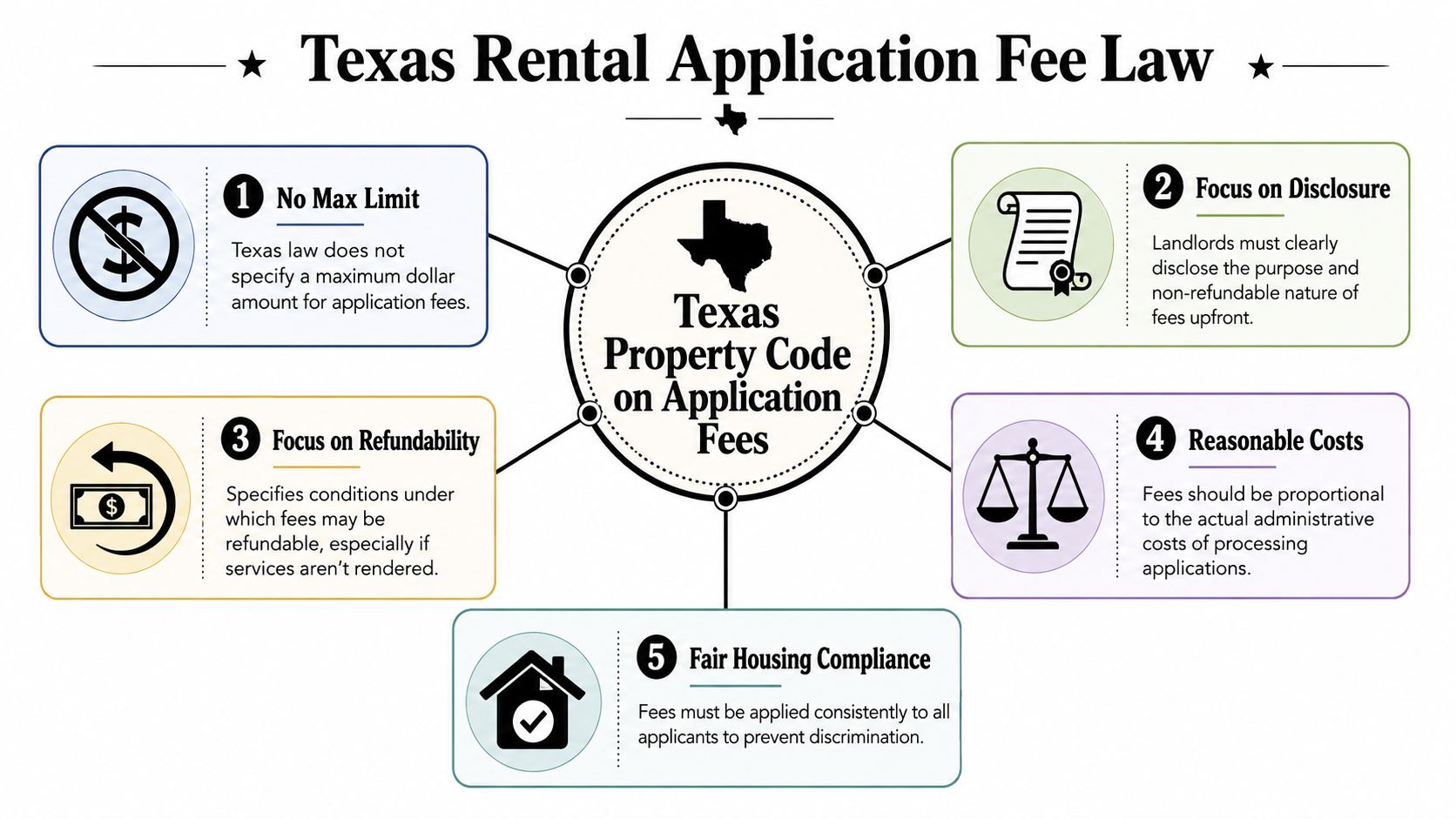
The law focuses on disclosure
Many people assume the law must limit the price. In Texas, that isn't the main control. The better way to think about it is this. The state doesn't regulate the price tag the way some people expect, but it does regulate whether the applicant got the terms up front.
That disclosure rule matters because it lets applicants decide whether it's worth paying before the landlord runs screening. It also forces landlords to define their standards before they start picking winners and losers.
What works and what doesn't
A compliant process usually looks like this:
- Written standards first: The landlord gives screening criteria before taking any money.
- Consistent use: The same criteria go to each applicant.
- Actual screening: The landlord uses the process described, rather than making a decision on the fly.
A risky process usually looks different:
- Fee first, paperwork later: The office collects payment and sends criteria only after the fact.
- Unwritten rules: A manager relies on internal habits instead of a written policy.
- Changing reasons: The applicant is rejected for something that was never clearly disclosed beforehand.
The amount charged gets attention. The timeline of disclosure often decides the dispute.
Texas also generally treats application fees as nonrefundable when the landlord follows the law. That's why landlords shouldn't assume “nonrefundable” language alone will protect them. If the required written notice wasn't provided first, that label may not save the fee.
Application Fees vs Application Deposits
People often use these two terms as if they mean the same thing. They don't. That confusion causes problems for both renters and landlords.
An application fee is usually payment for the screening process itself. Think credit review, background review, and the administrative work involved in evaluating the applicant. An application deposit serves a different function. It's tied more to holding the property while the application is being considered.
Why the distinction matters
Here's a simple way to think about it.
| Term | What it is for | Usual treatment |
|---|---|---|
| Application fee | Screening the applicant | Often treated as nonrefundable if handled lawfully |
| Application deposit | Holding the unit during the application process | More closely tied to whether the applicant is accepted, rejected, or withdraws |
If you want a broader explanation of when rental deposits may need to be returned, this guide on a refundable rental deposit in Texas is a useful companion topic.
A real-world example
Suppose a college student applies for an apartment near campus. The leasing office asks for one payment to process the application and another payment to take the unit off the market while the file is under review. Those two payments shouldn't be blended together just because they were collected at the same time.
That distinction becomes critical in a dispute. If the landlord's paperwork calls everything a “fee,” but part of the money was really intended to hold the unit, the refund analysis gets messy very quickly.
Where landlords get into trouble
Landlords create avoidable problems when they:
- Use the wrong label: Calling every payment a fee, even when one portion acts like a deposit.
- Skip written explanations: Failing to tell the applicant what each payment is for.
- Mix funds in one receipt: Giving a receipt that doesn't separate screening money from holding money.
For tenants, the lesson is to ask one direct question before paying: what part is for screening, and what part is being held toward the unit? If the answer is vague, the dispute later will be even vaguer.
A Landlord's Legal Duties for Compliance
The safest landlords in Texas don't treat application fees as casual office income. They treat them as part of a documented screening system. Texas does not impose a statutory cap on residential rental application fees, so landlords can set the fee amount without a state-law maximum. The fee is generally treated as non-refundable, which makes upfront disclosure of the screening criteria and fee structure the key compliance control point rather than the price itself, as noted by Landlord Studio's discussion of rental applications in Texas.
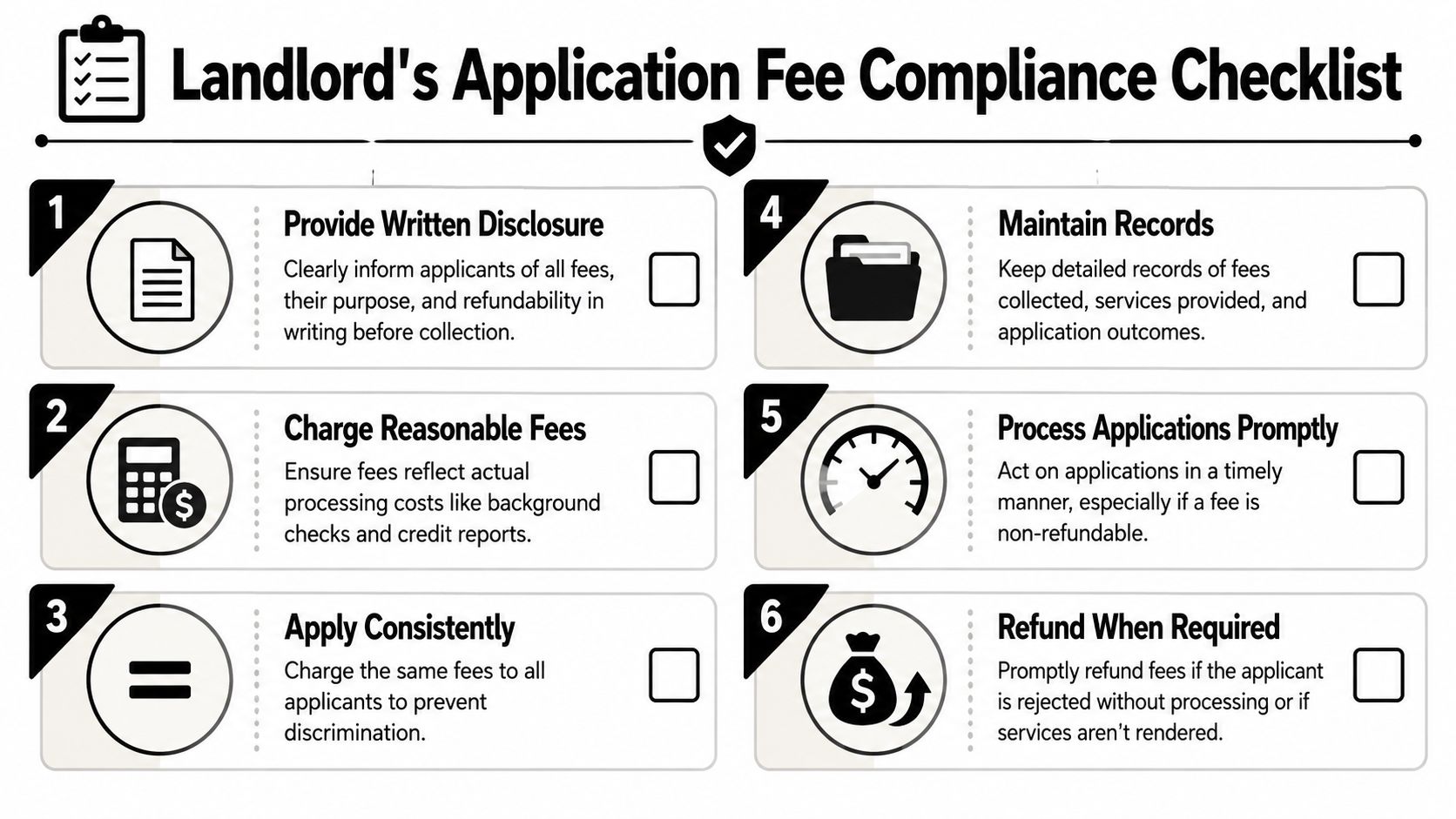
The five habits that reduce disputes
Landlords who stay out of trouble usually do these things in order:
Write the screening criteria before advertising the unit.
Don't rely on staff memory. Put the criteria in writing so the same standards are used every time.Deliver the criteria before collecting money.
This is the pressure point. If you can't prove this happened, you've created a refund risk.Give clean receipts and keep copies.
A dispute is much easier to resolve when the file shows what was paid, when it was paid, and what documents were given.Process the application.
If a fee is collected for screening, the file should reflect that screening happened.Communicate the decision clearly.
Delays and vague responses often trigger arguments that the process wasn't handled fairly.
Consistency matters as much as paperwork
A landlord can have a strong written policy and still create problems by applying it unevenly. If one applicant gets the criteria by email before payment, but another gets it only after being rejected, the second file becomes the one that ends up in court.
That's why property managers should use one intake procedure, one packet, and one recordkeeping method. It doesn't have to be fancy. It does have to be consistent.
Office practice that helps: Timestamp the disclosure, save the delivery method, and keep the exact version of the criteria that went to the applicant.
Where legal review helps
This is one area where preventive legal work is cheaper than a dispute. A Texas landlord tenant lawyer can review the application packet, selection criteria, receipts, and denial process to see whether the system matches the Texas Property Code. The Law Office of Bryan Fagan, PLLC handles lease and rental dispute matters involving screening practices, documentation issues, and other landlord-tenant compliance questions in Texas.
Understanding Your Rights as a Tenant
Tenants often assume that if a form says “nonrefundable,” the conversation is over. It isn't always over. In Texas, the strongest application fee disputes usually come from a broken process, not from the word printed on the receipt.
The most important question is whether the landlord gave you the required written tenant selection criteria before taking your money. If that didn't happen, and you were later rejected, you may have a basis to demand the return of the application fee and any application deposit.
The facts that matter most
If you believe a landlord kept your money unfairly, gather the basic paper trail first:
- Your receipt or payment confirmation: This shows what you paid and when.
- The application packet: Look for any written screening criteria and note when you received them.
- Emails or text messages: These often show whether the landlord gave reasons later that weren't disclosed upfront.
- The rejection notice: Even a short message can help frame the dispute.
A tenant's advantage usually comes from simple proof. You paid first. The criteria came later, or never came at all. Then you were denied.
Common refund situations
The table below gives a practical way to evaluate where you stand.
| Scenario | Is the Fee Refundable? | Reason Under Texas Law |
|---|---|---|
| You paid, were rejected, and never received written tenant selection criteria before payment | Often yes | Texas requires the criteria to be available for review before money is collected, and failure to provide that notice can trigger a refund obligation if the applicant is rejected |
| You paid an application deposit, were rejected, and the required written notice was not provided beforehand | Often yes | The same disclosure failure can require return of both the application fee and the application deposit after rejection |
| The landlord says the fee was nonrefundable, but you did receive the required written criteria before paying and the landlord followed that process | Usually not | A properly handled application fee is generally treated as nonrefundable |
| You were rejected for a reason that appears different from what the landlord represented during the process | Possibly | This may support a dispute about whether the screening process was properly disclosed and followed |
| You suspect the landlord collected the fee but did not really process the application | Possibly | This can raise questions about whether the fee was handled consistently with the stated screening process |
A practical example
Suppose you applied for a rental home, paid the screening charge, and were denied because of an issue involving pets. If the written criteria you received before payment never addressed pets at all, that inconsistency deserves a closer look. It doesn't automatically decide every claim, but it often points to a flawed application process.
If the landlord's real standards were never clearly disclosed up front, the applicant is left paying for a process they didn't agree to on informed terms.
What tenants should do next
Don't rely on phone calls alone. Ask for copies. Save screenshots. Put your refund request in writing. If the landlord provided the required materials on a portal or by email, pin down the date and time.
In many disputes, the winning side isn't the louder one. It's the one with the clearer file.
How to Handle Application Fee Disputes
When an application fee dispute starts, many tenants either give up too quickly or go straight to threats. Neither approach works well. Start with a short written demand that states the problem clearly and asks for a refund by a reasonable deadline.
If you need a model for the format and tone, this guide to a Texas demand letter can help you organize the request.

Start with a written demand
Your letter doesn't need to sound dramatic. It should include:
- The property address and date of application
- The amount you paid
- When you were rejected
- Why you believe the fee should be returned
- A request for payment by a specific date
A simple version might read like this:
I paid a rental application fee in connection with my application for the property. I was later rejected. I was not provided the written tenant selection criteria before payment. Please return the application fee and any application deposit promptly.
If the landlord refuses
If the landlord still won't return the money, the dispute may move to Justice Court. That's where even a relatively small fee issue can become more serious for the landlord if the statute was violated.
Be careful here. Court claims need accurate pleading, supporting documents, and a clear theory. Tenants often weaken good claims by filing too fast with incomplete proof. Landlords weaken defenses by arriving with no records showing when the criteria were delivered.
Build the file before filing the case
Before you sue or defend, organize:
- Proof of payment
- The application and any attachments
- Emails, texts, and portal screenshots
- Any rejection notice or explanation
- A copy of your demand letter
The strongest application fee cases are usually not legally complicated. They're factually clean. One side can show the written criteria were provided first, or the other side can show they weren't.
Frequently Asked Questions on Rental Applications
Can a landlord charge an application fee for each adult applicant
Often, yes, if each adult is being screened separately and the process is disclosed clearly in writing before payment. Problems start when the landlord's paperwork is unclear about who is being screened and what each payment covers.
What if I withdraw my application
That usually depends on the documents you received and when you withdrew. If the landlord already began the disclosed screening process, the landlord may argue the fee was earned as an application fee. If the money included a separate holding deposit, the analysis may be different.
Can a landlord keep the fee if I was approved but decided not to sign
Often yes, if the charge was a true application fee tied to screening and the process was handled properly. A separate application deposit may raise different issues depending on the written terms.
Does a landlord have to tell me why I was rejected
Landlords should communicate clearly, but the most important issue in many fee disputes is whether the written screening criteria were provided before payment and then followed. If the explanation given later doesn't match what was disclosed earlier, that may support a challenge.
What should landlords keep in their file
At minimum, landlords should keep the application, the written tenant selection criteria given to the applicant, proof of when those criteria were delivered, the payment record, and the final decision notice. Good records often end a dispute before it grows.
When should I talk to a lawyer
Talk to a Texas landlord tenant lawyer when the paper trail is messy, the landlord refuses to refund money after a written request, or the dispute is part of a larger problem involving discrimination, lease issues, or an eviction attorney's help.
If you need help with an application fee dispute, lease issue, or other rental conflict under the Texas Property Code, contact The Law Office of Bryan Fagan, PLLC for a free consultation today.