Dealing with mold in a rental can feel personal fast. You see dark spots near an AC vent, smell something musty in the bathroom, or notice a wall bubbling after rain. Then serious stress starts. Is this a simple cleaning issue, a leak inside the wall, or a legal problem under the Texas Property Code?
For tenants, the fear is usually the same. Health concerns, damaged belongings, and a landlord who says it's just “normal mildew” or blames your housekeeping. For landlords, the pressure looks different. You need to separate a real habitability issue from a tenant maintenance complaint, move quickly, and document your response before the dispute turns into a claim, a broken lease, or an eviction fight.
The hard part is that mold cases often turn on proof, not suspicion. Many online guides stop at “notify the landlord.” That's not enough. In Texas, the method of notice, the cause of the moisture, and the scope of the remediation all matter. If you're searching for mold in apartment tenant rights Texas, you need a practical roadmap, not generic advice.
Discovering Mold in Your Apartment Is Stressful but You Have Rights
You may be reading this after finding mold behind a couch, under a sink, or around a window frame that keeps getting damp. A common pattern is simple. The tenant reports a leak or moisture problem, the landlord sends someone to wipe the surface, and the mold comes back. Then both sides get stuck arguing about blame instead of solving the problem.
That's where people make expensive mistakes. Tenants rely on texts and phone calls. Landlords treat visible mold as a housekeeping complaint without checking the moisture source. Neither approach works well if the condition later ends up in court.
A better first move is to document what you see before anyone paints, wipes, or tears out drywall. Take clear photos. Note the room, the date, and whether the mold is near plumbing, a window, an exterior wall, or an air-conditioning register. If you manage property, using a practical inspection list like this essential checklist for property managers can help you separate surface conditions from signs of an ongoing water problem.
Mold disputes are often won or lost by the paper trail and the moisture story, not by who sounds more confident.
Texas law gives tenants rights when a condition materially affects health or safety, but it also gives landlords defenses when the condition was caused by the tenant or the tenant's guests. That's why the details matter from day one.
Mold and the Texas Warranty of Habitability
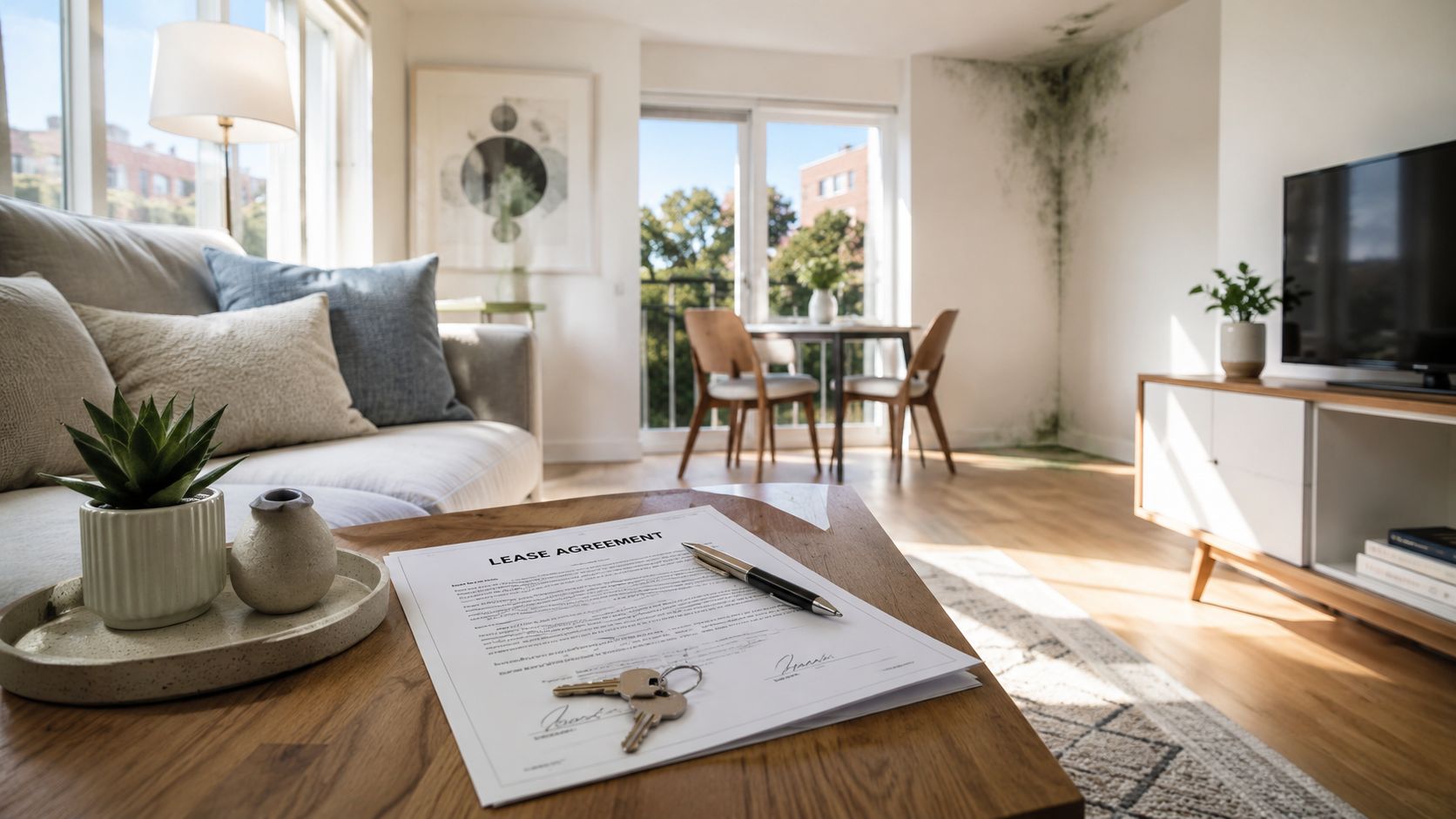
A residential lease isn't just an agreement to pay rent and occupy space. In plain English, it also carries a basic legal promise that the home will be safe and livable. Under the Texas Property Code, landlords must address conditions that materially affect a tenant's physical health or safety. Mold can fall into that category when it goes beyond a cosmetic issue.
What habitability means in real life
Think of habitability as the minimum safety promise behind the lease. A tenant doesn't rent an apartment expecting hidden leaks, recurring water intrusion, or mold growth that makes the unit unsafe to occupy. A landlord doesn't have to guarantee perfection, but the landlord does have to respond when conditions cross the line from inconvenience to health or safety risk.
That principle becomes clearer when you look at repair rights under the Texas Property Code. If you want a broader explanation of how these duties work, this guide on habitability laws in Texas and what landlords must provide is a useful companion.
Mold is usually a moisture problem first
In practice, mold cases are rarely just about what's visible on the wall. They're usually about what caused the moisture. A roof leak, plumbing leak, failed window seal, HVAC drainage issue, or building-envelope problem can all create the conditions for growth. Surface cleaning may make the problem look better for a short time, but it won't resolve the legal issue if the water source remains.
For tenants, that means your strongest argument usually isn't “there is mold.” It's “there is a condition affecting health or safety, and the moisture source has not been corrected.”
For landlords, the safest approach is to treat mold complaints as a repair investigation, not just a janitorial task.
Practical rule: If the moisture source isn't identified and corrected, the dispute usually comes back.
What the law does and doesn't promise
Texas law doesn't create a special mold warranty separate from general habitability rules. Instead, mold complaints are analyzed under the broader repair framework. That matters because the focus stays on three questions:
- Was the condition serious enough to affect health or safety?
- Did the tenant preserve legal rights properly under the Texas Property Code?
- Was the condition caused by the tenant or a guest, or by the property itself?
Those questions shape everything that follows, including notice, remediation, lease termination, and any later dispute over damages or a security deposit.
A Landlord's Legal Duty to Remediate Mold
A typical dispute looks like this. The tenant reports a dark patch spreading around an AC closet. Maintenance wipes the surface, paints over it, and leaves. Two weeks later, the spot returns because the drain line or supply plenum is still leaking. Legally, that second round often matters more than the first complaint, because it helps show the underlying issue was an unresolved moisture source, not a cosmetic stain.
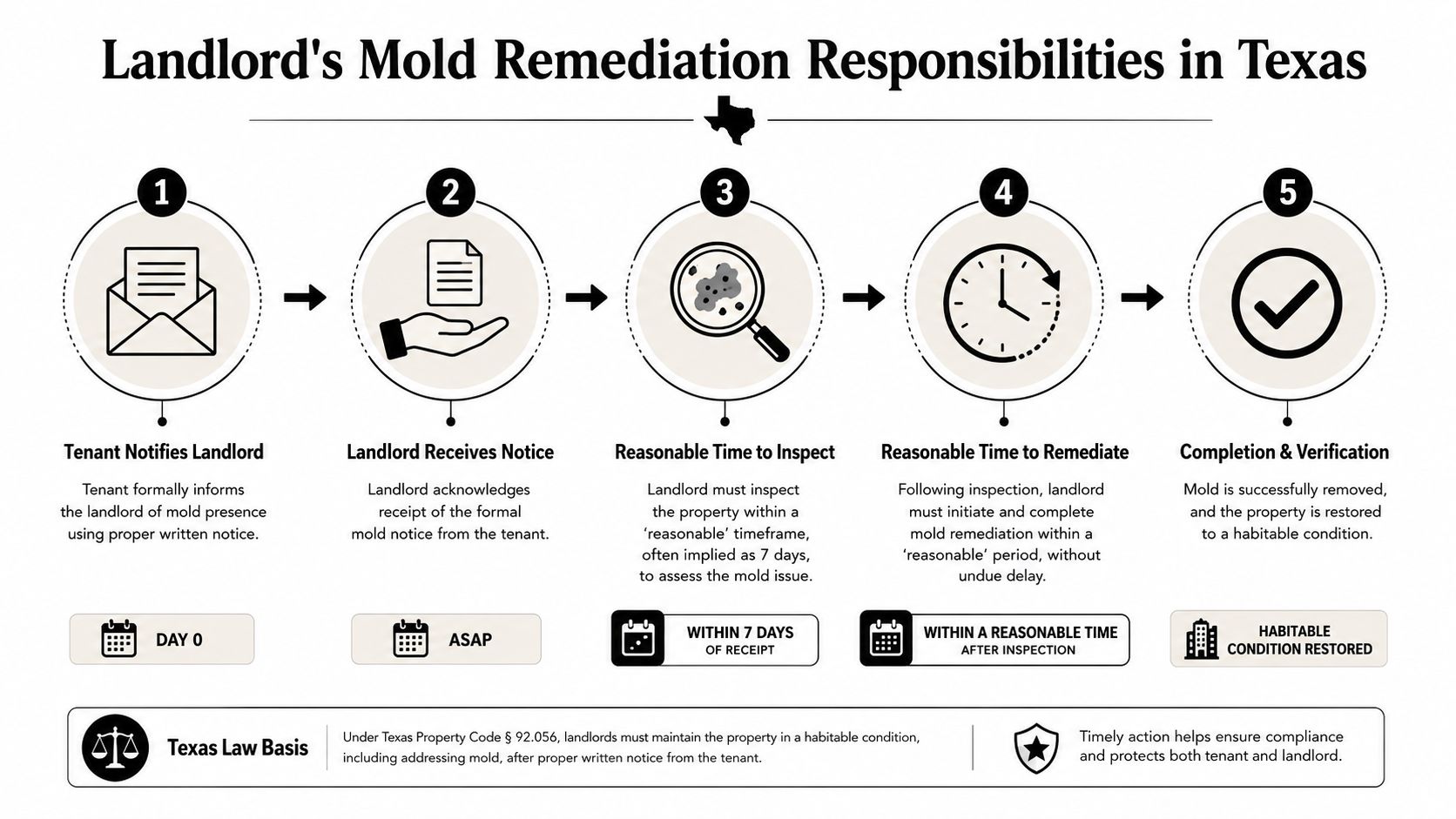
A landlord who receives proper notice of a condition that may affect health or safety has a duty to make a reasonable repair effort under the Texas Property Code. In mold cases, that usually means more than sending someone to clean what is visible. It means investigating where the moisture is coming from, deciding what level of work is appropriate, and keeping a record that shows the problem was handled in a sensible way. The Texas Department of Licensing and Regulation explains the state licensing rules for mold remediation and assessment here: TDLR mold program information.
What a reasonable response looks like
Reasonableness turns on facts. A landlord does not have to guess perfectly on day one, but the response has to match the risk and the available evidence.
A careful response usually includes four pieces:
- Prompt contact with the tenant. Confirm the complaint and arrange access quickly.
- An inspection aimed at origin, not just appearance. Check plumbing, HVAC components, windows, roofing, and exterior intrusion points.
- A repair plan tied to the source. Drywall replacement or cleaning may be part of the job, but the leak, condensation problem, or drainage failure has to be addressed.
- Documentation. Photos, work orders, vendor findings, moisture readings, and written communications often decide later disputes.
The proof problem gets overlooked in online guides. If the file only shows “mold treated,” a tenant may argue the landlord never fixed the actual defect. If the file shows the drain pan overflowed, the line was cleared, wet materials were removed, and follow-up drying was confirmed, the landlord is in a much better position.
When licensed remediation rules may apply
Texas has separate rules for larger mold remediation jobs. If the affected area reaches the threshold set by state regulations, licensed mold professionals may be required. The details are laid out in the Texas Administrative Code provisions on mold assessment and remediation.
For tenants, the practical point is simple. Large or recurring contamination should raise questions about whether the landlord is treating a building problem as a basic maintenance call.
For landlords, the trade-off is cost versus later exposure. Trying to save money with informal cleanup on a project that should have been handled under the state mold rules can create a harder defense if the tenant claims the work was incomplete or improper.
| Issue | Practical effect |
|---|---|
| Small, isolated surface condition | Cleaning may be enough if the source is verified and corrected |
| Larger affected area | State licensing and remediation rules may apply |
| Recurring mold after prior work | Strong sign the moisture origin was missed or not fixed |
| Weak documentation | Harder to prove the response was reasonable |
Residential and commercial rules are not the same
Most apartment disputes fall under Chapter 92. Commercial leases usually turn on the lease language and a different statutory framework. If you are dealing with business space instead of an apartment, Commercial Lease Disputes in Texas explains those differences.
A short written demand that identifies the location, dates, symptoms, and suspected moisture source can help both sides focus on the actual repair issue. This guide on how to write a demand letter to a landlord in Texas is a useful model.
What happens if the landlord's response falls short
A weak response usually fails in one of three ways. The landlord waits too long, treats visible mold without tracing the moisture source, or leaves no paper trail showing what was found and fixed.
That matters because later remedies often turn on proof. Tenants need to show the condition persisted and materially affected health or safety. Landlords need to show they acted reasonably and that any remaining problem was not caused by the property, or was made worse by tenant conduct such as failing to report leaks promptly or blocking access for repairs.
In other words, remediation is not just a cleanup question. It is an evidence question.
The Most Important Step Giving Proper Legal Notice
If you remember one thing from this article, remember this. Proper notice is the hinge that most tenant remedies swing on. A tenant can be completely right about the mold problem and still weaken their position by giving notice the wrong way.
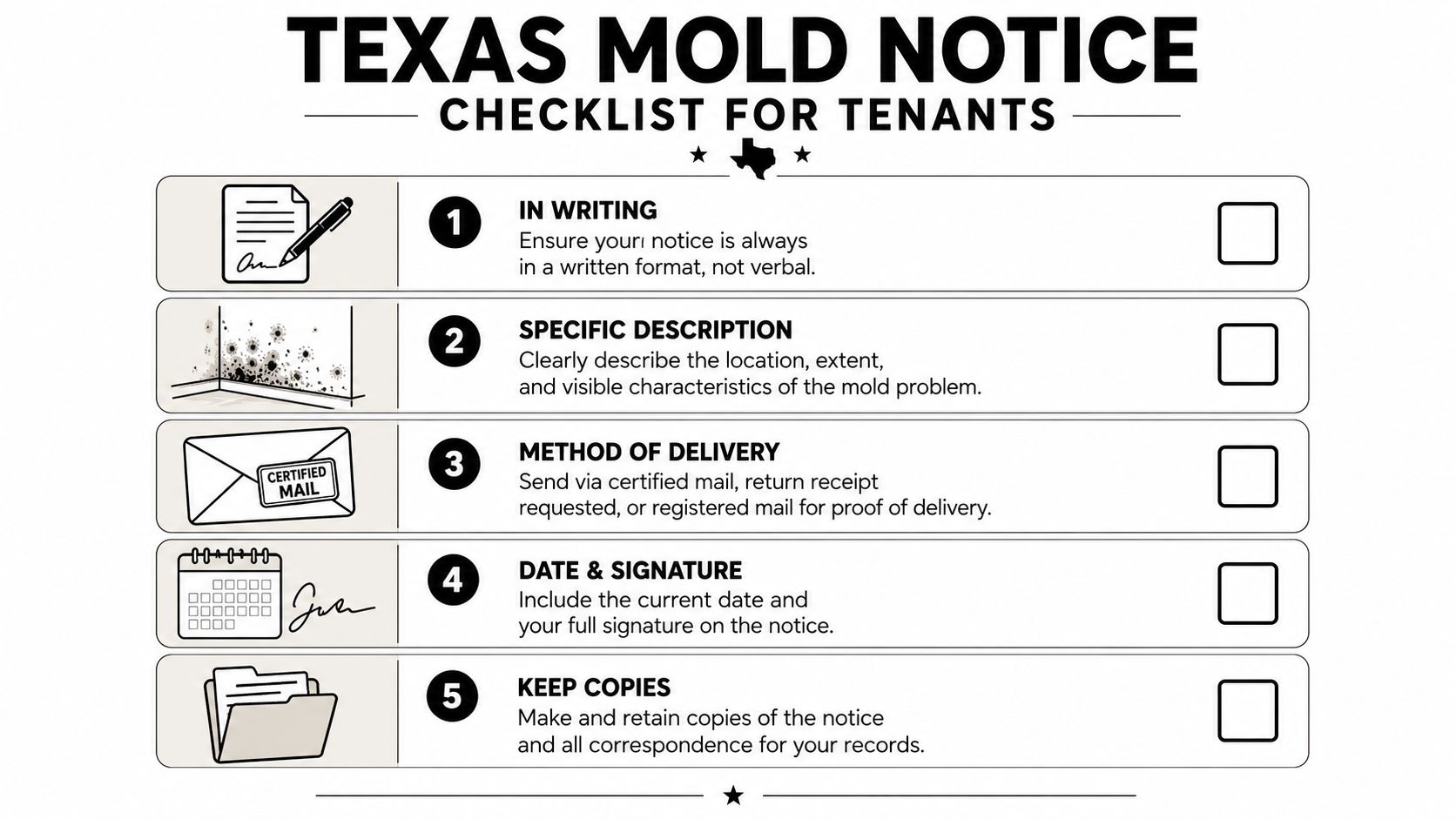
Texas requires more than a conversation in the leasing office. Under Texas Property Code §92.0561, a tenant must provide written notice by certified mail with a return receipt to preserve key mold remedies, and that documented delivery record is what triggers the landlord's obligation to act within a presumptive seven-day reasonable period, as explained by Texas Law Help's guide to mold and renters' rights in Texas. If you only send a text, email, or portal message, you may think you've done your part. Legally, that can be a costly mistake.
Why certified mail matters so much
Certified mail does two jobs at once. It creates proof that you sent the notice, and it creates proof that the landlord received it at the place where rent is normally paid. That's what courts care about.
Phone calls are useful for speed. Emails are useful for day-to-day communication. But neither one replaces the legal value of certified mail when you may later need to repair and deduct, terminate a lease, or defend against a nonpayment or eviction claim.
If you need help drafting the notice itself, a guide on how to write a demand letter to a landlord in Texas can help you organize the facts clearly.
A simple notice format that works better
Your notice doesn't need legal jargon. It does need specifics.
- Identify the problem clearly. State where the mold appears and what water issue you've observed.
- State the impact. Explain that the condition affects health or safety.
- Request repair. Ask the landlord to inspect and remediate the condition.
- Keep your records. Save a copy of the letter, mailing receipt, and return receipt.
A plain example:
“I am giving written notice of mold and moisture conditions in my apartment. The mold appears in the bathroom ceiling and on the bedroom wall near the exterior window. I have also observed ongoing moisture in those areas. Please inspect and repair this condition because it materially affects health and safety.”
This video gives additional context on handling landlord notice issues in Texas.
What doesn't work well
Tenants often undermine their own case by doing one of these:
- Relying only on verbal reports. You can't prove timing or content later.
- Sending notice to the wrong place. The statute ties notice to the person or place where rent is normally paid.
- Waiting too long to document the issue. Conditions change. Photos and dates matter.
For landlords, dismissing informal complaints is also risky. Even when notice isn't yet technically sufficient, an early inspection can prevent the legal problem from getting bigger.
Your Legal Remedies If Your Landlord Ignores the Mold
A tenant with a real mold problem usually reaches the point where waiting is more dangerous than acting. At that stage, Texas law offers a few possible remedies, but none of them are automatic and none work well without proof. The hard part is not only showing that mold exists. It is showing that the condition materially affects health or safety, that proper notice was given, and, in many cases, that the tenant did not cause the moisture problem in the first place.
Repair and deduct
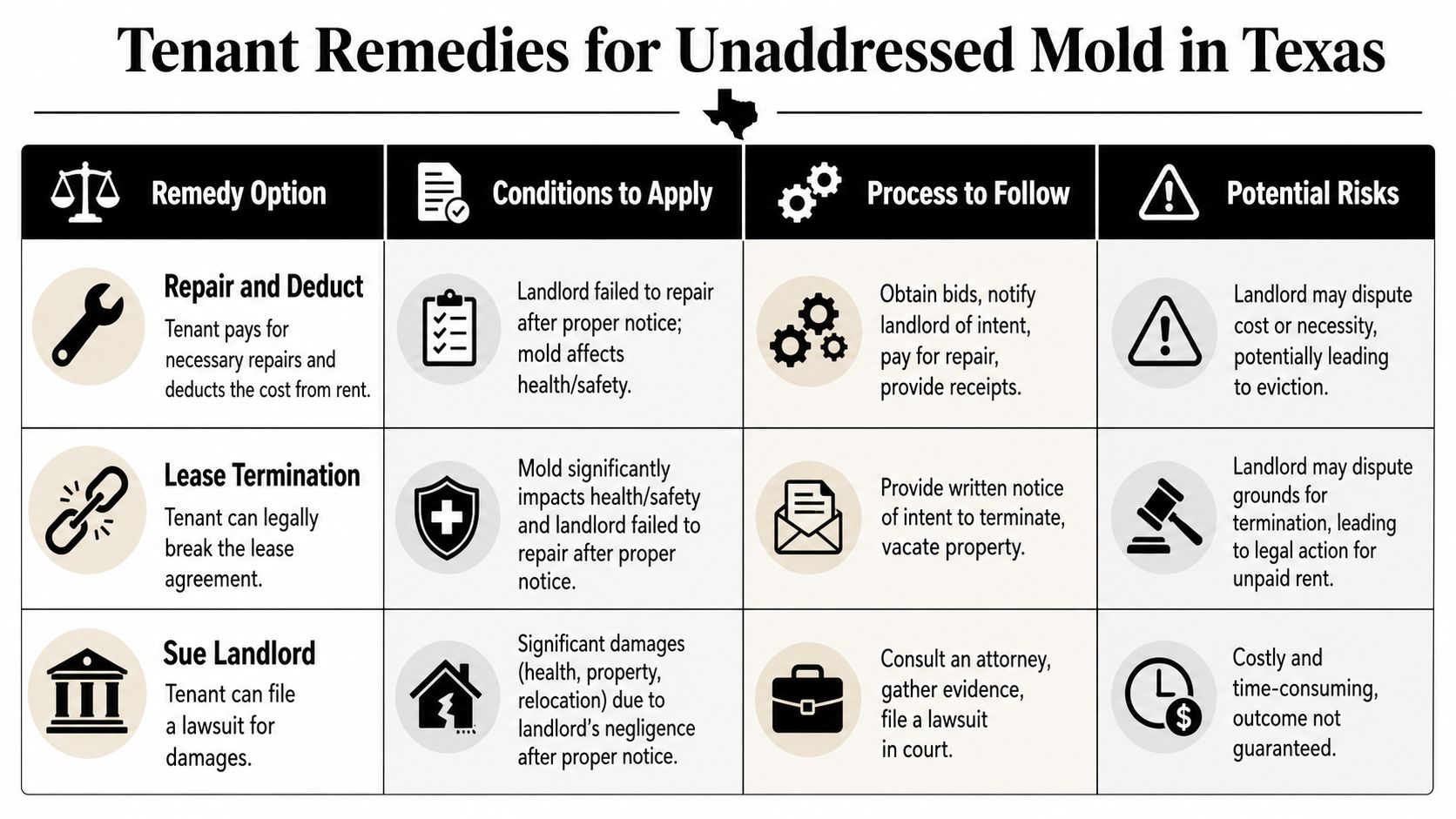
Texas allows a limited repair-and-deduct remedy under Texas Property Code §92.0561. It is narrower than many tenants expect. A tenant can use it only after meeting the statute's requirements, and the deduction cap is limited by law. The practical problem in mold cases is that true remediation often costs more than the statute allows, especially if the work involves opening walls, correcting a leak, or addressing hidden moisture rather than wiping a visible patch.
That is why this option fits only a small set of cases. It works best when the repair is modest, the source of moisture is identifiable, and the tenant has a clean paper trail. The Texas State Law Library repair-request guide is a better starting point than informal online summaries because it tracks the statutory process.
Tenants also need to be realistic about the proof issue. If you hire a contractor to clean visible mold but nobody identifies whether the cause was a plumbing leak, exterior intrusion, or tenant-generated humidity, the dispute often comes back later in a different form. The landlord may challenge the deduction. The tenant may still be living with the underlying moisture problem.
Lease termination
Sometimes the sounder remedy is to leave, not to keep fighting over repairs in an unhealthy unit. Texas law can permit lease termination when a condition materially affects health or safety and the landlord does not make a diligent repair effort after proper notice. But tenants get into trouble here by treating frustration as legal grounds to break the lease.
The repair history matters. The notice history matters. The origin of the mold can matter just as much.
The Texas State Law Library repair-request guide explains the repair-and-remedy framework, including the notice rules that often control whether termination is legally defensible. In practice, a tenant who leaves too early may win the argument about bad conditions and still lose the fight over unpaid rent, reletting charges, or a damaged rental history.
For landlords, this is also a risk point. If the file shows repeated complaints, visible water damage, and no meaningful inspection, a lease-break claim can become much harder to defend.
Lawsuit or court-based relief
Court becomes the better option when the mold problem is serious, the facts are disputed, or money damages matter. A tenant may seek judicial remedies allowed by the Texas Property Code, and in the right case may also pursue losses tied to the condition, such as damaged property, temporary relocation expenses, or other provable harm. The legal theory depends on the facts, and mold cases often turn less on dramatic photos than on records, timelines, and competing explanations for where the moisture came from.
That is why evidence should be built before filing, not after. Useful proof can include dated photos, maintenance requests, test results if they exist, reports identifying water intrusion, and contractor findings about whether the source was structural, plumbing-related, or tenant-created. The Texas Attorney General's tenant page gives a plain-language overview of repair rights and landlord duties under state law: Texas Attorney General guidance on tenant rights and repairs.
A lawsuit makes more sense in cases like these:
- The mold keeps returning after surface cleaning or repainting.
- The core dispute concerns the moisture source, not whether staining exists.
- The landlord blames the tenant without a solid inspection.
- The tenant has measurable losses tied to the condition.
- Retaliation or eviction threats start after repair requests.
Comparing the options
| Remedy | Best use | Main risk |
|---|---|---|
| Repair and deduct | Small, well-documented repair with a clear legal record | Deduction is disputed, or the work does not fix the moisture source |
| Lease termination | Conditions are serious enough that staying is not realistic | Landlord claims the tenant left without satisfying statutory steps |
| Lawsuit or court relief | Major damage, disputed cause, repeated failed repairs, or financial losses | More time, cost, and factual scrutiny |
The mistake I see most often is choosing a remedy before identifying the evidence problem. In mold cases, the question is rarely just, “Is there mold?” The question that decides leverage is, “Can you prove why it is there, who was notified, and what happened after that?”
Common Landlord Defenses and the Mold Origin Trap
The most common landlord defense in a mold case is simple: the tenant caused it. That may mean an argument about poor housekeeping, failure to use bathroom ventilation, overflowing tubs, uncovered aquariums, wet laundry indoors, or spills that were never cleaned properly.
Sometimes that defense is legitimate. Sometimes it isn't. The hard cases sit in the middle, where nobody disputes the mold exists, but both sides disagree about why it appeared. That's the mold-origin trap.
Why origin matters so much
Texas repair law gives tenants remedies when the harmful condition wasn't caused by the tenant or a guest. That sounds straightforward until you apply it to a real apartment. A bathroom ceiling stain might come from tenant humidity, an upstairs plumbing leak, missing insulation, a failed exhaust system, or water intrusion behind the wall. The surface can look the same in each scenario.
A commonly overlooked problem is that tenants often carry the practical burden of disproving blame. As noted in Enjuris' discussion of mold in Texas rentals, a common landlord defense is that mold was caused by “the tenant or one of their guests,” and tenants may need independent moisture mapping or forensic inspections to counter that claim.
What tenants should document
If you're a tenant, focus less on arguing and more on building a record.
- Show the location. Mold near windows, exterior walls, plumbing chases, or AC components may support a structural or system-related cause.
- Track recurrence. If maintenance cleaned the area and it returned, document that timeline.
- Preserve moisture clues. Staining, bubbling paint, soft drywall, warped baseboards, and repeated dampness all matter.
- Collect repair history. Prior leak complaints, work orders, and repeated AC or plumbing calls can be important.
What landlords should do to avoid weak defenses
Landlords hurt their own position when they jump to blame without investigating. A fair investigation should include entry, inspection, moisture-source review, and written findings. If you're managing multiple units, compare whether neighboring units show similar staining, leaks, or ventilation failures.
The strongest defense is evidence, not a reflex accusation that the tenant “must have caused it.”
A landlord who documents a real tenant-caused moisture problem is in a better position. A landlord who ignores signs of building failure usually isn't.
The practical trade-off
Independent inspections can help, but they also cost money and increase the stakes. Tenants may hesitate to spend on testing without knowing whether they'll recover that cost. Landlords may resist outside opinions that could expand the scope of repairs. Still, in close cases, neutral inspection evidence often breaks the stalemate better than another round of emails.
When You Need a Texas Landlord Tenant Lawyer for a Mold Issue
Some mold disputes can be resolved with prompt notice, a proper inspection, and a workable repair plan. Others become too risky to handle informally. That's usually the point where a Texas landlord tenant lawyer can help you avoid a preventable mistake.
Red flags that call for legal help
You should consider legal advice sooner rather than later if any of these are happening:
- Retaliation concerns. The landlord threatens fees, notices to vacate, or other pressure after you request repairs.
- Large or recurring contamination. The problem keeps returning or appears tied to leaks behind walls, roofs, plumbing, or HVAC.
- Health and habitability issues. You believe the condition has made the unit unsafe to live in.
- Security deposit disputes. You moved out over the condition and the landlord now claims you broke the lease wrongfully.
- Repair-and-deduct questions. You're considering a rent deduction and want to avoid creating an eviction defense issue.
If you're a tenant and need counsel focused on these disputes, a Texas tenant rights lawyer can review your notices, lease, photos, and timeline before you take a step that can't be undone.
Why timing matters
Mold cases get harder when people wait too long. Evidence disappears. Walls are painted. Units are re-rented. Memories get fuzzy. The same is true for landlords. If you're facing a tenant complaint that may turn into a broken lease, withholding dispute, or later damages claim, getting advice early often costs less than cleaning up the record afterward.
The Law Office of Bryan Fagan, PLLC handles Texas landlord-tenant disputes involving repairs, habitability, lease enforcement, security deposits, and related conflicts under the Texas Property Code. In mold cases, that usually means evaluating notice, causation, documentation, and the safest next move before the dispute escalates into court.
A good eviction attorney or landlord-tenant lawyer isn't there just for trial. Their primary value often comes earlier, when a clear strategy can keep both sides from making the kind of mistake that turns a repair problem into a much bigger case.
If you need help with an eviction, lease issue, or rental dispute, contact The Law Office of Bryan Fagan, PLLC for a free consultation today.