Dealing with a landlord dispute can be stressful—but understanding your rights under Texas law can make all the difference. That refundable rental deposit you paid isn't a bonus for your landlord; it's a safety net they hold in trust.
Texas law is very clear on this: your security deposit is not their personal piggy bank. Knowing your rights as a tenant is the only way to get your money back without a battle. This guide will walk you through the process step-by-step.
What the Texas Property Code Says About Your Deposit

When you handed over that deposit, you probably weren't thinking about having to fight for it later. But if you're worried about seeing that cash again, understanding Texas law is your most powerful tool.
The Texas Property Code lays out strict rules for how landlords must handle your deposit. The most important rule? The money is legally yours until the landlord can prove a legitimate reason to keep it.
The Purpose of a Security Deposit in Texas
Think of the deposit as an insurance policy for the landlord, not a blank check. It’s meant to cover specific, provable costs directly related to your tenancy.
Under Texas law, a landlord can generally only deduct for three things:
- Unpaid rent: This is the most common deduction. If you don't pay your last month's rent, your landlord can take it from the deposit.
- Damages beyond normal wear and tear: This means actual damage—a smashed window, a giant hole in the wall, or deep carpet stains. It does not include minor scuffs on the paint or slightly worn-out carpet from everyday living.
- Other charges specified in your lease: Some leases might outline fees for breaking the lease early, and those could be deducted if you do.
It's just as important to know what a deposit isn't for. A landlord cannot use your money to pay for routine maintenance, cosmetic upgrades, or fixing "normal wear and tear."
Texas Property Code § 92.101 defines a security deposit as any advance of money, other than a rental application deposit or an advance payment of rent, that is intended primarily to secure performance under a lease.
This simple explanation means the money is there to secure performance (like paying rent and not destroying the place), not to pad the landlord's bottom line. Understanding this is your first step to protecting your rights.
For more tips, check out this excellent guide on how to get your security deposit back.
The Landlord's Legal Obligations Under Texas Law
Fighting a landlord over your refundable rental deposit can feel like an uphill battle. But you're not on your own—Texas law provides a clear framework to protect you. The rules are laid out in Chapter 92 of the Texas Property Code, and they exist for one reason: to stop landlords from wrongfully pocketing your cash.
The most important rule to know is the timeline established by Section 92.103. Once you've moved out and given your landlord a written forwarding address for the refund, a 30-day clock starts ticking.
Within that 30-day window, your landlord must do one of two things:
- Return your full security deposit.
- Provide a written, itemized list of all deductions, along with any remaining portion of your deposit.
If they miss this deadline, there can be serious legal consequences. This isn't just a suggestion; it's the law.
Normal Wear and Tear vs. Actual Damage: A Real-World Scenario
Here’s where most deposit disputes happen. The law draws a line between "normal wear and tear" and actual "damage." Your landlord can only deduct for damages you or your guests caused—not for the simple, ordinary effects of living in a place.
Example Scenario:
- Normal Wear and Tear (Not Deductible): You lived in an apartment for three years. The carpet in the hallway is slightly worn down, and there are a few small nail holes from hanging pictures. The landlord cannot use your deposit to replace the carpet or repaint the walls. These are considered costs of doing business.
- Actual Damage (Deductible): During your move-out, you accidentally knock a large hole in the drywall. You also leave behind a significant wine stain on the living room carpet. Your landlord can use your deposit to pay for the cost of patching the drywall and professionally cleaning or replacing the stained section of the carpet.
A landlord who illegally withholds a security deposit may be presumed to be acting in "bad faith." This is a huge advantage for tenants, as it forces the landlord to prove their deductions were legitimate and reasonable.
If a judge finds your landlord acted in bad faith, you could be awarded three times the amount of the deposit they wrongfully kept, plus your attorney's fees. You can dig deeper into these protections by reading about the Texas Property Code and your tenant rights.
Knowing the law is your best defense against unfair deductions and empowers you to stand up for your rights.
How to Prevent Deposit Disputes in Texas

The best way to get your full refundable rental deposit back is to prevent a dispute from happening in the first place. This comes down to one thing: documentation.
The Texas Property Code allows landlords to subtract for unpaid rent and property damage beyond “normal wear and tear.” The gray area between living in a place and damaging it is where most disagreements arise. A clear record is your best protection.
Step-by-Step Guide to Documenting Your Rental
In a deposit dispute, the person with the best proof usually wins. Your smartphone is your most powerful tool. Here is a step-by-step process for creating a record that is difficult to argue with:
- Document at Move-In: Before you move a single box inside, walk through the property and take detailed photos and videos of every room. Zoom in on any existing scratches, stains, or damage.
- Narrate Your Videos: While recording, state the date and describe what you see. For example: "This is the kitchen on August 1st, 2026. There is a long crack on the granite countertop next to the sink." This creates undeniable, time-stamped proof.
- Complete a Condition Form: If your landlord provides a move-in condition form, fill it out in detail. If not, create your own checklist.
- Send Your Proof to the Landlord: Email your photos, videos, and checklist to your landlord immediately. This creates a digital paper trail proving they were aware of pre-existing issues from day one.
- Repeat at Move-Out: After the property is completely empty and clean, repeat the entire process. Document the clean floors, empty closets, and wall conditions to prove you left the property in good condition.
This same meticulous record-keeping is also essential for landlords to justify legitimate deductions and defend against false claims. Following these steps and understanding landlord responsibilities in Texas is the surest way to ensure a fair and transparent move-out process.
Normal Wear and Tear vs. Property Damage Chart
| Item | Normal Wear and Tear (Not Deductible) | Damage (Deductible) |
|---|---|---|
| Walls | Minor scuffs, faded paint, small nail holes from pictures | Large holes, unapproved paint colors, excessive markings or drawings |
| Carpets | Slight matting or thinning in high-traffic areas, minor fading | Significant stains (pet urine, wine), burn marks, rips, or tears |
| Flooring | Minor surface scratches on hardwood, worn finish | Deep gouges, chipped tiles, water damage from overflow |
| Fixtures | Loose grout in tile, tarnished faucets, wobbly toilet seat | Broken windows, cracked countertops, missing blinds, broken doors |
| Cleaning | A home left "broom clean" but needing a standard cleaning | Excessive filth, trash left behind, appliances caked with grime |
Step-by-Step: How to Get Your Money Back
When you hand over your keys for the last time, a countdown begins for your landlord. The Texas Property Code doesn't allow them to hold your refundable rental deposit indefinitely.
As mentioned, once you've moved out and given your landlord a written forwarding address, they have exactly 30 days to return your deposit or provide an itemized list of deductions. If they fail, Texas law assumes they acted in "bad faith." This legal term shifts the balance of power in your favor.
"Bad faith" means a judge will presume your landlord intentionally and dishonestly kept your money without a good reason. The burden is no longer on you to prove they were wrong. Instead, it’s on them to prove their failure was an honest mistake.
If a court finds your landlord acted in bad faith, Texas Property Code § 92.109 allows a judge to order them to pay you:
- A penalty of three times the amount of the deposit they wrongfully withheld.
- Your reasonable attorney's fees.
- All court costs.
Example Scenario:
If your landlord unlawfully keeps your $1,500 deposit and a judge rules they acted in bad faith, you could be awarded $4,500 ($1,500 x 3), plus the cost of your lawyer.
Modern Refund Methods
In 2026, waiting for a check in the mail feels outdated. Recent data shows that nearly 74% of renters prefer faster digital options like direct deposit or payment apps. You can learn more about these modern trends in rental deposit returns. While Texas law doesn't mandate a specific refund method, don't hesitate to ask for a digital transfer—it's faster for you and helps your landlord meet the 30-day deadline.
What to Do If Your Landlord Withholds Your Deposit
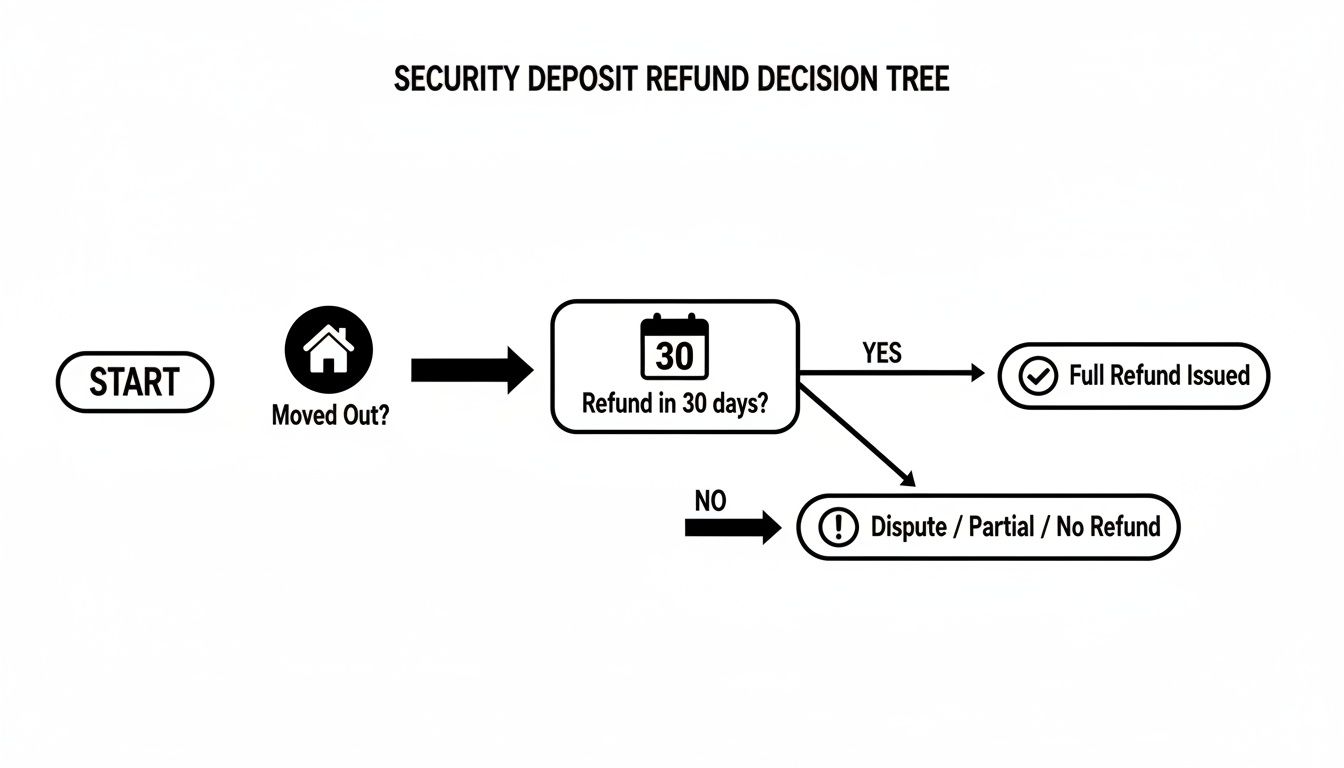
If the 30-day deadline has passed and your deposit is nowhere in sight, it's time to take action. Texas law gives you a clear path to get back what you’re owed.
Step 1: Send a Formal Demand Letter
Your first official step is to send a demand letter. This is a formal legal document that puts your landlord on notice and is crucial for your records.
You must send it via certified mail with a return receipt requested. The receipt is your undeniable proof that the landlord received your demand, which is critical if you end up in court.
Your letter should include:
- The current date.
- Your name and the address of the property you rented.
- Your lease dates.
- The amount of your refundable rental deposit.
- The date you moved out and provided your forwarding address.
- A clear demand for the full return of your deposit within a set timeframe (e.g., 10 days).
- Your forwarding address, listed again.
A formal demand letter shows you are serious about protecting your rights. You can learn more about how to write an effective demand letter in Texas to ensure it has the necessary legal weight.
Step 2: File a Lawsuit in Justice of the Peace Court
If your landlord ignores the demand letter, your next step is to file a lawsuit in a Justice of the Peace (JP) court, also known as small claims court.
These courts are designed to be accessible to everyday people. The rules are simplified, filing fees are low, and you can represent yourself. By filing in JP court, you are asking a judge to enforce the Texas Property Code. If the judge finds your landlord acted in "bad faith," you could be awarded up to three times the amount of your deposit plus attorney's fees.
An experienced Texas landlord-tenant lawyer can guide you through every step, from drafting a powerful demand letter to representing you in court.
Common Questions About Texas Security Deposits
Our Texas landlord-tenant lawyers frequently answer questions from both tenants and landlords about the rules governing a refundable rental deposit. Here are some of the most common ones.
Can a landlord deduct for cleaning fees in Texas?
Yes, but only if the property requires cleaning beyond what is considered normal. A landlord cannot use your deposit to cover their standard "make-ready" expenses for the next tenant. For example, leaving behind trash or a filthy appliance may justify a deduction. If you left the unit "broom clean," your landlord generally cannot charge you for a professional deep clean.
What happens if I don’t provide a forwarding address?
This is a critical mistake. Under the Texas Property Code, your landlord's 30-day deadline to return your deposit does not begin until they receive your new address in writing. Without it, you lose the "bad faith" presumption and make it much harder to sue for a wrongfully withheld deposit. Always send your new address via certified mail to protect your tenant rights.
What does "bad faith" mean in a deposit dispute?
"Bad faith" is a legal term that means a landlord is presumed to have acted dishonestly. This happens automatically if they fail to return your deposit or provide an itemized list of deductions within 30 days of you moving out and providing a forwarding address. If a judge finds bad faith, Texas Property Code § 92.109 allows you to recover a penalty of three times the deposit amount, plus attorney’s fees.
Do these security deposit rules apply to commercial leases?
No. The laws discussed here are in Chapter 92 of the Texas Property Code and apply only to residential leases. Commercial lease deposit rules are governed entirely by the terms of the lease agreement. The 30-day deadline and bad faith penalties do not apply to business rentals.
If you need help with an eviction, lease issue, or rental dispute, contact The Law Office of Bryan Fagan, PLLC for a free consultation today.