Eviction in Texas usually takes 21 to 60 days, and many straightforward cases land around 30 to 35 days. If you're asking how long does eviction take in Texas because you just gave notice, received notice, or got a court date, the answer depends on what happens at each stage and whether either side makes a mistake that slows everything down.
Dealing with a landlord dispute or eviction can be stressful, but understanding your rights under the Texas Property Code can make all the difference. A landlord may feel stuck with unpaid rent and no clear path forward. A tenant may be staring at a Notice to Vacate and wondering whether they have days, weeks, or more time to respond.
The timeline is not one long countdown. It is a chain of separate legal steps. The notice period comes first. Then the court filing. Then service of the lawsuit, the hearing, the appeal window, and finally the Writ of Possession if the landlord wins and the tenant does not leave. What speeds the case up is usually preparation and compliance. What slows it down is usually defective notice, missed deadlines, contested facts, or a tenant using legal rights that pause or extend the process.
Understanding the Texas Eviction Clock
A common initial concern is the date. They want to know when they can get possession back, or when they may have to move. Texas law gives a framework for that, but the process still moves in stages rather than in one fixed block of time.
According to the Taylor County eviction process guide, the minimum legal timeline to complete a full eviction in Texas is 21 days, the typical process takes about 30 to 35 days, and many non-complex cases fall within 21 to 60 days.

Why the timeline varies
A Texas eviction isn't just about whether rent was paid. It turns on whether the landlord gave a valid notice, whether the tenant was properly served, whether the tenant appears in court, and whether anyone appeals.
A simple nonpayment case can move relatively quickly when the paperwork is clean and the tenant doesn't contest possession. The same case can stretch much longer if the notice was defective, the service process takes time, or the tenant raises defenses.
Practical rule: Most delay in Texas eviction cases comes from procedural problems, not from the court trying to slow anyone down.
What each side should expect
For landlords, the biggest misconception is thinking the court hearing equals immediate removal. It doesn't. Even after a favorable judgment, there are required waiting periods before a constable can carry out a physical eviction.
For tenants, the biggest misconception is assuming a notice on the door means immediate lockout. It doesn't. A landlord can't lawfully skip the court process and remove you because rent is late or the lease was violated.
That is why understanding the clock matters. It helps landlords avoid reset-causing errors and helps tenants protect tenant rights early, when timing often matters most.
The Standard Texas Eviction Timeline Step by Step
Most Texas residential evictions follow the same basic path. The details matter, but the sequence stays familiar from county to county.
To make the process easier to follow, here is the standard flow at a glance.
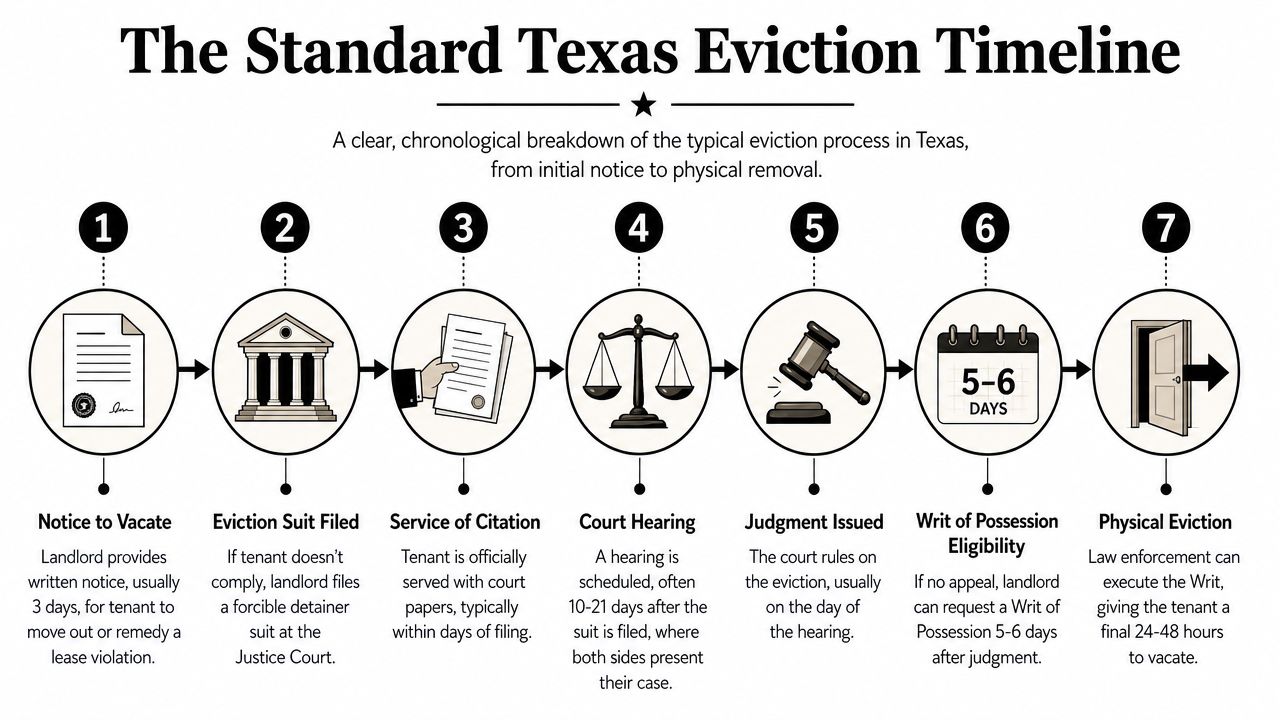
The core stages
Under Texas Property Code guidance summarized here, a landlord must give a written Notice to Vacate with at least 3 days before filing an eviction suit unless the lease sets a different period. After filing, the hearing must be set between 10 and 21 days later.
If you want a plain-language explanation of the first step, this guide on what is a Notice to Vacate in Texas is a useful starting point.
| Stage | Minimum Time | Typical Time |
|---|---|---|
| Notice to Vacate | 3 days | Often 3 days unless lease says otherwise |
| Filing the eviction case | After notice expires | Shortly after notice expires |
| Hearing setting | 10 days after filing | Up to 21 days after filing |
| Post-judgment wait before writ request | 6 days after judgment | About a week after judgment |
| Final posting before removal | 24 hours | Depends on constable scheduling |
Step 1 through Step 3
Notice to Vacate
The eviction process commences with this notice. The notice tells the tenant to leave by a deadline or face a court filing. Under Texas Property Code §24.005, the default rule is at least three days unless the lease says something different. If the notice is missing required information or is served improperly, the landlord may have to start over.Eviction suit filed in Justice Court
If the tenant doesn't leave by the deadline, the landlord can file the eviction case. This is often called a forcible detainer case. Filing too early is a common error. If the notice period has not fully expired, the case may be vulnerable.Service of citation
The tenant must be formally served with the court papers. This part matters because due process requires real notice of the lawsuit. If service is delayed or challenged, the hearing may still be pending while everyone waits for proper service.
The first notice often causes the most confusion. The Notice to Vacate: Requirements and Timing addresses what a valid Texas Notice to Vacate must contain before an eviction can be filed.
A short video can help if you're trying to visualize the sequence:
Step 4 through Step 6
Court hearing
The hearing date must fall within the statutory window after filing. During the hearing, both sides can present the lease, payment records, notices, photos, messages, or other evidence. A tenant who appears and raises a real legal issue may change the pace and direction of the case.Judgment
In many cases, the judge decides possession at or around the hearing. A landlord win does not mean same-day removal. A tenant loss does not mean immediate lockout.Eligibility for writ
There is still a required post-judgment period before the landlord can move to the next enforcement step.
A well-documented file often matters more than a long argument. Judges usually want the lease, the notice, proof of delivery, and a clear explanation of what happened.
What works and what doesn't
What works:
- Clear notice language: Say what the violation is and when the tenant must leave.
- Accurate records: Keep the lease, ledger, messages, and proof of notice delivery.
- Prompt action: File when the notice period ends, not weeks later when the facts are harder to organize.
What doesn't:
- Self-help eviction: Lock changes, utility shutoffs, or intimidation can create separate legal problems.
- Loose paperwork: If dates don't line up, the case can stall.
- Assumptions: Landlords shouldn't assume silence means surrender. Tenants shouldn't assume inaction means the case went away.
After the Judgment The Writ of Possession Phase
Many people think the case ends when the judge rules. In practice, the judgment is only the handoff into enforcement.
The post-judgment phase matters because possession doesn't return physically until law enforcement carries out the writ. If you're a landlord, patience and follow-through are particularly important. If you're a tenant, deadlines become especially important at this stage.
The appeal window
After judgment, the tenant has a short period to decide whether to appeal. During that window, the landlord is not yet at the final removal stage.
That pause is one reason the answer to how long does eviction take in Texas often surprises people. Even in a strong landlord case, there is still a mandatory sequence after the hearing.
The writ process
The Texas State Law Library eviction process guide explains that a landlord can request a Writ of Possession 6 days after final judgment. The writ cannot be issued more than 60 days after the judgment is signed, and the constable must execute it within 5 days of issuance, followed by a 24-hour notice before physical removal.
For a focused explanation of this stage, see this page on the Writ of Possession in Texas.
Why this stage often causes delay
The court can sign a judgment, but the constable still has to post and execute the writ. That creates a practical gap between winning possession on paper and regaining the property in real life.
Court victory and physical vacancy are not the same event.
A common landlord mistake is waiting too long after judgment and then scrambling when scheduling becomes tight. A common tenant mistake is ignoring the posted writ and assuming there will be more warning than the law requires.
If no appeal is filed and the writ moves forward, the tenant will receive final notice before removal. At that point, voluntary move-out is usually the least disruptive option for everyone involved.
Key Factors That Can Change the Eviction Timeline
Some cases move cleanly from notice to writ. Others slow down because one decision, one missing document, or one special rule changes the path.
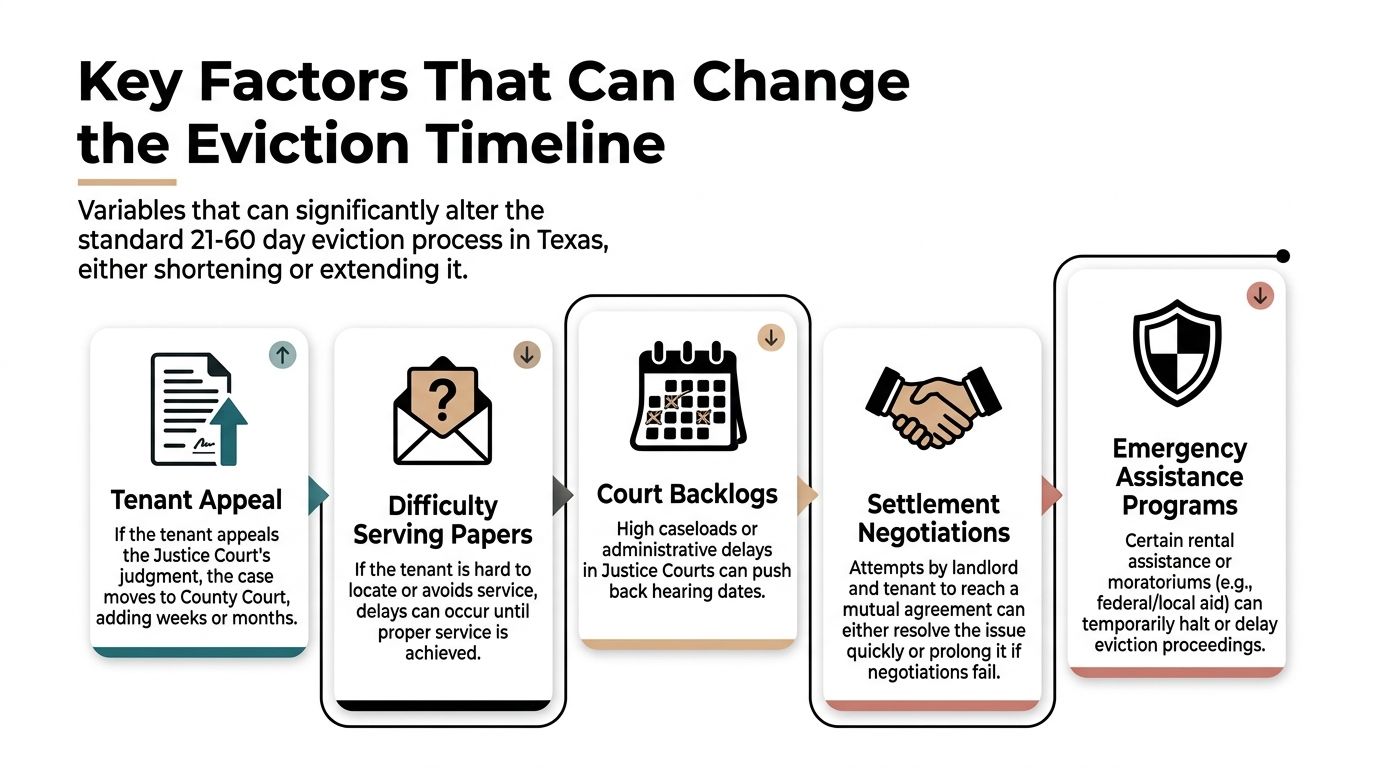
Delays that commonly extend the process
The first category is legal delay. A tenant may contest the case, appear in court, request more formal process, or appeal after judgment. Some defenses are weak. Some are serious. Improper notice, retaliation, and service problems can all affect timing.
The second category is practical delay. Papers have to be served. Hearings have to be scheduled. Constables have to execute writs. Even when the law sets clear windows, local workload can affect how quickly the next step happens.
Some tenants also look for lawful ways to buy time while they work out a move, gather rent, or prepare defenses. This overview of how to delay an eviction in Texas legally explains common procedural options.
The federal notice issue many people miss
One of the most important timeline changes has nothing to do with the hearing date. It begins before the lawsuit is even filed.
The Texas eviction law summary here notes that tenants in federally subsidized housing or in properties with federally backed mortgages may be entitled to a 30-day federal notice, which overrides Texas's standard 3-day notice and adds 27+ days to the pre-filing phase. If a landlord misses this requirement, the notice can be invalid and the process may have to restart.
That issue matters in real practice because many owners do not realize their financing or property type triggers a different rule. Many tenants do not realize they may have more time than a standard state-law notice suggests.
Watch for this early: If federal rules apply, a technically correct Texas notice may still be legally insufficient.
What tends to keep a case moving
Faster does not mean careless. It means legally clean.
- Complete documentation: Landlords who keep the lease, ledger, notices, and communications organized usually avoid unnecessary resets.
- Prompt response: Tenants who answer notices quickly, ask questions early, and appear in court preserve options that disappear later.
- Focused negotiation: Sometimes the fastest outcome is an agreed move-out date or payment arrangement. Sometimes negotiation burns time because neither side is prepared to compromise.
A practical example: if a landlord posts a notice that doesn't comply with the lease, the case may collapse before the merits are even reached. By contrast, if the landlord serves a proper notice and the tenant knows there is no real defense, a negotiated exit can end the dispute far more predictably than a contested hearing.
Timelines for Different Types of Evictions
Not every eviction starts with unpaid rent. The legal framework is similar, but the reason for the eviction changes how much conflict to expect and what evidence matters most.
Nonpayment cases
These are often the most direct. The landlord usually relies on the lease, the payment ledger, and the notice. The tenant may respond by disputing the amount owed, arguing the notice was defective, or raising a defense tied to the landlord's conduct.
When the records are clean, nonpayment cases are often the easiest for a court to sort out. When the accounting is messy, they can become much harder than landlords expect.
Lease violation and holdover cases
Lease violations can include unauthorized occupants, repeated disturbances, property misuse, or other breaches. These cases often turn less on math and more on proof. Photos, witness statements, notices, and prior warnings can matter.
Holdover matters are different. The tenant may not have done anything wrong except remain after the right to possession ended. In those cases, the timeline can feel similar to a nonpayment case, but the dispute is often about notice and lease expiration rather than missed rent.
A month-to-month tenancy can also require more careful analysis because the lease terms and termination provisions may shape the path before any eviction is filed.
Commercial evictions
Commercial cases deserve special attention. The same broad principles apply, but commercial leases often contain their own notice rules, default clauses, cure language, and possession terms.
For landlords, that means the lease has to be read before action is taken. For tenants, it means rights and obligations may look very different from a residential lease. Commercial disputes also tend to involve higher stakes and more negotiation before either side wants a court hearing.
In both residential and commercial settings, the cause of the eviction doesn't just affect the legal argument. It affects whether the case is likely to settle, be defended aggressively, or need very careful compliance review under the Texas Property Code and the lease itself.
Your Next Steps Guidance for Landlords and Tenants
A Texas eviction case often speeds up or slows down because of what the parties do in the first few days. I tell clients the same thing every week. Small mistakes at the notice, filing, or hearing stage can add more time than people expect.
If you're a landlord
Start by reading the lease closely, then compare it to the notice you plan to send. The timeline usually turns on that first step. If the notice period is wrong, the delivery method is weak, or the stated reason for possession does not match the lease, the case may have to be redone from the beginning.
Build your file before you file suit. Gather the signed lease, payment history, notices, text messages or emails, photos if the dispute involves damage or other violations, and proof showing how notice was delivered. If the issue depends on lease language, AI legal contract analysis can help you review clauses and identify questions to raise with counsel before you go to court.
Landlords also need to decide what result they want. Fast possession, a payment plan, and a negotiated move-out do not always point to the same strategy. In some cases, pressing ahead immediately makes sense. In others, a short written agreement saves more time than a contested hearing.
Legal help makes the biggest difference when the facts are not clean. That includes federal housing rules, subsidized tenancies, retaliation allegations, repair disputes, disability-related issues, or any case where the tenant is likely to appear and fight possession. For legal help, consider The Law Office of Bryan Fagan, PLLC, which handles Texas landlord-tenant disputes for both landlords and tenants.
If you're a tenant
Treat every notice and court paper as time-sensitive. Do not wait to see what happens. The clock usually keeps running whether you respond or not.
Read the lease and compare it to the notice line by line. Check the dates, the reason given, and what the landlord is asking for. Then gather the documents that could change the outcome, such as receipts, bank records, repair requests, photos, inspection reports, or messages with the landlord.
Ask practical questions early:
- Was the notice legally sufficient and delivered the right way?
- Does the landlord's reason for eviction match the lease and the facts?
- Do you have records that show payment, unresolved repairs, or another defense?
- Is there a realistic chance to settle before the hearing?
Tenants often lose time by focusing on what feels unfair instead of what they can prove. Judges usually need documents, dates, and a clear explanation. If you plan to contest the case, arrive organized and on time. Missing the hearing can hand the landlord a judgment without your side being heard.
If you are unsure what kind of dispute you are dealing with, start by putting the paper trail in one place. That step often reveals whether the case is really about unpaid rent, a notice problem, lease compliance, repairs, or something else entirely.
Frequently Asked Questions About Texas Evictions
Can a landlord legally speed up an eviction in Texas
A landlord usually can't skip steps. The lawful way to keep a case moving is to use a valid notice, file promptly after the notice period ends, serve the right documents, and arrive at court with organized proof. Mistakes slow cases down more often than the court does.
What happens if I miss my court date
If a tenant misses the hearing, the judge may proceed without hearing the tenant's side. If a landlord misses the hearing, the case may be dismissed or delayed. Either way, missing court usually makes the outcome worse for the absent party.
Can a tenant stop the eviction by paying after the case is filed
Sometimes the parties work out a solution, but payment after filing does not automatically erase the case. It depends on the lease, the landlord's position, and whether both sides agree to resolve the matter.
Does bankruptcy stop an eviction
Bankruptcy can affect timing, but whether it stops an eviction depends on the status of the case and the type of relief involved. This is one of those situations where fast legal advice matters because the answer turns on posture and timing.
Can a landlord change the locks or remove property without a court order
No lawful eviction should rely on self-help removal. Physical removal from the property comes through the court process and enforcement by the proper officer, not by the landlord taking possession personally.
What's the most common reason a Texas eviction gets delayed
In practice, the biggest problems are defective notice, service issues, missing documentation, and disputes that could have been addressed earlier. For tenants, failing to act quickly often gives up options that were available at the beginning.
If you need help with an eviction, lease issue, or rental dispute, contact The Law Office of Bryan Fagan, PLLC for a free consultation today.