Yes, a landlord can charge late fees in Texas, but only if the lease allows it, the rent stays unpaid for more than two full days after the due date, and the amount stays within the Texas Property Code safe-harbor limits of 12% for properties with four units or fewer and 10% for properties with five units or more.
That answer sounds simple until you're the person holding the notice, reviewing the ledger, or deciding whether to post one. A tenant may see a charge that feels sudden or inflated. A landlord may assume a standard lease clause is enough. In practice, late-fee disputes in Texas usually come down to timing, lease wording, and whether extra charges were piled on in a way the law doesn't support.
The Stress of an Unexpected Rent Dispute
A late rent issue rarely starts as a legal question. It starts with stress.
A tenant opens an online portal and sees a balance higher than expected. A landlord checks the account on the first business morning after rent was due and sees nothing posted. Then come the texts, the emails, the printed notice on the door, and the sinking feeling that a routine payment problem may turn into a bigger conflict.

What this looks like in real life
A common tenant-side scenario goes like this. Rent was due, money was tight, and payment landed later than planned. The next screen shows not just late rent, but a late fee, a notice fee, and another line item that wasn't clearly explained when the lease was signed.
On the landlord side, the issue looks different. Mortgage payments, vendors, taxes, and property expenses don't pause because a tenant pays late. Owners often want a rule that pushes rent toward the due date and keeps collections predictable.
Both sides usually think they are being reasonable.
A rent dispute gets harder to solve once people argue from assumptions instead of the lease and the Texas Property Code.
Why these disputes get messy fast
Texas does allow residential late fees. But it doesn't give landlords unlimited freedom to charge whatever they want, whenever they want. The details matter. A fee that would be enforceable in one lease may fail in another because the clause is vague, the timing is off, or the accounting stacks multiple charges around one missed payment.
That gray area is why people often search for can landlord charge late fees Texas limits explained. They aren't just asking whether late fees exist. They're asking whether a specific charge on a specific ledger is lawful.
If you're a tenant, your concern may be whether you have to pay a charge that seems padded. If you're a landlord, your concern may be whether enforcing the fee will hold up if the tenant pushes back in court. Both are fair concerns, and both have clearer answers than might be assumed.
The Legal Foundation for Late Fees in Texas
The starting point is Texas Property Code Section 92.019. If you're dealing with a residential late-fee dispute, that's the statute to check first.
Texas tightened its late-fee rules in 2019 when Senate Bill 1414 added clearer safe harbors to replace what had long been a broader "reasonable" standard. Under Texas Property Code § 92.019, a late fee may not be charged unless it is written into the lease and the rent remains unpaid for more than two full days after it was due, as explained by the Texas State Law Library's overview of rent rules.
Two requirements matter first
Before anyone argues about the amount, ask two basic questions:
- Is the late fee written in the lease? If it isn't, the landlord doesn't get to create it later by text message, portal notice, or office policy.
- Was the rent unpaid long enough? A charge posted too early can be challenged even if the lease mentions late fees.
These are threshold issues. If one is missing, the rest of the debate may not matter.
What changed after the 2019 law update
Before the statutory change, people often fought over what "reasonable" meant. That led to avoidable confusion. One landlord might think a certain charge was ordinary. A tenant might think the same charge was punitive.
The 2019 change didn't remove all disputes, but it gave both sides a firmer compliance framework. The practical rule now is that late-fee enforcement depends on lease language and timing, not just a general belief that the amount seems fair.
For readers who want a broader look at the statute's role in Texas rental disputes, this overview of Texas Property Code Chapter 92 is a useful starting point.
Practical rule: If a landlord wants to collect a late fee, the lease needs to say so clearly before the problem happens.
What doesn't work
Several approaches create trouble quickly:
- Verbal policies: A manager says, "We always charge a fee after the first." That's not enough by itself.
- Hidden portal terms: If the lease doesn't support the charge, software won't fix the problem.
- Retroactive enforcement: A landlord can't decide mid-lease to add a late fee structure that was never agreed to in writing.
For both landlords and tenants, the safest move is simple. Pull the signed lease, find the late-fee clause, and compare the actual charge to what the statute allows.
Calculating the Maximum Allowable Late Fee
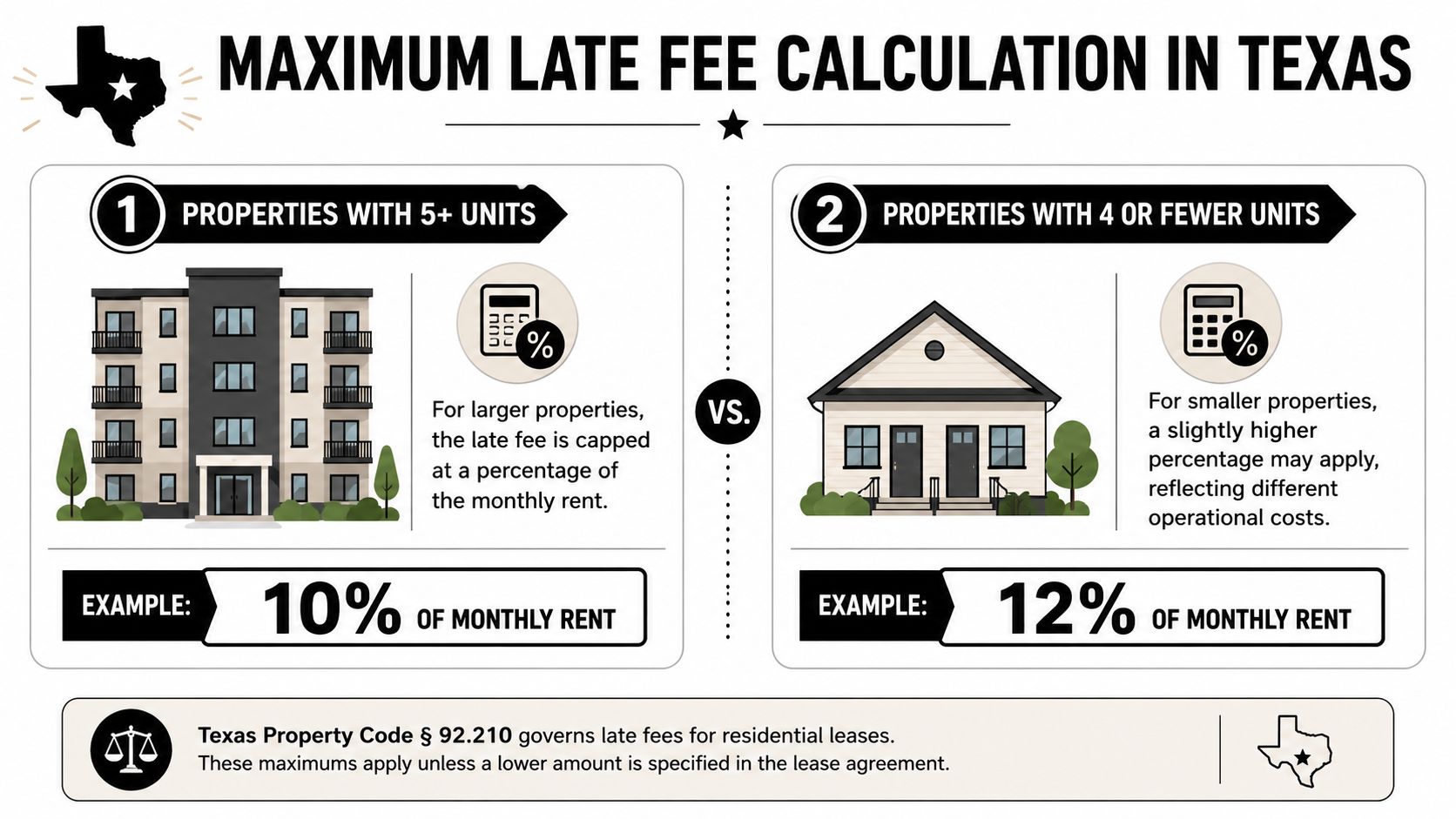
Texas uses a property-size threshold to decide what late fee is presumed reasonable. For dwellings in structures with four units or fewer, the safe-harbor limit is 12% of monthly rent. For structures with five units or more, the limit is 10% of monthly rent, according to the Texas Tenant Advisor explanation of late fees.
The two categories
The law treats smaller properties and larger properties differently.
| Property type | Presumed reasonable late fee |
|---|---|
| Structure with four units or fewer | 12% of monthly rent |
| Structure with five units or more | 10% of monthly rent |
That distinction matters more than many people realize. A tenant renting a single-family house and a tenant renting in a larger apartment complex may pay the same monthly rent, but the safe-harbor late fee isn't necessarily the same.
A concrete example
The same source gives a simple illustration. On $1,500 monthly rent, the safe-harbor late fee is $180 in a property with four units or fewer and $150 in a larger property with five units or more.
That makes the math easier to spot on a ledger. If the property is in a larger apartment complex and the late-fee total tied to that month climbs above the safe-harbor figure, the landlord is moving outside the cleaner compliance zone.
Stay grounded in the full monthly ledger. One line item may look modest on its own, but the legal question is whether the total late-fee charge tied to that month remains within the safe harbor.
What landlords should do with this rule
For landlords, the smart practice is consistency. Use a lease clause that tracks the applicable property category and make sure your management software doesn't automatically generate charges that go beyond what the law presumes reasonable.
A few practical checks help:
- Confirm the property type: Count the structure correctly before selecting a lease template.
- Use one calculation method: Flat-fee models and percentage models can both create confusion if the lease language is sloppy.
- Audit your ledger settings: Many disputes start with automated postings, not intentional overcharging.
What tenants should look for
Tenants should compare three things side by side:
- The signed lease clause.
- The type of property involved.
- The actual amount charged.
If those don't line up, it may be worth disputing the charge in writing before the issue snowballs into a notice or eviction argument. That is often where can landlord charge late fees Texas limits explained becomes less of a search query and more of a recordkeeping project.
Understanding the Mandatory Two-Day Grace Period
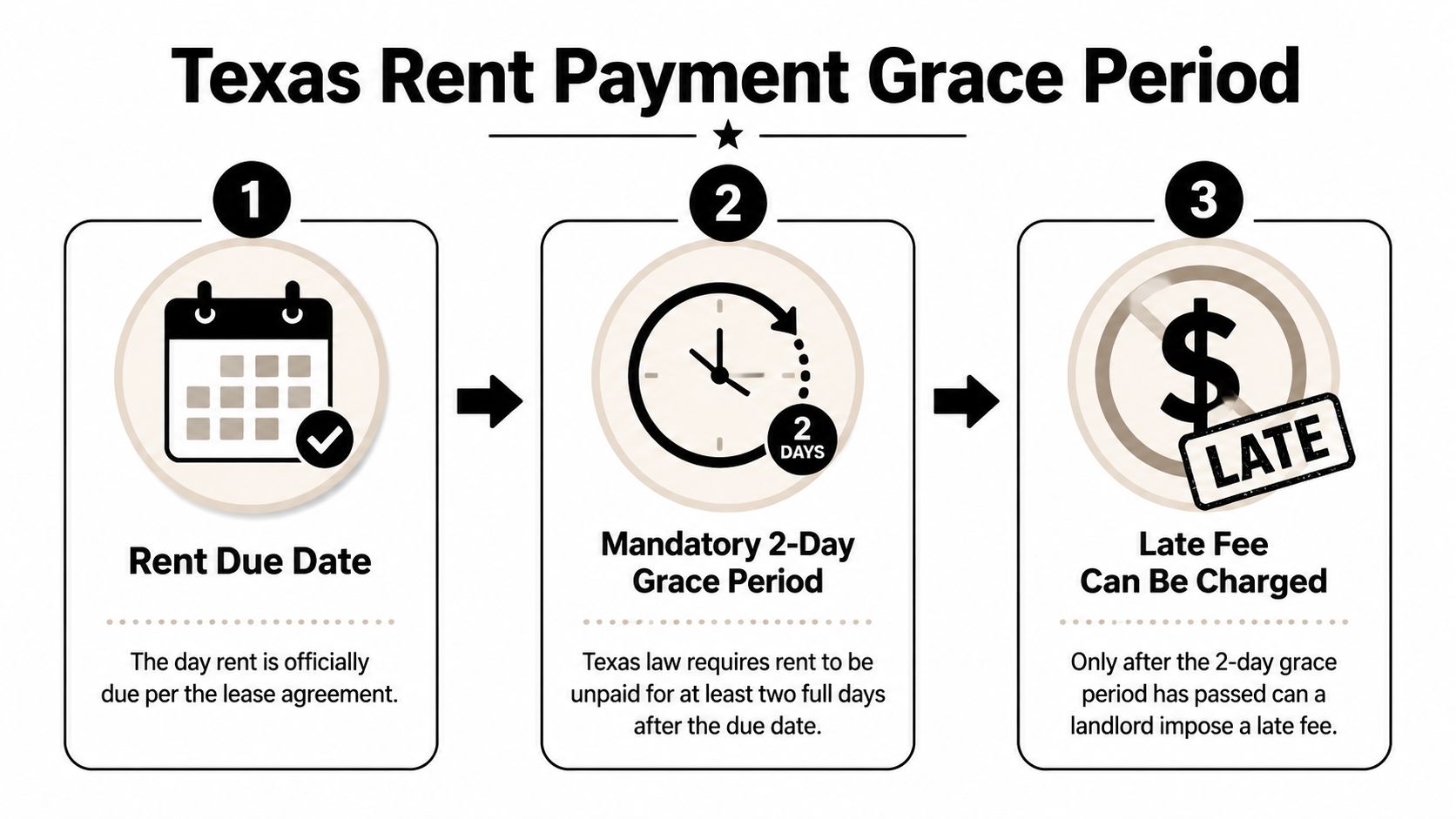
Timing is just as important as amount. Texas law doesn't allow a landlord to impose a late fee the moment rent becomes overdue.
The Texas State Law Library explains the rule this way in practice. If rent is due on the 1st, a late fee generally can't be charged until the 4th day because the law requires two full days to pass after the due date, as noted in the earlier legal framework and reflected in the Texas guidance on late rent payment issues.
A simple calendar example
Think about the timeline this way:
- Day rent is due: No late fee yet.
- First full day after due date: Still no late fee.
- Second full day after due date: Still no late fee.
- Next day after those two full days pass: The late fee can be assessed if the lease allows it.
That rule clears up one of the most common mistakes in residential leasing. Some people assume that "late" automatically means "fee due now." It doesn't.
Why this matters in disputes
A fee charged too early can undermine a landlord's position, even when the tenant plainly missed the due date. Courts tend to care about whether the landlord followed the statute, not whether the landlord felt justified.
For tenants, this is one of the easiest things to verify. Check the due date in the lease, then check when the fee appeared on the statement, portal, or ledger.
This video gives a helpful visual overview of how the timing issue works in practice:
A practical way to document the issue
If you're challenging a fee based on timing, keep your proof organized:
- Save the lease page: Highlight the due date and late-fee clause.
- Capture the ledger: Screenshots showing when the charge first appeared can matter.
- Preserve payment records: Bank confirmation, portal receipt, or money-order proof helps frame the timeline.
If the fee hit the account before the required waiting period expired, the tenant has a concrete issue to raise.
Landlords should also document timing carefully. A lawful fee posted one day too soon can create a needless dispute that would have been easy to avoid with better internal controls.
How to Write an Enforceable Late Fee Clause
A rent dispute often starts with one sentence in the lease. The tenant reads "late fee" one way. The landlord reads it another way. Then the ledger shows a late charge, an admin charge, and maybe a notice fee tied to the same missed payment. By that point, the problem usually is not the missed rent alone. It is vague drafting.
An enforceable late-fee clause should answer three questions on the page itself. What triggers the fee, how much is charged, and whether the landlord plans to add anything else related to that same late payment. If the lease leaves those points fuzzy, both sides are exposed. Landlords get a harder clause to defend. Tenants get surprise charges that were never explained clearly.
What a strong clause should say
Good drafting is specific. In Texas, a late-fee clause should be written so a judge, property manager, or tenant can read it once and understand how it works without guessing.
A useful clause usually does four things:
- It states that the fee applies only after rent remains unpaid long enough for Texas law to allow the charge.
- It gives a fixed amount or a formula that can be calculated from the monthly rent.
- It identifies any separate charge the landlord may claim in connection with nonpayment, instead of hiding those items under broad labels.
- It avoids open-ended language that lets management add new fees later.
Here is the kind of wording that tends to hold up better:
Tenant agrees to pay a late fee equal to the applicable percentage allowed by Texas law if the full monthly rent remains unpaid after the required statutory waiting period. No additional administrative, notice, or collection-related charge will be imposed for that same late payment unless this lease specifically identifies the charge and the legal basis for it.
That last sentence matters. It addresses the fee-stacking problem directly. A landlord cannot make a clause stronger by using several labels for what is really one late-payment penalty. If extra charges are going to appear on the ledger, the lease should explain exactly what they are and when they apply.
Drafting mistakes that create avoidable fights
I see the same clause problems over and over. They are usually small on paper and expensive in practice.
- Undefined add-ons: "Administrative fee," "processing fee," or "collection charge" with no description.
- Catch-all wording: Phrases such as "and any other charges landlord deems appropriate."
- Conflicting lease language: One section describes a capped late fee, while another allows daily penalties or separate notice charges.
- Stacking by label: A late fee appears in one paragraph, then other rent-default charges are buried elsewhere in the lease.
The safest approach is simple. If a charge is tied to the same missed rent payment, draft it with enough precision that a tenant can tell whether it is a true separate charge or just an added penalty in disguise.
If you are reviewing the lease as a whole, this guide on what to include in a Texas lease agreement is a useful starting point.
Electronic signing does not fix bad drafting
Many Texas landlords use online leasing platforms. That is fine. Electronic signatures can make execution faster and recordkeeping cleaner. This overview of SignWith for electronic leases explains the signing side well.
Still, an electronically signed bad clause is still a bad clause. Clear drafting matters more than the format.
A practical review checklist before anyone signs
Landlords should compare the lease language to the way fees appear in the portal, notices, and ledger. If the lease mentions one late fee but the software posts three separate rent-default charges, fix that mismatch before move-in.
Tenants should slow down at the fee section. Ask what each listed charge means. Ask whether any notice fee, returned-payment fee, admin fee, or daily penalty could be added on top of the late fee for the same missed rent. Those answers should be in writing, preferably in the lease itself.
Sometimes a short pre-signing review prevents months of argument later. Consulting with a firm experienced in Texas property law, like The Law Office of Bryan Fagan, PLLC, can help parties spot language problems before they turn into a billing dispute.
Common Late Fee Disputes and Tenant Defenses
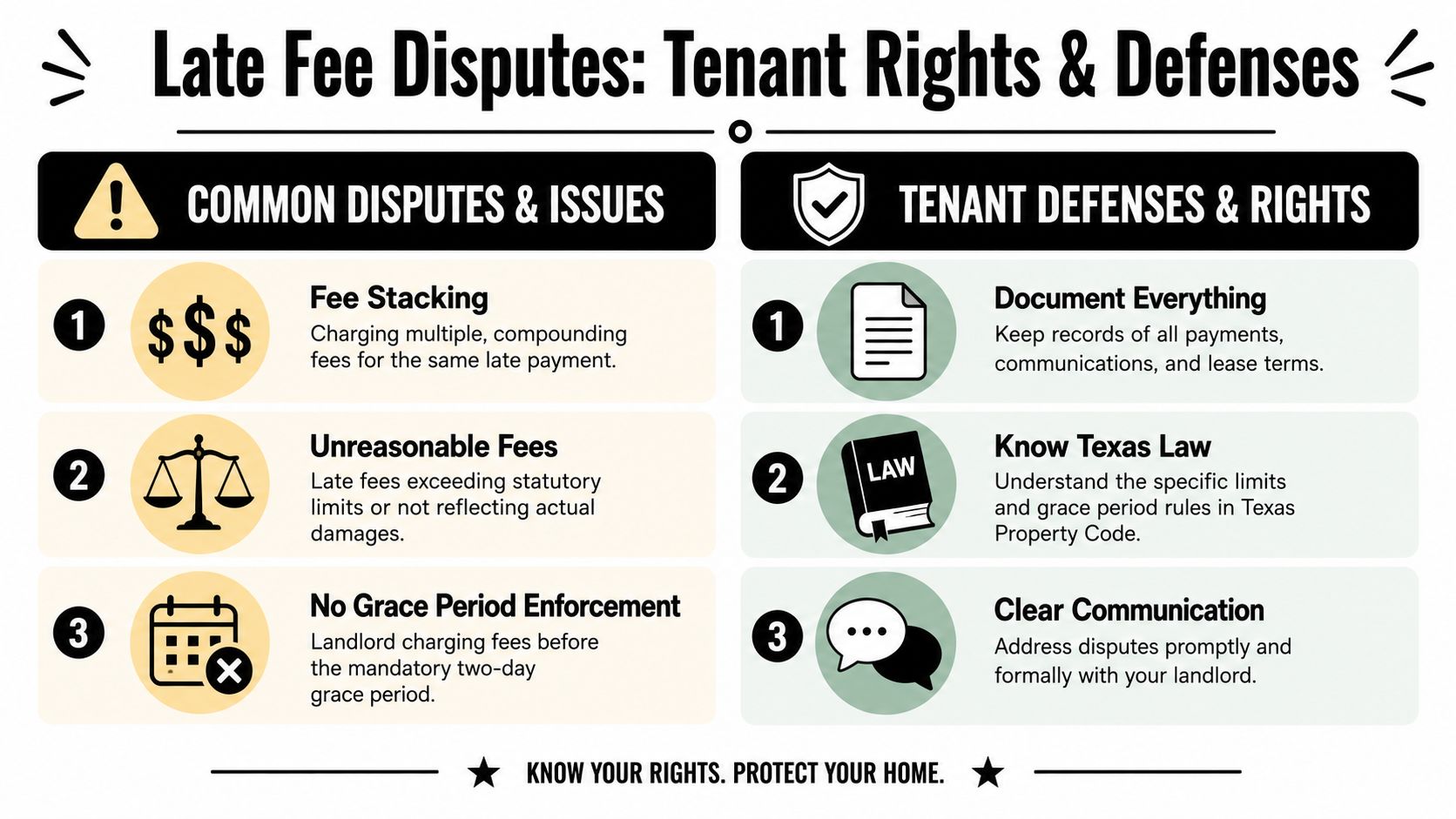
Two questions are commonly asked. Was the fee in the lease, and was it charged late enough? The harder cases involve what happens when landlords add multiple charges around the same missed payment.
That is where fee stacking becomes important.
The fee stacking problem
A commonly overlooked issue is whether a Texas landlord can stack a late fee with other charges such as NSF or bounced-check fees, notice fees, or daily rent penalties. As discussed in this Texas late-fee analysis focused on stacking concerns, many consumer guides explain the percentage caps and timing rules but don't address how borderline billing practices appear in actual notices and ledgers.
Here is the practical concern. A landlord may list one charge as the "late fee" and then add another charge for a notice, a separate daily penalty, or some other rent-related label tied to the same missed payment. On paper, each item may look small. Together, they may function like a single inflated late-fee package.
The legal issue isn't the label. It's whether the landlord is using multiple labels to do what the statute limits as one late-fee obligation.
How tenants can challenge questionable charges
If a tenant thinks the charges were stacked, the best defense is careful documentation.
Use this approach:
- Match each line item to the lease: If the lease doesn't clearly authorize it, ask why it appears.
- Ask what triggered the charge: Was it the late payment itself, a returned check, a notice, or something else?
- Request a written ledger explanation: Vague verbal answers don't help later.
A written dispute often changes the tone. It forces everyone to identify whether a charge is separate or just another way of increasing the cost of being late.
Other defenses that matter
Fee stacking isn't the only issue that comes up.
Waiver through inconsistent enforcement
If a landlord has repeatedly accepted late rent without enforcing the lease in the same way, a tenant may argue that the sudden change was inconsistent or waived by prior conduct. That doesn't mean the landlord permanently loses all enforcement rights. It does mean uneven practices can weaken the landlord's position.
Retaliatory or selective enforcement concerns
Late fees shouldn't become a pressure tactic after a repair complaint, habitability dispute, or other protected tenant action. When tenants report serious property issues and then face sudden aggressive fee enforcement, the facts deserve a closer look.
Bad records on both sides
Some disputes are less about law and more about proof. Tenants may have paid but failed to save confirmation. Landlords may have intended a lawful charge but posted the wrong amount or date through software settings.
What works and what doesn't
What works:
- A clean lease
- Consistent enforcement
- A complete payment ledger
- Written communication
What doesn't:
- Surprise add-ons
- Different rules for different tenants
- Portal charges no one can explain
- Fighting about a fee without first checking the documents
If your dispute has moved beyond a simple correction request, legal review often saves time and money. A tenant rights issue can quickly overlap with notice problems, lease interpretation, or eviction defenses. A landlord may also need an eviction attorney to make sure a nonpayment case isn't weakened by a defective fee claim.
When to Call a Texas Landlord-Tenant Lawyer
Some late-fee disputes are easy to fix. A manager removes an early charge. A tenant pays the corrected balance. Everyone moves on.
Others don't stay small. They become part of a notice to vacate, an eviction filing, a lease-default claim, or a larger argument about retaliation, accounting, or tenant rights under the Texas Property Code.
Call a Texas landlord tenant lawyer when the dispute involves more than a simple math error. That includes situations where the lease language is unclear, extra charges were stacked around one missed payment, the landlord is threatening eviction based on a questionable ledger, or the tenant believes fees were imposed in a way that violated Texas law.
A short checklist helps:
- The lease is vague: No one agrees on what the clause permits.
- The ledger is crowded: Multiple charges appear for one late payment.
- The dispute affects possession: A notice to vacate or eviction case has started.
- The relationship has broken down: Emails and portal messages are no longer solving the problem.
If you're reading this because you searched can landlord charge late fees Texas limits explained, the core answer is still straightforward. The fee must be in the lease. The timing rules must be followed. The amount must stay within the applicable statutory limit. The hard part is proving what happened when the paperwork and payment history don't line up cleanly.
If you need help with an eviction, lease issue, or rental dispute, contact The Law Office of Bryan Fagan, PLLC for a free consultation today.