Texas is widely considered one of the most landlord-friendly states in the country because landlords can serve a 3-day notice to vacate for nonpayment and many eviction cases move through Texas justice courts in under 30 days. But that label does not mean tenants have no rights, and it does not mean landlords can skip the strict steps required by the Texas Property Code.
If you're a tenant worried about losing your housing, or a landlord trying to deal with unpaid rent without making a costly mistake, you're probably looking for clear answers, not legal slogans. That's where Texas landlord-tenant law often gets misunderstood. People hear “landlord-friendly” and assume landlords can do whatever they want, or tenants hear it and assume they have no power. Neither is true.
Texas gives landlords powerful tools. It also gives tenants meaningful protections for repairs, retaliation, security deposits, and court procedure. The practical reality is simple. The side that documents carefully and follows the rules usually stands in the stronger position.
Navigating Your Rights in a Landlord-Friendly State
A lease dispute can escalate fast. One missed rent payment, one ignored repair request, or one badly worded notice can turn a routine problem into a court case. When that happens, people often search the same question: Is Texas a landlord friendly state?
The short answer is yes. The better answer is yes, but only within a rule-driven system. Texas favors property owners in several important ways, especially on eviction speed, rent-setting freedom, and deposit flexibility. At the same time, tenants still have enforceable tenant rights, especially when a home becomes unsafe or a landlord retaliates after a legal complaint.
Why this question matters in real life
For landlords, “landlord-friendly” usually means you can protect your property and income without waiting months for the legal system to act. For tenants, it means you need to act quickly, respond in writing, and understand deadlines before they pass.
A few common situations show why the details matter:
- A landlord faces nonpayment: The landlord wants possession back, but serving the wrong notice can delay the case.
- A tenant lives with dangerous conditions: The tenant may have remedies, but only if notice is sent properly.
- A lease has expired: Both sides may assume the next step is obvious, yet the procedure still matters.
- A security deposit dispute starts after move-out: Good records often decide whether the withholding was lawful.
Practical rule: In Texas, rights and remedies often depend less on who feels wronged and more on who followed the required steps first.
What actually helps
If you're a landlord, start with the lease, your written notices, and your timeline. If you're a tenant, start with your lease, your written communications, and proof that the landlord received them. A Texas landlord tenant lawyer or eviction attorney usually looks at those documents before anything else.
The legal environment isn't complicated because the rules are hidden. It's complicated because small procedural errors create big consequences. That's why understanding the Texas Property Code matters so much for both sides.
The Verdict on Texas A Decidedly Landlord-Friendly Landscape
A Texas landlord posts a notice after rent is missed. A Texas tenant finds that notice on the door and has only a short window to decide what to do next. That pressure is part of the answer here.
Texas has earned its reputation. A 2026 renter-friendliness report discussed by the Austin American-Statesman says Texas ranks 41st out of 50 states for renter-friendliness, down from 22nd place in 2025, and notes that total eviction timelines from notice to lockout typically take 3–4 weeks.
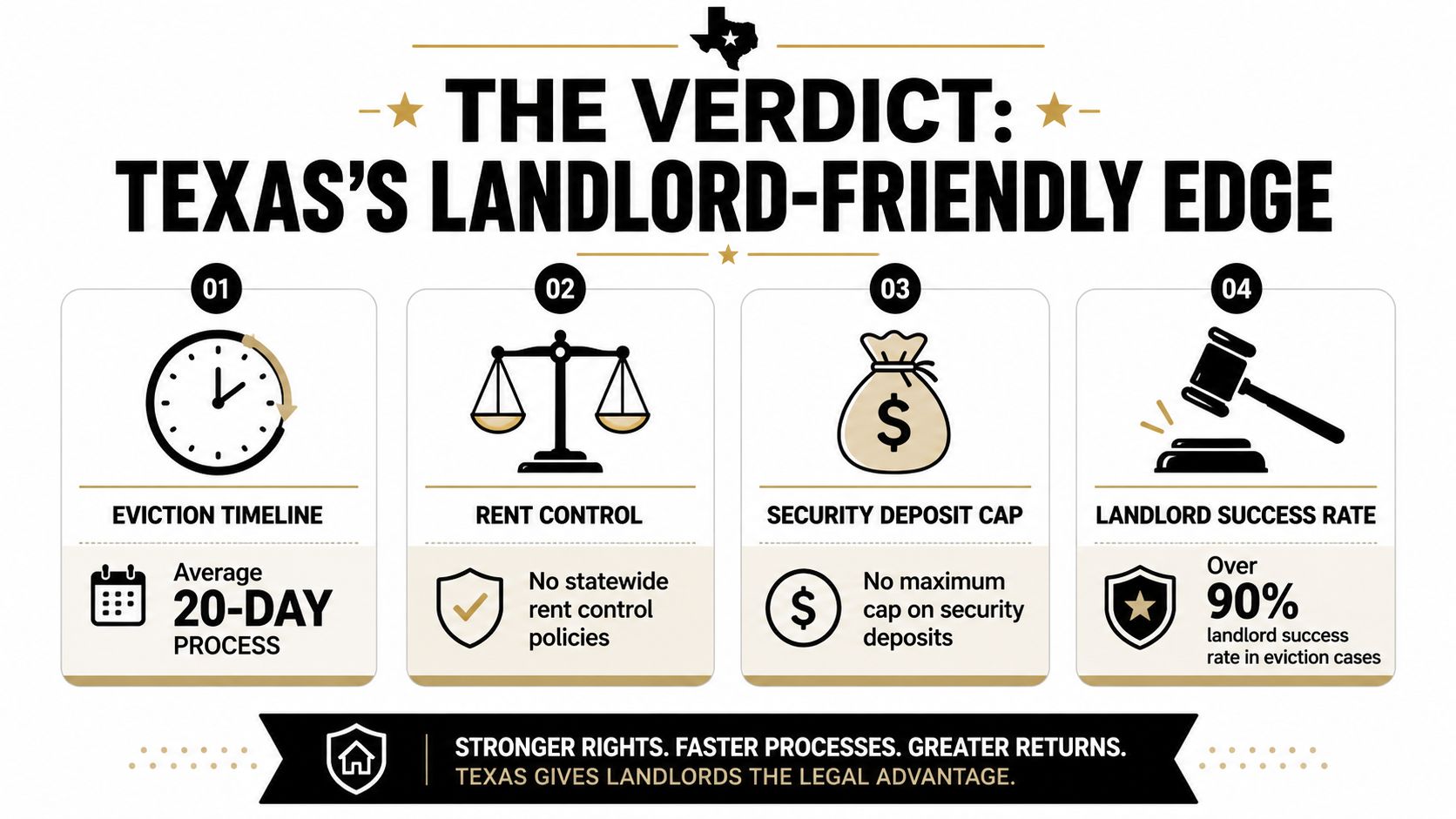
That result reflects a system that usually gives landlords more room to enforce the lease, set financial terms, and recover possession than tenants see in more regulated states. It also reflects something many people miss. Texas favors landlords in structure, but it still requires precision. A landlord who skips a statutory step can lose time and money. A tenant who knows the rules can slow an improper case, defend it, or force the landlord back to the starting line.
What landlord-friendly means in Texas
In day-to-day practice, the label usually points to three features.
| Issue | What it means in practice |
|---|---|
| Evictions move quickly | A landlord who gives the correct notice and files properly can often reach a hearing fast. A landlord who serves the wrong notice can lose that advantage just as fast. |
| Rent-setting is flexible | Texas bars local rent control in most circumstances, so owners generally keep broad discretion at renewal and lease-up. |
| Upfront risk tools are broader | State law gives landlords more flexibility on deposits, fees, and lease drafting than many tenant-protective states, subject to limits on what can actually be enforced. |
For owners, those rules reduce delay risk. For tenants, they raise the cost of waiting to respond. Anyone comparing markets can use broader educational material such as Sims Ventures Texas investor resources for business context, but legal decisions still turn on the lease and the Texas statutes that govern notices, deposits, repairs, and possession. A solid starting point is this guide to Texas Property Code landlord-tenant rules.
Why the label causes mistakes
I see two bad assumptions over and over.
Some landlords hear "landlord-friendly" and assume the court will forgive shortcuts. It will not. Lockouts, utility shutoffs, defective notices, and poor paperwork can create defenses, delay possession, and expose the landlord to separate claims.
Some tenants hear the same phrase and assume the hearing is a formality. It is not. Tenants still have rights tied to notice, habitability, security deposits, retaliation, repair requests, and the landlord's proof. Those rights are strongest when the tenant acts early, keeps records, and raises the correct issue in the correct forum.
Texas favors landlords, but procedure controls the result.
That is especially true in Justice Court, where eviction cases move quickly and small errors matter. If either side needs to challenge the result, Appealing a Texas Eviction Judgment explains the deadlines and mechanics for appealing a Justice of the Peace ruling.
The practical bottom line
If the question is whether Texas is a landlord friendly state, the short answer is yes. The better answer is yes, with real limits.
Landlords usually benefit from speed, flexibility, and fewer statutory restraints. Tenants still hold meaningful rights, but those rights depend heavily on timing, written notice, and proof. In Texas, the party who follows the procedure usually has the stronger position.
Understanding Pro-Landlord Rules in the Texas Property Code
A missed rent payment on Monday can turn into a filed eviction case soon after if the landlord follows the statute and the lease. That speed is one reason Texas is widely viewed as landlord-friendly. The larger point, though, is more precise. Texas gives landlords meaningful tools, but those tools work only when the landlord follows the written rules and the tenant understands where the limits are.
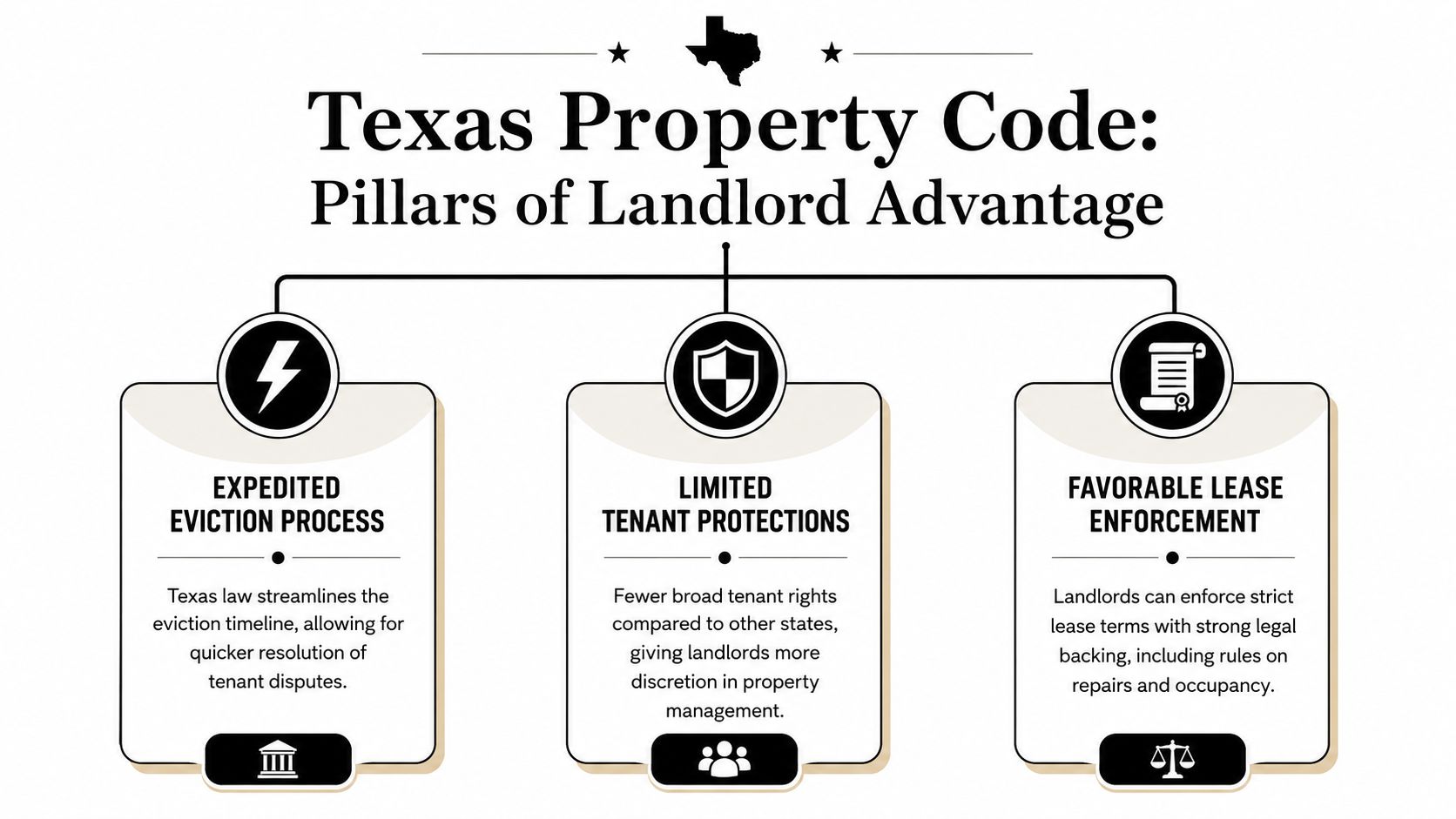
For a broader statutory reference, this guide to Texas Property Code landlord tenant rules is a useful starting point.
The three-day notice rule under Section 24.005
Texas Property Code Section 24.005 allows a landlord in many nonpayment cases to serve a three-day written notice to vacate before filing a forcible detainer case, unless the lease lawfully gives a different notice period. In practice, that short deadline puts pressure on tenants fast.
For landlords, the advantage is speed. For tenants, the risk is delay. A tenant who waits until the constable posts court papers has already lost time that could have been used to pay, negotiate, document repairs, or get legal advice.
The trap for landlords is assuming a fast process excuses sloppy notice. It does not. The notice still has to match the statute and the lease, be delivered in a legally recognized way, and give the full required time. If the notice is defective, the case can be delayed or lost even when rent is plainly overdue.
No statutory cap on security deposits and tight rules on fees
Texas does not set a statewide dollar cap on security deposits. That gives landlords room to price risk based on the applicant, the property, and the market.
That flexibility has limits.
A large deposit may be legal, but it can narrow the applicant pool and increase move-in disputes. Landlords also still have duties tied to returning the deposit and providing an itemized accounting when deductions are taken. Tenants should pay close attention to written lease terms, move-in condition forms, photos, and deadlines after move-out, because deposit fights often turn on documentation rather than general fairness.
Late fees also require care. Texas law allows them in many leases, but a fee provision still needs to be written clearly and charged in a way that complies with the statute. A vague lease clause can create problems that are easy to avoid at the drafting stage.
No municipal rent control
Texas law also bars most municipal rent control. As a practical matter, that means cities generally cannot set local caps that prevent a landlord from raising rent when the lease term ends.
For property owners, that is real pricing freedom. For tenants, it means affordability pressure can change quickly at renewal.
Still, legal freedom and business judgment are different things. A landlord can raise rent and still make a poor decision if the increase causes vacancy, turnover costs, or a weaker tenant pool. I often tell clients that Texas gives owners room to make decisions, not protection from the consequences of bad ones.
What courts tend to reward
The landlords who usually do well in Texas are not the ones who act aggressively. They are the ones who keep clean records, use a clear lease, send the right notice, and prove their case with dates, payment history, and written communications.
The same is true for tenants asserting their rights. A tenant may still have strong arguments about improper charges, defective notice, retaliation, or unresolved repair problems. Those arguments carry more weight when the tenant has written proof and raises the issue early.
Texas favors landlords in several important ways. It also requires procedure, and procedure is where both sides win or lose.
Powerful Protections Your Rights as a Tenant in Texas
Texas may be landlord-friendly, but tenants are far from powerless. Some of the strongest tenant protections involve habitability, required repairs for health and safety issues, and protection from retaliation when a tenant asserts legal rights.
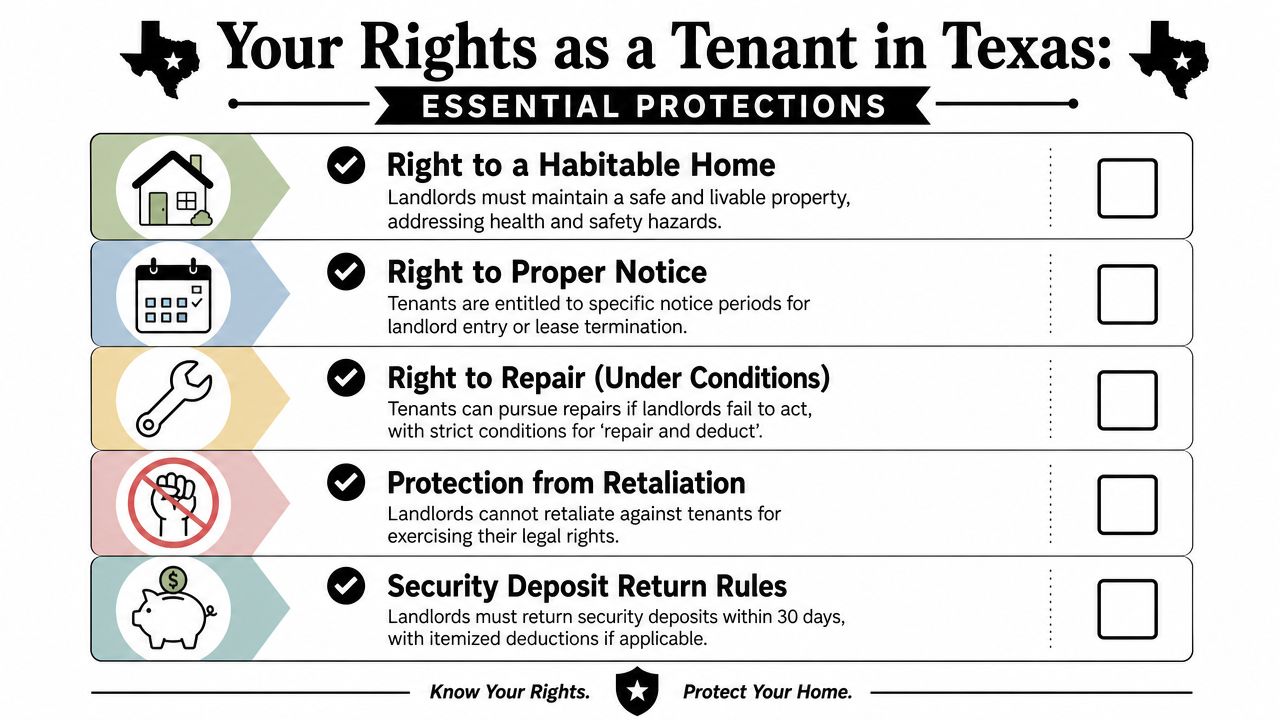
A more detailed discussion of those standards appears in this guide to Texas habitability laws and what landlords must provide.
Repairs for health and safety problems
Under Texas Property Code Sections 92.056 and 92.0561, tenants may have the right to terminate the lease, repair the issue and deduct the cost from rent, or sue the landlord if the landlord fails to make repairs for health or safety problems after proper notice. The Texas Attorney General's renters' rights guidance explains that proper notice often involves certified mail, and that a landlord who retaliates can face a penalty of one month's rent plus $500, along with damages and attorney's fees.
Many tenants find themselves at a disadvantage by acting too informally. Text messages may help prove communication, but the statutory notice rules still matter.
How tenants should protect themselves
If you're dealing with mold concerns, broken security features, plumbing failures, or another serious condition affecting health or safety, use a disciplined process:
- Describe the problem clearly in writing. State what is broken, how long it has been happening, and why it affects health or safety.
- Send notice in a provable way. Certified or registered mail often matters under the statute.
- Keep copies of everything. Save letters, photos, delivery receipts, emails, and repair invoices.
- Give the landlord a fair chance to act. The law focuses on whether the landlord made a diligent effort after proper notice.
- Don't withhold rent casually. Texas law has specific rules. A tenant who guesses wrong can create a bigger problem.
If you skip the notice step, you may weaken a good repair claim. If you document carefully, you may strengthen it considerably.
Retaliation is still unlawful
A landlord can't lawfully punish a tenant because the tenant asked for repairs, complained about code issues, or exercised other protected rights. Retaliation claims often arise when a tenant reports serious conditions and then suddenly faces pressure, threats, or adverse actions.
Here's a common example. A tenant reports a dangerous leak affecting electrical service. The landlord ignores the written request. After the tenant complains again, the landlord threatens immediate removal or punitive fees. That pattern can raise serious legal issues beyond the original repair problem.
Security deposit disputes also matter
Tenants also have rights after move-out. Texas law requires landlords to return deposits within the required time frame or provide lawful deductions. Deposit fights often turn on basics: move-in photos, move-out condition, cleaning records, written itemization, and whether the charge reflects actual damage rather than ordinary wear.
For landlords, the lesson is straightforward. Fast eviction rights don't excuse neglecting repairs or mishandling deposits. For tenants, the lesson is equally important. Your rights are strongest when your records are organized and your notices follow the statute.
How the Texas Eviction Process Actually Works
A landlord posts a notice on Friday. A tenant comes home Sunday night, reads it at the door, and assumes there is still plenty of time to sort things out. In Texas, that assumption can be expensive. The process is often fast, but it is not informal, and both sides can lose good arguments by missing a step.
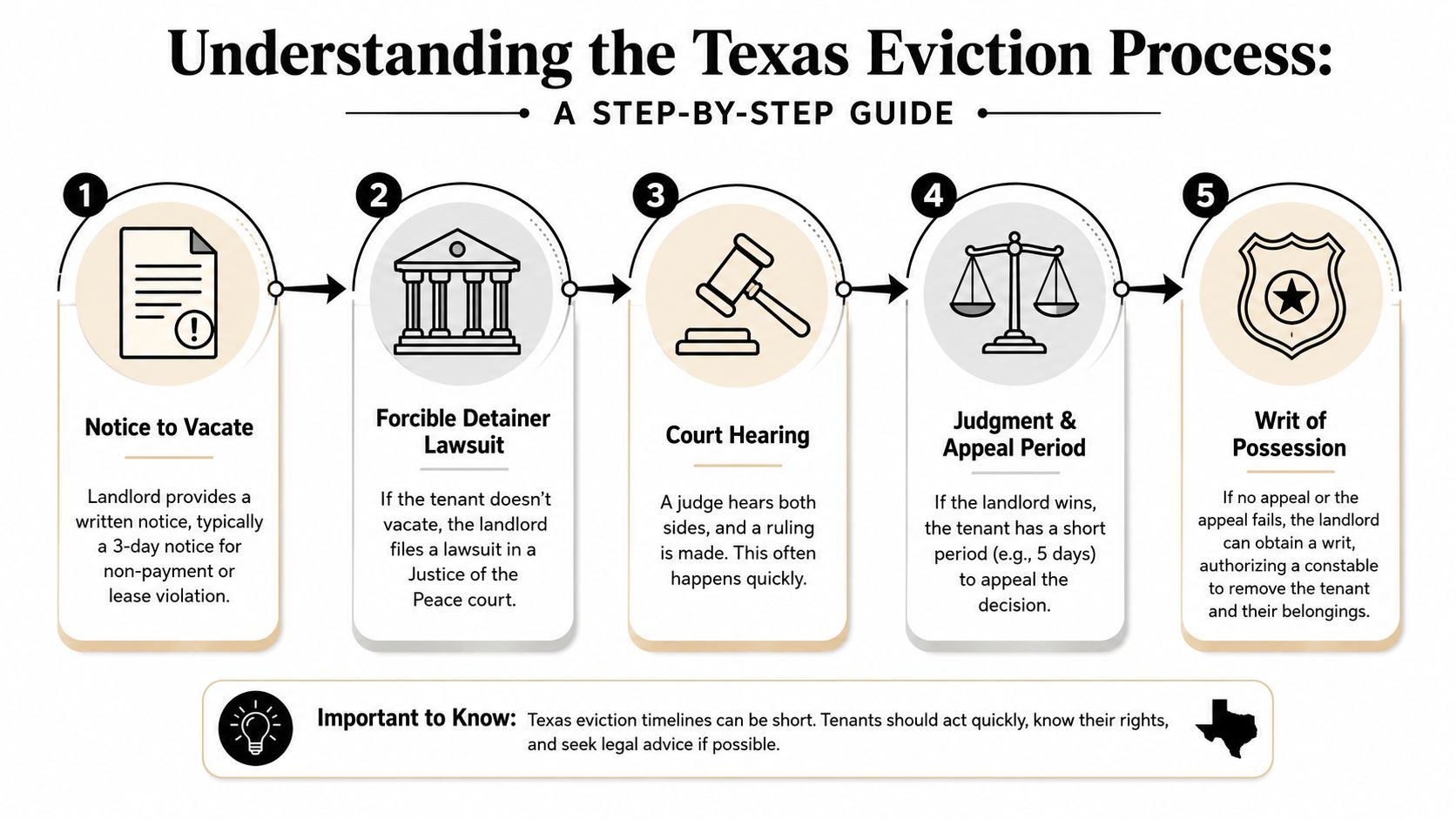
If you need a tighter timeline, this guide on how long the eviction process is in Texas helps frame the deadlines.
The first step is usually a written notice to vacate. Under Texas Property Code Section 24.005, many residential evictions begin with a three-day notice unless the lease lawfully sets a different period. That notice matters. A landlord who files too soon may have the case dismissed. A tenant who ignores the notice may lose the best chance to resolve the dispute before court costs start piling up.
After the notice period ends, the landlord files a forcible detainer case in the proper Justice of the Peace court. This is a possession case, not a full lawsuit about every dispute between the parties. Judges usually focus on a narrow set of questions: Was proper notice given, is there a right to possession, what does the lease say, and did the parties bring credible records?
A short video can help if you're trying to picture the process in real time.
The hearing is where procedure starts to separate strong cases from sloppy ones. Landlords should bring the lease, payment ledger, notice, delivery proof, and any communications that support the default. Tenants should bring receipts, bank records, photos, texts, repair notices, or anything else tied to a defense. Even in a state that gives landlords efficient remedies, judges still expect the file to be in order.
If the landlord wins, the tenant usually has a short window to appeal. If no appeal is perfected, the landlord can request a writ of possession. That writ authorizes the constable to carry out the removal under court order. Landlords cannot lawfully change locks, cut utilities, remove property, or force someone out on their own just because they believe they are right.
One recurring trap involves people who are not cleanly classified. An unauthorized occupant with no lease history may be treated differently from a current tenant or a holdover tenant whose lease expired but who once had lawful possession. That distinction can change the procedure. Landlords should confirm which process fits before acting. Tenants should not assume that an expired lease means all protections disappeared overnight.
This is also where management decisions matter. Owners who are choosing between a landlord and property manager should pay attention to who will serve notices, keep records, appear in court, and track deadlines. Eviction cases are often lost through bad administration, not bad facts.
The practical point is simple. Texas gives landlords a relatively direct path to recover possession, but that path is still rule-bound. Tenants still have the right to notice, a hearing, and the chance to raise defenses. Landlords who follow the statute carefully usually move faster. Tenants who respond early usually have more options.
Actionable Strategies for Texas Landlords and Tenants
A Texas rental dispute often turns on small decisions made early. A landlord accepts partial rent without a written reservation. A tenant reports a serious repair problem by text but keeps no copy. Weeks later, both sides are in court arguing about facts that should have been documented from day one.
Texas generally favors landlords on possession and timing. It does not excuse sloppy paperwork, ignored repair duties, unlawful fees, or self-help. Tenants also have more protection than many people assume, especially if they give notice properly, keep records, and respond before deadlines expire.
For landlords
- Use a lease that says what you mean: State rent, due dates, late fees, repair reporting steps, guest limits, holdover terms, notice requirements, and who pays which charges.
- Keep a clean file from move-in to move-out: Save the lease, payment ledger, inspection photos, repair requests, notices, and proof of delivery.
- Stay professional in writing: Threats, insults, and off-the-cuff promises can become exhibits.
- Handle repair complaints promptly: A state that favors landlords can still punish retaliation, bad-faith deposit deductions, and failures tied to health or safety conditions.
- Match your management system to your portfolio: Owners with multiple units should think hard about who sends notices, tracks deadlines, and appears in court. This comparison on choosing between a landlord and property manager is a useful starting point.
For tenants
- Read the lease before a problem starts: Focus on late fees, repair procedures, renewal terms, utility rules, guest restrictions, and move-out obligations.
- Report serious conditions in writing: For repairs affecting health or safety, written notice matters. Keep a dated copy.
- Build your own paper trail: Save the lease, payment confirmations, photos, inspection forms, emails, letters, and any notice posted on your door.
- Do not ignore a court date or notice to vacate: A short deadline does not mean you have no defense.
- Get legal help early if the facts are messy: A Texas landlord tenant lawyer or eviction attorney can spot notice defects, retaliation issues, repair claims, and deposit disputes before they become harder to fix.
One practical option for Texans dealing with notices, lease violations, repairs, or eviction disputes is The Law Office of Bryan Fagan, PLLC, which handles landlord-tenant matters across Texas and gives case-specific guidance based on the documents, deadlines, and history of the tenancy.
The fair answer to “is Texas a landlord friendly state” is yes, with an important qualifier. Landlords usually have strong procedural advantages, but tenants still have enforceable rights, and landlords who miss statutory steps can lose time, money, or the case itself.