Dealing with a landlord dispute or eviction can be stressful, but understanding your rights under Texas law can make all the difference.
If you're reading this because your landlord won't fix a dangerous problem, kept your deposit, changed the rules after you complained, or is suddenly threatening eviction, you're not powerless. Texas Property Code Chapter 92 gives tenants real protections. It also gives landlords clear duties. The problem is that many disputes don't turn on who feels right. They turn on who followed the procedure.
That's where people get hurt. A tenant may have a serious repair issue, but weaken their position by sending the wrong kind of notice. A landlord may think a delay is minor, then step into a retaliation claim by reacting badly to a repair request. In Texas landlord-tenant cases, details matter.
This guide breaks down Texas Property Code 92 tenant rights in plain English. If you need a Texas landlord tenant lawyer, an eviction attorney, or practical answers about repairs, deposits, locks, or retaliation, start here.
Your Guide to Tenant Rights Under Texas Property Code 92
A common situation looks like this. Your ceiling is leaking. Water gets into the wall. The air starts smelling musty. You text the landlord, then email, then call. Days pass. You hear excuses, not a repair date. At that point, most tenants think the law says the landlord has to fix it.
That's only half true.
Texas Property Code gives tenants strong rights, but those rights only become enforceable when you use the process the statute requires. That's the part often overlooked by tenants. They focus on the bad condition and ignore the notice rules. Then they try to withhold rent, move out, or hire a contractor too early. That mistake can cost you your deposit and put you in an eviction fight.
Texas Property Code Chapter 92 deals with the most important parts of a residential tenancy dispute. It covers repair duties, security deposits, required security devices, and retaliation protections. For landlords, it sets the boundaries. For tenants, it creates tools you can use. But those tools aren't automatic.
What Chapter 92 means in real life
Here's what this chapter usually decides:
- Unsafe conditions: Can you force repairs, break the lease, or repair and deduct?
- Deposit disputes: Can the landlord keep your money, and what paperwork should exist?
- Security concerns: What happens if required locks or rekeying are ignored?
- Retaliation: Can a landlord raise rent, reduce services, or push you out after you complain?
Practical rule: In Texas landlord-tenant law, the person with the better paper trail usually has the stronger case.
If you're a tenant, your first job is to stop acting on frustration and start acting on documentation. If you're a landlord, your first job is to respond carefully and consistently. That's how you protect your position.
Your Right to a Safe and Habitable Home
Texas law requires a landlord to address conditions that materially affect the physical health or safety of an ordinary tenant. That's the core habitability rule. It's not about inconvenience. It's about danger.
A broken cabinet door usually won't qualify. Sewage backing up into the unit might. A cosmetic crack in drywall is one thing. No hot water, severe roof leaks, a major pest problem, or a failed HVAC system during extreme weather can be something very different.
What counts as a serious condition
Think in terms of health and safety, not annoyance.
Examples that often raise habitability concerns include:
- Water intrusion: Active leaks, standing water, or conditions that can lead to mold growth
- Loss of essential services: No hot water, no working plumbing, or a major system failure
- Unsafe access or structure: Broken exterior doors, dangerous stairs, or exposed hazards
- Infestation issues: Severe pest conditions that create a health problem
If you suspect a plumbing failure under the foundation is causing leaks or moisture, getting a diagnosis from a licensed professional can help you document the problem. In that situation, resources like Professional slab leak solutions can help you understand what the issue may involve before you put the landlord on formal notice.
Notice is what activates the duty
A landlord's repair duty doesn't exist in a vacuum. The landlord has to receive proper notice of the condition. That's where many tenants lose otherwise valid claims.
Most online articles oversimplify the repair timeline. As explained in this plain-English review of Chapter 92, courts weigh contractor scheduling, parts availability, and repair complexity when deciding whether the landlord made a diligent effort. That means the seven-day period is a rebuttable presumption, not an automatic violation date. The same analysis warns that skipping the certified-mail step can wipe out your remedies, even if the condition is serious.
A dangerous condition matters. But in court, your notice history matters just as much.
That's why tenants should understand both the legal standard and the procedure. For a focused explanation of what landlords must repair under Chapter 92, see habitability laws in Texas and what landlords must provide and The Landlord's Duty to Repair in Texas.
Landlord entry during repairs
Tenants sometimes ask whether they can refuse access because they're angry about the delay. Usually, that's a bad idea. If the landlord or a contractor is trying to inspect or repair the reported problem, blocking access can damage your position. You want proof that you cooperated and the landlord still failed to act reasonably.
The Official Step-by-Step Repair Process
If your landlord hasn't fixed a dangerous condition, don't improvise. Follow the statutory process carefully.
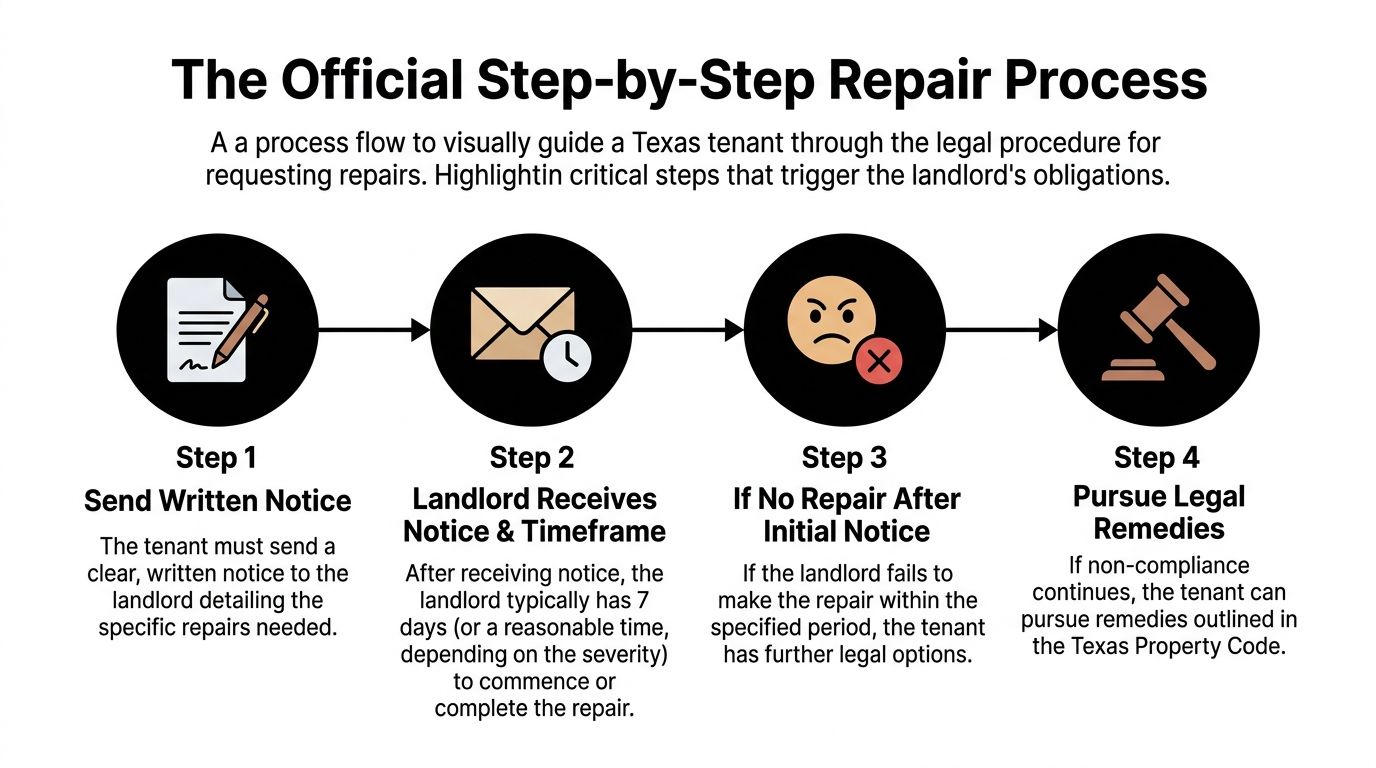
Under the Texas Attorney General's renters' rights guidance, Texas Property Code §92.056 presumes seven days is a reasonable period for a landlord to attempt repairs after proper notice for a condition affecting health or safety. If the landlord doesn't make a diligent effort within that period, and the first notice was sent by certified mail, return receipt requested or registered mail, the tenant may terminate the lease, repair and deduct, or seek a court order. If the first notice was not sent that way, the tenant must send a second notice letter before using those remedies.
Step one: Send written notice that is specific
Don't send a vague text that says “things still broken.” State the actual problem.
Include:
- The condition: Describe what is happening and where
- The risk: Explain how it affects health or safety
- The request: Ask the landlord to repair it promptly
- The date: Keep a copy of exactly what you sent
If the issue is “water leak in bathroom wall causing soft drywall and odor,” say that. Specific notice is stronger than emotional notice.
Step two: Use certified mail first if you want real leverage
This is the procedural trap that hurts tenants most. If your first notice goes out only by text, portal message, or standard email, you may still have evidence of communication. But you may not have triggered the full set of remedies.
Send the first formal repair notice by certified mail, return receipt requested. That gives you a documented delivery trail. It also puts you in a better legal position if the landlord stalls.
For a practical walkthrough, review how to request repairs from your landlord in Texas.
Client advice: Send the notice the way a judge would want to see it later, not the way that feels easiest today.
Step three: Wait, document, and evaluate the response
After notice, don't jump straight to withholding rent or moving out. Track what happens.
Use a simple log:
| What to track | Why it matters |
|---|---|
| Date notice was mailed | Shows when the clock started |
| Delivery confirmation | Proves the landlord received it |
| Responses from landlord | Shows whether they ignored or addressed it |
| Inspection or contractor scheduling | Helps show whether there was a diligent effort |
| Photos and videos | Preserves the condition over time |
A landlord doesn't necessarily violate the law just because the problem isn't fully fixed immediately. If the landlord is actively coordinating access, parts, or qualified labor, a court may view that differently than total silence.
Step four: Use remedies carefully
If the landlord still fails to make a diligent effort after proper notice, you may have options. But each one carries risk if you get the procedure wrong.
Possible paths can include:
- Lease termination: This may make sense if the condition is serious and ongoing.
- Repair and deduct: This is narrow and should be handled with care.
- Court action: Sometimes the safest move is asking a court to force repairs.
If your dispute is tied to move-out timing or deductions, it also helps to understand Security Deposit Rules in Texas, including the 30-day return rule under Chapter 92.
Security Deposits and Essential Security Devices
Tenants usually think of security in two separate ways. First, there's your money. Second, there's your physical safety in the unit. Chapter 92 addresses both.
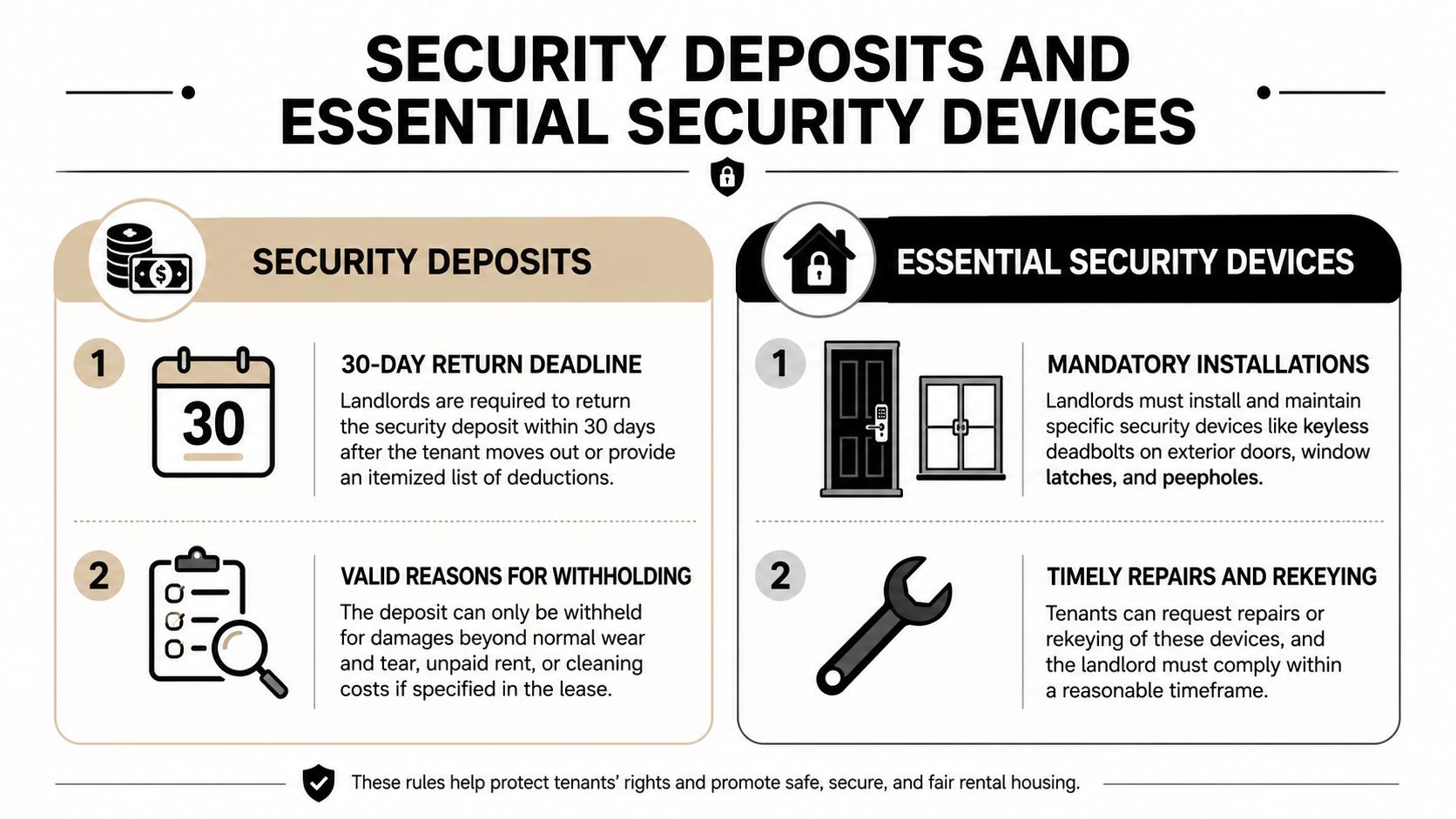
Security deposits
Security deposit fights often start with a move-out surprise. You cleaned the place, turned in keys, and expected your money back. Then the landlord claims damage that you believe was already there or just normal wear.
The key issue is documentation. Tenants should keep move-in photos, move-out photos, lease paperwork, and any inspection notes. Landlords should keep itemized records and support for any charge they make.
A useful place to start is Texas security deposit law, which covers the Chapter 92 rules that govern returns and deductions.
Essential security devices
Texas law also requires certain security devices, including locks and related protections for the unit. This isn't optional background law. It can create immediate rights for a tenant when the landlord fails to act.
Under Texas Property Code §92.164, if a landlord fails to install or rekey a required security device after written notice, and doesn't comply within three days of receipt, the tenant may terminate the lease without court proceedings. The tenant may also sue for one month's rent plus $500, actual damages, court costs, and attorney's fees.
That's a powerful remedy. It also means both sides should treat lock and rekey requests seriously.
A practical example
Suppose you move into a house and discover the exterior door lock was never properly rekeyed. You send written notice. The landlord shrugs it off. If that failure involves a required security device, waiting around and hoping for a response is the wrong move. The statute puts you in a strong position, and the short deadline means the issue needs immediate attention.
Secure locks are not a luxury item in a rental. They are part of the legal baseline.
If the dispute escalates into lockouts or shutoff tactics, review Illegal Lockouts and Utility Shutoffs in Texas. Chapter 92 restricts self-help tactics for a reason. Landlords have to use legal process, not pressure.
Protecting Yourself from Landlord Retaliation
Many tenants are afraid to complain because they assume the landlord will “find a reason” to punish them. Texas law addresses that fear directly.
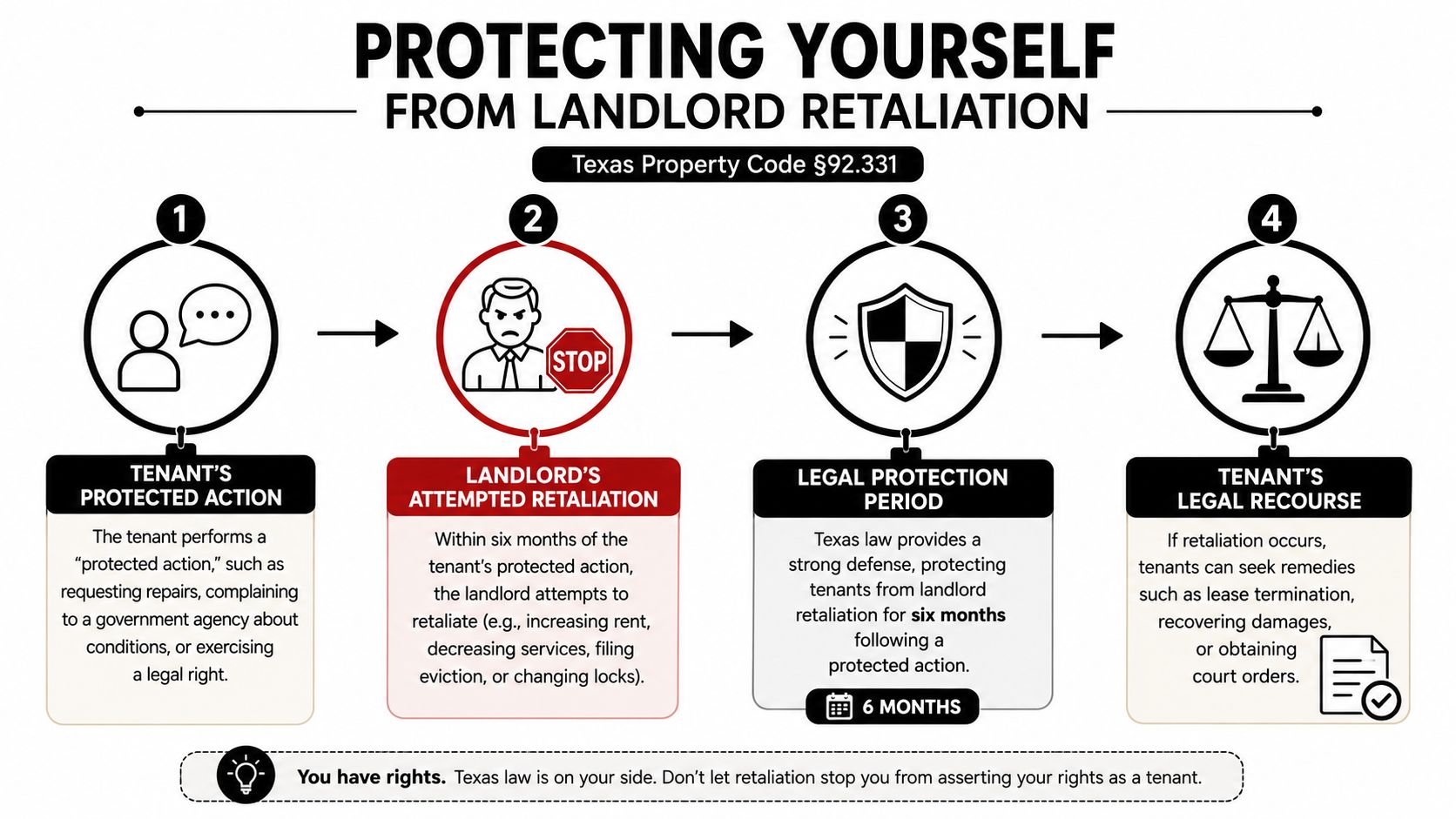
Under this Chapter 92 retaliation overview, Texas Property Code §92.331 gives tenants a six-month protection window after lawful actions such as requesting repairs, complaining to housing authorities, or joining a tenant organization. During that period, a landlord can't evict, deny use of the premises, decrease services, increase rent, or terminate the lease in retaliation. If retaliation occurs, the tenant may sue for one month's rent plus $500, reasonable moving costs, attorney's fees, court costs, and injunctive relief. The same source explains that §92.332 still allows defenses such as nonpayment of rent, material lease violations, intentional tenant-caused damage, or a bona fide sale unrelated to the complaint.
What counts as a protected action
Protected actions commonly include:
- Repair requests: Especially when tied to health or safety issues
- Agency complaints: Reporting serious conditions to the proper authority
- Tenant organizing: Joining or working with a tenant group
- Using Chapter 92 rights: Asserting rights the statute gives you
What retaliation often looks like
Retaliation is usually about timing and motive.
A common example is this: the tenant complains about dangerous conditions, then suddenly receives a rent increase, a service reduction, or an eviction filing that didn't seem to be in motion before. That timing matters. So does the landlord's paper trail.
Landlords still have legitimate defenses
This protection isn't a free pass for tenants to stop paying rent or ignore the lease. If the landlord has a real, documented, lawful reason to act, the statute doesn't block that action just because the tenant also made a complaint.
That's why both sides need records:
- tenants should preserve notice letters, photos, and complaint dates
- landlords should preserve rent ledgers, violation notices, and repair logs
If you think you're facing retaliation, act quickly. Delay helps the other side reshape the story.
Your Legal Remedies When a Landlord Refuses to Comply
Once you've followed the repair process correctly and the landlord still won't do the job, Chapter 92 can give you serious remedies. But this is the point where many tenants make their worst mistake. They assume being morally right is enough.
It isn't. Procedural mistakes can turn a strong claim into an eviction defense problem.
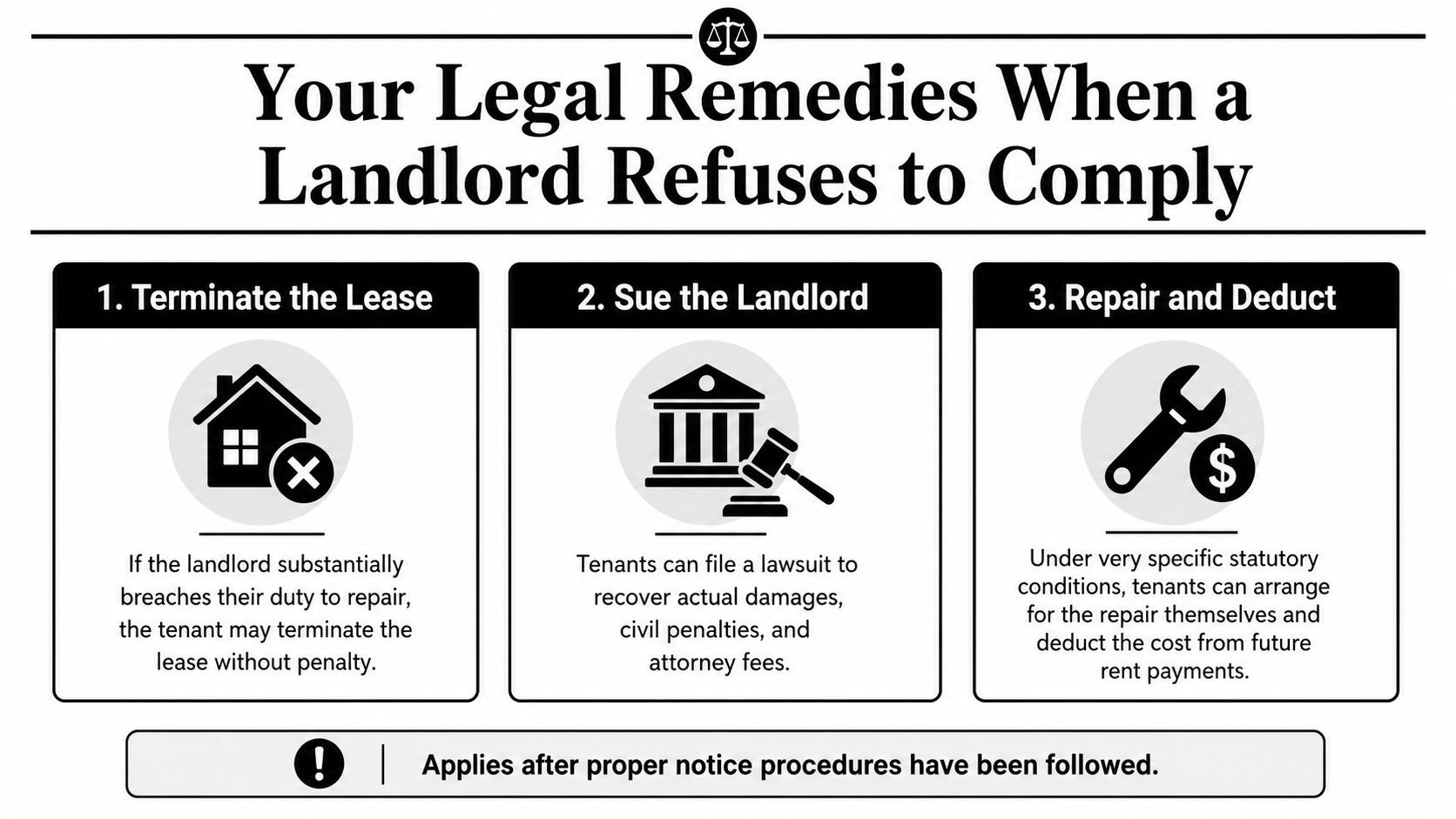
Three main options
The usual remedies are:
| Remedy | When it may fit | Main risk |
|---|---|---|
| Lease termination | Serious unresolved conditions make the unit unsafe | Leaving too early without meeting notice rules |
| Repair and deduct | The condition qualifies and the statute's process has been followed | Being accused of nonpayment if done incorrectly |
| Lawsuit or court order | The landlord refuses to act despite proper notice | Delay, expense, and the need for solid evidence |
Why caution matters
Repair and deduct sounds simple. It isn't. Tenants often hire a contractor too soon, use the wrong notice method, or deduct the wrong amount. Then the landlord claims the rent is short and files eviction.
Lease termination has the same danger. If you move out before your statutory rights have matured, the landlord may argue you abandoned the lease without legal justification.
Court action is often the cleanest remedy when the facts are strong but the consequences are significant. A judge can evaluate the notices, the condition, and whether the landlord made a diligent effort.
If you're considering withholding money from rent, stop and get legal advice first. That step creates risk fast.
For tenants already facing a notice to vacate or eviction filing after a repair dispute, legal help matters. An eviction attorney can review whether the landlord's case is really about nonpayment or whether it grew out of a Chapter 92 violation. In some disputes, The Law Office of Bryan Fagan, PLLC can evaluate the repair record, notice sequence, and eviction posture during a consultation so you know whether to fight, negotiate, or move.
When to Call a Texas Landlord-Tenant Lawyer
Texas Property Code 92 tenant rights are real. So are the traps.
You may have the right to a safe home. You may have the right to proper security devices. You may have protection from retaliation after asserting your rights. But none of that helps if you use the wrong notice, act too early, stop paying rent without legal cover, or fail to preserve evidence.
Call a Texas landlord tenant lawyer when the problem is no longer just annoying and starts threatening your housing or your money.
Strong reasons to get legal help now
You should talk to an attorney if:
- You received an eviction notice: Especially after asking for repairs
- Your landlord ignored a certified-mail repair notice: That often means the dispute is moving into remedy territory
- A large deposit is being withheld: Documentation and timing become critical
- You suspect retaliation: Fast action helps protect your rights
- A lock, rekey, or access issue affects your safety: Those disputes can escalate quickly
A good eviction attorney doesn't just quote statutes. They help you avoid self-inflicted mistakes. That's often the difference between protecting your rights and losing them on a technicality.
If you need help with an eviction, lease issue, or rental dispute, contact The Law Office of Bryan Fagan, PLLC for a free consultation today.
If you need help with a repair dispute, eviction defense, security deposit claim, or landlord retaliation issue, schedule a free consultation with The Law Office of Bryan Fagan, PLLC. You'll get clear guidance on your rights under the Texas Property Code and a practical strategy for what to do next.