Finding out your landlord is selling the home you rent can rattle you fast. One text message or email can trigger a dozen questions at once. Do you have to move, can strangers start walking through your home, what happens to your deposit, and who do you even pay next month?
In Texas, the answer usually starts with one calming point. A sale does not automatically wipe out your lease. That surprises many tenants because the practical pressure of a sale often feels bigger than the legal reality.
A lot of confusion comes from mixing real estate rules with lease rules. If you want a plain-English explanation of how sale restrictions can affect ownership transfers, mastering the alienation clause real estate is a useful background read. But for tenants, the immediate issue is simpler. Your lease and your possession rights matter, and the buyer usually takes the property subject to those rights.
If the person claiming to be the new owner starts making demands, ask for documentation. Texas tenants are often better protected when they insist on basic proof first, including proof of ownership and landlord authority. That step alone can prevent payment mistakes and a lot of avoidable conflict.
Your Landlord Is Selling Your Rental What Happens Now
The most common first reaction is panic. A tenant hears, “We’re listing the property,” and assumes a move-out is next. In many Texas cases, that assumption is wrong.
A sale creates a transition, not an automatic eviction. If you have a written lease for a set term, the sale usually changes who your landlord is, not whether your lease exists. If you rent month to month, the situation is different, but even then the landlord still has to follow the legal process to end the tenancy.
Here is what usually helps in the first few days:
- Pull your lease immediately: Look for the start date, end date, renewal language, entry rules, and any clause that mentions sale of the property.
- Slow down before agreeing to anything: Tenants sometimes sign move-out papers, “updates,” or side agreements they didn’t need to sign.
- Move communication into writing: Email is better than hallway conversations. Text is better than a phone call if you may need a record later.
Practical rule: A landlord’s plan to sell and a tenant’s duty to move are not the same thing.
The emotional side matters too. Sales can bring repeat requests for cleaning, pictures, appraisals, inspectors, and showings. That doesn’t mean you’ve lost control of your home. It means you need a clear process, clear records, and a firm understanding of your tenant rights when landlord sells property in Texas.
Does Your Lease Survive the Sale The Golden Rule in Texas
The central rule is this. In Texas, leases run with the land. That means the lease is attached to the property interest, not just to the personality of the old landlord.

Texas practice reflects that principle. This Texas rental sale discussion explains that a fixed-term lease survives a property sale, and gives a simple example: if a tenant signs a 12-month lease in January and the property sells in July, the new owner must honor the remaining six months unless the lease contains a rare termination-upon-sale clause.
Fixed-term leases usually stay in place
If your lease ends on a specific date, the buyer generally steps into the shoes of the seller. The buyer takes on the existing deal. Rent amount, due date, maintenance duties, pet terms, parking terms, and other lease conditions usually stay the same until the lease expires.
Think of the lease as super-glued to the property. Selling the building doesn’t peel the lease off.
That’s why a buyer who wants the property vacant cannot announce a faster timeline. If the lease is still active, the buyer usually has to wait it out or negotiate with you.
Month-to-month tenancies work differently
Month-to-month renters have fewer timing protections because there is no long end date locking the tenancy in place. But fewer protections does not mean no protections.
A month-to-month tenant still has the right to proper notice before the tenancy is ended. The seller or buyer can’t lawfully skip the notice step just because the property is under contract or because closing is near.
Here’s the practical difference:
| Tenancy type | What sale usually means |
|---|---|
| Fixed-term lease | New owner usually must honor the lease through expiration |
| Month-to-month | Tenancy can often be ended with proper notice under Texas law |
| Lease with sale clause | The exact wording matters and should be reviewed carefully |
What tenants should check first
Not every lease is clean or well-drafted. Some contain conflicting language. Some have addenda that matter more than the first page.
Review these items carefully:
- Term dates: Confirm whether you are still inside a fixed lease period.
- Special sale language: A sale-related termination clause can change the analysis.
- Notice provisions: Your lease may say how notice must be delivered.
- Entry language: Showing disputes often start here.
The fastest way to lose leverage is to assume what your lease says instead of reading what it actually says.
If you’re dealing with pressure from an owner, agent, or buyer, a Texas landlord tenant lawyer can often spot the controlling clause quickly and tell you whether the demand is real or just negotiation dressed up as legal authority.
The New Landlord's Obligations Under Texas Law
When ownership changes, the new landlord doesn’t get to pick and choose which parts of the old lease they like. The obligations come with the property.
This tenant-rights explanation from Shelter England describes the broader rule as automatic continuity of existing leases with 100% legal transfer to new owners, a principle mirrored in Texas landlord-tenant law. It also notes that the new landlord must be formally disclosed and must honor pre-existing lease terms without alteration.
What the buyer usually inherits
The practical effect is straightforward. The buyer becomes your landlord under the same lease framework already in place.
That usually means the new owner must honor:
- The current rent amount: They can’t rewrite the price in the middle of the lease just because they paid more for the property.
- The due date and payment structure: If rent was due on the first under the lease, that remains the rule unless both sides agree otherwise.
- Repair and maintenance duties: A sale doesn’t erase basic Texas Property Code obligations tied to the rental.
- Other lease promises: Parking, appliance use, pet terms, and similar provisions stay in force unless the lease lawfully changes later.
What you should ask for right away
The transition often breaks down over basic logistics, not deep legal theory. A tenant should quickly ask for practical details in writing.
Request:
- The new landlord’s full contact information
- Where rent should be paid
- How maintenance requests should be submitted
- Written notice confirming the ownership change
This protects you from sending rent to the wrong place or being accused of nonpayment during the handoff.
What doesn't work for a new owner
Some buyers assume closing gives them instant authority to make house rules from scratch. It doesn’t.
These moves often create disputes:
- Demanding a new lease immediately
- Trying to shorten the move-out date mid-lease
- Changing payment methods without clear notice
- Ignoring existing repair obligations because “we just bought it”
A buyer gets ownership at closing. The buyer does not get a reset button on your lease.
For landlords, the lesson is just as important. If you buy tenant-occupied property, you should read every lease before closing and plan for a transition that respects the Texas Property Code and the existing tenancy.
Your Rights During the Selling Process Showings and Privacy
The sale process is where many tenant disputes become personal. Even when everyone agrees the house can be sold, conflict starts when strangers want access to the home you’re still paying to live in.

The core principle is quiet enjoyment. In plain English, that means you have a right to use your rental without unreasonable interference. A sale does not erase that right. In major rental markets, protections around entry and notice are getting stronger. This discussion of the projected Spring 2026 UK Renters' Rights Bill highlights 24 to 48 hours' notice for viewings and notes that 15.6% of 451,154 listings in early 2025 were ex-rentals. That broader trend underscores why privacy rules matter when rental homes hit the market.
Reasonable notice matters
Texas tenants often assume they must say yes to every showing request at any time. That’s not how this should work.
The seller still has to respect the fact that this is your home. If an agent wants access, notice should be reasonable and the entry should be for a legitimate purpose tied to the sale. Surprise visits are where legal and practical trouble usually begins.
A workable standard in real life looks like this:
- Scheduled, written notice
- Defined entry windows instead of “sometime tomorrow”
- No walk-ins just because a buyer is nearby
- No pressure to leave the home during the showing unless your lease requires it
Cooperation is smart, but unlimited access isn't required
Most tenants benefit from being reasonably cooperative. A property that sells efficiently usually ends the disruption sooner. But cooperation is not the same as surrendering all boundaries.
You do not have to live in model-home condition every day. You also don’t have to accept repeated disruption that interferes with work, school, childcare, sleep, or safety.
A practical response to showing pressure is to propose a system. For example:
| Problem | Better approach |
|---|---|
| Agent texts at random hours | Ask for all requests by email or text with advance notice |
| Back-to-back showing requests | Offer limited windows on specific days |
| Unannounced entry | Document the incident and object in writing |
| Buyer asks personal questions | Redirect them to the landlord or agent |
Here’s a short explainer that many tenants find helpful before they start responding to showing requests:
What to do when agents ignore boundaries
If someone enters without proper notice, don’t just complain verbally and hope it stops. Create a record.
Use this sequence:
- Write down the date, time, and who entered
- Save texts, emails, call logs, and photos if relevant
- Send a short written objection
- State your preferred showing procedure going forward
Put your boundary in writing once, clearly and calmly. That often solves more than three emotional phone calls.
This is one of the most misunderstood parts of tenant rights when landlord sells property. Tenants are often willing to cooperate. What they need is a process that respects privacy, safety, and daily life.
What Happens to Your Security Deposit in a Sale
The security deposit question usually shows up later than it should. A tenant focuses on showings and move-out pressure, then realizes no one has clearly said who now holds the deposit.
Under Texas practice, the deposit obligation follows the change in ownership. The transfer itself matters, but the paperwork matters just as much.
A smart first step is learning the broader rules that apply to Texas tenant rights for security deposits. Once you understand the deposit framework, sales become much less confusing.
Who is responsible after the property changes hands
Texas Property Code Chapter 92 ties the sale of a rental property to ongoing landlord obligations, including the handling of the security deposit. In practical terms, the new owner should be treated as the party responsible for lease obligations going forward, and Texas Property Code Section 92.105 is commonly cited in connection with deposit transfer on sale.
Here is a practical concern for tenants. If you move out months later, you don’t want the old owner saying, “That’s the buyer’s problem,” while the new owner says, “We never got your file.”
A simple paper trail protects you
When the sale closes, ask for written confirmation of three things:
- The name of the current landlord holding the deposit
- The address for notices
- Where move-out and refund communications should be sent later
If you don’t receive that information, send a polite written request and keep a copy. Email works well because it creates a timestamp.
A short note can be enough:
Please confirm in writing the identity and mailing address of the current landlord, whether my security deposit was transferred with the sale, and where future move-out correspondence should be directed.
Why this matters before move-out
Deposit disputes get harder when ownership records are messy. A tenant who waits until after moving out is already behind.
The cleaner approach is to fix the ownership trail while you still live there. That way, when you surrender the unit, you know exactly who must account for the deposit and where your written demand should go if there is a dispute.
For landlords, this is one of the easiest transition issues to handle well. Clear written notice early can prevent months of argument later.
Navigating Early Termination and Cash for Keys Agreements
Sometimes staying is the right legal move, but not the right personal move. You may have a valid lease and still decide the disruption isn’t worth it. If that’s where you are, the question becomes strategy.
Before signing anything, review your options for how to terminate a lease in Texas. Early exit can be structured in different ways, and the details matter.

Option one stays in place
If your lease survives the sale and there is no effective sale-termination clause, you may stay until the lease ends. That is often the strongest legal position.
This option makes sense when:
- Your rent is favorable
- You need housing stability
- The landlord is mostly respecting the lease
- You don’t want to rush into a new place
The downside is practical, not legal. You may still deal with showings, inspections, and uncertainty around what happens at lease end.
Option two is a mutual termination agreement
A mutual termination is exactly what it sounds like. Both sides agree to end the lease early on negotiated terms.
That can work well if the owner wants the property vacant for marketing or for an owner-occupant buyer. It can also work well if you were considering a move anyway.
A good written agreement should address:
| Issue | What the agreement should say |
|---|---|
| Move-out date | Exact date and possession deadline |
| Rent owed | Whether any prorated rent is due |
| Deposit handling | Whether it will be refunded, credited, or separately processed |
| Condition of unit | Expected move-out condition |
| Release language | Whether both sides are resolving claims |
Option three is cash for keys
“Cash for keys” sounds informal, but it is a business arrangement. The owner offers money or another concrete benefit in exchange for an agreed early vacancy and an orderly turnover.
It can be a practical solution because both sides get something. The landlord gets control over timing. The tenant gets compensation for giving up a right to remain.
What works in these negotiations:
- Ask for all terms in writing before you move
- Make the payment timing clear
- Tie your move-out duty to actual payment
- Address the security deposit separately so it doesn’t disappear inside vague promises
What doesn’t work:
- Verbal promises
- “We’ll work out the money later”
- Turning over keys before the deal is documented
- Assuming the agent has authority without landlord approval
If you negotiate an early move-out, the writing matters more than the conversation that led to it.
For some tenants, a mutual deal is better than a legal standoff. For others, it isn’t. A Texas landlord tenant lawyer can help you decide whether the offer on the table reflects the bargaining power you have.
Protecting Yourself from Landlord Harassment and Retaliation
Most sales are disruptive but manageable. Some turn ugly. That usually happens when a landlord or buyer decides legal process is too slow and starts using pressure tactics instead.
The pressure can take many forms. Constant texts. Surprise entries. Threats that “the new owner will have you out right after closing.” Repeated demands to sign documents you don’t understand. Sometimes it escalates into lockout threats, utility problems, or notices that don’t comply with Texas rules.
One reason tenants should take this seriously is that bad notices are not rare. This discussion of post-sale tenant disputes states that 28% of post-sale eviction filings in Houston and Dallas-Fort Worth involve improper notices and also highlights the protections in Texas Property Code §92.331 against retaliation.
What retaliation can look like
Retaliation is a legal issue, not just a personality conflict. If a tenant exercises a legal right and the landlord responds with punishment or pressure, that can trigger statutory protection.
Examples can include:
- Threatening eviction after you object to illegal entry
- Punishing you for insisting on quiet enjoyment
- Pressuring you after you report code or repair issues
- Using repeated showings to make the home feel unlivable
Not every rude landlord act is retaliation. But when the timing is suspicious and the conduct follows your assertion of rights, the pattern matters.
What to do right away
When harassment begins, tenants often make one of two mistakes. They either ignore it too long, or they answer every incident with an angry call and leave no paper trail.
A more effective approach is disciplined and boring. That’s often what wins.
Document each event
Keep a running log with dates, times, names, and what happened.Save every written communication
Screenshots, emails, voicemails, and notices can become key evidence.Object in writing
Short and factual is better than emotional and long.Call for immediate help if the conduct becomes urgent
An illegal lockout or threat to personal safety may require law enforcement involvement.
The tenant who keeps records is usually in a stronger position than the tenant who relies on memory.
What landlords should avoid
Landlords trying to sell often create liability by doing things they think are “common sense.” They aren’t.
Avoid:
- Self-help eviction tactics
- Repeated unannounced visits
- Showing schedules designed to force a tenant out
- Retaliating after a tenant asks for legal compliance
If the situation is moving toward an eviction filing, an eviction attorney should review the notices before the landlord proceeds and should advise the tenant if the notice is defective. Sales do not excuse shortcuts under the Texas Property Code.
Your Action Plan A Tenant's Checklist When the Landlord Sells
When the sale notice arrives, most tenants don’t need more theory. They need a sequence. Use this checklist in order and keep copies of everything.
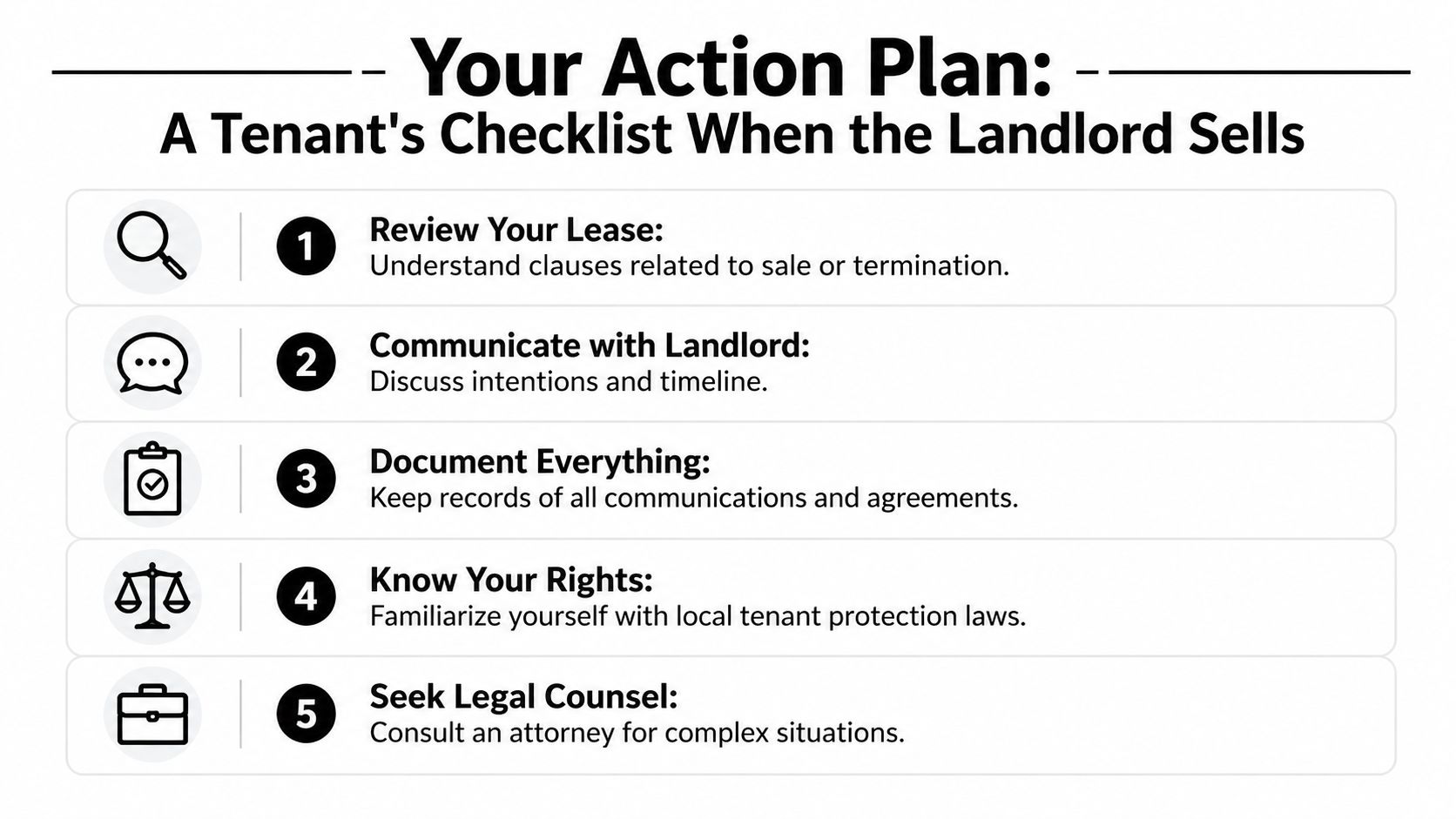
First review the lease and freeze the facts
Start with the document that controls most of your rights.
- Read the lease start and end dates: Confirm whether you are in a fixed term or month to month.
- Flag any sale clause: If the lease says anything about termination on sale, get that language reviewed carefully.
- Check entry rules: Some showing disputes can be resolved by the lease alone.
Then control communication
Confusion multiplies when too many people start talking at once.
- Ask who the point of contact is: Owner, manager, broker, or buyer.
- Move important conversations to writing: Follow up phone calls with a short email summary.
- Request ownership and payment details: Don’t guess where rent should go.
Set boundaries for access and records
At this point, many tenants regain control.
- Create a showing log: Note notice given, time requested, and whether entry happened.
- Respond with available windows if needed: Cooperation works better when it’s structured.
- Object promptly to unauthorized entry: A short written objection is better than a delayed argument.
Protect the deposit and your exit position
Even if you plan to stay, prepare like a future dispute is possible.
- Ask for written confirmation of deposit handling
- Save all notices about the sale
- Keep the property condition documented with photos and dated notes
Know when to get legal help
Some problems are manageable alone. Others are not.
Call a Texas landlord tenant lawyer if:
- You receive a notice to vacate and your lease is still active
- The landlord or buyer keeps entering without permission
- You’re being pushed to sign a move-out agreement
- You suspect retaliation, lockout tactics, or an improper eviction filing
A clear timeline and organized documents often change the outcome of a rental dispute before it gets worse.
Don't Navigate This Alone Get Expert Legal Help Today
A landlord’s decision to sell can change your routine quickly, but it does not erase your tenant rights. In Texas, the most important protections are often the ones people overlook at the start. Your lease may survive the sale. Your privacy still matters during showings. Your security deposit still has to be accounted for. And pressure tactics are not a lawful substitute for the Texas Property Code.
The hard part is that these cases rarely feel clean while you’re living through them. A tenant may be hearing one thing from the landlord, another from an agent, and something else from a buyer. A landlord may be trying to close a sale while also avoiding a dispute that delays everything. Good legal guidance cuts through that noise.
If you’re dealing with tenant rights when landlord sells property, don’t rely on assumptions or verbal promises. Get the lease reviewed, get the notices checked, and get a plan based on Texas law.
If you need help with an eviction, lease issue, or rental dispute, contact The Law Office of Bryan Fagan, PLLC for a free consultation today.