A property dispute often starts small. A fence goes up a little too far over the line. A neighbor keeps mowing and planting on the edge of your lot. A former tenant stays put after the lease ends and starts acting like time alone gives them rights.
That’s when people hear the phrase adverse possession, often called squatter’s rights, and panic.
In Texas, adverse possession is real, but it is not easy to prove. The law does not hand over title just because someone used land for a while. A claimant must satisfy a strict legal test, and courts examine these claims closely. For landlords, tenants, investors, and homeowners, that distinction matters. A holdover tenant is not automatically an adverse possessor. A fence in the wrong place is not automatically a lost boundary. A vacant parcel is not automatically abandoned.
If you're trying to confirm what land is legally yours before a dispute grows, start with the basics of proof of ownership in Texas property matters. Good records often decide what happens next.
Protecting Your Property from an Unexpected Claim
Individuals typically don’t think about adverse possession until something feels off on the ground.
Maybe you own a rental house and notice the neighbor’s shed seems to sit past the old line. Maybe you inherited rural acreage and learn someone has been grazing livestock there. Maybe you’re a tenant caught in the middle of a landlord-neighbor boundary fight and wondering whether your lease, driveway access, or backyard use will change.
Those situations feel personal because land is personal. It’s your home, your investment, your rental income, or your family property.
Adverse possession matters because Texas law can, in limited circumstances, allow someone to claim title through long-term possession. But the doctrine only works when the claimant proves each required element. Missing one element can sink the claim. That’s why calm analysis matters more than assumptions.
Practical rule: Treat every encroachment, holdover, or unexplained use as a documentation issue first and a courtroom issue second.
A worried owner’s first instinct is often to argue about fairness. A worried occupant’s first instinct is often to rely on rumors. Neither approach helps much. What helps is understanding the legal elements, knowing the Texas timelines, and acting early enough to preserve your rights under the Texas Property Code and related title rules.
What Is Adverse Possession in Texas
Adverse possession is a title claim built on conduct, not on a handshake story about who has been around the longest. In Texas, the person making the claim has to prove a specific set of elements. If the proof breaks on one element, the claim usually breaks with it.
For landlords and tenants, that point matters. A fence in the wrong place, a driveway used for years, a holdover occupant who starts acting like the property is theirs, or a neighbor who folds your strip of land into their yard can all trigger the same question. Is this just a nuisance, or is it becoming a legal claim?
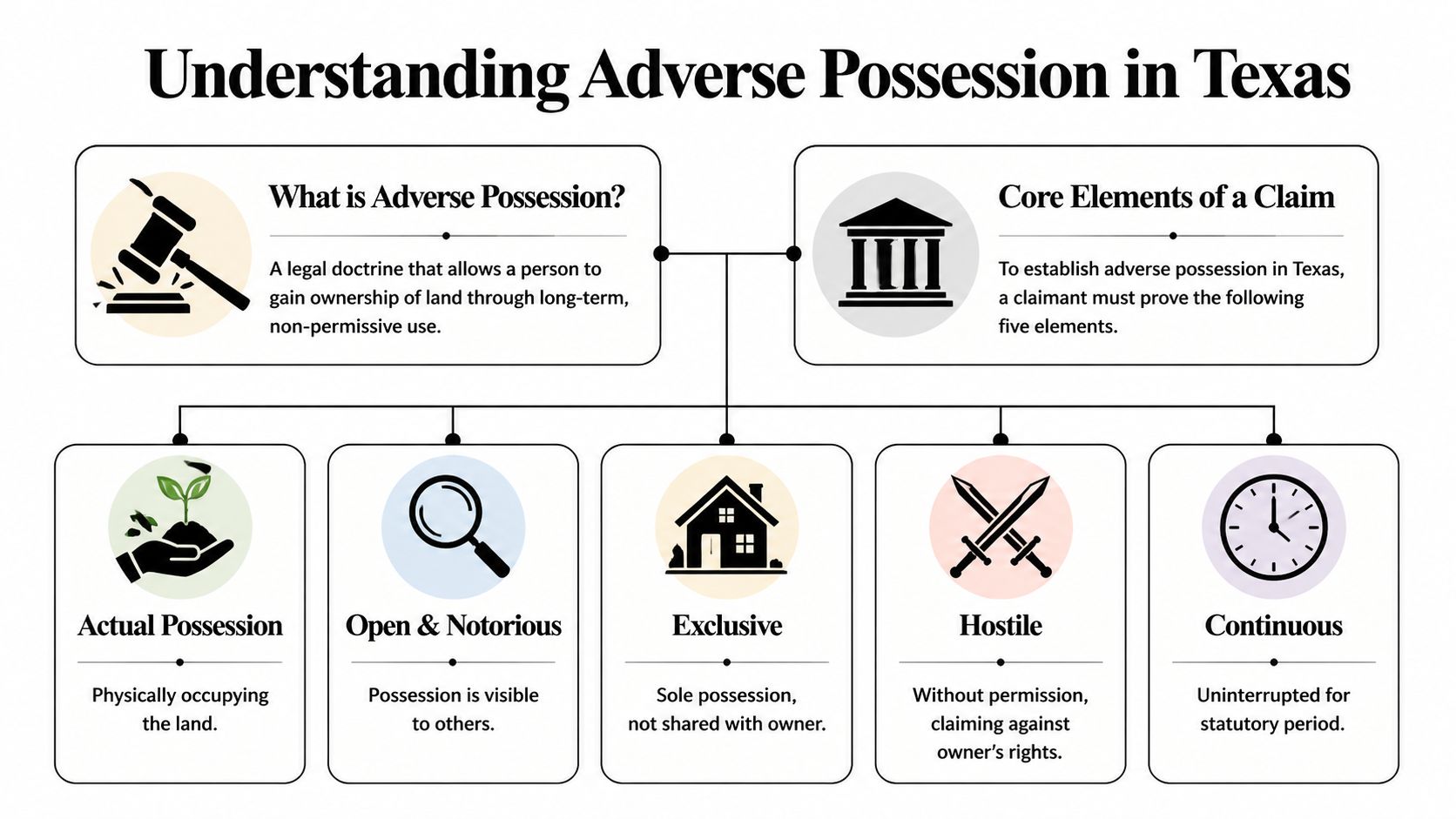
People often call this Texas squatters rights, but that shorthand causes confusion. The critical issue is whether the occupant can prove the required elements of adverse possession under Texas law.
Actual possession means real control of the property
The claimant must physically possess the land in a way that matches the type of property at issue.
On a residential lot, that may involve fencing the area, mowing it as part of the yard, storing property there, or building and maintaining improvements. On rural land, use may look different. Grazing, cultivation, or other visible acts of control may carry more weight than suburban-style occupancy.
Courts look for conduct that shows possession, not occasional use. Walking across a tract from time to time is very different from treating it as part of your own property line.
Open and notorious use means the possession is visible
The use has to be obvious enough that a reasonably attentive owner could discover it.
A visible fence, a patio extension, a storage shed, a regularly maintained strip between two homes, or years of crop use can support this element. Secret use usually does not. If the owner had no fair chance to notice the occupation, the claim gets much weaker.
This is why old surveys, dated photos, repair invoices, text messages, and lease files matter in real cases. Boundary disputes are often won by boring records.
The legal question is not whether the owner actually noticed the use. The question is whether the use was visible enough that the owner could have noticed it.
Exclusive possession means the claimant acts like the owner
The claimant must possess the property as their own, rather than sharing control with the record owner or the public.
Shared use creates problems fast. If the owner still stores equipment there, uses the area regularly, gives others access, or continues to manage the space, exclusivity becomes hard to prove. In practice, many weak adverse possession claims fail here because the facts look more like neighborly tolerance than exclusive control.
This issue comes up often with rental property. A tenant living in leased premises is in possession with permission. That is not adverse possession. But a holdover tenant, a former tenant using extra land outside the lease, or someone occupying a detached garage or side lot without the landlord’s consent can create a more complicated record.
Hostile possession means without the owner’s permission
"Hostile" is a legal term here. It does not mean angry, threatening, or violent.
It means the possession is inconsistent with the owner’s rights and not based on permission. If a landlord allowed an occupant to stay temporarily, if neighbors agreed informally to share a strip of land, or if a family member used property with the owner’s consent, that permission usually defeats hostility unless the claimant later makes a clear break and starts claiming the land as their own.
I tell clients the same thing in these disputes. Permission is cheap to document and expensive to reconstruct later. A simple written license, lease addendum, text confirmation, or demand letter can make the difference between a manageable dispute and a title fight.
Continuous possession means the use holds up over time
The claimant must prove uninterrupted possession for the full period required by the Texas statute that applies.
That does not always mean daily occupation. The pattern of use is judged in light of the property itself. A farm may be used seasonally. A rural tract may show possession through recurring agricultural activity rather than constant physical presence. But abandonment, long gaps, or a clear interruption by the owner can stop the clock.
That is why timing disputes are rarely just about counting years. The better question is whether the claimant can show a steady pattern of possession, with evidence, for the entire required period.
How Long You Must Possess Land Under Texas Law
A Texas owner discovers that a neighbor’s fence has been sitting a few feet over the line for years. A landlord realizes a former tenant never left and now acts as if the property is theirs. In both situations, the first question is usually about time.
Time matters, but Texas does not use one deadline for every adverse possession claim.
Texas has several limitation periods, and the right one depends on how the claimant says they got there and what proof they have. As noted earlier, Texas law includes a 3-year route tied to title claims, a 5-year route that generally involves a recorded deed and tax payment, a 10-year route that comes up often in possession disputes, and longer 25-year provisions that can affect harder cases involving peaceable possession or legal disability.
Different timelines require different proof
The shorter routes usually demand better paperwork. The longer routes may give a claimant more time to build a case, but they still have to prove the required possession for the full statutory period.
That distinction matters in real disputes. A person claiming under a deed, even a defective one, presents a different case from a neighbor who fenced and used a strip of land for years with no deed at all. For landlords, the same principle applies to holdover occupants. Staying put for a long time does not erase the need to prove the legal character of that possession.
| Statutory Period | Code Section | Key Requirements | Acreage Limit |
|---|---|---|---|
| 3 years | §16.024 | Color of title, meaning a defective deed or similar claim of title | Not specified here |
| 5 years | §16.025 | Recorded deed, tax payment, and use of the property | Not specified here |
| 10 years | §16.026 | Common route when no deed supports the claim | 160 acres |
| 25 years | §16.027 / §16.028 | Longer-limitations issues, including some disability questions | Not specified here |
Color of title, in plain English
Color of title means the claimant has a document that looks like it gives ownership, but the document has a legal defect.
That often changes the whole fight. Instead of arguing only about who used the land, the parties start arguing about deeds, recording dates, legal descriptions, and tax history. On a boundary case, that can be the difference between a minor survey dispute and a lawsuit over title.
Why the 10-year period gets so much attention
The 10-year statute comes up often because many disputes do not involve a clean paper trail. A fence gets built in the wrong place. A shed crosses the boundary. A ranch road is used as if it belongs to the neighbor. A former tenant stays in possession after the lease relationship breaks down.
Those cases are fact-heavy. The claimant still has to prove possession that satisfies Texas law for the full period, and acreage limits can matter. For owners dealing with encroachments, practical help often starts with documenting the boundary problem early and addressing fence-related property line issues before years of use harden into a legal claim.
What resets the clock
Owners often have more control here than they realize.
The adverse possession clock can reset if the continuity of possession is broken. That may happen if the owner retakes the property, gives express permission, sends a clear objection that changes the nature of the occupancy, or otherwise interrupts the claimant’s possession. The facts matter, and the sequence is critical.
This is one reason landlords should not treat a holdover tenant like a vague nuisance. If the lease ended, the next steps matter. A new agreement, a written demand for possession, rent accepted after termination, or mixed messages about permission can change how the dispute is analyzed later.
The longer timelines can complicate old property disputes
The 25-year provisions tend to appear in older, messier cases. Inherited land, family property used informally for decades, co-owned tracts, and long-neglected rural parcels often raise questions that do not fit the usual 10-year conversation.
These cases turn on records and chronology. Who held title, who was under a legal disability recognized by statute, who occupied the land, and when those facts changed. By the time a family realizes there is a problem, the paper trail may be harder to rebuild than the fence line.
What owners and tenants should do with this information
Start with documents, not assumptions.
Owners should gather deeds, surveys, tax records, photos, lease files, notices, and any writing that shows permission or objection. Tenants and occupants should do the same if a dispute is brewing. Then identify which statute might apply before arguing about the number of years.
That approach saves time and money. In Texas adverse possession disputes, the wrong timeline often leads people to miss the stronger argument.
Common Scenarios Where Adverse Possession Arises
Most disputes don’t begin with someone announcing a legal theory. They begin with ordinary conduct that slowly turns into a serious title problem.
That’s why the most useful way to understand adverse possession elements is to watch how they play out in common Texas situations.

The fence that crossed the line
A suburban owner replaces an old fence. Years later, the adjoining owner learns the fence sits a few feet onto their lot.
This is one of the most common fact patterns because boundary lines on the ground are often less clear than people think. One verified source notes that a common issue involves unintentional adverse possession from boundary misunderstandings, and Texas courts must weigh whether a good-faith mistake, like an encroaching fence, meets the hostile requirement. That point is discussed in this overview of boundary mistake and adverse possession issues.
The legal tension is obvious. The person behind the fence may say, “I thought this was mine.” The record owner may say, “Then this was a mistake, not a hostile claim.”
Both sides may have a point. Texas courts still have to ask whether the use was actual, visible, exclusive, non-permissive, and continuous for the required time. A mistaken fence can support a claim in some cases, but not every encroachment turns into title.
If you're trying to sort out next steps before a dispute escalates, this practical guide on addressing fence-related property line issues is a useful starting point for understanding what property owners often do first on the ground.
The holdover tenant who stays after the lease ends
This one causes confusion because landlords understandably worry that delay will cost them ownership rights.
A tenant who originally entered under a lease started with permission, not hostility. That matters. Adverse possession requires possession that is against the owner’s rights, not under a rental agreement. Even after lease termination, the legal analysis is still more complicated than “tenant stayed, therefore tenant can claim title.”
What usually works for landlords here is prompt, documented action. Serve notices properly. Preserve the lease file. Document that the occupancy is unauthorized after termination. If a landlord sits on the issue and lets a holdover remain without clear enforcement, the facts can become muddier over time.
The worst evidence problem in property cases is silence. If no one wrote anything down, a simple holdover can later be recast as something else.
For tenants, the practical lesson is different. Staying after the lease ends may create an eviction problem, but that does not mean you’ve acquired ownership rights. Tenant rights and title rights are not the same thing.
The vacant lot that someone begins using
This scenario appears often with rural land, inherited property, and investment parcels. An owner lives elsewhere. Another person starts using the land for gardening, storage, or livestock.
These disputes get stronger or weaker based on the nature of the use. Occasional presence may look like trespass. Fencing, cultivation, or grazing that fits the character of the land may look more like actual possession. Visibility matters. Exclusivity matters too. If the owner and others still use the land freely, that can undermine the claim.
Owners of vacant land make a common mistake. They assume no rent house means no landlord problem. But a vacant parcel still needs management. Boundary checks, posted signs, written permissions, and quick response to unauthorized use can prevent a weak claim from maturing into a harder case.
The shared driveway misunderstanding
Shared access creates some of the messiest disputes because people treat convenience like ownership.
One neighbor has used a driveway apron or side strip for years. Both households know about it. No one ever reduced anything to writing. Then one owner sells, and the new owner objects.
These facts often weaken an adverse possession claim because shared use can undermine exclusivity, and neighborly tolerance can look like permission rather than hostility. But the details matter. If one side fenced off the area, excluded the owner, maintained it as their own, and did so openly over the proper time, the argument changes.
The practical lesson is simple. Informal access arrangements may keep the peace for years, but they also create future evidence problems. A short written agreement often prevents a long lawsuit later.
A Landlord’s Guide to Preventing Adverse Possession
Landlords and property owners usually have more control over this problem than they think.
Most adverse possession claims become dangerous because the owner let uncertainty sit too long. The strongest defense is often not a dramatic lawsuit. It’s a paper trail showing that the possession was permissive, interrupted, shared, or challenged before it matured into a real title claim.
A verified summary of the landlord-side problem notes that Texas landlords face a real gap because general adverse possession advice often ignores issues like vacant properties during eviction proceedings and holdover tenants who may wrongly try to build a claim. That concern appears in this discussion of adverse possession and landlord-specific risks.
The first defense is permission in writing
If you allow someone to use part of your land, document that permission.
That one step can defeat the hostility element, which is one of the core adverse possession elements. A text, email, license agreement, or signed letter is often far better than a handshake. If the use is temporary, say so. If it can be revoked, say that too.
This is especially useful with neighbors, family users, and short-term occupancy arrangements around vacant property.
Inspections beat assumptions
Owners lose their advantage when they stop looking at the property.
For single-family rentals, small multifamily properties, and rural parcels, regular inspections help you spot fence movement, unauthorized storage, extra occupants, and extended use of side lots or rear strips. Property managers often rely on digital logs, inspection photos, and recurring reminders for this. If you’re organizing multi-property oversight, these best property management apps can help owners and managers keep better records of visits, notes, and maintenance follow-up.
What works here is consistency. What doesn’t work is driving by once in a while and assuming everything looks fine from the street.
Act quickly with holdover tenants
A holdover tenant is still primarily an eviction and possession problem, not a title shortcut. But delay is still risky.
If the lease has ended and the tenant refuses to leave, preserve all notices, payment records, communications, and inspection notes. If you need a practical starting point, review the process for how to evict a squatter or unlawful occupant in Texas. The label may differ depending on the facts, but prompt action matters.
Here’s a useful overview if you want a visual explanation of property-rights enforcement issues:
A practical prevention checklist
Owners usually do best when they follow a routine rather than improvising after a dispute appears.
- Mark the boundaries: Use current surveys, visible markers, and consistent property descriptions in leases and notices.
- Post the property clearly: Signs won’t solve every dispute, but they help show that the owner did not yield control passively.
- Document every permission: If someone may garden, park, cross, store equipment, or graze animals, reduce it to writing.
- Preserve interruption evidence: If you objected, entered the property, removed items, sent notice, or reasserted control, keep proof.
- Coordinate leasing and title records: Landlords should make sure lease files, ownership documents, and management notes tell the same story.
Written permission is one of the cheapest ways to stop an adverse possession argument before it starts.
What owners often get wrong
Some owners think conflict avoidance is the same as legal safety. It isn’t.
If you see a neighbor using land and say nothing, or let a former tenant remain without clear written objection, the facts can drift in the wrong direction. On the other hand, overreacting without checking the survey or deed can also create unnecessary litigation.
The right approach is measured. Confirm the boundary. Confirm the right to possession. Put your position in writing. Then enforce it in the proper forum under the Texas Property Code and related title procedures.
When to Contact a Texas Landlord Tenant Lawyer
Some property disputes stay manageable with good communication and clean records. Others stop being do-it-yourself problems the moment title, boundaries, or post-lease possession becomes contested.
That shift usually happens when the facts are no longer simple.

Gather the right evidence early
If you may need to assert or defend against a claim, start collecting proof while the facts are still fresh.
Useful evidence often includes:
- Recorded ownership documents: Deeds, legal descriptions, and closing records.
- Survey materials: Existing surveys, stakes, plats, and any newer boundary work.
- Visual proof: Photos, videos, satellite images if available to you, and date-stamped inspection records.
- Occupancy records: Leases, notices to vacate, rent ledgers, emails, texts, and maintenance logs.
- Land use proof: Tax records, repair invoices, fencing receipts, cultivation records, and witness statements.
Some cases turn on a tiny factual distinction. Was that use permissive, or not? Was the fence visible the whole time, or only recently? Did the owner ever interrupt possession? Small answers can change the entire case.
Call a lawyer when any of these are true
You should get legal help promptly if any of the following applies:
- You’ve been served with a lawsuit involving title, possession, or boundary claims.
- A survey conflicts with long-standing use and the other side refuses to cooperate.
- A holdover tenant won’t leave and the facts are becoming tangled with ownership arguments.
- You may need a trespass to try title or quiet-title type action to establish rights clearly.
- Inherited or co-owned property is involved, especially where records are old or incomplete.
If the dispute requires more than a simple notice and a conversation, legal strategy matters as much as legal research.
Why these cases are hard to fix late
Adverse possession disputes are fact-heavy. They depend on records, timelines, witness credibility, land use patterns, and the exact legal theory at issue. That’s why waiting can be expensive.
A Texas landlord tenant lawyer or eviction attorney can help you identify whether you’re dealing with tenant rights, trespass, boundary encroachment, holdover possession, or a real title claim. Those are not interchangeable, and using the wrong procedure can waste time you don’t have.
Take Action to Protect Your Texas Property Rights
Adverse possession feels alarming because it sounds like the law rewards the wrong person. In reality, Texas requires strict proof, and weak claims often fail when owners and occupants understand what the law requires.
That’s the practical takeaway. Know the adverse possession elements. Watch your boundaries. Put permission in writing. Treat holdover tenants and vacant land issues as legal matters, not loose arrangements that will sort themselves out.
If you’re a landlord, property manager, homeowner, or tenant dealing with a boundary dispute, unauthorized occupancy, or a post-lease possession problem, early action usually gives you more options. Good documentation, clear notices, and prompt legal review can prevent a small problem from turning into a title fight.
If you need help with an eviction, lease issue, or rental dispute, contact The Law Office of Bryan Fagan, PLLC for a free consultation today. Their Texas landlord tenant lawyers help landlords, tenants, and property owners protect their rights under the Texas Property Code and respond strategically to adverse possession, holdover occupancy, and boundary disputes.