Dealing with a landlord dispute over your security deposit can be stressful—but understanding your rights under Texas law can make all the difference. It’s your money, and you have a right to get it back. Fortunately, the Texas Property Code lays out clear rules for what a security deposit can be used for and when your landlord is legally required to return it. Knowing these rules is your best defense against unfair charges from a landlord.
Your Fundamental Tenant Rights on Security Deposits in Texas
Let's be clear: your security deposit is not a bonus for your landlord. Think of it as your money held in trust for a very specific purpose. The law is designed to cover two things only: any unpaid rent you might owe and the cost to repair damages that go beyond normal wear and tear.

Most disputes happen because landlords and tenants disagree on what counts as "damage" versus "normal wear and tear." This is where knowing your rights from day one can save you significant stress and money. A Texas landlord tenant lawyer can help you navigate these issues, but understanding the basics is the first step.
What the Texas Property Code Says About Security Deposits
Security deposits are standard practice. In fact, a 2023 study found that a staggering 87% of recent renters paid one. With typical apartment deposits in Texas falling between $500 and $999, we’re talking about a significant amount of your cash on the line.
Because so much money is involved, the state created a clear set of rules. The Texas Property Code creates a framework that balances the landlord’s need to protect their property with your right to get your deposit back. No one wants a fight over their security deposit, but being prepared is essential. You can learn more about your general protections in our detailed guide to the Texas Property Code.
To understand how this works, it helps to see the responsibilities laid out side-by-side.
Landlord vs. Tenant Security Deposit Responsibilities in Texas
This table breaks down the essential duties for both landlords and tenants under Texas law. Getting these right is the key to a smooth move-out process.
| Responsibility | Landlord's Duty | Tenant's Duty |
|---|---|---|
| Handling the Deposit | Must hold the deposit as security for damages and unpaid rent. | Pay the deposit as agreed upon in the lease. |
| Returning the Deposit | Must refund the deposit or provide an itemized list of deductions within 30 days of move-out. | Provide a written forwarding address to the landlord for the refund. |
| Deductions | Can only deduct for damages beyond normal wear and tear, unpaid rent, or other lease violations. | Return the property in the same condition as received, minus normal wear and tear. |
| Documentation | Should document the property's condition before move-in and after move-out. | Should document the property's condition with photos/video at move-in and move-out. |
The bottom line is that both sides have a part to play. When landlords and tenants both follow these rules, disputes are far less likely to happen. But if they do, this framework is what a judge will use to decide who is in the right.
What Landlords Can Legally Deduct from Your Deposit
The lease is over, you’ve handed back the keys, and now you’re waiting. That security deposit refund is your money, and you’re counting on getting it back. But then the letter or email arrives, and it’s full of deductions you don’t understand or agree with.
This is one of the most common—and frustrating—disputes between tenants and landlords in Texas. What a landlord can legally take from your deposit isn't a matter of opinion; it's defined by the Texas Property Code. Knowing these rules is the first step to protecting yourself from unfair charges.
In Texas, your landlord can only deduct for two specific things:
- Unpaid Rent: This one is straightforward. If you move out owing rent, your landlord has a clear right to use the deposit to cover what you owe.
- Damages Beyond Normal Wear and Tear: This is where disputes often arise. Your landlord can charge you to fix damage you, your family, or your guests caused. They cannot, however, charge you for the routine, expected decline of a property over time.
Getting this distinction right is critical. It’s the difference between a fair deduction and a landlord trying to make you pay for their business expenses.
Distinguishing Normal Wear and Tear from Actual Damages
The key to protecting your deposit is knowing the difference between living in a home and damaging it. The law recognizes that living in a place leaves a mark. Paint gets scuffed, carpets fade in high-traffic areas, and fixtures show their age. This is normal wear and tear.
Real-World Scenario: Imagine you lived in an apartment for two years. The carpet in the hallway is naturally faded from sunlight and foot traffic. That’s an expected cost of renting the property, and the landlord has to cover it. However, if a guest spills a glass of red wine, leaving a large, permanent stain on the beige carpet, the cost to professionally remove that stain—or replace that section if necessary—can likely be deducted from your deposit.
Let's break it down with some more examples.
What Landlords Can Charge You For (Legitimate Deductions):
- A large hole in the wall: This is obvious damage from an accident, not a small nail hole from hanging a picture.
- Broken windows or appliances: If you cracked a window or broke the microwave door through misuse, the repair is on you.
- Filth requiring heavy cleaning: If you leave the place trashed—piles of garbage, caked-on grime in the bathroom, or a kitchen that’s a biohazard—the landlord can deduct for the extra cleaning costs needed to make it rentable again.
- Unauthorized paint jobs: If you painted the bedroom black without permission, the landlord can charge you the cost to prime and repaint it back to a neutral color.
What Landlords Cannot Charge You For (Illegitimate Deductions):
- Routine professional cleaning: Unless your lease has a specific, enforceable clause requiring it, a landlord can't charge you for a standard cleaning if you left the apartment reasonably clean.
- Minor scuffs on walls: Small marks from moving furniture or hanging a few pictures are part of normal living.
- Pre-existing damage: Your landlord cannot charge you to fix a problem that was already there when you moved in. This is exactly why your move-in inspection and documentation are your most powerful tools.
- Replacing worn-out carpet: If the carpet is old and was already showing its age, the landlord can't make you pay for its replacement. That's a capital improvement, and it's their expense.
Documenting the property’s condition with photos and videos when you move in and when you move out is the best way to shut down bogus claims. It creates a clear record that can save you hundreds or even thousands of dollars.
Understanding the Critical 30-Day Refund Rule in Texas
When you move out of a Texas rental, the clock starts ticking for your landlord. This isn't just a courtesy—it's a hard legal deadline. Under Texas Property Code, Section 92.103, your landlord has a strict 30-day window to return your security deposit.
Once you’ve handed back the keys and given them a forwarding address, they have exactly one month to either send your deposit back in full or provide a detailed, written list of every single deduction. This rule is one of the strongest tenant rights protections you have to get your money back.
How to Legally Start the 30-Day Countdown
That 30-day clock doesn't start on its own. You must take two specific steps to trigger it:
- Officially Move Out: The countdown starts only after you've surrendered the property. This means you’ve cleared out all your belongings and returned the keys, officially giving possession back to the landlord.
- Provide a Forwarding Address in Writing: This is the step tenants absolutely cannot forget. Your landlord has no legal duty to refund your deposit until you give them a new address where they can mail the check and the itemized list. A text or a verbal heads-up won't cut it. Send it by certified mail to create a paper trail that can stand up in court.
If you fail to provide that written forwarding address, the clock stops. A landlord isn't acting in "bad faith" by holding your money if they simply have no idea where to send it.
The list of deductions you might receive should only include legitimate issues like property damage beyond normal wear and tear or any unpaid rent, as the image below illustrates.
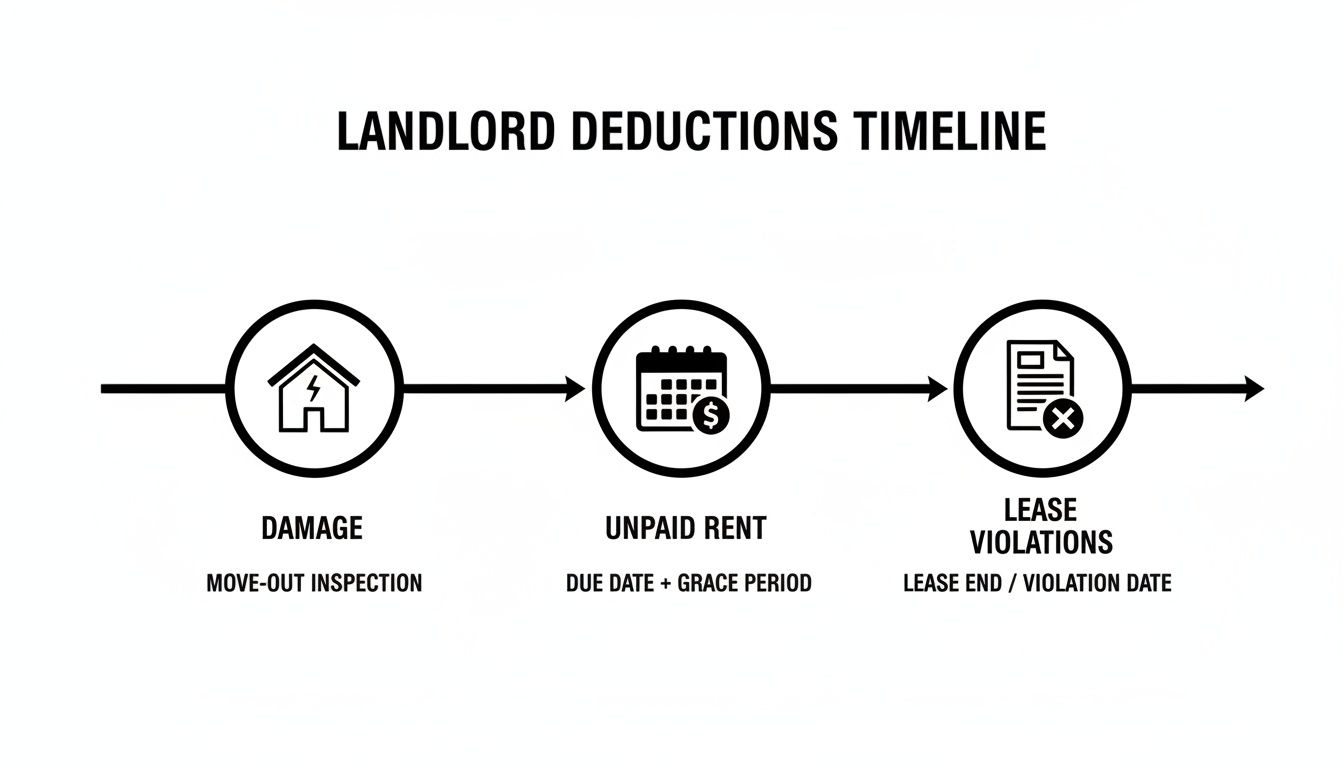
Remember, your deposit isn't a slush fund for the landlord's general maintenance. Deductions must be for specific damages or lease violations.
What Happens When Landlords Miss the Deadline?
So, your landlord blew past the 30-day mark. Now what? The law comes down hard on landlords who wrongfully withhold a deposit. If they fail to either return your money or provide that itemized list on time, they are legally presumed to be acting in “bad faith.”
A landlord found to be acting in bad faith doesn't just lose the right to keep any of your deposit—they can be hit with a massive penalty. A judge can order them to pay you three times the amount of the wrongfully withheld deposit, plus your attorney’s fees and all court costs.
Let's put that in real numbers. If your deposit was $1,500 and the landlord ghosted you—no refund, no list—you could sue and potentially walk away with $4,500 ($1,500 x 3), on top of what you spend on legal help. This isn't a slap on the wrist; it's a powerful deterrent meant to make landlords take this deadline seriously.
If you’re staring at a calendar wondering where your money is, it might be time to fight back. You can start by learning how to file a complaint against a landlord in Texas to see what your next steps should be. That 30-day deadline is your leverage—don’t let a landlord get away with ignoring it.
How to Dispute Wrongfully Withheld Security Deposits
You followed all the rules. You cleaned the place, took photos to prove it, and gave your landlord a forwarding address in writing. But the 30-day deadline came and went, and your security deposit is nowhere to be seen. Or maybe you received a list of deductions that seem completely unfair.
Thankfully, you don’t have to accept this. Texas law gives you a clear path to fight back. The key is to take methodical, informed steps to get what you're owed and hold your landlord accountable.
Step 1: Send a Formal Demand Letter
Before you head to court, you must make a formal, written demand for your deposit. This isn't just a suggestion—it's a critical legal step. It proves you tried to resolve the issue in good faith and creates a powerful piece of evidence if you end up in front of a judge.
Your demand letter needs to be firm and professional. It should clearly state the facts and your legal position, putting the landlord on notice that you know your tenant rights for your security deposit under the Texas Property Code.
Make sure your letter includes these key details:
- The date and your former property address.
- The exact amount of your security deposit.
- The date you officially moved out and provided your forwarding address in writing.
- A clear statement that they have either failed to meet the 30-day deadline or made improper deductions.
- A firm demand for the full and immediate return of your deposit (or the disputed portion).
We walk you through this crucial document in our guide on writing a demand letter in Texas. Always send this letter via certified mail with a return receipt requested. That little green card is your undeniable proof the landlord received your demand.
Step 2: Take Your Case to Justice Court
If the demand letter is ignored or your landlord refuses to pay, your next move is filing a lawsuit in a Texas Justice Court (also known as small claims court). The process is designed to be straightforward, so you can represent yourself if you choose. An experienced eviction attorney can also represent you to ensure your case is presented effectively.
Filing a suit is often the wake-up call a landlord needs. A landlord who was happy to ignore your letter might suddenly become very cooperative once a constable serves them with a court summons.
The process breaks down into a few simple steps:
- File a Petition: You'll fill out a simple form at the Justice of the Peace precinct for the area where your old rental is located, explaining why you're suing.
- Pay a Filing Fee: There's a small fee to get the case started, though you may be able to get it waived if you can't afford it.
- Serve the Landlord: The court arranges for a constable to officially deliver the lawsuit to your landlord.
- Prepare Your Evidence: This is where you win your case. Gather every piece of documentation you have.
This isn't just a "you" problem. Disputes over deposit returns are on the rise. For example, one report on rising renter disputes showed cases jumping from 172 to 195 in just one year—a trend we see in hot Texas rental markets.
Step 3: Prove Your Case and "Bad Faith"
When you get to court, documents are everything. You need to walk in with an organized file of proof to hand the judge. A landlord who intentionally and knowingly keeps your deposit in violation of the law is acting in "bad faith." Proving this is the key to unlocking significant penalties.
Your evidence file should contain:
- A copy of your lease agreement.
- Your move-in and move-out photos and videos to show the property's condition.
- A copy of the written notice where you gave your forwarding address.
- The certified mail receipt from your demand letter.
- Any emails, texts, or other written communication with the landlord.
Under Texas Property Code § 92.109, if a judge finds your landlord acted in bad faith, the court can order them to pay you $100, three times the amount of the deposit they wrongfully withheld, and your attorney's fees. This isn't just about getting your money back; it's a penalty designed to stop landlords from illegally pocketing tenant funds. For a $2,000 deposit, that could mean a judgment of up to $6,100 plus court costs.
Proactive Steps to Protect Your Security Deposit
The best way to get your security deposit back is to make sure your landlord never has a legitimate reason to keep it. This isn't about hoping for the best—it's about taking strategic, proactive steps from the moment you get your keys until the day you move out. You have to build your case from day one.

Think of it this way: you’re creating a crystal-clear record that protects your money from unfair claims and keeps everyone honest.
The Power of the Move-In Inspection
Your single best piece of evidence is a thorough move-in inspection, completed before you move a single box. Don't rush this. This is the most critical moment for protecting your deposit.
Take a detailed video walkthrough of the entire rental. Narrate what you see, pointing out every scratch, scuff, stain, or appliance that isn’t working correctly.
Go room by room and document everything:
- Walls and Ceilings: Look for paint chips, old nail holes, or water stains.
- Flooring: Get close-ups of scratches on wood floors, stains in the carpet, or cracked tiles.
- Appliances: Test everything—the stove, fridge, dishwasher, microwave.
- Fixtures: Turn on faucets to check for leaks, flick every light switch, and test the blinds.
- Windows and Doors: Open, close, and lock them all to ensure they work.
When you’re done, send your landlord a dated email with the video, photos, and a written list of every issue you found. This creates a time-stamped record proving they knew about the property's condition the moment you took possession.
Best Practices for a Smooth Move-Out
Transparency is good for both sides. While tenants need to be diligent, smart landlords also take steps to minimize disputes. For landlords, doing a joint move-in inspection with the tenant is a game-changer. It prevents countless arguments later.
For tenants, the job doesn’t end after the inspection. Keep the property in good shape and report any repair needs right away. This shows you're a responsible occupant and stops small problems from becoming big, expensive ones.
When your lease is up, your goal is simple: return the property in the same condition you received it, minus normal wear and tear. Pull out your move-in photos—that’s your guide. Clean the unit thoroughly. This doesn't automatically mean you have to hire a professional service (unless your lease explicitly requires it), but it should be spotless. Resources like A Renter’s Guide to End of Lease Carpet Cleaning can offer helpful tips.
Just like you did when you moved in, do a final inspection after all your belongings are gone. Take another set of photos and videos. Better yet, ask your landlord to do a final walk-through with you. This final step is your proof that you held up your end of the deal.
Common Questions About Texas Security Deposit Law
Security deposit rules can feel confusing. To help, we’ve laid out straight answers to the most common questions we hear from Texas tenants and landlords based on the Texas Property Code.
Can My Landlord Charge Me for Painting After I Move Out?
Usually, no. A landlord can't deduct the cost of a routine paint job from your deposit. Small scuffs from furniture, minor fading, and a few nicks in the wall are expected and fall under "normal wear and tear."
However, your landlord might have a legitimate reason to deduct for painting if you:
- Left significant damage, like deep gouges that need to be patched.
- Painted a room a dark or bold color without written permission.
- Allowed drawings or crayon murals on the walls that a simple coat of paint can't hide.
Your best defense is to document the wall's condition with photos when you move in and again when you move out.
What Happens If I Forget to Give My Landlord My New Address?
This is a huge mistake. You are legally required to give your landlord your forwarding address in writing. If you don't, the 30-day clock for your landlord to return the deposit never starts. The responsibility is on you to provide a valid address where they can mail the refund.
Expert Insight: That 30-day deadline only activates once two things have happened: you've fully vacated the property, and you've provided a forwarding address in writing. Until both are done, your landlord isn't legally on the clock.
Protect yourself. Send your forwarding address using certified mail with a return receipt requested. This gives you undeniable proof that you sent it and they got it.
Does My Landlord Have to Pay Me Interest on My Deposit?
No. Texas law does not require landlords to pay interest on security deposits. The deposit is held as security for the landlord, not an investment account for the tenant. Any interest the money earns belongs to the landlord unless your lease has a very rare clause that says otherwise.
Can a Landlord Deduct for Professional Carpet Cleaning?
This comes down to two things: what your lease says and the condition you left the carpet in.
- If Your Lease Requires It: Many leases now include a clause requiring the tenant to pay for professional carpet cleaning at move-out. If you signed a lease with that provision, the landlord can generally deduct the cost.
- If Your Lease is Silent: The landlord can only charge for cleaning if the carpet is left filthy or damaged beyond normal wear and tear.
So, what’s the difference? A slightly worn path in a hallway is normal wear. Big, obvious stains from pets, burn marks, or tears are damage. Your best weapon against an unfair cleaning deduction is documentation. Take clear, dated photos of the carpets when you move in and again right after you've cleaned them before moving out. If you're unsure whether a deduction is fair, a Texas landlord tenant lawyer can review your lease and evidence to give you a clear answer.
If you need help with an eviction, lease issue, or rental dispute, contact The Law Office of Bryan Fagan, PLLC for a free consultation today. You can get more information on our website at https://texastenantlawyers.com.