Dealing with a landlord dispute or needing to end a lease can be stressful—but understanding your rights under Texas law can make all the difference. It’s not as simple as packing your bags and walking away. One wrong move, and you could find yourself on the hook for thousands in unpaid rent or facing a lawsuit. To terminate a lease legally, you either need a valid reason recognized by Texas law or a mutual, written agreement with the other party. This guide will walk you through the right way to handle it.
Navigating Lease Termination: Your Rights and Duties

Whether you're a tenant needing to move or a landlord facing a vacancy, the stress of ending a lease can feel overwhelming. But understanding your rights under Texas law is your best defense. A lease is a binding contract, and breaking it without proper grounds can have serious fallout, from a judgment for back rent to a major hit on your credit score.
Your first step? Read the lease agreement. It’s the foundational document that spells out the rules for both sides. But here’s what many people miss: Texas law—specifically Chapters 91 and 92 of the Texas Property Code—provides rights and obligations that can override or add to what’s in your lease.
What the Texas Property Code Says About Lease Termination
In Texas, you can't just break a lease because your plans changed or you found a cheaper place. The law is very specific about when early termination is justified. Figuring out if your situation fits one of these scenarios is the critical first step.
For tenants, the Texas Property Code allows you to break a lease under certain conditions:
- Active Military Duty: If you're a servicemember and receive orders for deployment or a permanent change of station, both federal and state laws give you the right to terminate your lease.
- Uninhabitable Living Conditions: Your landlord has a duty to make repairs that affect your health and safety. If they fail to do so after you've given them proper written notice, you may have grounds to end the lease.
- Family Violence: Victims of documented family violence have a statutory right to break a lease early by providing specific proof, like a protective order.
- Landlord Harassment or Privacy Violations: If a landlord illegally enters your home, removes your property, or otherwise harasses you, you may be able to terminate the lease.
For landlords, termination is almost always tied to the tenant's failure to follow the lease. The number one reason is non-payment of rent, but other material breaches—like illegal activity or causing significant damage—can also be grounds for termination and eviction.
The table below summarizes some of the key statutory reasons a lease can be terminated in Texas.
Summary of Legal Reasons for Lease Termination in Texas
| Reason for Termination | Who Can Initiate | Governing Texas Property Code Section(s) | Key Requirement |
|---|---|---|---|
| Family Violence | Tenant | § 92.016 | A copy of a protective order or other required documentation. |
| Military Service | Tenant | § 92.017 | Official orders for deployment or permanent change of station. |
| Landlord's Failure to Repair | Tenant | § 92.056 | Proper written notice given and reasonable time to repair has passed. |
| Lease Violations | Landlord | § 91.001 | A material breach of the lease terms (e.g., non-payment of rent). |
| Landlord Retaliation | Tenant | § 92.331 | Proof the landlord is acting against you for exercising a legal right. |
| Sexual Assault/Stalking | Tenant | § 92.0161 | Required documentation, such as a protective order. |
This isn't an exhaustive list, but it highlights that you must have a legally sound reason to act. Simply wanting to move isn't enough.
Key Takeaway: A lease is a serious legal contract. Before you try to end it, you must have a legally valid reason or get a written mutual termination agreement. Anything less exposes you to significant financial and legal risk.
Getting this right requires meticulous attention to detail. For instance, a tenant trying to break a lease over failed repairs must prove they gave proper written notice and allowed the landlord a "reasonable" amount of time to fix the problem. A landlord can't just lock the doors for unpaid rent; they must first provide a formal, written "Notice to Vacate" before they can even start the eviction process in court.
Understanding these fundamentals is the first move toward resolving your lease issue without a costly legal battle. If you're facing a complicated lease situation, getting advice from a Texas landlord tenant lawyer who knows Texas law isn't just a good idea—it's essential.
If you need help with an eviction, lease issue, or rental dispute, contact The Law Office of Bryan Fagan, PLLC for a free consultation today.
How to Legally Break a Lease in Texas

Signing a lease feels like a firm commitment. But what happens when life throws you a curveball? Sometimes, staying in a rental isn't just inconvenient—it's impossible or unsafe. It's a stressful situation, and many tenants feel trapped, thinking there's no way out.
While a lease is a binding legal contract, it's not an iron cage. Texas law recognizes that certain situations give tenants the legal right to terminate their lease early. These aren't just convenient excuses; they are specific, legally protected reasons that allow you to move on without penalty. Understanding your tenant rights is your first step to a solution.
Military Service Obligations
For our active-duty servicemembers, both federal and Texas laws offer a clear path for ending a lease due to military service. This isn't a favor from the landlord; it's your right under the Servicemembers Civil Relief Act (SCRA) and Texas Property Code § 92.017.
You can legally terminate your lease if you:
- Are called to active duty for a period of more than 90 days.
- Receive orders for a permanent change of station (PCS).
- Are ordered to deploy with a military unit for 90 days or more.
To exercise this right, you have to give your landlord written notice of termination along with a copy of your official military orders. Once you do that, the lease terminates 30 days after your next rent payment is due. So, if your rent is due on the first of the month and you give notice on July 10th, your next rent payment is August 1st, and your lease would officially end on August 31st.
What the Texas Property Code Says About Repairs
Every landlord in Texas has a legal duty to provide a home that is safe and habitable. This is known as the "warranty of habitability." If a problem arises that materially affects your physical health or safety—and you didn't cause it—you may have grounds to break the lease under Texas Property Code § 92.056.
We’re not talking about a small cosmetic issue here. Think bigger.
Real-World Scenario: Imagine the roof in your apartment has a severe leak every time it rains, causing water damage and mold growth. You've notified your landlord in writing, but weeks go by with no action. This is a clear condition that affects your health and safety, giving you legal options.
However, you can't just pack up and leave. To legally terminate for this reason, you must follow a very specific, step-by-step process.
- First, you must give your landlord written notice of the problem, sent by certified mail to create a paper trail.
- The landlord then has a "reasonable" amount of time to make the repair.
- If they don't, you need to send a second written notice. If the problem still isn't fixed, you may then have the right to terminate the lease.
Document everything. Every phone call, every email, every photo. This documentation is your best defense if the landlord disputes your claim.
Family Violence and Sexual Offenses
Texas law provides incredibly important protections for tenants who are survivors of domestic violence or certain sexual crimes. Your safety comes first.
Under Texas Property Code § 92.016, a tenant can break their lease if they obtain a protective order related to family violence. A similar right exists under § 92.0161 for victims of sexual assault or stalking.
If you are in this terrible situation, providing your landlord with a copy of the protective order (or other qualifying document) and a written notice to vacate allows you to terminate the lease immediately and without any further rent obligation. You can explore a more comprehensive list of reasons you can legally break a lease in Texas on our website.
Landlord Harassment or Privacy Violations
When you rent a property, you have a right to "quiet enjoyment." This means your landlord can't just show up whenever they want or interfere with your life. While the lease gives them a right to enter for legitimate reasons, like emergency repairs, it doesn't give them a key to your private life.
If your landlord is constantly entering your home without proper notice, removing your personal property, or shutting off your utilities to try and force you out, you might have a case for what's called "constructive eviction."
Be warned: this is one of the hardest claims to prove. It requires showing a consistent pattern of harassment that makes living in the home impossible. If you believe this is happening, your first step is to document every single incident—write down dates, times, what happened, and take photos or videos if you can. This is a situation where you should absolutely consult with a Texas landlord tenant lawyer to assess whether the landlord's actions are severe enough to justify breaking your lease.
A Landlord's Guide to Lease Termination and Eviction in Texas
Your rental property is more than just a building; it’s a business and a significant investment. When a tenant stops paying rent or otherwise violates their lease, you need to act decisively to protect that investment. But in Texas, you can't just change the locks and move on.
Terminating a lease and, if it comes to it, evicting a tenant is a strict legal process. One misstep can get your case thrown out of court, costing you weeks of lost rent and forcing you to start all over again.
Curable vs. Incurable Breaches: Knowing the Difference
The first thing to understand is that Texas law views lease violations differently. The path you take often depends on whether the problem is something the tenant can fix (a curable breach) or something they can't (an incurable breach).
Curable Breaches: Think of these as fixable mistakes. The most common is non-payment of rent. Other examples include having an unauthorized pet or failing to keep up the yard. For these, you must give the tenant a chance to "cure" the problem—in other words, pay what they owe or get rid of the pet.
Incurable Breaches: These are serious, irreversible violations. This includes things like committing illegal acts on the property, causing major intentional damage, or other severe conduct that makes it impossible to continue the tenancy. With these, you can typically move straight to an unconditional notice to vacate.
The Notice to Vacate: Your Critical First Step
Before you can even think about filing an eviction suit, you have to legally end the tenant's right to be in the property. This is done with a formal, written "Notice to Vacate." This isn't a suggestion; it's a non-negotiable legal document governed by Texas Property Code § 24.005.
Real-World Scenario: Your tenant's rent was due on the 1st. It's now the 5th, and they've gone silent. Your first and only legal move is to deliver a proper Notice to Vacate. You cannot change the locks, turn off utilities, or file with the court until this step is done correctly.
For non-payment of rent, Texas law requires you to give the tenant at least a 3-day notice to move out, unless your written lease specifically allows for a shorter or longer period.
This notice is not just a simple letter. It must:
- Be in writing.
- State the exact deadline for the tenant to move out.
- Clearly state the reason for the notice (e.g., "for non-payment of rent").
- Include the total amount of rent due to fix the breach.
- Be delivered properly—either in person to the tenant (or someone over 16 at the home), by mail, or by posting it on the inside of the front door.
Getting the delivery wrong is one of the easiest ways to lose an eviction case. An experienced eviction attorney knows these rules inside and out and can prevent a simple mistake from derailing the entire process.
After the Notice Is Delivered
Once the notice is in their hands, the ball is in the tenant's court. If they pay the rent in full, the lease is reinstated, and the matter is closed—for now.
But if that deadline passes and the tenant has neither paid the rent nor moved out, you now have legal grounds to file an eviction lawsuit. This is officially called a "forcible detainer" suit, and you'll file it with the local Justice of the Peace court.
Only after you win the eviction case and get a judgment from the court can you have the tenant legally removed by a constable or sheriff. Trying to force a tenant out yourself is called a "self-help" eviction, and it's illegal. Doing so will expose you to serious lawsuits and financial penalties.
If you are a landlord dealing with an eviction, lease issue, or rental dispute, contact The Law Office of Bryan Fagan, PLLC for a free consultation today.
Navigating Commercial Lease Terminations in a Shifting Market
Ending a commercial lease is a different league compared to a residential one. For Texas business owners, the stakes are higher, the contracts are far more complex, and the financial fallout from a mistake can be devastating.
You can't just walk away from a commercial space, but the key to your exit might be hiding in the fine print of the very lease you signed.
Unlike residential leases, which are heavily guided by the Texas Property Code, commercial agreements are creatures of contract. This means the specific language in your lease is king. Clauses that look like standard boilerplate can become powerful tools when your business needs to pivot.
A buyout clause, for example, could let you terminate the lease early by paying a set penalty, like a few months' rent. This gives you a clear, calculated exit strategy—and it’s often much cheaper than being on the hook for years of rent you can no longer afford.
Key Clauses That Can Open Doors
Beyond a simple buyout, other complex provisions can offer a pathway out. Understanding these is crucial, especially when market conditions shift and a new location becomes a better fit for your business.
- Co-Tenancy Clause: A must-have in retail centers. This could allow you to slash your rent or even terminate the lease if a major "anchor" tenant, like a grocery store, leaves the shopping center. The logic is simple: their absence kills customer traffic and hurts your bottom line.
- Force Majeure Clause: This provision can excuse you from your obligations due to unforeseen events outside your control, like natural disasters or government mandates. Its application can be narrow, but it's become a major point of negotiation in recent years.
- Bailment or "Go Dark" Clause: This gives a tenant the right to cease operations at the location while still paying rent. It’s not a direct termination, but it can be a strategic first step while you negotiate a full exit or find a sublessee.
The market has seen a huge shift in how companies view their physical footprint. Many are actively looking to upgrade or right-size. In fact, a recent analysis showed that business relocations made up 31% of large occupier activity last year—a sharp rise from just 21% the year before. This 48% year-over-year jump shows a clear trend: businesses are re-evaluating and exiting leases for better opportunities. You can discover more insights about commercial real estate trends from CBRE.
Negotiating a Mutual Termination
What if your lease has no clear exit clause? All is not lost. You can always try to negotiate a mutual termination agreement with your landlord. This is a brand-new contract where both you and the landlord agree to end the original lease on specific terms.
Real-World Scenario: A tech startup signed a five-year office lease. Two years in, they've outgrown the space and found a better location for less money. Their lease has no buyout clause. Instead of just breaking the lease and waiting for a lawsuit, their attorney starts a conversation with the landlord. They propose a clean break in exchange for forfeiting the security deposit and paying two extra months' rent. The landlord, facing a long and costly legal battle if the tenant defaults, agrees.
This is a win-win. The tenant gets to move, and the landlord gets paid and can start looking for a new tenant right away. For a landlord, a negotiated exit is almost always better than a defaulted tenant and a vacant property.
Because the stakes are so high, you should never try to interpret or negotiate a commercial lease termination on your own. A skilled Texas landlord tenant lawyer can break down your agreement, find your points of leverage, and negotiate with the landlord to protect your business's future. Understanding the fine print in your commercial lease agreement is the first step.
How to Resolve Security Deposit Disputes and Move-Out Issues
Getting out of a lease isn’t just about packing boxes. The final steps—giving proper notice, handling the security deposit, and managing the move-out—are where a simple ending can turn into a legal mess. This section provides a step-by-step guide to resolving these common issues.
Whether you're a landlord or a tenant, how you handle this administrative endgame is critical. It’s all about clear, documented communication. A quick text or phone call won't cut it in court; you need to follow the letter of the law to ensure a clean break and avoid fights over money down the road.
Step 1: Give Proper Written Notice
The whole process kicks off with a formal written notice. If you're a tenant leaving when your lease is up, you'll send a "Notice of Intent to Vacate." If you're a landlord ending a tenancy because of a lease violation, you’ll start with a "Lease Termination Letter," which is often a specific type of Notice to Vacate.
For a tenant’s notice to be legally sound, it has to be crystal clear.
It must include:
- Your full name and the property address.
- The exact date you plan to be moved out, which needs to match the notice period in your lease (typically 30 or 60 days).
- A forwarding address where the landlord can mail your security deposit.
- Your signature and the date you sent the notice.
This diagram shows the general path for a commercial lease exit, which similarly hinges on careful review and professional guidance.
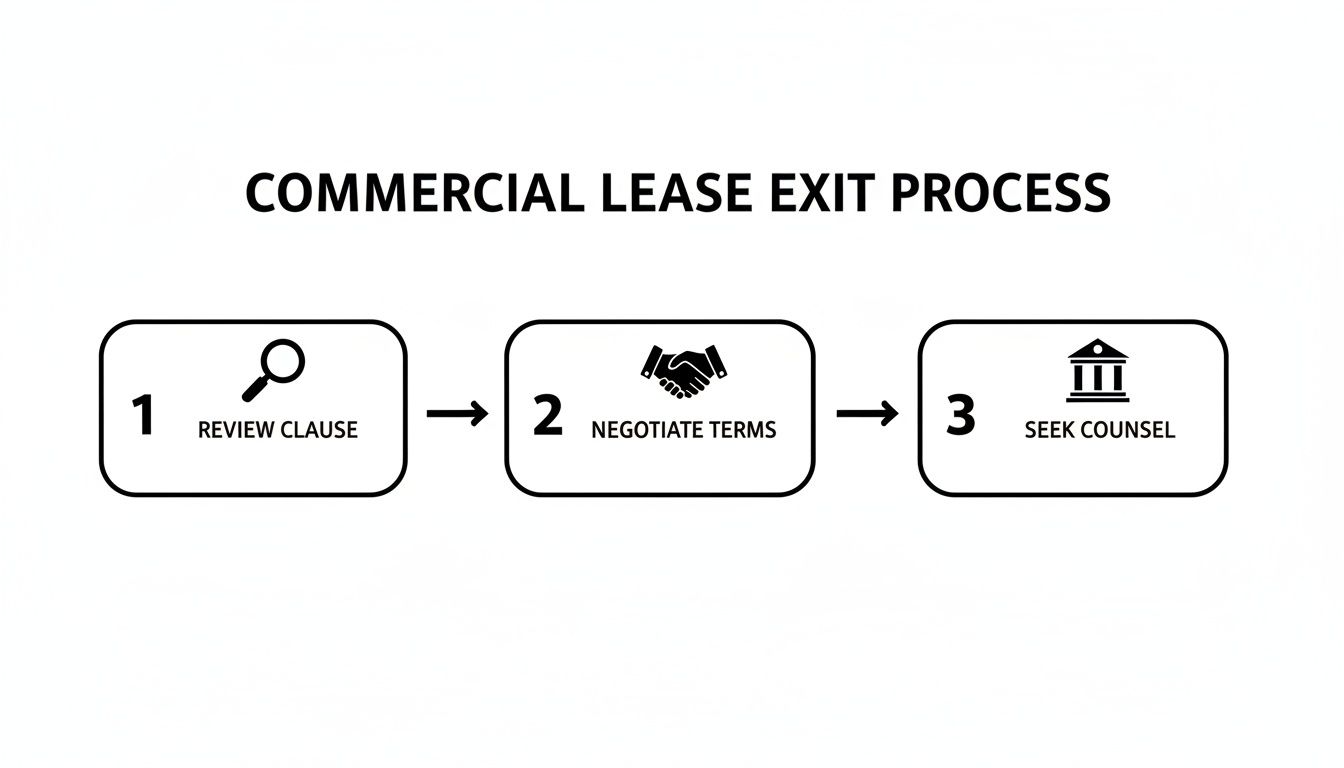
As you can see, a successful exit always starts with understanding the contract. From there, it's about negotiation and, often, getting an attorney involved to protect your interests.
Step 2: Understand the Security Deposit Rules
The security deposit is easily the most common source of post-lease conflict. Texas Property Code § 92.103 puts a strict timeline on this to keep things moving.
Landlords have exactly 30 days from the day a tenant moves out to do one of two things: return the full security deposit or provide a written, itemized list of every deduction.
Miss that deadline, and a landlord could lose the right to keep any of the deposit. If a court finds they withheld it in bad faith, they could be on the hook for three times the amount wrongfully withheld, plus the tenant's attorney's fees.
Crucial Tip for Tenants: The 30-day clock doesn't start until you've both moved out and given your landlord a written forwarding address. Don't forget this step!
So, what can a landlord actually deduct for? The law draws a line between "normal wear and tear" and "actual damage."
- Normal Wear and Tear: This is the unavoidable, minor decline that happens from living in a place. Think small scuffs on the paint from furniture or slightly worn carpet in hallways. A landlord can't charge you for this.
- Actual Damage: This is the stuff that happens because of negligence or abuse. We're talking about big holes in the drywall, a cracked window, pet scratches all over a door, or deep, permanent carpet stains. The landlord can absolutely deduct the cost of these repairs.
Step 3: Conduct a Thorough Move-Out Inspection
A thorough move-out inspection is the best way to prevent a security deposit dispute from ever starting. Both the landlord and the tenant should be there.
Tips for a Smooth Move-Out:
- Bring a Checklist: Use your original move-in condition form as a guide. Walk through every room and compare the current state to how it was when you moved in.
- Document Everything: Take photos and videos of the property's condition on your way out. Make sure they’re date-stamped. This creates an objective record that's hard to argue with.
- Leave It Clean: Your job as a tenant is to leave the property in the same condition you found it, minus that normal wear and tear. To ensure you get your full deposit back, professional Move Out Cleaning services can make a huge difference.
By being meticulous with your notice, deposit follow-up, and move-out inspection, you can close out your lease cleanly and fairly. For more specific help with your notice, you can learn more about how to write a lease termination letter from our detailed guide.
Common Questions We Hear About Terminating a Texas Lease
When it's time to end a lease, the same handful of real-world questions always seem to pop up. These are the concerns we hear about day in and day out from both landlords and tenants across Texas. Here are some straight answers grounded in our experience with Texas law.
I Lost My Job. Can I Break My Lease?
This is a tough one, and we get this call a lot. Unfortunately, under Texas law, financial hardship—even something as sudden as losing your job—is not a legally protected reason to break a lease. That contract you signed is legally binding, and the responsibility to pay rent doesn’t just go away when your income does.
Your first move should always be to talk to your landlord. Immediately. Explain the situation honestly and see if they're willing to work with you on a mutual termination agreement. They might agree to let you out of the lease if you forfeit your security deposit or pay a one-time fee. For many landlords, this is a better option than a long, drawn-out eviction process.
But just walking away is the worst thing you can do. If you abandon the property, your landlord can sue you for every dollar of rent left on the lease. While Texas Property Code § 91.006 requires them to "mitigate damages" by trying to find a new tenant, you’re on the hook for rent for every month the unit is empty, plus any costs they rack up for advertising.
What Exactly Is a Mutual Termination Agreement?
Think of a mutual termination agreement as a negotiated peace treaty between a landlord and a tenant. It’s a new, written contract designed to end the original lease early, allowing both parties to walk away without the threat of a lawsuit.
For this agreement to hold up in court, it absolutely must:
- Be in writing—a verbal promise is not enough.
- Be signed by the landlord and every tenant on the original lease.
- Clearly state the final move-out date.
- Detail the financial terms—like what happens to the security deposit.
- Contain a clause releasing both you and the landlord from any further obligations under the old lease.
This is often the cleanest way out when you don't have a legally valid reason to break the lease but circumstances demand you move.
A Word of Caution from Our Attorneys: Never rely on a verbal agreement to end a lease. Without a signed, written mutual termination agreement, you're leaving yourself wide open to being sued for back rent or other damages down the road. Get it in writing, every time.
What Happens if I Just Break My Lease Without a Legal Reason?
Trying to end a lease without a legally sound reason can be a costly mistake. Your landlord has every right to take you to court and sue for the full amount of rent remaining on your lease term.
Now, Texas law does require the landlord to make a reasonable effort to re-rent the unit. But that doesn't get you off the hook. You are still liable for the rent for every single month the property sits vacant, plus any legitimate costs the landlord has to pay for things like advertising to find a new tenant.
This can easily lead to a massive financial judgment against you, which can wreck your credit score and make it incredibly difficult to rent from anyone else in the future. It's always smarter to negotiate a mutual termination or make certain you have a valid legal justification under the Texas Property Code before you make a move.
Does My Landlord Need a Reason Not to Renew My Lease?
For most standard, fixed-term leases, the answer is no. Once the lease term is up, neither you nor the landlord is obligated to renew it. As long as your landlord gives you proper written notice (usually 30 days, but check your lease), they don’t have to explain why they're not renewing.
But there’s a huge exception here: a landlord cannot refuse to renew for discriminatory or retaliatory reasons. For example, they can't decide not to renew your lease because of your race, religion, or because you have children. They also can't retaliate against you for exercising a legal right, like when you report a code violation.
If you have even the slightest suspicion that the non-renewal is illegal, you need to speak with a tenant rights attorney immediately.
If you need help with an eviction, lease issue, or rental dispute, contact The Law Office of Bryan Fagan, PLLC for a free consultation today.