Skip to content
You found a space that looks right. The location works, the rent seems manageable, and you can already see your office, shop, or family life fitting there. Then the lease lands in front of you, and suddenly everything gets muddy. It talks about build-outs, allowances, landlord approval, punch lists, restoration, and who owns the improvements when the lease ends.
That confusion is normal. It’s also expensive if you ignore it.
In Texas, tenant improvements can help you shape a space around your real needs. They can also trigger disputes over repairs, delays, reimbursement, and move-out obligations. That’s true for a business tenant negotiating a commercial lease, and it can matter for a residential tenant too, especially when a landlord tries to label a required repair as some kind of optional upgrade. If you care about your tenant rights, your money, and your timeline, you need to understand exactly what these terms mean under the Texas Property Code and under your lease.
Your Guide to Navigating Tenant Improvements in Texas
A common Texas scenario goes like this. A restaurant owner in Houston finds a second-generation retail space that seems perfect, but the kitchen layout is wrong, the lighting is poor, and the HVAC needs work before opening day. At the same time, a renter in Dallas asks a landlord to fix a failing air conditioner and gets told, “That’s an improvement, not a repair.” Those are very different problems, but both turn on the same core issue. Who is supposed to pay for changes to the property, and what does Texas law require?
That’s where people get tripped up. They assume any work done to a leased property counts as a tenant improvement. It doesn’t. Some work is optional and negotiable. Some work is legally required. If you blur that line, you can sign a bad commercial lease or mishandle a residential repair dispute that later becomes an eviction fight.
Practical rule: If the lease doesn’t clearly say who approves the work, who pays for it, when it must be completed, and what happens at move-out, you don’t have a real agreement. You have a future argument.
A seasoned Texas landlord tenant lawyer looks at these clauses differently than a broker or contractor does. The legal question isn’t just what the space needs. The legal question is who carries the risk if the project runs over budget, finishes late, fails inspection, or becomes part of the building.
You don’t need more jargon. You need a clean framework. Start with the basic definition, then separate residential from commercial, and then negotiate the lease like the clause matters. Because it does.
Understanding Tenant Improvements A Plain English Definition
Tenant improvements are physical changes to a leased property that make the space work for the tenant’s use. In commercial leases, that usually means construction or upgrades the tenant requests, the landlord approves, and the lease allocates between the parties. In residential leases, the term is trickier because tenants and landlords often misuse it to describe work that Texas law may treat as a repair obligation instead.
That distinction matters in Texas. A restaurant build-out in Houston and an air-conditioning dispute in a Dallas apartment are not the same legal problem, even if someone casually calls both of them “improvements.”

Build-outs change the layout
A build-out changes the structure, layout, or core use of the space. This is the classic commercial TI.
Examples include:
- Adding walls or offices: A law firm divides an open suite into offices, a lobby, and a conference room.
- Reworking a retail floor plan: A boutique adds fitting rooms, storage, and a checkout counter.
- Changing systems tied to the layout: Moving plumbing, doors, vents, or electrical lines to match the new design.
In residential leasing, build-outs are rare. If a tenant and landlord agree to install grab bars, built-in storage, or other accessibility features, the agreement needs to say who pays, who owns the work, who maintains it, and whether it stays after move-out. If the lease is silent, you are inviting a dispute.
Alterations update the space without rebuilding it
An alteration changes the property in a meaningful way without fully reconfiguring it.
Common examples include:
- New flooring
- Updated lighting
- Paint beyond normal touch-ups
- Ceiling work
- HVAC modifications
- Cabinet or counter changes
Here is the legal pressure point in Texas. In a commercial lease, many of these items are negotiable improvements. In a residential lease, some of the same work may overlap with a landlord’s duty to repair conditions that affect health or safety under the Texas Property Code. A tenant does not turn a broken system into a personal upgrade request just because the landlord labels it an “improvement.”
A new branded light fixture in a storefront is usually a tenant improvement. Replacing a failed air conditioner in a Texas rental home may be a repair duty.
Fixtures create the biggest move-out fights
A fixture is personal property that becomes attached to an immovable property closely enough that ownership becomes a lease issue.
Examples include:
- Built-in shelving
- Reception desks attached to the floor or wall
- Commercial kitchen equipment tied into utilities
- Custom lighting
- Mounted displays or cabinetry
Tenants risk losing money. If you install something permanent and your lease does not clearly give you removal rights, the landlord will often argue it became part of the building. That argument can be valid. For a practical construction-side view of navigating commercial renovations, it helps to compare the legal paperwork with how the work is handled in the field.
What tenant improvements mean in practical terms
In practical terms, tenant improvements are lease-controlled changes to the property itself. They are not ordinary furniture, décor, or movable equipment.
A freestanding bookshelf is not a tenant improvement. A built-in counter usually is. A plug-in appliance usually is not. A hardwired lighting system usually is.
Use permanence as your first test. Then use the lease as the final answer. In Texas, that approach keeps commercial tenants from paying for landlord-owned value without protection, and it keeps residential tenants from confusing optional upgrades with repairs the landlord may already be required to make.
Who Pays for the Work The Tenant Improvement Allowance Explained
You sign a lease for office space in Texas. The broker says the landlord is giving you a generous allowance. Then the bids come back, the HVAC upgrade is excluded, permit fees are capped, and the lease makes you pay every overage. That is how tenants end up financing a landlord’s building improvements with their own cash.
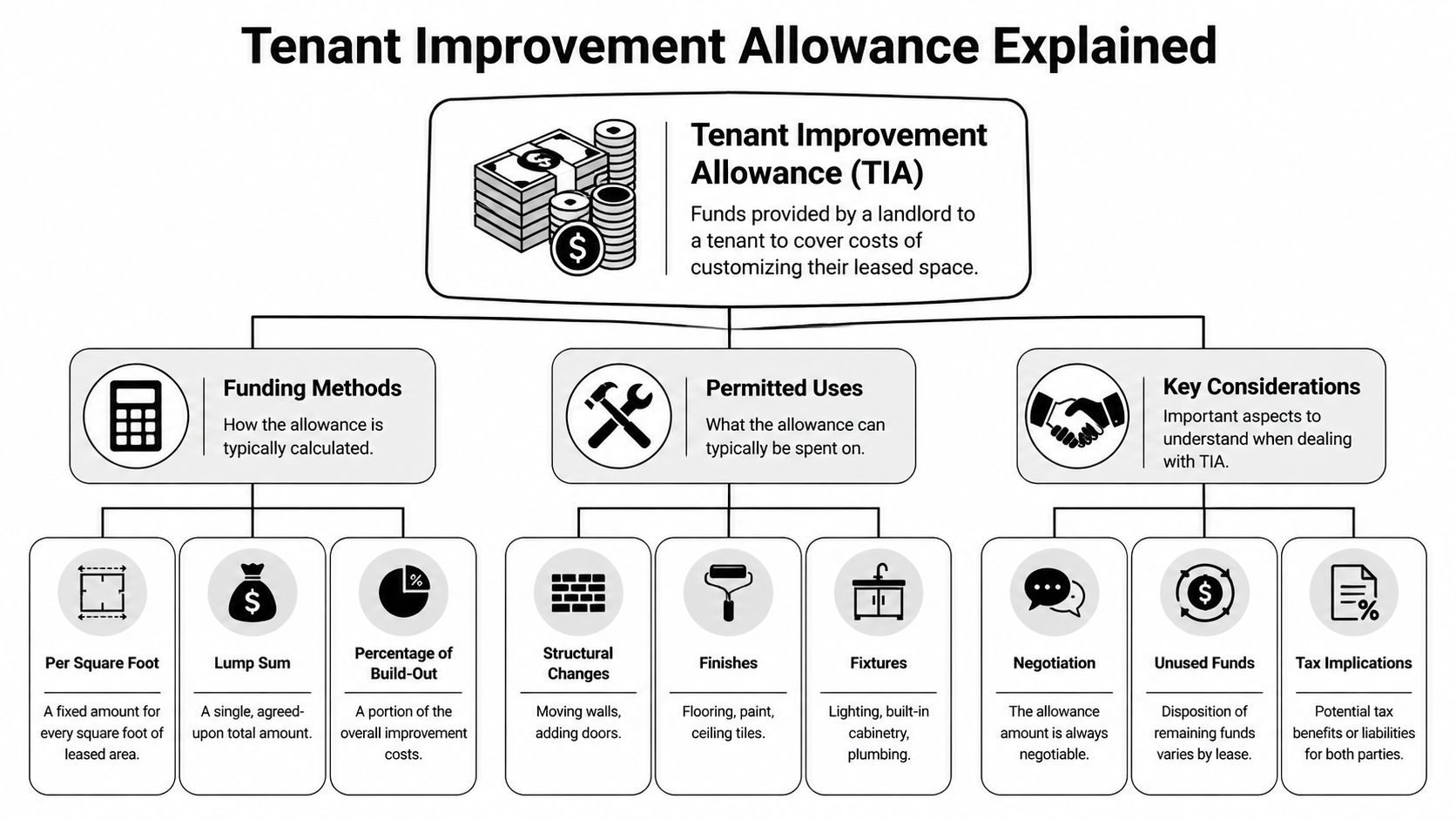
For commercial tenants, the party paying for the work is usually determined by the tenant improvement allowance, or TIA. The allowance is a lease-defined contribution toward approved build-out costs. It is not open-ended. It is not automatic. It is only as useful as the clause that controls it.
How the allowance is usually calculated
Most TI allowances are stated as a dollar amount per rentable square foot. Multiply the lease square footage by the stated rate, and you have the maximum contribution the landlord agreed to make. The math is easy. The fight is over what expenses count against that number.
Do not get distracted by the allowance amount alone. In Texas commercial leasing, a larger TIA usually comes with tradeoffs. Longer lease terms, higher rent, tighter approval rights, or stricter reimbursement conditions are common. A landlord who spends more on the front end will usually recover that money somewhere else in the deal.
That point matters even more if your business could outgrow the space or needs flexibility. Before you accept a large allowance tied to a long commitment, review the lease together with any commercial lease early termination clause in Texas. A strong allowance can become expensive if the exit terms are weak.
What the landlord usually covers and what the tenant usually pays
The landlord’s allowance usually applies to permanent, approved work inside the leased premises. It often does not cover everything required to open your doors.
| Cost Category | Commonly Covered by Landlord Allowance | Commonly Paid by Tenant |
|---|---|---|
| Demolition and basic layout work | Yes, if shown on approved plans | Overage costs or scope changes |
| Flooring, paint, ceilings | Often covered within standard finishes | Premium materials or upgraded finishes |
| Lighting and built-in fixtures | Often covered if part of the approved build-out | Decorative upgrades outside allowance |
| HVAC, plumbing, electrical work | Sometimes covered, but often subject to limits | Extra capacity, code-triggered upgrades, tenant-driven revisions |
| Furniture, décor, movable equipment | Usually excluded | Usually tenant-paid |
| Permits, design fees, engineering, project management | Only if the lease says they are reimbursable | Tenant-paid if excluded, capped, or silent |
This table is a negotiating guide, not a rule of Texas law. The lease decides the result.
Texas tenants should pay close attention to code compliance language. If your build-out triggers ADA work, fire safety upgrades, or mechanical changes required by the city, the lease should say who pays. If it does not, assume the dispute is coming later.
Commercial leases get TI allowances. Residential leases usually do not.
Texas law gets sloppy in many articles, and clients pay for that confusion.
Commercial leases often use a formal TIA structure because the space is being customized for business use. Residential leases usually do not. In a residential setting, if a tenant asks for grab bars, a different lockset, or a minor interior modification, the legal question is often whether the request is an optional upgrade, an accessibility issue, or a repair the landlord may already owe under the Texas Property Code. Calling everything an "improvement" lets landlords blur that line.
That distinction matters. A residential tenant should not agree to pay for work that is really correcting an unsafe condition the landlord is already obligated to address. A commercial tenant, by contrast, usually has much more room to bargain and much less statutory protection.
Why amortization matters
Landlords do not offer TI money out of generosity. They price it into the deal.
Sometimes the recovery shows up in higher base rent. Sometimes it shows up in a longer term, personal guaranties, tighter default language, or limits on assignment and subletting. The actual cost of the allowance is the full economic package, not the headline number on page one.
If a landlord offers a large allowance but requires above-market rent and a long term, you are likely paying back that allowance over time. Treat TI dollars like financed money. Price the entire lease, not just the concession.
For a field-level view of scope, sequencing, and pricing before you sign, navigating commercial renovations is a useful companion to the lease analysis.
The mistake that causes the biggest budget shock
Tenants often assume the allowance equals the project budget. It rarely does.
Overages usually fall on the tenant. So do change orders the tenant requested, upgrades beyond the approved plan, delays caused by late selections, and soft costs the lease failed to mention. If the clause does not clearly address plan approval, disbursement timing, lien waivers, permit responsibility, and who owns unused allowance funds, you do not have a finished deal. You have a future argument.
My advice is simple. Never agree to a TI allowance without a written scope, a reimbursement procedure, a completion deadline, and a sentence that allocates every dollar above the allowance. If the lease is silent, the tenant usually loses that fight.
Residential vs Commercial Leases A Critical Distinction in Texas Law
A Texas apartment tenant asks for a working air conditioner in August. A retail tenant asks for upgraded lighting to improve sales. Both are asking for work to be done. Legally, they are standing in two very different places.
That distinction gets blurred in generic articles, and that is a mistake. In Texas, residential "improvements" often overlap with a landlord's repair duties under the Texas Property Code. In commercial leases, tenant improvements are usually a matter of contract, budget, and bargaining power.
The meaning of Texas Property Code Section 92.052
Under Texas Property Code §92.052, a residential landlord must repair conditions that materially affect the physical health or safety of an ordinary tenant, if the statutory notice requirements are met. That duty does not disappear because the landlord calls the problem an upgrade. Labels do not control. The legal duty does.
A failed HVAC system during extreme heat, dangerous wiring, sewage problems, or major plumbing failures may be repair issues, not tenant improvements. That classification matters because the tenant may have remedies under the Code, while the landlord may face exposure for failing to perform a legal duty. Repair disputes also show up regularly in Texas landlord-tenant conflict, according to DoorLoop’s summary of Texas repair disputes.
Use the right test
Ask one question first. Is the tenant requesting a custom feature, or is the tenant asking the landlord to fix a condition that affects habitability, health, or safety?
Here is the practical split:
- Commercial custom need: “I want better lighting for my showroom.” That is usually a tenant improvement.
- Residential health or safety issue: “The air conditioning failed and the unit is unsafe to occupy.” That may trigger a repair duty under §92.052.
- Residential preference request: “I want stone counters instead of laminate.” That is usually a preference, not a required repair.
- Commercial branding feature: “I want a custom reception wall and upgraded glass fronts.” That is a standard TI request.
Texas landlords should take this seriously. Misclassifying a repair as an optional improvement can lead to claims over noncompliance, retaliation, withheld rent disputes, or bad eviction decisions. Texas tenants should take it seriously too. If you accept the wrong label, you may pay for work the landlord already owed.
Start with the landlord's legal duty in residential leases. Start with the written lease in commercial leases.
Commercial tenants live and die by the lease
Commercial tenants in Texas do not get the same statutory repair protections that residential tenants do. Their rights turn on the lease language, the work letter, the delivery condition, and the default provisions. If the lease says the space is accepted "as is" except for a narrow punch list, that language can shift real cost and risk onto the tenant.
That is why build-out obligations should be reviewed with exit rights, default remedies, and surrender obligations at the same time. If those provisions do not line up, the tenant can end up paying for unfinished work, restoration, or rent after a deal has gone bad. This discussion of a commercial lease early termination clause in Texas is worth reading when TI obligations and move-out liability may collide.
Large companies may spend heavily on space design, but that does not change your legal position. TheRetailBroker's view on Under Armour's campus may be useful as a design reference, but Texas tenants are protected by contract language and statutory rights, not by attractive examples of corporate real estate.
A common residential mistake
A tenant reports a leaking water heater that is damaging the unit and creating unsafe conditions. The landlord replies that replacement is an "upgrade" and tells the tenant to pay for it.
That response may be legally wrong. If the condition affects health or safety, and the tenant gave proper notice in the manner required by law and is current on rent unless a legal exception applies, the issue may fall under the landlord's repair duty rather than a tenant improvement request.
My advice is simple. Residential tenants should document the condition, give written notice that satisfies the statute, and keep the dispute focused on repair obligations. Commercial tenants should assume nothing and negotiate every build-out term in writing. In Texas, the difference between a repair and an improvement is not semantics. It is liability, cost, and influence.
How to Negotiate Your Tenant Improvement Clause
A Texas tenant signs a lease, sees a decent allowance number, and assumes the build-out problem is solved. Then the bids come in, the landlord approval process drags, and the lease effectively makes the tenant pay the gap, absorb the delay, and hand the finished space back at the end. That is not bad luck. That is bad drafting.
In Texas commercial leases, the tenant improvement clause decides who controls the work, who carries the risk, and who owns the result. Treat it like a major business term, because it is one.
Landlords also care about keeping good tenants in place. CRE Insight Journal’s discussion of tenant satisfaction data explains why build-out quality and responsiveness affect renewal decisions. Use that point the right way. A well-drafted TI clause reduces disputes, shortens vacancy risk, and gives both sides a clearer path from lease signing to opening day.
The clause points you should never leave vague
Start with scope. If the allowance is supposed to cover demolition, framing, electrical, flooring, permits, architect fees, inspections, ADA items, or fire code work, list them. If you do not list them, expect an argument later.
Then deal with control. The lease should say who picks the contractor, who prepares plans, who approves revisions, and how long the landlord has to respond. A landlord with unlimited approval time has the power to delay your project without technically breaching anything.
Deadlines need consequences. Put dates on plan approval, permit submission, commencement, and substantial completion. Tie landlord-caused delay to real remedies such as rent abatement, a delivery extension, or a pushback of the opening covenant.
Reimbursement terms matter just as much as the allowance amount. If the tenant fronts costs, the lease should say exactly what backup is required, when reimbursement is due, and whether the landlord can hold back funds over minor paperwork disputes.
Texas tenants need to separate commercial build-out issues from residential repair rights
This point gets blurred in generic articles, and it causes expensive mistakes.
A residential tenant usually is not negotiating a true tenant improvement clause at all. In Texas, many disputes that get labeled as "improvements" are really repair disputes governed by landlord duties under the Texas Property Code. If a condition affects health or safety, the primary question is often whether the landlord must repair it after proper notice, not whether the tenant should pay to "improve" the property.
A commercial tenant is in a different position. Commercial rights usually rise or fall on the lease language. If the document is silent, vague, or one-sided, the landlord usually keeps the advantage. That is why commercial tenants should review the TI clause against the full lease package, including work letters, exhibits, and default provisions. This commercial lease agreement Texas template discussion is a useful starting point for spotting inconsistent terms before you sign.
Ownership at the end of the lease decides whether your investment has any exit value
Do not spend serious money improving a space without settling the move-out rules.
Your lease should answer four direct questions:
- What becomes part of real estate
- What the tenant may remove
- Whether the landlord can require restoration
- Whether the tenant gets any credit or buyout for unrecovered value
Ask the blunt question early: If I pay to make this space usable, what do I own when the lease ends?
That question matters even more in Texas because many tenants assume "my contractor installed it" means "I control it." That assumption fails all the time. The lease controls.
Negotiate the process, not just the budget
Tenants often fixate on the allowance number and miss the procedure around it. The procedure is where landlords protect themselves, and where tenants get trapped.
Require written change-order approval. Require a response deadline for plan review. Require objective completion standards. Require lien waiver procedures. Require clarity on whether allowance funds can be used for soft costs such as design and engineering. If the lease leaves those points open, the landlord can turn routine project administration into pressure.
Tax treatment also belongs in the conversation, but the lease language comes first. As noted earlier, unrecovered tenant investment can become a real loss if improvements stay with the property and the lease gives no removal right, restoration option, or buyout mechanism.
The best negotiating posture
Do not present TI requests as personal preferences. Present them as operating requirements tied to a realistic build-out schedule, a workable opening date, and a stable tenancy.
Be specific. Show the scope, the approval path, the timeline, and the cost responsibility. In Texas commercial leasing, clarity gets deals done. Vagueness creates lawsuits.
Common TI Disputes and How to Prevent Them
A Texas tenant signs the lease, hires the contractor, and plans an opening date. Then the bids come back high, the landlord slows plan approval, and everyone starts blaming everyone else. That is how TI disputes usually begin.
They are rarely complicated. They are usually the result of a lease that left too much unsaid.

Cost overruns start with bad scope control
In commercial leases, the fight usually centers on scope creep. The initial plans look manageable. Then code upgrades, utility work, permitting changes, or landlord-required finishes push the project past the allowance. If the lease does not say who absorbs those added costs, the tenant often pays the difference.
Do not leave that issue to emails and phone calls. Put the approval rule in the lease. No change order gets built unless it is approved in writing by the party paying for it. The lease should also say whether the allowance covers design, engineering, permits, delivery charges, and other soft costs. If it does not, the allowance number can be misleading from day one.
Residential disputes look different, but the money problem is just as real. A residential tenant may agree to pay for flooring, accessibility changes, security upgrades, or appliance replacements without first asking the right legal question. Is this an improvement, or is it work the landlord already owes as a repair under the Texas Property Code? That distinction matters. A tenant should not volunteer to fund work that falls within the landlord's repair duties.
Delay disputes are often rent disputes
Delay hurts commercial tenants fast. If the space is not usable, the business may miss an opening window, staffing plans, or seasonal revenue. Yet many leases still start rent on a fixed date instead of tying it to delivery of a usable premises.
Fix that before signing. Tie rent commencement to substantial completion, or at least build in an abatement right if landlord-controlled work is late. Also require firm deadlines for plan review, permit submissions, and punch-list completion. A landlord should not have unlimited time to approve drawings while the tenant carries pre-opening costs.
In residential leasing, delay usually shows up as habitability or access trouble. If a landlord calls the work an "improvement project" but the tenant cannot safely or reasonably use part of the home, the label does not solve the legal problem. Texas residential tenants need to compare the facts against the landlord's statutory repair obligations, not just the landlord's preferred wording.
Quality fights happen when the lease uses vague standards
"Workmanlike manner" is not enough by itself. Neither is "substantially complete" if nobody defined it.
Use terms that can be enforced. The lease should identify the approved plans, the finish level, the code standard, the inspection rights, the closeout documents, and the deadline for fixing punch-list items. If the parties expect a certificate of occupancy, final inspection, lien waivers, or manufacturer warranties, say so directly.
Serious workmanship problems can also spill beyond the lease and into broader building claims. If a TI project leaves structural, water-intrusion, or system defects behind, review these Texas construction defect claims before assuming the dispute is only a lease issue.
Reimbursement fights usually come down to paperwork
A landlord says the invoice backup is incomplete. The tenant says the work was approved and the allowance should be released. Both sides then spend weeks arguing over forms instead of finishing the project.
Prevent that with a payment procedure that is boring and precise. State what documents must be submitted, who reviews them, how long review takes, what objections must look like, and when reimbursement is due. If lien waivers are required, say whether partial waivers are enough for progress payments or if final waivers are required at the end.
Move-out disputes are ownership disputes in disguise
A common pitfall for many tenants. They paid for the improvements, so they assume they can remove them. Texas leases often say the opposite, especially in commercial space.
Residential tenants need to be careful here too. A tenant-installed item may become a fixture, and a dispute over removal can turn into a security deposit fight or a claim for property damage. Commercial tenants face the same fixture problem plus restoration liability, which can be expensive if walls, wiring, plumbing, or flooring must be returned to an earlier condition.
Use a clear end-of-term clause.
| Dispute | Why it happens | Best prevention |
|---|---|---|
| Budget overrun | Scope, soft costs, or code-related work were not allocated clearly | Written plans, allowance limits, and signed change-order rules |
| Late delivery | The lease sets dates but no remedy | Tie rent, access, or abatement rights to actual completion |
| Poor workmanship | Completion standards are vague | Define substantial completion, punch-list rights, and warranty obligations |
| Reimbursement fight | Payment conditions are incomplete | List required backup, review deadlines, and objection procedures |
| Removal and restoration fight | The lease does not separate fixtures, removables, and items that stay with the property | State ownership, removal rights, and restoration duties in plain terms |
The practical rule is simple. Commercial tenants should document every approval, every draw request, and every change in scope. Residential tenants should stop and ask whether the requested work is an upgrade or a repair the landlord already owes under Texas law. That one distinction prevents a surprising number of bad deals and unnecessary disputes.
Protect Your Investment Your Next Steps
You sign the lease, spend money on the space, and assume the improvements will protect your business or make the home livable. Then the job runs late, the landlord rejects reimbursement, or move-out turns into a fight over what stays and who pays. That is the point where tenants learn the hard lesson. Tenant improvements are lease rights first and construction work second.
In Texas, your next step depends on the kind of lease you signed. Commercial tenants usually get only the rights they negotiated. Residential tenants have a different question at the start. If the work is really a repair that affects health or safety, the landlord may already owe that duty under the Texas Property Code. Do not agree to treat a landlord obligation like a tenant upgrade.
The priorities that deserve your attention
Focus on the points that change the outcome:
- Pin down the work in writing: Plans, materials, deadlines, approval rights, and completion standards should all be stated clearly in the lease or an attached work letter.
- Classify the work correctly: Residential tenants should compare any requested work against §92.052 before paying, because a repair dispute is not the same thing as an improvement request.
- Tie money to process: Commercial tenants should not rely on vague promises about reimbursement. State the allowance amount, draw procedure, backup required, and deadline for payment.
- Read the exit terms early: The lease should say who owns the improvements, what can be removed, and what must be restored at the end.
- Keep a clean paper trail: Save notices, bids, approvals, invoices, photos, and emails. If a dispute starts, those documents usually matter more than anyone’s memory.
Taxes also deserve attention. Tenant-funded build-out costs can create accounting and tax consequences over time, and unrecovered value can become a real loss if the lease says the improvements stay with the landlord at the end. That problem is common in commercial leases and often ignored until the tenant is preparing to leave.
A practical path forward
If you have not signed yet, mark up the tenant improvement language now. Ask direct questions. Who controls the contractor? Who carries insurance? What happens if permits stall the job? When does rent start if the space is not ready?
If you already signed, get organized fast. Pull the lease, amendments, plans, change orders, invoices, notices, emails, text messages, and dated photos into one file. Commercial tenants should match each expense and each approval to the lease language. Residential tenants should organize repair notices carefully and confirm whether the issue falls under the landlord's statutory repair duties.
A strong lease gives you a way to enforce your deal. A weak lease leaves you arguing about basics after the money is gone.
If you need help with an eviction, lease issue, or rental dispute, contact The Law Office of Bryan Fagan, PLLC for a free consultation today. Whether you’re a residential renter protecting your tenant rights, a landlord trying to comply with the Texas Property Code, or a commercial tenant negotiating build-out terms, a Texas landlord tenant lawyer can help you spot risk early and act with confidence.