A home deal can feel solid one day and uncertain the next. You may have packed boxes, lined up movers, or told your family the closing was almost here. Then the contract ends, and the question that suddenly matters most is simple: who gets the earnest money?
That’s where many Texas buyers, sellers, landlords, and tenants get stuck. People search for “release of earnest money trec” expecting a quick form and a quick answer. In practice, the answer depends on the contract, the timing, and whether both sides will cooperate.
Your Home Purchase Is on the Line What About Your Earnest Money
Say a buyer signs a contract, pays earnest money, and schedules inspections. A few days later, the deal falls apart. The title company still holds the deposit. The buyer wants it back. The seller thinks they should keep it. Both are frustrated, and both are asking the same thing: what happens now?
That stress is real. Earnest money often represents meaningful money set aside in good faith while the property is off the market. In Texas, 15-20% of contracts fail to close, which is why earnest money disputes are common, and why the TXR-1904 Release of Earnest Money form matters so much because it addresses both the money and future liability under the contract, as noted by the Texas Real Estate Research Center article on failed contracts and TXR-1904.

If you’re in that position, the first thing to know is this. The money doesn’t automatically go back to the buyer, and it doesn’t automatically go to the seller. The title company is usually holding it in escrow and waiting for proper instructions.
A lot of confusion starts with the phrase “release of earnest money trec.” People assume TREC itself issues the release form or decides who wins the dispute. That’s not how it works. The actual answer sits in the contract paperwork, the termination rights, and the release process the parties follow.
Practical rule: The earlier you match your facts to the contract timeline, the easier it is to see whether the earnest money should be refunded, forfeited, or negotiated.
For Texas readers who want broader context on how contracts work in property deals, this guide to Texas real estate contracts helps connect the earnest money dispute to the contract you signed.
Understanding the Release of Earnest Money Form
The easiest way to think about earnest money is as a security deposit for a home purchase contract, but with different rules. It shows the buyer is serious. The title company holds it during the deal, and the contract decides what happens if the sale closes or falls apart.
What many people miss is the form itself. The document commonly referred to as the "release of earnest money trec" form is TXR-1904, and it is promulgated by Texas REALTORS, not TREC. That distinction matters because people often search for the wrong form or assume TREC handles the dispute directly.
It does two jobs at once
The most important point is this: TXR-1904 is not just a payment instruction. It is also a legal release.
According to the explanation of the Texas release of earnest money form and its legal effect, the form expressly releases the buyer, seller, brokers, and title companies from all liability under the contract. In plain English, signing it can shut down future contract claims, not just move the money.
That’s why I tell clients to treat this form like a settlement document, not a receipt.
Signing TXR-1904 can end more than the escrow dispute. It can also end claims one side thinks they still have.
Why that catches people off guard
A buyer may think, “I’m only agreeing to get my deposit back.”
A seller may think, “I’m only authorizing the title company to send the money.”
But the document is broader than that. Once signed, it can close the door on later arguments about breach, damages, or blame under the contract.
That broad release is part of what makes the form effective. Contracts need clear terms, mutual agreement, and enforceable promises. If you want a plain-English refresher on how agreements become binding, 6 essential contract elements explained is a useful primer.
Why the title company asks for signatures
The title company is holding escrow funds for both sides. It isn’t there to judge who was right. It needs written authority to release the money.
That is why the process often feels slower than people expect. The title company is trying to avoid making the wrong call and getting dragged into the dispute itself.
Here’s the short version:
| Issue | What TXR-1904 does |
|---|---|
| Money in escrow | Directs where the earnest money goes |
| Contract claims | Releases parties from liability under the contract |
| Title company role | Gives the escrow agent written authority to disburse |
If you remember one thing from this section, remember this: the release of earnest money trec search usually leads people to a form that is far more powerful than they realize.
Key Players and Their Duties in the Release Process
When earnest money gets stuck, the fastest way to lower the temperature is to identify who holds the power to act. In many disputes, the issue is not bad faith at the start. It is that each person in the deal has a different job, a different risk, and a different reason for slowing down.

If you treat the release process like a three-person tug-of-war, you will miss what is really happening. It works more like a locked box with three separate keys. The buyer has one set of rights under the contract. The seller has another. The escrow agent has the money, but usually cannot open the box unless the paperwork or the law clearly allows it.
The escrow agent
The escrow agent is usually the title company. Its job is to hold the funds neutrally and release them only on proper authority.
That point matters more than people expect. A title company is not there to decide who behaved badly, whose story sounds more believable, or who is threatening to sue first. If the parties disagree, the title company often has to stay put until it receives a signed release, a final court order, or some other legally sufficient instruction. The Texas Real Estate Commission explains the broker side of this neutral handling in its discussion of disputes and escrowed money.
So if the title company says, “We need both signatures,” that is usually caution, not stonewalling.
The buyer
A buyer’s role is less about arguing and more about proving. If the contract gave the buyer a right to terminate and recover the earnest money, the buyer needs a paper trail that shows the right was used correctly.
That usually means:
- sending notice in the manner required by the contract
- sending it before the deadline expires
- keeping delivery confirmations, emails, text screenshots, and addenda
- signing release documents that match the buyer’s position
Clients often feel frustrated here because they know what happened and assume that should be enough. In a dispute, “I told them” is weaker than “Here is the notice, here is the timestamp, and here is the contract paragraph that allowed it.”
The seller
The seller’s job is to evaluate the contract, not merely react to the buyer’s request. Sometimes the seller has a legitimate claim to the earnest money, especially if the buyer missed a deadline or defaulted without a valid termination right.
That said, refusing to sign just to gain an advantage can create a longer and more expensive fight. Sellers should ask a focused question: does the contract support keeping the funds?
In practice, earnest money amounts vary by price point and local custom. In some Texas transactions, smaller deposits are common, while competitive markets and higher-priced homes often involve larger sums, as described by Texas REALTORS in its overview of earnest money, option fees, and buyer risk. The larger the deposit, the more pressure both sides feel when the release stalls.
Why agents matter, but do not control the money
Real estate agents often become the day-to-day messengers in an earnest money dispute. They gather documents, relay timelines, and push for signatures.
But agents do not get to order the escrow agent to release funds on their own. They can explain the contract and help the parties reach agreement. They cannot substitute their judgment for signed instructions or a court ruling. That distinction confuses a lot of people because agents are often the most visible people in the dispute.
A quick role chart
| Party | Main duty | Main limit |
|---|---|---|
| Buyer | Show the contract right to terminate or recover funds, with proof | Cannot rely on memory or informal notice |
| Seller | Decide whether the contract supports retaining the deposit | Cannot force unilateral release from escrow |
| Escrow agent | Hold and disburse funds only on proper authority | Cannot choose who wins the dispute |
| Real estate agents | Help document facts and move paperwork | Cannot override escrow instructions |
The practical takeaway is simple. If your earnest money is tied up, start by matching the problem to the right person. Ask the title company what authority it needs. Ask whether the buyer’s notice was timely and documented. Ask whether the seller can point to a specific contract basis for keeping the funds. Those questions often reveal whether the money should be released, whether a signature dispute is coming, or whether the matter is drifting toward interpleader or litigation.
How Earnest Money Is Handled in Common Scenarios
Legal rules make more sense when you can place yourself inside the facts. Most earnest money disputes fit into a small number of patterns. Once you know which pattern matches your situation, the next step becomes clearer.
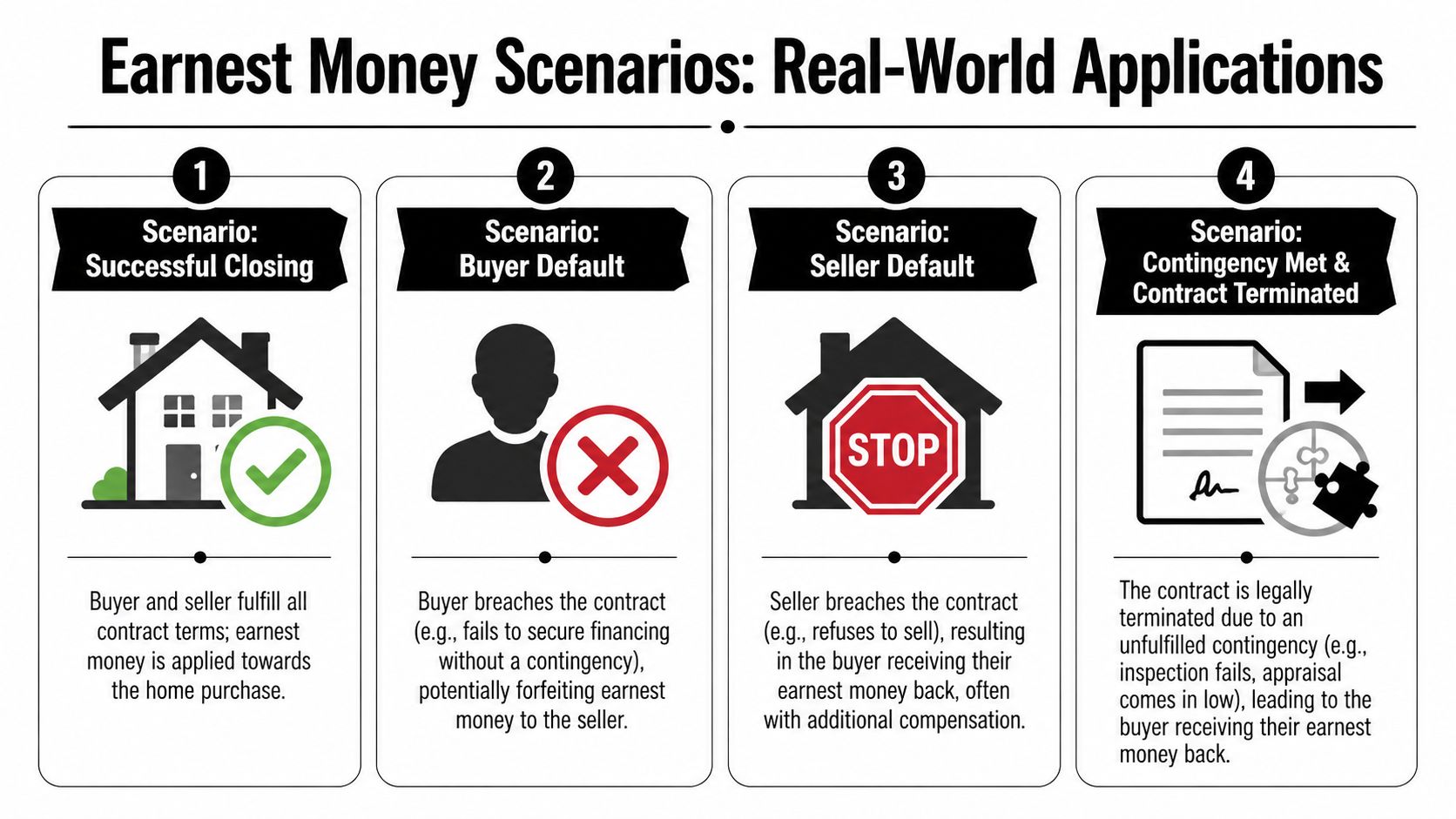
The clean exit during the option period
A buyer signs a contract, pays the option fee and earnest money, then learns during inspections that the home needs more work than expected. The buyer decides not to move forward and sends written notice before the option period ends.
That is usually the least controversial scenario. The buyer bought the contractual right to walk away during that period. In that setting, the buyer typically receives the earnest money back, while the seller keeps the separate option fee.
The confusion comes from mixing those two payments together. They are not the same pot of money.
- Earnest money: Held in escrow and may be refundable depending on the contract.
- Option fee: Paid for the right to terminate during the option period and generally retained by the seller.
A contingency fails
Another common example is financing trouble, appraisal problems, title issues, or some other condition the contract addresses. The buyer may have done everything in good faith and still be unable to close.
If the contract gives the buyer a valid termination right based on that failed condition, the earnest money often goes back to the buyer. The key question is not whether the deal collapsed. The key question is whether the collapse happened in a way the contract anticipated and protected.
Documents matter most here:
- The signed contract and addenda
- Termination notice
- Any supporting paperwork required by the contract
If your right to terminate depends on a condition, your paperwork is usually as important as your reason.
Buyer default after the contract protections expire
This is the scenario that produces the sharpest fights. The buyer changes course after the option period or outside any valid contingency. Maybe the buyer gets cold feet. Maybe another property looks better. Maybe money gets tight, but there is no contractual protection left.
In that situation, the seller may claim the earnest money as damages for the buyer’s default. That claim is not automatic, but it is often much stronger than buyers expect.
Texas contracts also impose a strict timing requirement for delivery of earnest money. The updated TREC contract, form 20-14, requires earnest money to be delivered within three business days of the effective date, with extension to the next business day if the deadline falls on a weekend or legal holiday. Failure to meet that deadline is buyer default under the contract, as explained in the earnest money deadline calendar and Wakefield discussion.
A practical example helps:
| Effective date | Delivery deadline |
|---|---|
| Friday | End of day Monday |
| Saturday | Monday |
That deadline sounds simple, but it trips people up. A buyer may think one late day is no big deal. Under the contract, it can matter a lot.
The historical cases behind these rules matter too. In Wakefield v. Hudson, a buyer’s failure to make the full deposit required by the agreement was treated as default, rather than an automatic contract termination. The lesson is straightforward: earnest money obligations are not casual details. They are part of the bargain.
Seller default
Sometimes the buyer did everything right, but the seller cannot or will not perform. A seller may refuse to close, fail to satisfy a contractual obligation, or create a problem the contract doesn’t excuse.
In that kind of case, the buyer usually has a strong claim to the earnest money back. Depending on the contract facts, the buyer may also consider other remedies. But the immediate release of the deposit still usually depends on signed instructions, negotiation, or legal pressure if the seller resists.
A practical comparison
| Scenario | Typical result |
|---|---|
| Option period termination | Buyer usually gets earnest money back |
| Contract contingency fails | Buyer often gets earnest money back if the contract was followed |
| Buyer default | Seller may claim earnest money |
| Seller default | Buyer usually seeks return of earnest money |
For readers used to rental disputes, there’s a useful parallel. A landlord can’t keep a tenant’s security deposit just because the tenancy ended badly. The Texas Property Code requires lawful reasons and proper handling. Earnest money works differently, but the same principle applies: the contract and the facts decide the result, not emotion.
Your Step-by-Step Guide to Requesting Your Funds
When the contract has ended and you believe the earnest money should be released, the biggest mistake is waiting for someone else to handle it. A calm, documented process usually works better than repeated calls asking, “Did they sign yet?rdquo;
Step one, confirm how the contract ended
Start with the contract and the addenda. Identify the exact basis for termination.
Was it an option period termination? A financing issue? A title objection? A seller failure to perform? The reason matters because it tells you what proof you need and what argument the other side may raise.
Write down:
- The effective date
- The termination deadline that applied
- When notice was delivered
- What section or addendum gave you the right to terminate
If you’re dealing with a disputed release, using a well-organized written demand can help. This guide on preparing a Texas demand letter is useful for structuring a clear request.
Step two, gather your documents before you contact anyone
People often send a release request before they have their file in order. That makes it easier for the other side to stall.
A better approach is to gather:
- The executed contract
- Relevant addenda
- Termination notice
- Proof of delivery
- Emails or texts that confirm the timeline
- Any lender, inspection, appraisal, or title documents tied to the termination right
You want the other side to see that your request is not emotional. It is documented.
Step three, complete the release paperwork carefully
If the parties agree, TXR-1904 can direct the title company how to disburse the earnest money and resolve liability under the contract. Before signing, read every line. Make sure the property address, contract date, and disbursement terms are accurate.
Readers often become confused; they believe the form merely states the money's destination. As discussed earlier, it also includes a broader release function. That means you should understand what claims, if any, you are giving up.
Plain-language warning: Don’t sign a release just because someone says it is “standard.” Standard forms can still carry major legal consequences.
Step four, send a formal written demand if the release is not moving
If the other side is slow, silent, or evasive, a formal written demand may be the next move. Under Paragraph 18 of the TREC contract, a written demand can trigger a response obligation and start the clock on an objection.
Your demand should be simple and direct. It should identify the contract, state why you believe the earnest money should be released, attach supporting documents, and request signature on the release.
A basic sequence often looks like this:
| Action | Why it matters |
|---|---|
| Confirm termination basis | Shows your entitlement rests on the contract |
| Attach evidence | Reduces room for delay or denial |
| Demand written response | Creates a clear record |
| Send through a reliable method | Helps prove the other side received it |
Certified mail is often useful because it helps document delivery. Depending on the situation, email may also be used, but proof matters.
Step five, stay organized while the deadline runs
Once the demand is sent, don’t disappear and don’t flood everyone with scattered messages. Keep one clean file with:
- The date of demand
- A copy of what was sent
- Delivery confirmation
- Any written response or objection
- Notes on follow-up communications
This kind of recordkeeping matters in earnest money disputes for the same reason it matters in landlord-tenant cases. Under the Texas Property Code, written records often decide who looks credible when a dispute reaches mediation or court.
Step six, know when process becomes leverage
If the other side doesn’t sign, you are no longer just asking for cooperation. You are creating a record that may support the next legal step.
That shift matters. The strongest position is often not the loudest one. It is the one that can show a judge, mediator, or escrow officer a complete and careful timeline.
What to Do When One Party Refuses to Sign
The hardest earnest money cases are not the ones where the contract is unclear. They are the ones where one side knows the likely result but refuses to cooperate anyway.

A refusal to sign can happen for many reasons. Some people think delay gives them bargaining power. Some are angry and want to make the other side work for the money. Some believe they are right. The contract has a way to deal with that.
Paragraph 18 gives structure to the standoff
Under Paragraph 18 of the TREC contract, a party has 15 days to object in writing to a demand for earnest money. If no written objection is made, the funds can be released to the demanding party, and a wrongful refusal to sign can expose the refusing party to damages, including attorney’s fees, as described in this discussion of Paragraph 18 objection rules and earnest money disputes.
That matters because silence is not always neutral. In some situations, silence can cost the objecting party bargaining power.
What wrongful refusal usually looks like
A wrongful refusal often has one of these patterns:
- The buyer terminated within a valid right, but the seller won’t sign anyway
- The seller has a clear default claim, but the buyer refuses to acknowledge it
- One party never gives a real legal reason and only says they are “not comfortable signing”
- The objecting party ignores written demands and hopes the title company will hold the money forever
That last assumption is dangerous. Holding the money in escrow doesn’t make the dispute disappear. It usually increases stress, cost, and pressure on both sides.
A stalled signature is not just a paperwork issue. It can become evidence of bad-faith conduct.
Use pressure that looks professional, not personal
You do not need angry messages. You need an advantage the contract recognizes.
A better path often includes:
- Send a clear written demand
- Attach the contract basis for release
- State the objection deadline
- Request a written response, not just a verbal one
- Prepare for mediation if the objection comes in
Mediation is often the smartest next move because it puts a neutral person in the room without the full cost and delay of litigation. If you want a practical overview of that process, this page on Texas real estate mediation is a good starting point.
Sometimes clients need to hear the dispute discussed out loud before the legal risk becomes obvious. This video may help frame how these conflicts develop and why the release process matters.
Why refusing to sign can backfire
If a party wrongfully resists release, the dispute can shift from “who gets the earnest money” to “who caused avoidable legal damage.” That is where attorney’s fees and other damages become part of the conversation.
Here is the practical reality:
| Refusal strategy | Likely result |
|---|---|
| Ignore the demand | Loss of credibility and legal exposure |
| Object without support | Weaker position in mediation or court |
| Negotiate reasonably | Better chance of efficient resolution |
This logic should sound familiar to landlords and tenants. Under the Texas Property Code, people who ignore deadlines, notices, or lawful requests often make their own cases harder. Documentation and response timing matter there too.
When You Need a Texas Property Attorney for Your Dispute
You are usually at the attorney stage when the dispute stops being about a form and starts becoming about risk.
A stalled release can turn expensive fast. One party digs in. The title company will not disburse the funds without proper authority. Deadlines pass, positions harden, and what should have been a short signature process starts looking more like a court file than a closing issue. If the other side refuses to sign, ignores a supported demand, changes its story, or threatens suit without tying that position to the contract, legal help is often the practical next step.
One of the clearest warning signs is interpleader. Under Texas procedure, a stakeholder holding disputed funds can ask the court to take control of the money and decide who is entitled to it. The title company is not choosing sides in that moment. It is stepping out of the middle and asking the judge to sort it out. If you want to see how Texas courts treat that process, the Texas Rules of Civil Procedure address interpleader in Rule 43.
That change matters. Once the dispute moves into court, the problem is no longer just "who should get the earnest money?quot; It becomes a matter of pleadings, deadlines, evidence, attorney's fees, and procedure. A missed response or poorly framed claim can weaken a position that may have been strong at the contract stage.
You may also want a Texas property attorney when the earnest money dispute is only one piece of a larger possession or occupancy problem. That happens more often than people expect. A buyer may still be in possession after a failed closing. A seller may claim holdover damages. A leaseback may exist in the background. Those overlapping facts can pull in different legal rules and different remedies.
The same is true if the disagreement starts to blur into rental issues. The earnest money fight is governed by the sales contract and the release process, while a security deposit dispute is handled under different rules. They can feel similar because both involve money being withheld, but they are not interchangeable. The Texas Property Code, including Chapter 92, sets separate standards for residential rental deposits, notices, and wrongful withholding. A lawyer helps keep those lanes clear so you do not argue the right facts under the wrong law.
If your dispute has reached the point where signatures have stopped, the title company is talking about court, or possession issues are developing alongside the money dispute, getting legal advice early is often cheaper than cleaning up mistakes later.
If you need help with an earnest money dispute, a lease issue, an eviction, or another rental conflict, contact The Law Office of Bryan Fagan, PLLC for a free consultation today. Whether you’re a buyer, seller, landlord, or tenant, clear guidance under the Texas Property Code can protect your rights and help you move forward with confidence.