Dealing with a lease problem in Texas is stressful enough. You sign the document, exchange keys or deposits, and assume the hard part is over. Then a dispute starts. A tenant says the landlord never agreed to a repair promise. A landlord discovers the copy on file is missing a signature page. Someone relies on a text message instead of the lease itself.
That’s usually the moment people hear the phrase fully executed contract and realize it matters far more than it sounds.
In landlord-tenant disputes, this isn’t just paperwork talk. It affects whether you can enforce rent terms, defend against an eviction, prove a repair obligation, or recover a security deposit. For both landlords and tenants, understanding what counts as a fully executed contract under the Texas Property Code can prevent avoidable fights and strengthen your position if a fight already started.
Your Signed Lease Might Not Be as Secure as You Think
A tenant finds a rental home in Houston, pays the deposit, signs the lease online, and starts packing. The landlord also believes everything is done. A week later, the tenant asks for a copy of the final lease and notices the landlord never countersigned the version the tenant received. Attached to the email is a different draft with a changed move-in date.
A landlord in Dallas faces the opposite problem. The tenant moved in months ago, but the lease file is messy. One addendum has initials, another doesn’t. A pet agreement was discussed but never attached. Now the tenant has stopped paying, and the landlord wants to enforce late fees and other terms that may not be clearly documented.
Both people thought they had a solid deal. Both may now have to prove what the agreement was.

Why this causes so much confusion
Signing is often treated as the finish line. In real life, signing is often just one step. Texas lease disputes often turn on small details:
- Which version controlled if drafts changed by email
- Whether all parties signed the same final document
- Whether addendums were included and accepted
- Whether performance matched the lease after signing
That last point matters more than many people realize. A lease can look complete on paper and still create trouble if one side never follows through on basic obligations.
Practical rule: A signed lease helps, but a signed lease plus clean records is what usually protects you.
The high stakes for landlords and tenants
This concept matters when a landlord wants to enforce rent, late fees, property rules, or a move-out obligation. It matters when a tenant needs to prove rights involving habitability, repairs, privacy, or a wrongfully withheld deposit.
Texas law gives both sides important protections, including rights tied to habitability under Texas Property Code Section 92.001 and related landlord-tenant rules. But those rights are easier to enforce when the lease was properly finalized and the parties kept good records afterward.
If you’re dealing with a lease dispute now, the key question isn’t only “Did we sign something?” It’s also “What exactly was finalized, and what happened after that?”
What a Fully Executed Contract Really Means in Texas
The phrase fully executed contract sounds technical, but the basic idea is simple. It refers to an agreement that has been properly completed in the way the law requires.
In everyday conversation, people often use “executed” to mean “signed.” Lawyers sometimes use it that way too. But in contract law, there are two related ideas that people mix up all the time.
Signed versus fully performed
The first layer is signature execution. That means the required parties signed the agreement. In a lease, that usually means the landlord and tenant signed the same final version.
The second layer is performance execution. That means the parties carried out the obligations the contract required.
A lease is a good example because it often sits in the middle. The lease may be fully signed on day one, but it usually remains executory, meaning performance is still ongoing. Rent is still due in future months. Repairs may still need to be made. Notice rules still matter. Security deposit obligations still exist.
Consider it similar to a restaurant order:
- You place the order and pay. That’s like signing the agreement.
- The kitchen cooks the meal and the server brings it out. That’s performance.
- The whole transaction is complete only when both sides have done their part.
A lease usually doesn’t become “complete” in the performance sense right away because both sides continue performing over time.
Why readers get tripped up
People often assume a signed lease is the same thing as a completed lease. It isn’t.
A tenant may say, “We both signed, so the landlord has to do everything I expected.” A landlord may say, “The tenant signed, so I can enforce every term immediately.” Sometimes that’s true. Sometimes it isn’t. The answer depends on the exact document, any addendums, and whether both sides performed required obligations.
That’s one reason contract management matters so much after signing. A World Commerce & Contracting study found that poor contract management costs companies an average of 9.2% of annual revenue, as noted in ContractSafe’s explanation of a fully executed contract. In the rental setting, that can show up as lost rent, turnover problems, lost security deposits, or fee disputes.
What makes a lease binding in the first place
Before you can talk about a fully executed contract, you have to know whether you have a binding agreement at all. If you want a plain-English primer, this guide on what is a binding agreement is a useful starting point.
For Texas leases, a few practical questions matter:
| Question | Why it matters |
|---|---|
| Did all required parties sign? | Missing signatures can create a proof problem |
| Was it the final version? | Draft confusion can undermine enforcement |
| Were addendums included? | Pet, repair, or parking terms often sit outside the main lease |
| Were dates filled in? | Start dates and notice periods matter in disputes |
A simple way to think about it
Use this short test when reviewing your lease:
- Was the document finalized?
- Did everyone who needed to sign sign it?
- Did each side begin doing what the lease required?
- Did anyone change terms later without proper written proof?
If any answer is uncertain, you may have a contract problem rather than just a conflict problem.
For a closer look at Texas contract basics in real estate matters, review real estate contracts in Texas.
The Legal Power of Your Executed Texas Lease
A properly executed lease gives structure to the entire landlord-tenant relationship. It tells the court what rent was due, when possession began, who was responsible for repairs, how notices had to be delivered, and what happens if someone defaults.
Without that clarity, both sides end up arguing about memory, custom, or side conversations. Courts generally prefer documents over competing stories.
Why written agreements matter so much
Modern contract rules strongly favor written proof. The U.S. Uniform Commercial Code, widely adopted since 1952, standardized requirements for contracts to be in writing to be enforceable, a principle described in this discussion of fully executed contracts. While leases involve their own legal rules, the same basic lesson applies. Written agreements reduce fraud claims and make disputes easier to evaluate.
For landlords, that means a signed lease can support claims for unpaid rent, lease violations, or possession. For tenants, it can support claims involving promised conditions, privacy terms, repair duties, or improper charges.
Texas law still controls the lease
Here’s the part many generic contract articles miss. A lease can be signed by everyone and still have weaknesses.
Texas courts don’t stop at signatures. They also look at whether the lease reflects real agreement on important terms and whether the lease complies with Texas law. In residential matters, that includes statutory protections found in the Texas Property Code, including habitability-related rules tied to Section 92.001 and surrounding provisions.
A lease isn’t “safe” just because it has signatures on it. If the terms conflict with Texas law, the signatures won’t fix that problem.
That matters in disputes involving repairs, access to the property, retaliation, or security deposits. A landlord cannot rely on a lease clause that violates Texas law because the tenant signed it. A tenant also can’t ignore valid lease duties by claiming the whole contract is meaningless when only one term is disputed.
Electronic signatures can count
Texas landlords and tenants often use online platforms to sign leases. That’s usually fine. Under electronic transaction rules, electronic signatures can be valid when the signing process clearly shows who signed and what document they accepted.
The practical problem is proof. A proper e-sign platform usually creates a better trail than a vague text message saying “looks good.” When a dispute reaches court, the cleaner digital record usually wins the argument.
Signature power versus performance power
A signed lease gives you one kind of legal advantage. Actual performance gives you another.
A landlord may have a signed lease but still face problems in an eviction case if maintenance obligations were ignored and the tenant raises habitability issues. A tenant may have a signed lease but still struggle if rent records, notice records, or move-in documentation are missing.
That’s why lease enforcement in Texas often has two tracks:
- Track one asks whether the lease was properly formed.
- Track two asks whether each side performed as required.
Both matter.
Where landlords and tenants can strengthen their position
Here are the strongest habits to build early:
- Keep the final signed copy with all addendums attached
- Save delivery records for notices, demands, and repair requests
- Document performance such as rent paid, repairs completed, and inspections
- Check the lease against Texas law before relying on a questionable clause
If you want to compare your lease terms with common state requirements, start with this overview of Texas lease agreement laws.
Your Practical Checklist for a Bulletproof Lease Execution
Most lease problems don’t start in court. They start at the kitchen table, the property manager’s office, or the online portal where someone clicks “sign” too quickly.
A good lease file should answer one question instantly. What did both sides agree to, and can we prove it?
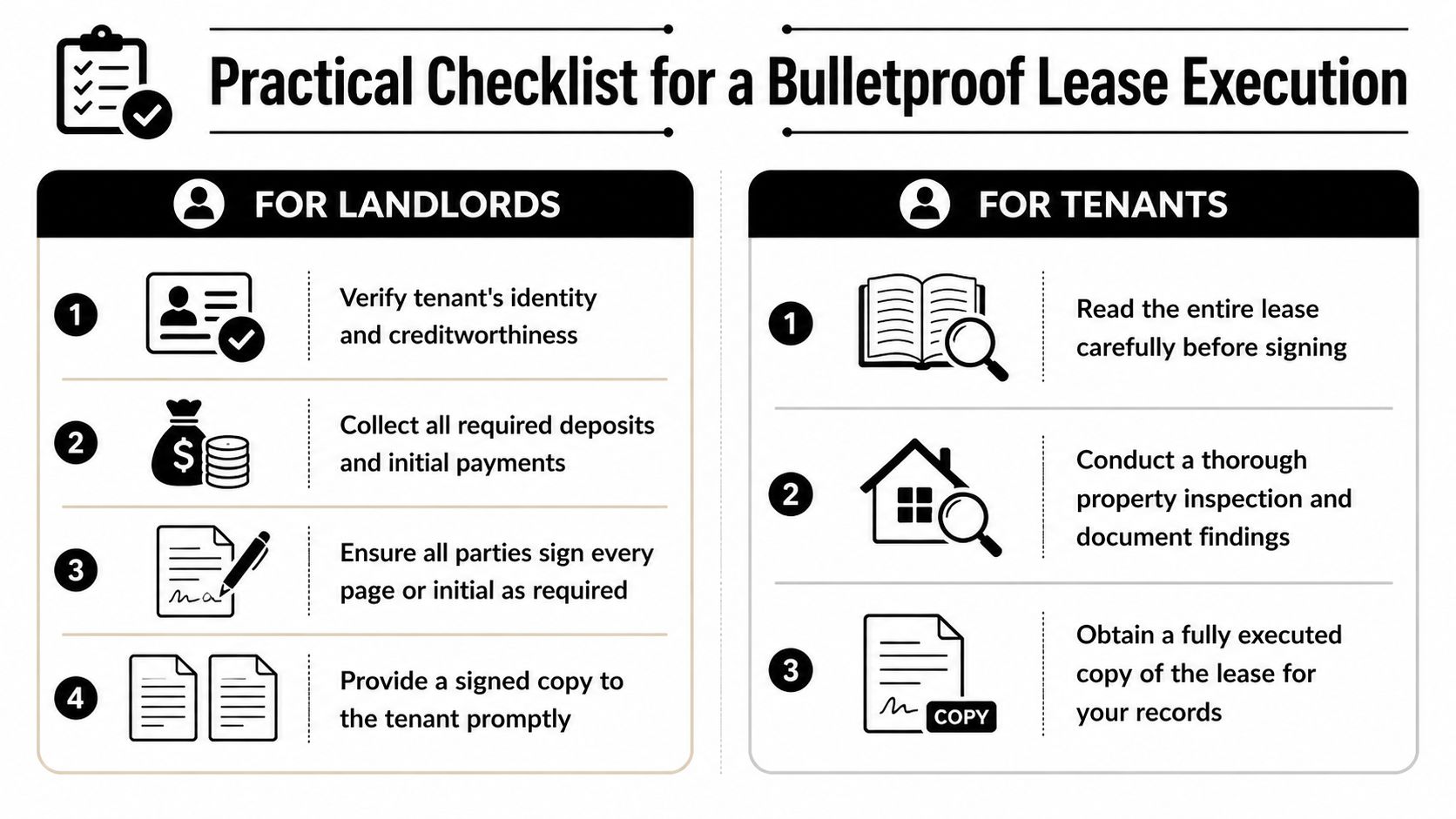
For landlords and property managers
A landlord’s goal isn’t just to get signatures. It’s to create a lease file that holds up under pressure.
Match every signature to the right person. If more than one tenant is responsible, make sure each tenant signs. If an owner uses a property manager, make sure the authority to sign is clear.
Confirm the dates before possession starts. The lease start date, move-in date, and due date for initial funds should all match your actual arrangement. If those dates are sloppy, notice periods and payment disputes get harder to prove.
Attach every addendum at signing. Pet agreements, parking rules, HOA disclosures, appliance terms, and move-in condition forms should be part of the final package. Don’t assume “we talked about it” is enough.
Give the tenant the complete countersigned copy. Many disputes begin because the tenant never received the final version. A landlord should be able to show exactly when that final copy was sent or delivered.
For tenants
Tenants often focus on monthly rent and move-in timing. Those matter, but so do the details that show up later in a conflict.
Read the whole lease before signing. Look for repair procedures, entry rules, late fees, guest limits, renewal language, and move-out requirements.
Check that the lease matches what you were told. If the landlord promised a repaired fence, reserved parking, or a new appliance, make sure it appears in writing.
Get the final signed version, not just your signed draft. If you don’t have the fully executed copy, ask for it immediately and save it in more than one place.
Inspect the property and document condition. Photos, videos, and written notes can help later if there’s a dispute over damage or a security deposit.
Quick warning: If a landlord or tenant says, “Don’t worry, we’ll fix it later,” slow down. Terms that matter later should go in writing now.
A short review table
| Item to verify | Landlord should do | Tenant should do |
|---|---|---|
| Final version | Save one complete PDF or paper file | Confirm you received that same version |
| Signatures | Check every required signature line | Check that the landlord signed too |
| Addendums | Attach all riders and disclosures | Make sure nothing referenced is missing |
| Dates | Confirm start date and payment dates | Confirm move-in and notice dates |
| Delivery | Keep proof of sending final copy | Save the email or portal confirmation |
What a clean signature block looks like
A solid signature block should identify who is signing and when. For example:
- Landlord or authorized agent with printed name and signature date
- Each tenant with printed name and signature date
- Property address clearly listed on the lease
- Any guarantor, if applicable, on a separate clear signature line
If initials are required on each page or on certain addendums, make sure that happens. If the lease says initials are required and they’re missing, someone may later argue the page was never accepted.
One useful review habit before signing
If you want a broader framework for reviewing contracts before they become problems, Documind's comprehensive contract checklist is a practical companion to lease review.
For Texas-specific drafting issues, it also helps to compare your document against this guide on what to include in a lease agreement.
Common Pitfalls That Can Invalidate Your Lease
Most lease disputes don’t begin with dramatic misconduct. They begin with shortcuts. Someone skips a signature. Someone relies on a verbal promise. Someone assumes a text message changed the lease.
That’s where trouble grows.
Industry data indicates that approximately 40% of Texas landlord-tenant disputes stem from confusion between signature execution and performance execution, leading to failed evictions or unenforceable claims, according to Genie AI’s definition of fully executed.
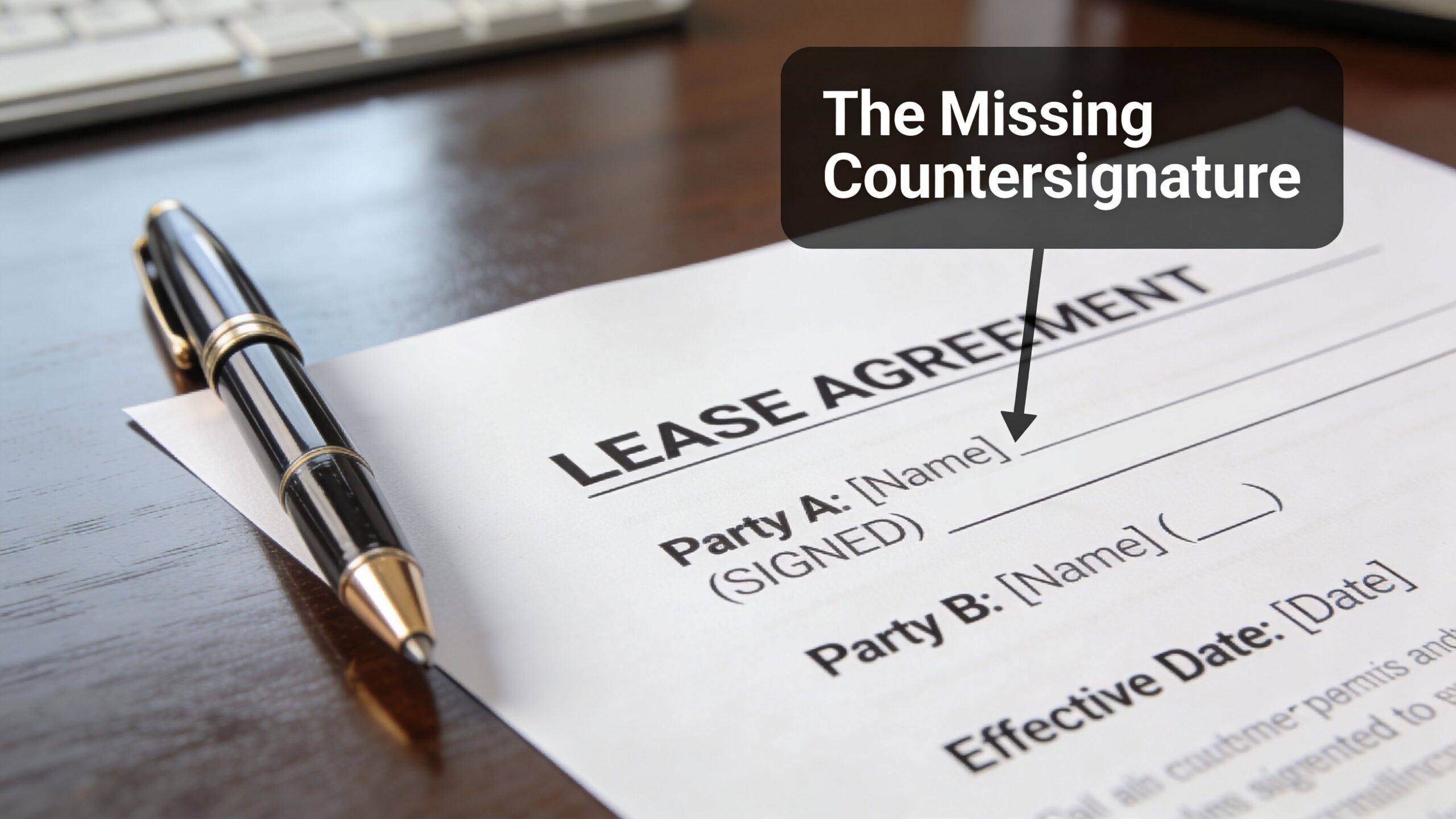
The missing countersignature
A landlord emails a lease to a new tenant. The tenant signs, pays the deposit, and moves in. Months later, the tenant stops paying rent. The landlord files for eviction and attaches the lease, but the version in the file lacks the landlord’s signature.
Now the argument shifts. Was there a lease on those exact terms, or did the parties create a tenancy through conduct that may be harder to define? The landlord may still have claims, but the cleanest proof is gone.
For tenants, this problem can work the other way. If the landlord never clearly accepted the final lease version, the tenant may struggle to enforce a disputed clause the landlord now denies.
The vague electronic signature
A property manager sends lease terms by email. The tenant replies, “Looks fine.” No formal e-sign process follows. No final PDF is returned.
That may feel efficient, but it creates proof issues. A court may ask: Which exact version did the tenant accept? Were there attachments? Was that email intended as a legal signature, or just part of negotiation?
An e-signature platform usually creates a much stronger record than a loose email chain or text thread.
The undated agreement
A lease without a clear date can cause bigger problems than people expect. If the start date is unclear, then the rent due date, notice deadlines, and move-out timeline can all become disputed.
A landlord may believe late fees started on one date. A tenant may believe possession began later because repairs delayed move-in. Without a clear written timeline, both sides may end up arguing from memory.
The verbal amendment
A tenant signs a lease but complains that the air conditioning isn’t working properly. The landlord says, “I’ll take care of it, and I’ll waive the first late fee too.” Nothing gets written down.
Later, the tenant claims the landlord promised a rent credit. The landlord denies it. Both may be telling the truth as they remember it. But if the lease requires changes to be in writing, the verbal side deal may be difficult to enforce.
If a change matters enough to mention, it matters enough to write down and save.
The missing addendum
This one shows up often with pets, parking, appliances, and move-out conditions. The main lease says there is a pet addendum. The file doesn’t include it. A dispute starts over damage, pet fees, or whether the animal was even authorized.
When an addendum is referenced but missing, the lease file starts to look incomplete. That doesn’t always destroy the whole agreement, but it can weaken the disputed term.
The performance gap
A signed lease doesn’t solve everything if one side never performs. A landlord may seek to remove a tenant for nonpayment while the tenant argues the landlord failed basic maintenance duties. A tenant may point to the signed lease but have no proof of rent payments or notice of repair requests.
The next video gives a practical overview of lease and eviction issues that often connect to these documentation problems.
A quick pitfall checklist
- No countersigned final copy
- Drafts sent back and forth without a clearly final version
- Missing dates or incomplete blanks
- Unattached addendums
- Text-message “agreements” that were never formalized
- Verbal changes after move-in
- Poor proof of performance after signing
The lesson from these mistakes
Courts deal with evidence, not assumptions. If your lease file is incomplete, your case gets harder. If your file is clean, your argument gets simpler.
That’s true whether you’re a landlord trying to enforce a lease or a tenant defending your tenant rights under the Texas Property Code.
Building Your Evidence Strategy for a Contract Dispute
When a lease dispute lands in court, the strongest story usually comes from the party with the best records. Not the loudest story. Not the most emotional story. The best-documented one.
That means your evidence strategy should begin long before a lawsuit or eviction notice.

What strong evidence looks like
Good evidence usually answers three questions:
- What did the lease say?
- What did each side do after signing?
- What proof backs that up?
For tenants, the post-execution phase is critical. They should keep rent receipts, log maintenance requests with dates, and take photos during move-out inspections to defend against wrongful eviction or security deposit claims, as explained in this discussion of fully executed contracts and post-signing management.
For landlords, the same principle applies. Keep payment ledgers, notices, inspection photos, repair invoices, and communications with the tenant in one organized file.
Build one file, not ten scattered trails
Use one folder, digital or paper, for each tenancy. Include:
- The final lease and all addendums
- Proof of signatures or e-sign completion
- Rent payment records
- Security deposit records
- Move-in and move-out photos
- Repair requests and responses
- Formal notices sent or received
- Emails and text messages that clarify disputed facts
If you use a property management platform, export records regularly. Portals change, accounts close, and access can disappear at the worst time.
Evidence habit: Save the record when it happens. Don’t wait until a dispute starts.
What helps in common Texas disputes
Different disputes call for different proof.
| Dispute type | Helpful evidence |
|---|---|
| Nonpayment | Ledger, receipts, returned payment records, notices |
| Repair dispute | Written requests, timestamps, photos, contractor records |
| Security deposit conflict | Move-in and move-out photos, condition forms, itemized deductions |
| Illegal entry or privacy issue | Messages, logs, witness notes, camera records if lawfully kept |
| Eviction defense | Lease, payment records, notices, repair history, communication trail |
Keep your records understandable
A pile of screenshots isn’t always persuasive. Organize them in date order. Label files clearly. Match each document to the issue you may need to prove.
If you’re a landlord, that helps your eviction attorney or Texas landlord tenant lawyer evaluate your case quickly. If you’re a tenant, it helps show you acted responsibly and gave proper notice when Texas law required it.
The most important mindset
Think like a future witness. Ask yourself, “If I had to explain this to a judge in five minutes, what documents would I want in my hand?”
That question usually tells you exactly what to save.
Need Help with Your Lease? Contact Us Today
A fully executed contract is more than a signed lease. In Texas, the primary question is whether the lease was properly finalized, whether it complies with the Texas Property Code, and whether both sides can prove what happened after signing.
That’s where many people get stuck. Landlords may have a tenant in default but weak paperwork. Tenants may have valid complaints about repairs, privacy, deposits, or eviction notices but no organized evidence to support them. A lease dispute can turn fast, and small document mistakes can have a big effect.
If you’re facing a problem, quick legal guidance can help you avoid making it worse. A Texas landlord tenant lawyer can review your lease, identify gaps in execution, explain your tenant rights, and help you decide what to do next. That may mean tightening a lease before signing, responding to a repair dispute, handling an eviction, or pushing back against unlawful charges or deposit withholding.
Legal help is also useful when the facts seem messy. Maybe the lease was signed electronically, but you never got the final copy. Maybe there was a verbal side agreement. Maybe an addendum is missing. Maybe a landlord accepted rent after default and now both sides disagree about what that means. Those details matter.
The good news is that many lease disputes become easier once the documents are organized and the legal issues are identified clearly. Whether you’re a landlord trying to enforce a lease or a tenant trying to protect your home and your rights, a careful review can show where you stand and what steps make sense now.
If you need help with an eviction, lease issue, or rental dispute, contact The Law Office of Bryan Fagan, PLLC for a free consultation today. Whether you need a lease review, help with a security deposit fight, guidance on repairs, or support from an experienced eviction attorney or Texas landlord tenant lawyer, the firm can help you understand your options and protect your rights under the Texas Property Code.