Dealing with a property dispute with a co-owner can be stressful — but understanding your rights under Texas law can make all the difference. Maybe you inherited a house with a sibling, bought property with a business partner, or own a home with an ex-significant other, and now you can't agree on what to do with it. When one owner refuses to sell or cooperate, your investment feels trapped.
What now? In Texas, the law provides a powerful tool for this exact situation: the suit to partition. It's a court-ordered process that allows a co-owner to force the division or sale of a jointly owned property, ensuring everyone can get their fair share and move on.
Navigating Co-Ownership When You Can't Agree

When communication with a co-owner breaks down, it’s more than just stressful—it puts your financial future on the line. But you don't have to stay stuck. A suit to partition provides a clear legal path forward when friendly negotiations have failed and you’re at a deadlock.
Think of it like a business partnership gone wrong. If partners can no longer run their company together, the law provides a way to dissolve the business and divide the assets. A partition lawsuit does the same thing for real estate. It’s a formal, legal exit strategy designed to protect your property rights.
Who Can File a Suit to Partition in Texas?
Here’s the key: in Texas, any joint owner of real property has an absolute right to file a suit to partition. You don’t need the other owners’ permission to start the process. This right is your legal leverage to get out of a difficult co-ownership situation.
You might need to file a suit to partition if:
- You inherited a family property with relatives who can't agree on its future.
- You bought a house with a partner, the relationship ended, and now you’re tied together by the mortgage.
- You invested in commercial real estate with partners, and the venture is no longer working out.
- You're simply stuck because one person's refusal to cooperate is holding your investment hostage.
What the Texas Property Code Says: The right to partition is clearly established in Texas law. Texas Rule of Civil Procedure 756 states that any joint owner or claimant of real property can compel a partition. This rule ensures you have a legal remedy and don't have to remain in a bad co-ownership situation indefinitely.
The purpose of a partition lawsuit is to untangle the joint ownership and make sure every owner receives the value of their stake in the property. It provides a final, court-ordered solution. This is why the initial agreements you made when buying the property, like those in real estate contracts in Texas, are so important. But when those plans fall apart, a partition suit gives you the power to move forward.
Understanding Your Two Paths: Partition in Kind vs. Partition by Sale

When you file a suit to partition, you’re asking a Texas judge to break a co-ownership deadlock. The court has two primary ways to resolve the dispute: a partition in kind or a partition by sale. The path the court chooses depends on what is fair and practical for the specific property involved.
It's critical to know the difference. One path leaves you with a deed to your own separate piece of real estate, while the other ends with a check in your hand. Texas law has a clear preference, but the property itself often dictates the outcome.
The Preferred Method: Partition in Kind
Texas courts will always try to order a partition in kind first. This means the court’s goal is to physically divide the property among the co-owners. Each person gets their own distinct tract of land that’s proportionate in value to their ownership stake.
Real-World Scenario: Imagine two siblings inherit a 100-acre square of undeveloped farmland. If the land is uniform in quality and has equal road access, a court could simply draw a line down the middle. Each sibling would walk away as the sole owner of their own 50-acre parcel, and the joint ownership would end.
Under Chapter 23 of the Texas Property Code, a property must be divided in kind unless it's proven that a fair and equitable division is impossible. The burden is on the person who wants to force a sale to convince the judge that a physical split just won’t work. This approach lets everyone keep their investment in real estate, just in a more manageable form.
When a Physical Split Is Impossible: Partition by Sale
For most properties, especially a single-family home or a commercial building, physically dividing it is out of the question. You can’t just saw a house in half and hand a fair share to each owner. This is where the court turns to the second option: a partition by sale.
When a physical split isn't feasible, a partition by sale is the only logical path forward. Here’s how it works:
- The judge orders the property to be sold for its fair market value.
- The proceeds from that sale are held by the court.
- Any outstanding mortgages, liens, and court costs are paid off first.
- The remaining cash is then distributed among the co-owners based on their percentage of ownership.
Real-World Scenario: An unmarried couple buys a house together but later breaks up. A partition by sale is almost always the outcome. The house is sold, the mortgage is settled, and they each get a check for their share of the remaining equity. A skilled Texas landlord tenant lawyer can ensure this process is handled correctly to protect your financial interests.
Partition in Kind vs. Partition by Sale at a Glance
This table breaks down the two primary outcomes of a partition suit to help you quickly see the differences.
| Feature | Partition in Kind | Partition by Sale |
|---|---|---|
| What You Get | An actual, physical piece of the property. | Cash proceeds from the property's sale. |
| When It's Used | Divisible property, like raw land or large acreage. | Indivisible property, like a house or a condo. |
| Texas Law's Preference | Strongly preferred by the courts. | Used only when an "in kind" split is unfair or impossible. |
| Key Benefit | Allows you to keep your ownership of real estate. | Provides a clean financial break and liquidates the asset. |
Understanding which path is more likely for your property is the first step in building a sound legal strategy with your attorney.
Your Step-by-Step Guide to the Partition Lawsuit Process
When you can’t agree with a co-owner, the legal system offers a solution. But facing a lawsuit can feel confusing and intimidating. The good news is that a suit to partition follows a structured process with a clear beginning, middle, and end.
Knowing the steps can help you feel more in control. Here is a step-by-step guide to the partition process so you can make informed decisions to protect your rights.
Step 1: Filing the Initial Petition
Everything starts when one co-owner files a partition petition with the court. This is the formal legal document that kicks off the entire process. It must be filed in the district court of the county where the property is located.
This isn’t just a simple form. To be legally valid, your petition must include specific details:
- A complete legal description of the property.
- The name and address of every single co-owner.
- The exact ownership percentage each person holds.
Filing the petition officially puts the court and all other owners on notice that you are exercising your right to divide the property.
Step 2: The First Hearing and Your Right to Partition
Once the petition is filed and served on all co-owners, the court sets an initial hearing. The judge has two simple but critical questions to answer at this stage: does the person who filed the lawsuit actually own a share of the property, and do they have a legal right to force a partition? In Texas, that right is nearly absolute for co-owners. Unless you signed a written agreement waiving your right to partition, the answer is almost always yes.
If the judge confirms your right, the court issues a decree that officially orders the partition to begin. To see how a firm handles the complexities of these cases, check out this case study from Talkov Law.
Step 3: Appointing Commissioners to Assess the Property
With the right to partition established, the court appoints one or more neutral third-party experts known as commissioners. Their job is to be the eyes and ears of the court.
Under Texas Rule of Civil Procedure 761, these commissioners must be disinterested parties with no financial stake in the outcome. They will inspect the property, review appraisals, and evaluate whether it can be physically divided in a way that is fair to everyone.
The commissioners' role is pivotal. They are tasked with determining if the property can be "partitioned in kind" (physically split) without hurting its overall value. The judge relies heavily on their impartial recommendation to make a fair decision.
Step 4: The Commissioners' Report and Recommendation
After finishing their analysis, the commissioners draft a formal written report for the judge. This document lays out their professional findings and gives a clear recommendation on how to proceed.
If they believe a physical split is fair, their report will propose exactly how to divide the property. If they conclude a physical split isn't practical—as is the case with a single-family home—they will recommend a partition by sale, stating the property is indivisible and should be sold. Every co-owner has the right to file an objection if they disagree.
Step 5: The Final Judgment and Property Division
This is the final stage where the judge makes a ruling. If no one objects to the commissioners' report, or if the judge overrules any objections, the court will issue a final judgment.
This legally binding order makes the partition official and will do one of two things:
- Approve a Partition in Kind: The court adopts the commissioners' plan, the property is legally divided, and each co-owner receives a deed to their newly separate piece of land.
- Order a Partition by Sale: The court orders the property to be sold, typically by a receiver or sheriff. The sale proceeds are used to pay off mortgages, liens, and court costs, with the remaining money distributed among the co-owners.
This final judgment officially resolves the dispute. An experienced eviction attorney can be a critical ally throughout this process, ensuring your rights are protected from start to finish.
How a Partition Action Impacts Landlords and Tenants
When co-owners of a rental property are fighting, it can create chaos for everyone involved, especially tenants. But what does a suit to partition mean for you if you're a renter? And what are your obligations as a landlord caught in the middle of a dispute?
A partition lawsuit creates uncertainty, but Texas law has clear rules to protect renters and guide landlords through the process. The legal battle is between the property owners, not the owners and their tenants.
What the Texas Property Code Says About Tenant Rights
If you’re a tenant in a property tangled up in a partition suit, your signed lease agreement is your shield. Your rights—and the landlord's duties—don't just disappear.
Here are the key protections you need to know:
- Your Lease Remains Valid: A written lease holds up, even if the property's ownership is in dispute. The co-owners are still legally bound by the agreement.
- You Have the Right to Stay: As long as you keep paying rent and following the lease terms, you have the right to live in the property until your lease expires.
- Landlords Must Make Repairs: The landlords, even while fighting, must still fulfill their obligations under the Texas Property Code, including making necessary repairs to keep the property habitable.
The biggest challenge for a tenant is often figuring out who to pay rent to or who to call for repairs when the owners can't agree. This is usually when a judge steps in.
The partition process itself follows a predictable, three-step path that brings clarity to the situation.
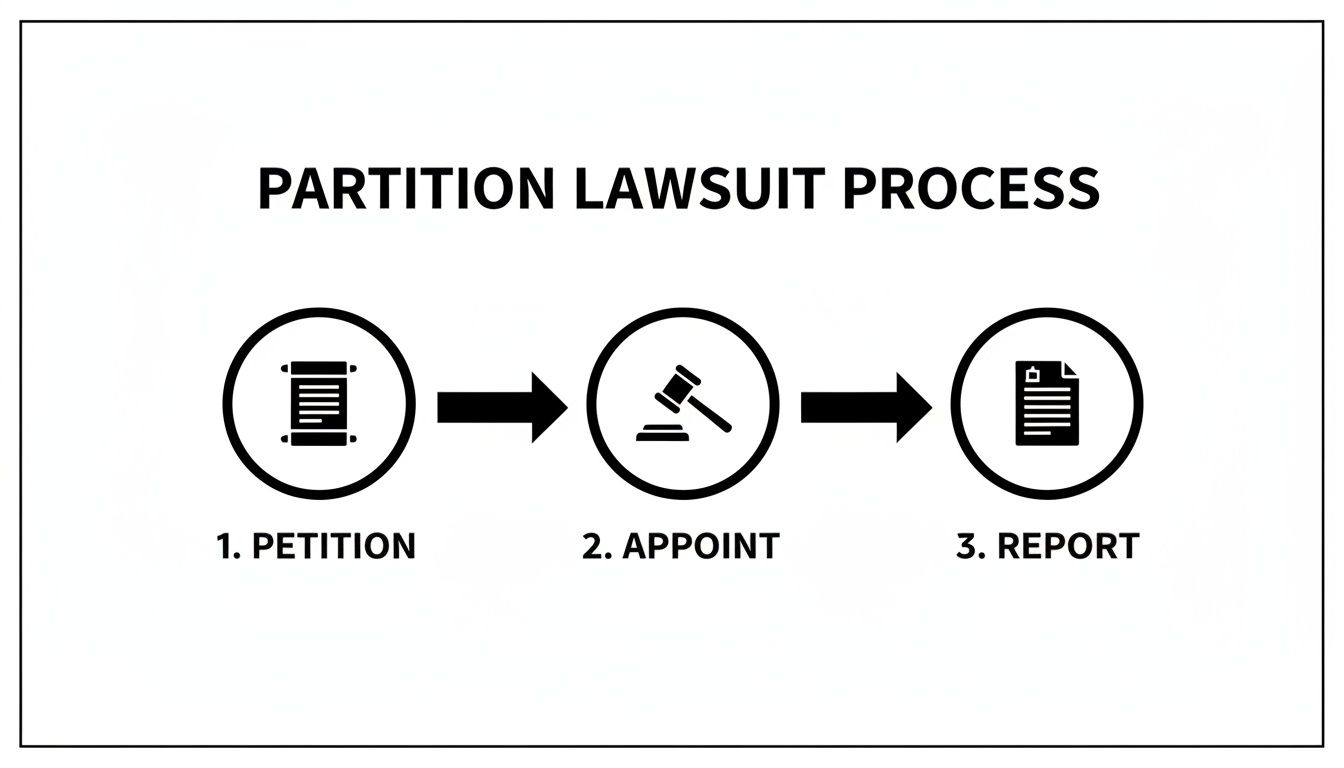
This flowchart breaks down the lawsuit: it starts with filing the petition, moves to the court appointing commissioners, and ends with their report, which helps the judge make a final decision.
The Role of a Court-Appointed Receiver
To restore order and protect the property's value during the lawsuit, a judge will often appoint a receiver. A receiver is a neutral third party who takes temporary control of the property until the ownership fight is settled.
The appointment of a receiver brings stability to a volatile situation. For tenants, it means you have a single, court-approved contact for paying rent and requesting repairs. For landlords, it ensures the property is professionally managed and income is properly collected while the case proceeds.
A receiver handles the day-to-day business, including:
- Collecting rent from all tenants.
- Paying the property’s bills, like the mortgage and insurance.
- Managing maintenance and repair requests.
- Providing the court with regular financial reports.
What Happens if the Property Is Sold?
If the lawsuit results in a partition by sale, the property gets sold to a new owner. In most situations, the new owner buys the property "subject to" all existing leases. This means your lease agreement is still valid, and the new owner must honor its terms until it expires. They can’t just kick you out or suddenly change the rent.
If you’re facing eviction threats from a new owner in this scenario, a Texas landlord tenant lawyer can step in to defend your tenant rights. The partition process is designed to solve problems between owners, not to upend the lives of tenants.
Exploring Alternatives to a Costly Partition Lawsuit
While you have an absolute right as a Texas property co-owner to file a suit to partition, a lawsuit isn't always the best first move. It’s a process that can be expensive, time-consuming, and emotionally draining.
Before committing to a legal battle, it's smart to explore other options. Many co-ownership disputes can be settled through practical negotiations or with help from a neutral third party—saving you time, money, and stress.
The Buyout Agreement: A Common-Sense Solution
One of the cleanest ways to resolve a dispute is with a buyout agreement. This is a private contract where one co-owner buys the other's share of the property. It’s a straightforward business transaction that lets you untangle the ownership without ever stepping into a courtroom.
Real-World Scenario: You and a former partner co-own a house. Instead of letting a judge force a sale where you could lose equity to fees, one of you could buy the other out. The partner keeping the house would refinance the mortgage in their name only and pay the other for their share.
A buyout is often the best path forward because it:
- Preserves Property Value: You avoid a forced "fire sale" that often brings in less than the property's true market value.
- Allows an Owner to Keep the Property: If it’s a family home or a great investment, one owner gets to hold onto it.
- Saves Money: You sidestep the court costs, commissioner fees, and steep attorney bills that come with a lawsuit.
The Power of Mediation
What if you and the other owners just can't agree on a buyout? That’s when mediation becomes a powerful tool. In mediation, a neutral third-party mediator helps guide the conversation toward a solution you can all agree on. The entire process is confidential and much quicker and less formal than a court hearing.
You can find out more about how it works in our guide on real estate mediation. When mediation is successful, you walk away with a signed settlement agreement that’s just as binding as a court order.
A voluntary agreement is almost always better than one forced on you by a court. You stay in control of the outcome—whether that means agreeing to a buyout, setting the terms for a private sale, or even creating a new plan to manage the property together.
Exploring Legal Defenses and Waivers
Before filing, it's critical to know if any legal defenses could stop a partition. The most significant one is a written agreement where the co-owners waived their right to partition. These clauses are sometimes found in co-ownership agreements or LLC operating agreements. If a valid waiver exists, it can shut down a partition suit before it even starts. Understanding your rights and exploring these alternatives first can protect your investment and your peace of mind.
The Real Costs and Risks of Forcing a Property Sale

Filing a suit to partition can feel like the only way out of a co-ownership nightmare, but it's a mistake to think of it as a simple or free solution. This is a lawsuit, and lawsuits cost money. Those costs come directly out of the property's sale price before any co-owner sees a dollar, which means your hard-earned equity is on the line.
The Hidden Fees in a Partition Lawsuit
The costs of a partition lawsuit add up quickly and are typically divided among the owners based on their share of the property. These fees include:
- Attorney Fees: While you pay your own lawyer, the court can order attorney fees to be paid from the sale money.
- Court Costs: These are the standard filing and administrative fees for any legal case.
- Appraiser Fees: A professional appraiser must be hired to determine the property's fair market value.
- Commissioner Fees: The court-appointed commissioners must be paid for their time and work.
- Receiver Fees: If a receiver is needed to manage the property during the lawsuit, their fees are also deducted from the sale proceeds.
These expenses can easily climb into the thousands of dollars, eating away at the value of your investment.
A History of Loss and the Need for Protection
It's also critical to understand the history of partition sales, which have a dark past in the United States and were often used to strip property from disadvantaged families who owned land as "heirs' property."
To fight this injustice, Texas passed the Uniform Partition of Heirs' Property Act (UPHPA). This important law created vital protections for families who inherit property. It ensures they get a fair price by giving co-owners the first right to buy out the person trying to force the sale, rather than sending the property straight to a public auction.
This law is a game-changer for protecting generational wealth, but it only applies to heirs' property. For other co-ownership situations, you need to understand all your rights, especially how a partition suit interacts with Texas homestead laws. A skilled Texas landlord tenant lawyer can tell you if the UPHPA applies and help you find the most cost-effective path forward to protect your property rights.
Common Questions on Texas Partition Suits Answered
When you're trapped in a property dispute with a co-owner, the questions can feel endless. A suit to partition is an intimidating process, and getting clear answers is the first step toward finding a solution. Here are some of the most common questions we hear from Texas property owners just like you.
How Long Does a Partition Lawsuit Take in Texas?
There’s no single answer. The timeline depends entirely on how much the other owners are willing to cooperate. If everyone agrees to the process, an uncontested partition can be resolved in as little as 3 to 4 months.
However, if a co-owner objects to the lawsuit or tries to block the sale at every turn, the fight can easily drag on for a year or even longer. The more conflict there is, the more time and money the process will take.
Can I Stop My Co-Owner from Forcing a Sale?
Frankly, in most situations, the answer is no. Texas law gives every joint owner an absolute right to partition their property. It’s an extremely powerful right, and unless you have a written agreement where all owners specifically waived that right, it is very difficult to stop a co-owner who wants to exit the investment.
Your best chance to avoid a court-ordered sale is to act before the judge issues a final order. This usually means negotiating a buyout with the other owner or reaching a settlement agreement through mediation.
Who Pays for Everything in a Partition Lawsuit?
This is a critical question. In a typical partition suit, the costs aren't paid out of your pocket upfront. Instead, all fees are paid directly from the proceeds of the property sale before any money is distributed to the owners.
These expenses almost always include:
- Attorney’s fees for bringing the lawsuit
- Court filing costs
- Fees for the court-appointed commissioners
- Real estate appraisal fees
- Costs for a receiver, if one is needed
The court orders these costs to be split equitably, which usually means in proportion to your ownership percentage. So, the money you ultimately receive is your share of the property's equity minus your share of all these legal and administrative costs. An experienced Texas landlord tenant lawyer can help you prepare for these expenses and fight to protect your bottom line.
If you need help with an eviction, lease issue, or rental dispute, or are considering a suit to partition, contact The Law Office of Bryan Fagan, PLLC for a free consultation today.