Dealing with property disputes or the threat of creditors can be stressful—but understanding your rights under Texas law can make all the difference. For homeowners, a powerful tool is on your side: the Texas homestead laws. These laws are specifically designed to protect your primary residence, shielding it from most creditors and offering significant property tax relief.
Think of it as a legal fortress built around your family's most important asset. Understanding how this protection works is the first step toward feeling secure in your home and making smart financial decisions.
What Are Your Rights Under Texas Homestead Law?

Legal issues involving your home can be overwhelming. But if you’re a Texas homeowner, you can breathe a little easier. The law here provides some of the strongest homeowner protections in the country, all designed to keep a roof over your family's head.
These protections are woven into the very fabric of Texas history and are a key part of our state's property law. They serve two main purposes that every homeowner needs to understand, as they directly impact your financial security and your rights.
Let's break down exactly what these protections do for you.
Two Core Benefits for Texas Homeowners
The Texas Constitution and the Texas Property Code work together to create a legal shield around your home. This shield defends you in two crucial ways:
- Protection from Creditors: This is a major benefit. It prevents most creditors from forcing the sale of your home to pay off a debt. It's a financial safety net that keeps your family sheltered, even when things get tough.
- Property Tax Relief: Homestead exemptions provide a direct path to a lower property tax bill. The law allows you to remove a portion of your home's value from taxation, which makes owning a home more affordable.
These two benefits are game-changers for Texas homeowners. To make it crystal clear, here's a quick look at how they work side-by-side.
Core Protections of Texas Homestead Laws at a Glance
| Type of Protection | What It Does for You | Key Homeowner Benefit |
|---|---|---|
| Creditor Protection | Prevents most lenders from seizing and selling your home to cover debts like credit card bills or medical expenses. | Your home remains a secure asset, protected from financial hardship. |
| Tax Exemption | Reduces the taxable value of your home, which directly lowers your annual property tax bill. | You save money every year, making homeownership more affordable. |
This powerful one-two punch is what makes the Texas homestead law so valuable.
At its core, Texas homestead law is about one thing: stability. It ensures that your family's home remains a sanctuary, shielded from many of the financial storms life throws your way.
Our goal here is simple: to give you clear, practical knowledge. By the time you're done with this guide, you’ll know how to use these laws to protect your home and your family. It doesn't matter if you're a brand-new homeowner or have been in your house for decades—understanding your rights is essential.
What Qualifies as a Homestead in Texas
Texas law can feel complex, but figuring out if your property qualifies for homestead protection is a straightforward first step. Before you can claim creditor protection or tax exemptions, your property has to meet the state's legal definition of a homestead, which is laid out in the Texas Property Code.
The core requirement is simple: the property must be your principal residence.
This means you must actually live in the home and intend for it to be your permanent address. A vacation cabin or a rental property you own but don't occupy won't qualify for these powerful protections. The law is specifically designed to shield the home you and your family actually live in day-to-day.
Once you've established your property is your primary home, the next question is what type of homestead you have. Texas law splits them into two distinct categories.
What the Texas Property Code Says About Urban vs. Rural Homesteads
Texas recognizes that a family living in a city has different property needs than one in the country. To account for this, the law created two classifications for homesteads, each with its own size limits.
- Urban Homestead: This is for properties located within city limits or a city's "extraterritorial jurisdiction" (the area just outside city limits). It must have city police and fire protection and at least three of these services: electric, natural gas, sewer, storm sewer, and water.
- Rural Homestead: If your property doesn't meet the definition of an urban homestead, it's considered rural.
This distinction is a big deal because it directly controls how much of your land is legally protected.
Acreage Limits: A Clear Breakdown
The amount of land you can protect under Texas homestead laws comes down to whether your property is classified as urban or rural. The limits are generous, reflecting the state's long history of protecting landowners.
Remember, the "homestead" isn't just the house itself; it includes the land it sits on. The law protects a certain amount of that land from being seized by most creditors.
The purpose of these acreage limits is to provide a real, substantial shield for your primary residence, whether you live on a small city lot or a sprawling rural tract.
Here’s a simple table to break down the specific limits for each type of homestead.
Comparing Urban and Rural Homestead Acreage Limits
Understanding the difference between urban and rural designations is crucial. It sets the boundary for one of the most powerful asset protections available to Texans. The table below lays out exactly how much property you can protect.
| Homestead Type | Maximum for a Single Adult | Maximum for a Family |
|---|---|---|
| Urban Homestead | Up to 10 acres | Up to 10 acres |
| Rural Homestead | Up to 100 acres | Up to 200 acres |
As an example, imagine a family living on a quarter-acre lot in a Houston suburb. They have an urban homestead. Their entire property easily falls within the 10-acre limit and is fully protected. On the other hand, a family on a 150-acre farm outside Austin has a rural homestead, and their entire 150 acres would be shielded under the 200-acre family limit.
Knowing these rules is also helpful if you're exploring different paths to homeownership. For instance, in a rent-to-own situation, the property's classification matters. You can learn more about how those agreements work by reading our guide on what a lease purchase contract is and how it can affect your property rights.
How Homestead Laws Protect Your Home from Creditors
One of the most powerful things about Texas homestead laws is the legal shield they put around your home. This protection is designed to make sure your primary residence can't be taken and sold off by most of your creditors.
If you fall behind on certain kinds of bills, this law stops creditors from taking the roof over your head to settle the debt. This protection is deeply rooted in the Texas Constitution and shows just how seriously the state takes property rights.
The Debts Your Homestead Is Protected From
This protection is broad and covers the most common types of unsecured consumer debt. This means if a creditor for one of these debts gets a judgment against you, they generally can't force the sale of your house to get paid.
Here are the most common debts that can't be used to seize your homestead:
- Credit Card Debt: The balance you owe on your credit cards.
- Medical Bills: Unpaid bills from a hospital stay, a doctor's visit, or other healthcare providers.
- Personal Loans: Unsecured loans you might have taken out from a bank or other lender.
- Other Consumer Debts: This is a catch-all for things like overdue utility bills or money owed from a personal lawsuit.
For a real-world scenario, let’s say you have an unexpected medical emergency that leaves you with $50,000 in hospital bills you can't pay. The hospital sues you and gets a judgment. Even with that court order, they cannot force you to sell your Texas homestead to satisfy that debt.
To understand how a creditor might try to collect on other assets, it helps to understand the legal tools they use. You can get more details by reading our breakdown of a Texas Abstract of Judgment and what it means for your property.
This next infographic gives you a quick visual guide to determine if your property is considered urban or rural.
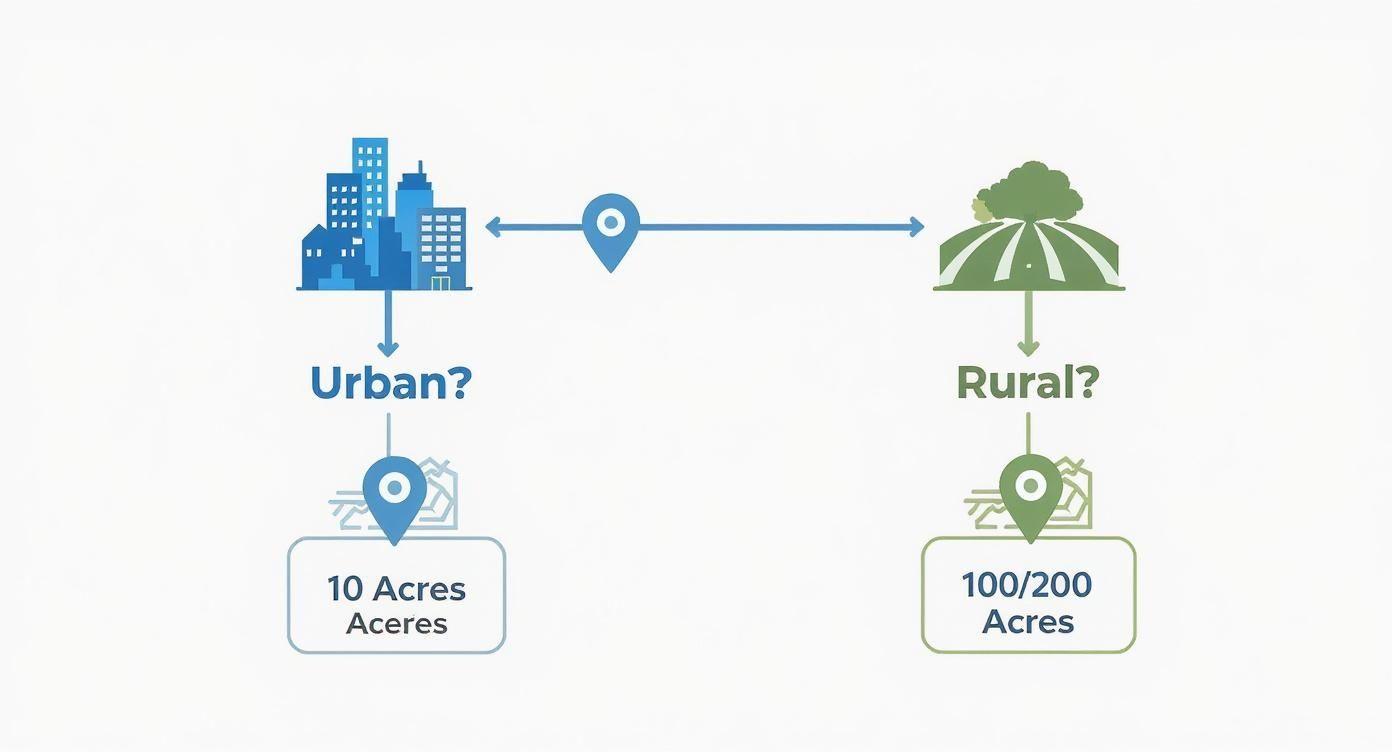
As you can see, it really boils down to acreage. The limit is 10 acres for urban properties and up to 200 acres for a family's rural home. That's what defines the scope of your protection.
Critical Exceptions You Must Understand
While the homestead shield is strong, it isn't bulletproof. It's absolutely crucial to know that there are specific types of debts that are not covered. If you don't pay these particular debts, a creditor can force the sale of your home.
The law is designed to protect you from general creditors, but it also ensures that those with a direct financial stake in your property get paid. Knowing these exceptions is just as important as knowing your protections.
Here are the specific, permitted exceptions under the Texas Property Code:
- Purchase Money Mortgage: This is your main mortgage—the loan you took out to buy the house. Miss these payments, and the lender can foreclose.
- Property Taxes: If you don't pay your property taxes, the local government can place a lien on your home and eventually foreclose.
- Home Equity Loans: If you borrow against your home's equity with a second mortgage or HELOC and default, that lender has the right to foreclose.
- Mechanic's Liens: This is for contractors. If a builder does work on your home and you don't pay them, they can file a mechanic's lien—but only if you have a written contract signed by all owners. This can lead to a forced sale.
- Owelty of Partition: This usually comes up in a divorce. It’s a legal tool used to ensure one spouse can pay the other for their share of the home's equity.
- Refinanced Liens: Any valid lien that you refinance (like refinancing your original mortgage) remains a valid lien against the homestead.
- Reverse Mortgages: Homeowners who default on the terms of their reverse mortgage agreement can also face foreclosure.
- Certain Federal Tax Liens: While state law protects you from most creditors, the federal government is a different story. The IRS can still put a lien on your homestead for unpaid income taxes.
Understanding both the strengths and the limitations of your homestead rights is key to truly protecting your property.
How Homestead Exemptions Slash Your Property Taxes
Beyond shielding you from creditors, the Texas homestead exemption puts real money back in your pocket every single year by cutting down your property tax bill. This isn't just some small-print discount; it's a powerful savings tool baked right into the state's tax code.
The homestead exemption works by legally lowering your home's appraised value before your tax bill is calculated. A lower taxable value means a lower tax bill. It's one of the most direct ways Texas makes owning a home more affordable.
The Mandatory School Tax Exemption
Every single Texas homeowner who qualifies for a homestead exemption gets a major break on their school district property taxes. It's not optional—it's the law.
State law mandates that all school districts must give you a $100,000 general residence homestead exemption.
For example, if your home is valued at $350,000, the school district can only tax you on a value of $250,000. This is a huge, statewide benefit that delivers substantial savings to homeowners.
The history here is pretty unique. The Texas Constitution of 1876 was designed to limit the state's power to tax, giving local governments more control. You can learn more about how this structure came to be by exploring the history of property taxes in Texas.
Optional Local Exemptions
On top of the mandatory school tax break, other local taxing entities can choose to offer their own exemptions. This is where your savings can really start to stack up.
These other taxing bodies include:
- Your county
- Your city
- Special districts (like hospital or community college districts)
Many of these local governments offer an exemption of up to 20% of your homestead's value (with a minimum exemption of $5,000). You'll need to check with your local county appraisal district to see which optional exemptions you can claim.
The real power comes from layering these benefits. The mandatory school exemption combined with optional local exemptions can drastically reduce your annual property tax burden.
Extra Relief for Seniors and Disabled Homeowners
Texas law provides even more help for some of its most vulnerable residents. If you're a homeowner who is over 65 or who has a disability, you are eligible for additional, specific exemptions.
For homeowners who qualify, here's what you get:
- Over-65 or Disabled Exemption: You get another $10,000 lopped off your home's value for school district taxes. This is in addition to the standard $100,000 exemption, bringing your total school tax exemption to $110,000.
- The School Tax Ceiling: This is a powerful benefit. Once you qualify for the over-65 or disability exemption, the dollar amount you pay in school taxes is frozen. It cannot go up for as long as you own and live in that home, even if your property's value skyrockets.
These protections are a core part of the Texas Property Code, ensuring that seniors and disabled individuals aren't priced out of their own homes. If you're struggling to understand these specific rights, a qualified Texas landlord tenant lawyer can help you navigate the system.
A Step-by-Step Guide to Claim Your Homestead Exemption
Knowing your rights is one thing. Claiming them is how you pocket the savings.
Fortunately, applying for the homestead exemption in Texas is a straightforward process designed for homeowners to handle themselves.
Let’s walk through exactly what you need to do to secure your property tax benefits.
Step 1: Find and Fill Out the Right Form
First, you need the official "Application for Residence Homestead Exemption." You can find this form on the website for your county appraisal district (like the Harris County Appraisal District or the Dallas Central Appraisal District). A quick search for "[Your County] appraisal district" will get you there. The form is almost always a downloadable PDF you can print right at home.
Step 2: Get Your Documents in Order
With the application in hand, you’ll need to prove you own the home and, more importantly, that you live there. The single most critical piece of paper you need is a copy of your Texas driver's license or state-issued ID.
This part is non-negotiable: The address on your driver's license MUST match the address of the homestead you’re claiming. If it doesn't, your application will be denied. Get your license updated with the Texas Department of Public Safety before you submit the form.
Step 3: Submit Your Application on Time
Timing is everything. In Texas, the window to file your homestead exemption application is between January 1 and April 30 of the tax year. Don’t put it off.
The best part? Once you’re approved, you do not have to reapply every year. The exemption automatically rolls over as long as you continue to own and live in the home as your main residence.
Here’s a quick checklist to make sure you’ve got it all covered:
- Get the Form: Download the "Application for Residence Homestead Exemption" from your county appraisal district's site.
- Check Your ID: Make sure your Texas driver's license address is an exact match for your property address.
- Make a Copy: Include a clear copy of that license with your completed application.
- File Before the Deadline: Submit everything to your county appraisal district between January 1 and April 30.
Following these steps is all it takes to lower your property tax bill. While most people can handle this on their own, snags can happen. If you hit a roadblock, talking to an experienced eviction attorney or property law expert can give you the clarity you need.
Why Texas Homestead Laws Are So Strong
To really understand why Texas homestead laws are so powerful, you have to look back at the state’s rugged beginnings. These laws were born out of necessity when Texas was its own country. The leaders of the Republic of Texas needed to offer more than just cheap land to attract settlers—they needed to offer security.
A Foundation Built on Protection
Early settlers knew that one bad year—a drought, a failed crop, an unexpected debt—could wipe them out completely. The solution was a legal shield: a law that made it almost impossible for creditors to take a family's home.
This wasn't just about protecting one family at a time. It was a bigger strategy to build a stable economy from the ground up. This core value—protecting the family home at all costs—is the bedrock of our homestead laws today. The Republic of Texas passed its very first homestead law on January 26, 1839, guaranteeing every family a piece of land that was safe from seizure. You can learn more about this foundational law by exploring the origins of Texas property rights.
From Republic to Modern-Day Security
That promise was so fundamental to the Texas identity that it was written directly into the Texas Constitution in 1876, where it still stands today. The numbers have changed over the years, but the core idea hasn't budged one bit.
The strength of Texas homestead law comes from its history. It was designed from day one to be a powerful, almost unbreakable promise to homeowners that their primary residence is a sanctuary.
This is why Texas is different. Many states offer some protection, but Texas provides an unlimited exemption on your home's equity. This isn’t some loophole; it’s the direct legacy of a principle that’s over 180 years old. When you understand this history, you see that your rights as a homeowner aren't just words on a page. They're a promise of security, passed down for generations.
Common Questions About Texas Homestead Law
When you dig into the details of Texas homestead laws, specific questions often come up. Let's tackle some of the most common points of confusion so you can feel confident in your rights.
Can I Claim More Than One Homestead in Texas?
No. Texas law is very firm on this point. You are only allowed to designate one property as your principal residence homestead in any given tax year. Even if you own multiple homes, only the one you actually live in as your primary home gets the creditor protections and tax breaks.
What Happens to the Homestead Exemption if I Inherit a House?
If the home you inherit already has a homestead exemption, you can usually keep it, but there’s a critical requirement: you have to move in and make it your principal residence. The exemption doesn't just transfer to you automatically if you don't live there. Your first move should always be to call your local county appraisal district to understand their specific rules.
Do I Need to Reapply for My Homestead Exemption Every Year?
Thankfully, no. This is a common myth. Once your residence homestead exemption is approved, it automatically renews every single year. You don't need to file the paperwork again and again, as long as you still own the home and it remains your main residence.
The "one and done" nature of the homestead application is designed for simplicity. The state wants homeowners to claim and keep their benefits without yearly bureaucratic hurdles.
Can a Mobile Home Qualify for Homestead Protections?
Yes, a mobile or manufactured home can get full homestead protections in Texas, but the details matter. To get the benefits—both creditor protection and tax exemptions—you generally must own both the mobile home itself and the land it sits on. If you own the home but lease the land, your ability to claim the exemption might be limited.
Does a Homestead Protect Me from Squatters?
While homestead laws are a shield against creditors, they don't directly handle problems with unauthorized occupants, or squatters. That issue falls under a different part of the Texas Property Code. Getting a squatter out of your house requires a specific legal process, much like an eviction. Your homestead status strengthens your legal position, but it’s not the tool you use to actually remove someone. To learn more about this challenge, check out our guide on how to properly evict squatters in Texas.
Navigating the nuances of property law can be challenging, but you don't have to do it alone. If you need help with an eviction, lease issue, or rental dispute, contact The Law Office of Bryan Fagan, PLLC for a free consultation today.