Dealing with a property dispute can be stressful—but understanding your rights under Texas law can make all the difference. Adverse possession, what many people call "squatter's rights," is one of the most surprising concepts in Texas property law. It’s the idea that someone can legally take ownership of your land without ever buying it.
This doesn't happen overnight. It’s a slow, creeping process that unfolds over years. But for a property owner who isn't paying attention, a simple encroachment or an unauthorized occupant can turn into a full-blown, costly legal battle to keep what's rightfully yours. This guide provides clear, practical guidance for Texas landowners to protect their property rights.
What Is Adverse Possession in Texas?
Think of it this way: someone builds a fence a few feet onto your property. Or a neighbor starts using a corner of your back lot as their own garden. You see it, but you don't do anything about it. Years go by. In the eyes of the law, your silence can sometimes be mistaken for abandonment.
If that person openly, exclusively, and continuously uses your property as if it were their own for a long enough time—and you never take legal steps to stop them—they might just be able to convince a judge to give them the title. It’s a harsh lesson in the importance of actively managing and defending your property lines.
The 5 Key Elements of an Adverse Possession Claim
For a claim to have any chance in court, the squatter’s possession of the land has to meet five critical legal standards. The burden of proof is entirely on the person making the claim (the claimant), and they have to prove every single element. If even one fails, their claim falls apart.
To win an adverse possession case, a claimant must prove all five of these elements. Here's what they mean for you as a property owner.
The 5 Key Elements of an Adverse Possession Claim
| Legal Element | Simple Explanation | What It Means for a Landlord |
|---|---|---|
| Hostile | Possession is without the owner's permission. | A tenant with a lease can't make a "hostile" claim because you've given them permission to be there. This element is automatically defeated by a valid lease. |
| Actual | The claimant is physically using the land like an owner would. | This could mean they've built structures, planted gardens, or fenced off the area. It's more than just walking across the property. |
| Exclusive | They are possessing the property for their own use, not sharing it with the owner or the public. | If the true owner is also using the property, or it's open for public use, the possession isn't exclusive. |
| Open & Notorious | Their use is obvious and out in the open, not hidden. | The possession must be so visible that a reasonably attentive owner would notice it. Secretly using the land doesn't count. |
| Continuous | They've possessed the property without interruption for the entire legal period (3, 5, or 10 years). | Any break in their possession—like moving away for a year—can reset the clock back to zero. |
As you can see, these aren't easy standards to meet. But ignoring them is a gamble.
Real-World Scenario: Imagine your neighbor puts up a fence that cuts five feet into your yard. You don't say anything for over a decade. They've been using that strip of land openly (Open & Notorious), without your permission (Hostile), and for their sole benefit (Exclusive). They could have a valid claim.
This is why understanding adverse possession law in Texas is critical—not just for lawyers, but for every single person who owns property in this state. Your land is your asset; protecting it starts with knowing the rules that could put it at risk.
What the Texas Property Code Says About Timelines
When it comes to adverse possession, time is everything. But it’s not as simple as one single clock. The Texas Property Code sets up several different timelines—or statutes of limitation—and each one comes with a completely different set of rules for the squatter to follow.
For you as a property owner, understanding these timelines isn't just academic. It's your first line of defense. Knowing the requirements helps you spot a threat before a squatter’s temporary use of your land becomes a permanent loss. The moment someone occupies your property without permission, their clock starts ticking. It’s your job to stop it.
Think of it this way: the moment someone sets foot on your property without permission, you're on the defensive. This flow chart gives you a quick look at how the risk assessment begins.
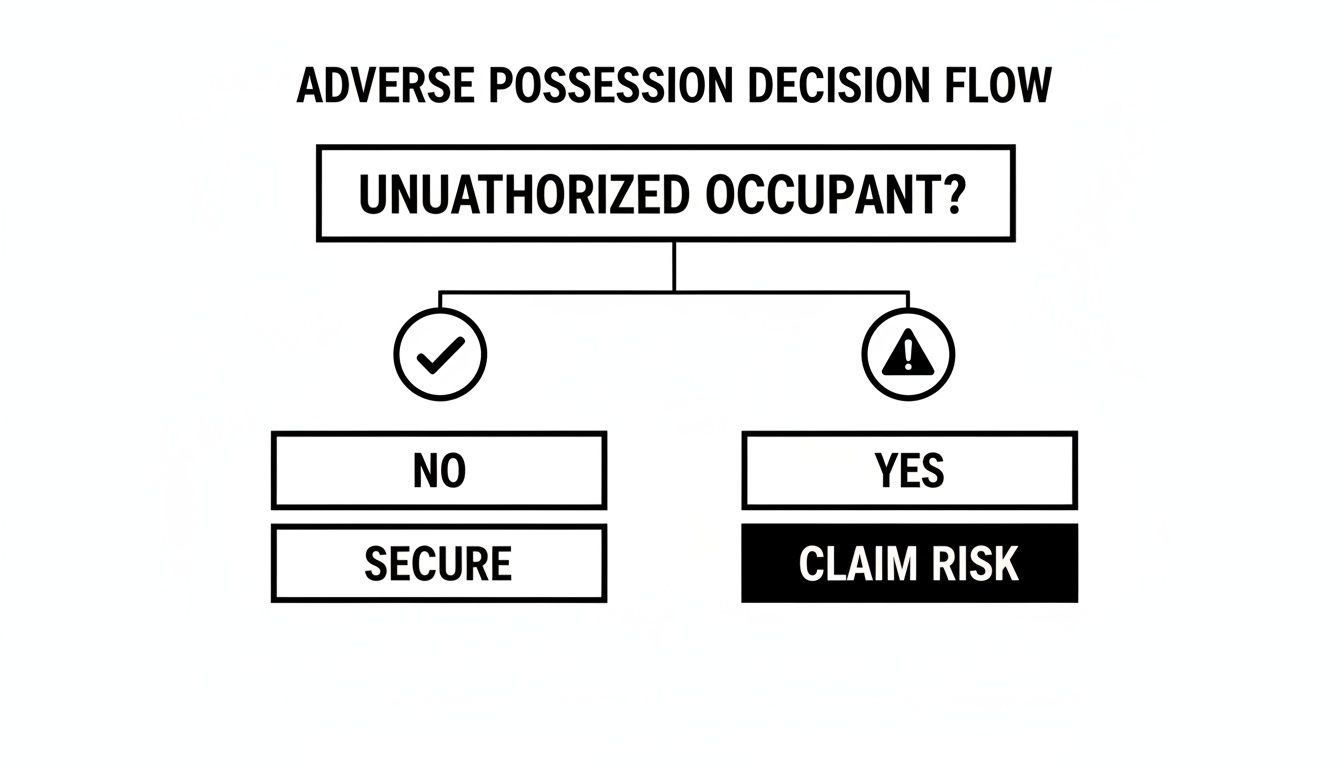
As you can see, any unauthorized use immediately puts your property at risk. Let’s break down the specific timelines defined in the Texas Civil Practice & Remedies Code so you know exactly what you’re up against.
The Three-Year Statute of Limitation
The fastest path for a claimant is the three-year statute, but it’s also the most difficult one to win. To even attempt a claim under this rule, the person must have “color of title.”
This is a legal term that means the squatter has a document that looks like a valid deed but has a serious legal defect. For example, maybe the deed was written incorrectly, or it was signed by someone who didn't actually have the authority to sell the property in the first place.
Simple Explanation: A claimant needs a piece of paper that appears to transfer ownership, even if it's flawed. Without this "color of title," their claim is dead on arrival under the three-year rule, no matter how long they've been on the land.
Because this requirement is so specific and strict, claims under the three-year statute are pretty rare. It takes a unique situation where faulty paperwork led someone to genuinely believe they were the rightful owner.
The Five-Year Statute of Limitation
Next up is the five-year statute. This timeline has its own unique hurdles and is a bit more common than the three-year version. To make a claim here, the possessor has to do more than just occupy the land. They must:
- Cultivate, use, or enjoy the property;
- Pay all applicable property taxes on time, before they become delinquent; and
- Claim the property under a duly registered deed (this is another form of "color of title").
The game-changer here is the tax requirement. Paying property taxes is a huge step. It’s a public, official action that shows a strong intent to act as the true owner. For landowners, this provides a simple and powerful defense: always pay your own property taxes on time. If you do, no one can succeed with a five-year claim against you.
The Ten-Year Statute of Limitation
This is the big one. The 10-year statute is, by far, the most common route for adverse possession claims in Texas. It's often called the "bare possession" statute because it strips away most of the technical requirements.
Under this rule, a person can gain legal title to your land simply by meeting the five core elements of adverse possession (hostile, actual, exclusive, open, and continuous) for 10 consecutive years. They don't need a deed, they don't need "color of title," and they don't have to prove they paid a single dollar in property taxes.
This is the timeline that poses the greatest risk for landowners who aren't paying close attention. A simple fence that’s a few feet over the property line or a neighbor who consistently mows and uses a piece of your back lot can, after a decade of being ignored, ripen into a full-blown legal claim to your land.
In Texas, the 10-year statute under Civil Practice & Remedies Code §16.026 is the weapon of choice in these disputes. It allows claimants to take title to up to 160 acres without paperwork, as long as they can prove their use. It forces property owners to act within 10 years or risk losing their land forever.
Courts have shown they will enforce this rule. You can see how courts have handled similar situations in other real estate law disputes. This is exactly why any good Texas landlord tenant lawyer will tell you that proactive monitoring isn't just a good idea—it's essential.
How a Lease Protects Your Property Rights
The thought of someone taking your property just by living on it is enough to make any Texas landlord nervous. But your single most powerful shield against this ever happening is something you already have in your toolkit: a proper lease agreement.

Here's why it works. For an adverse possession claim to even get off the ground, the squatter's occupation has to be "hostile"—meaning it’s done without your permission and against your ownership rights. A lease completely demolishes that argument.
By signing a lease, you give someone explicit, written permission to be there. Their possession is permissive, not hostile.
Simple Explanation: A tenant with a valid lease can never, by definition, win an adverse possession claim against you. The signed lease is your undeniable proof that you consented to their presence, making their occupation entirely legal and non-hostile.
This simple legal fact is your best defense. It draws a bright, clear line between a paying tenant and a potential squatter, but only if that landlord-tenant relationship stays well-defined. A solid lease is more than just a financial tool; it's a legal fortress. To better understand the key elements of a legally sound agreement, which serves as your primary defense, you can check out this comprehensive tenancy agreement guide.
What Happens When a Lease Expires or Is Breached
While a current lease is a rock-solid defense, things can get murky if you aren't careful when it ends. This is where permissive use can blur into hostile territory if you don’t act.
Think about the classic "holdover tenant." This is someone whose lease has expired, but they just… stay. They stop paying rent, and their legal right to be on your property is gone.
If you start accepting rent again, you might have accidentally created a new month-to-month tenancy. But if you do nothing—no rent, no eviction notice, no communication—their continued presence could slowly start to look more like a hostile occupation. This is why you must act swiftly.
Reinforcing Your Rights as a Landlord
To prevent any confusion that a squatter could try to exploit, you have to actively manage your property and enforce your rights under the Texas Property Code. Your actions—or your failure to act—are what keep a tenant’s use permissive.
Here are step-by-step actions every landlord should take to protect their property:
- Always Use Written Leases: Verbal agreements are a recipe for disaster. A written lease nails down the terms, defines the property boundaries, and sets a clear end date for their permissive use. We can help you navigate all the critical components of Texas lease agreement laws.
- Act Quickly on Lease Expirations: As soon as a lease ends, you have two choices: sign a new one or start the formal eviction process. Don't let a former tenant linger on your property without a clear, written agreement.
- Address Encroachments Immediately: If a tenant puts up a shed on an adjacent lot you own or starts using land not covered in their lease, you have to shut it down. Send a written notice telling them to stop, or if you don't mind, grant them temporary, revocable permission in writing.
- Initiate Timely Eviction Proceedings: If a tenant stops paying rent or breaks the lease, don't wait. An experienced eviction attorney can help you immediately follow the legal eviction process in the Texas Property Code. This action is the clearest possible signal that their possession is no longer welcome and that you are asserting your ownership rights.
By maintaining clear, documented, and legally enforced relationships with your tenants, you completely remove the "hostile" element required for an adverse possession claim. Your lease is the first line of defense, but proactive management is what wins the war.
Understanding 'Color of Title' and 'Tacking'
Adverse possession law has its own language, and two terms you absolutely need to know are “color of title” and “tacking.” These aren't just legal jargon; they are powerful tools a squatter can use to strengthen—and speed up—their claim to your land.
Understanding how these concepts work is the first step in spotting a potential threat before it becomes an irreversible legal problem. Think of them as shortcuts in the law that can work against an unsuspecting property owner.
What Is Color of Title?
The phrase “color of title” might sound strange, but the concept is straightforward. It happens when someone occupies your land while holding a document that looks like a legitimate deed but is actually defective for some hidden reason.
Maybe the deed was recorded improperly, describes the wrong piece of land, or was signed by someone who never had the legal right to sell it in the first place. This faulty document gives the possessor “color of title.” They aren't just a random trespasser; they have a piece of paper that gives them a good-faith (though mistaken) belief that they are the true owner.
Simple Explanation: Color of title is a claim to ownership based on a written document that appears valid on its face but has a critical legal flaw.
In Texas, having color of title is a game-changer. It’s a key requirement for the shorter three-year and five-year adverse possession statutes. This is exactly why a thorough title search is so critical—it's designed to unearth these defective documents from a property's past.
What Is Tacking in Adverse Possession?
The second key concept, "tacking," works like a relay race for squatters. It allows different people in succession to combine their individual periods of occupation to meet the required time limit.
For tacking to be valid, there has to be a direct and unbroken connection—what lawyers call "privity of estate"—between each possessor. Usually, this means one squatter formally "sells" or transfers their claim to the next person, creating a continuous chain.
Here’s a real-world example of how it works with the 10-year rule:
- Squatter A openly occupies a property for seven years, acting like an owner.
- Squatter A then creates a document "selling" their interest in the land to Squatter B.
- Squatter B takes over and continues occupying the property for another three years.
By "tacking" their three years onto Squatter A’s seven, Squatter B now meets the 10-year requirement. This allows an adverse possession claim to succeed even when no single person held the property for the full statutory period. For absentee landowners, this is a serious risk, as several short-term trespassers can add up to one big legal headache over time.
How to Prevent an Adverse Possession Claim
Knowing the legal theory behind adverse possession is one thing. Actively protecting your property from it is something else entirely. The best defense against losing your land isn’t a legal fight after the fact—it’s a good offense, starting today.
Instead of waiting for a problem to land on your doorstep, you can take simple, proactive steps to make it nearly impossible for a squatter or encroaching neighbor to establish a legitimate claim. Think of this as your routine maintenance plan for securing your investment. These actions send a clear, undeniable message: you are an active and engaged owner.

Step-by-Step Guide to Protecting Your Property
The single most effective way to stop an adverse possession claim before it even starts is to physically show up and inspect your property. This is non-negotiable, especially for vacant land or rental properties between tenants. An absentee owner is a vulnerable owner. Regular visits let you spot unauthorized activity right away—a new fence, signs of dumping, or someone clearly living there.
Here are the steps to follow:
- Conduct and Document Regular Property Inspections: When you visit your property, always take time-stamped photos and videos. This documentation becomes powerful evidence that you are actively monitoring and controlling your land. For a structured approach, our property inspection checklist for landlords will help make sure you don't miss a thing.
- Clearly Mark Your Property Boundaries: Fuzzy property lines are an open invitation for trouble. You can shut this down by hiring a surveyor, installing fencing along the correct boundary lines, and posting "Private Property" or "No Trespassing" signs. These signs put the world on notice that any use of your land is without your permission, which helps defeat the "hostile" element of a claim.
- Immediately Address Any Encroachments: If you discover that a neighbor's fence is two feet onto your property, you have to act. Now. Doing nothing can be seen as giving your silent consent. Your first move should be sending a formal, written notice by certified mail stating they do not have your permission and must remove the encroachment. This action creates a paper trail proving you didn't sit on your rights and stops the adverse possession clock cold.
- Use Written Agreements for Any Permissive Use: Never let someone use your property on a handshake deal. If you’re okay with a neighbor using a strip of your land, put it in writing. This document should spell out that your permission is temporary, can be revoked at any time, and grants no ownership rights. This proves the use is permissive, not hostile.
- Pay Your Property Taxes on Time, Every Time: Finally, pay your property taxes promptly. This is a public record of your ongoing ownership and, more importantly, it completely blocks anyone from using the five-year adverse possession statute, which requires the claimant to have paid the taxes themselves.
Real-World Scenario: Ignoring a small encroachment is one of the most common—and costly—mistakes landowners make. A simple written notice today can prevent a decade-long legal battle tomorrow.
How to Resolve an Issue With a Squatter
Finding someone on your property who doesn't belong there is a shock. Your first instinct might be to go out there and demand they leave. But in Texas, how you handle this first moment is critical. Acting on impulse can backfire, fast.
Before you do anything else, your first call should be to an experienced Texas landlord tenant lawyer. This isn't a DIY situation. The laws around property rights, squatters, and evictions are a minefield, and one wrong move could accidentally give the squatter more rights, not fewer.
Step-by-Step Information for Resolving the Issue
Your lawyer will get you on the right track immediately. You can't afford to wait, because every day you delay is another day the adverse possession clock can tick against you. Here’s how to start:
- Gather Evidence: Don't talk to the person on your land. Just document everything. This proof is the foundation of your legal case. Your evidence file needs to include time-stamped photos/videos, your deed, a current property survey, and proof of tax payments.
- Take Formal Legal Action: Once you have your evidence, your attorney will guide you through the formal legal process. You absolutely cannot change the locks, shut off utilities, or try to physically remove the person or their belongings yourself.
- File an Eviction or Lawsuit: Your attorney will likely recommend a formal eviction, which starts with a "notice to vacate." If they don't leave, the next step is filing an eviction lawsuit. For a more permanent solution, a "trespass to try title" lawsuit asks the court to make a final, binding decision about who owns the property, clearing your title and extinguishing any claim the squatter might have. Learn more about how to evict squatters in our detailed guide.
The biggest mistake a landowner can make is trying a “self-help” eviction. It’s illegal in Texas. You could find yourself getting sued by the very person who is trespassing on your property. Always use the court system.
Finding a squatter is a serious problem, but it has a solution. The key is to trade panic for a calm, methodical plan—one guided by a legal professional who knows how to protect you and your land.
Frequently Asked Questions About Texas Adverse Possession
When it comes to adverse possession, misinformation runs rampant. Landowners are often left wondering what's true and what's just rumor, worried about losing the property they've worked so hard for. Let's clear up some of the most common questions we hear about squatter rights and property claims in Texas.
Can someone take my property just by paying the taxes?
No. This is a common myth, but simply paying the property taxes is never enough to take your land on its own.
While paying taxes is a requirement for the shorter five-year adverse possession timeline, it's just one checkbox a squatter has to tick. They still have to prove every other element of their claim—that their possession was actual, open, hostile, and exclusive for the entire five years. But make no mistake: someone else paying your taxes is a massive red flag. Always pay your property taxes on time and make absolutely sure no one else is paying them for you.
Do 'No Trespassing' signs stop an adverse possession claim?
Posting "No Trespassing" signs is a good first step, but it’s not a magic shield that automatically defeats a claim. The sign is solid evidence that you never gave the person permission to be there, which helps establish that their presence is "hostile."
But a sign by itself is not enough. If you put up a sign and then do nothing for a decade while someone openly lives on your land, they could still build a case. The sign is a tool, not a complete solution. You have to back it up with real action, like sending a formal notice to vacate or filing a lawsuit to have them removed.
What is the difference between a squatter and a trespasser?
The real difference comes down to time and intent. A trespasser is usually there for a short, temporary period without any plan to stay. A squatter, on the other hand, moves in with the goal of living there permanently. Over time, what starts as simple trespassing can evolve into a squatter situation.
From a legal standpoint, both are on your property without permission. But it’s the squatter's long-term, continuous occupation that creates the risk of an adverse possession claim. The process for removing them typically starts with a formal notice to vacate and can escalate to a trespass to try title lawsuit—a legal action designed to clear your title for good.
If you need help with an eviction, lease issue, or rental dispute, contact The Law Office of Bryan Fagan, PLLC for a free consultation today.