Dealing with a landlord dispute or eviction can be stressful, especially when someone suddenly says the lease was never valid or the property title was flawed from the start. You may be a tenant trying to stay in your home, or a landlord trying to protect an investment that now feels legally tangled.
An old property rule can matter in a very modern Texas dispute. It’s called estoppel by deed, and while the name sounds technical, the basic idea is practical. If someone made a formal statement in a deed or similar property instrument, the law may stop that person from later taking the opposite position when a dispute arises.
For people dealing with lease fights, title problems, or eviction notices, that rule can affect tenant rights, ownership claims, and even whether an eviction attorney can challenge a landlord’s position in court. A skilled Texas landlord tenant lawyer often looks beyond the lease itself and asks a deeper question: what did the property documents say, and who is now trying to contradict them?
When a Property Dispute Gets Complicated
A lot of property disputes start small. Rent is late. Repairs aren’t done. A sale closes. A new owner shows up. Then someone pulls a deed, a title document, or an old lease file, and suddenly the problem gets much bigger.
A common example
Say a landlord rented out a house, accepted rent for months, and acted like they had full authority to lease it. Later, an ownership issue surfaces. Maybe there was a title defect, an inheritance fight, or a transfer that wasn’t handled correctly. Once the landlord fixes that problem, they might try to argue that the lease was defective from day one because they didn’t fully own the property at the time.
That’s where people get blindsided.
A tenant hears, “You never had valid rights here.” A landlord hears, “You can’t undo what your own documents promised.” Both sides feel confused because the issue is no longer just about missed rent or move-out dates. It’s about whether the law will let someone reverse their earlier position.
Practical rule: In property disputes, what someone signed earlier can matter just as much as what they’re arguing now.
Why this doctrine matters in Texas disputes
Texas landlord-tenant cases often turn on possession, notice, lease wording, and compliance with the Texas Property Code. For example, Texas Property Code Chapter 92 governs many residential landlord-tenant issues, including repairs, security deposits, and certain notice rules. Section 92.001 sits at the start of that chapter and helps frame the chapter’s scope for residential tenancies.
But not every fight fits neatly inside one code section. Some cases involve older common-law rules that courts still recognize when written property instruments create legal consequences. Estoppel by deed is one of those rules.
Why clients get confused
Ownership and leasing are often perceived as separate issues. In real life, they overlap all the time.
Here are the usual sticking points:
- The lease looked valid: Everyone acted like the deal was real.
- The title issue surfaced later: No one focused on it until conflict began.
- The story changed mid-dispute: One side now wants to deny what earlier documents implied.
- The financial stakes rose fast: Housing stability, unpaid rent, attorney’s fees, and business interruption all come into play.
If you’re in that situation, the key is not to panic and not to assume the other side’s new story is legally correct. Property law puts a lot of weight on formal written instruments for a reason. Courts want reliability in real estate transactions, and that often means holding people to what they previously put in writing.
What Is Estoppel by Deed in Plain English
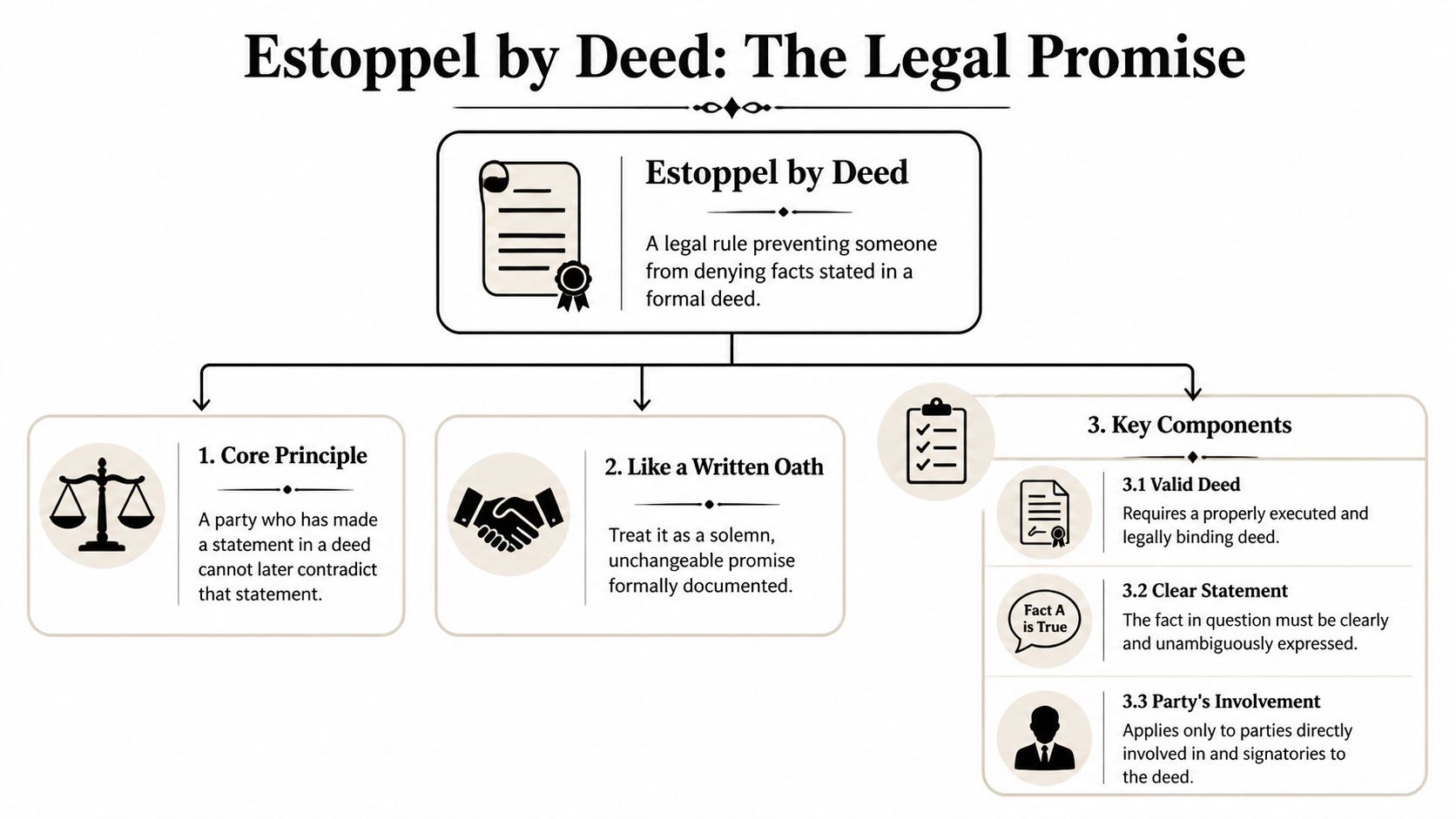
Estoppel by deed is easiest to understand if you think of it as a formal written promise the law won’t let you casually take back. When a deed clearly states a fact, the person who made that statement may be blocked from later denying it in a dispute tied to that deed.
The basic idea
A deed is not just a piece of paper. It’s a formal legal instrument. If a grantor signs a deed saying they have title, rights, or authority, courts may treat that statement as binding in later litigation involving the same transaction.
That’s why estoppel by deed often comes up when someone tried to transfer an interest they didn’t fully own at the time, but later acquired.
The after-acquired title rule
One of the most important applications is after-acquired title. If a person conveys property through a warranty deed without owning it at that moment, and later obtains title, that title automatically passes to the grantee. By contrast, a quitclaim deed conveys only whatever interest the grantor has at the time, so after-acquired title does not pass. That distinction is critical in disputes, as described in this discussion of warranty deeds and quitclaim deeds.
This is one reason deed type matters so much. If you’re reviewing a transfer, don’t treat every deed as interchangeable. The legal consequences can be very different. For a closer look at those differences, see this guide on property deeds in Texas.
A simple comparison
| Document type | What it generally conveys | What happens if title is acquired later |
|---|---|---|
| Warranty deed | A transfer backed by title-related promises | Later-acquired title can pass to the earlier grantee |
| Quitclaim deed | Only the interest the grantor currently has | Later-acquired title does not pass the same way |
A good way to think about it is this. A warranty deed speaks in stronger terms about ownership. A quitclaim deed is more like saying, “I transfer whatever I have, if anything.”
Why tenants should care
You might wonder what this has to do with leases. A lot, in the right case. Leases are property instruments too, and landlord-tenant disputes often sit on top of ownership questions. If the landlord’s position depends on denying rights that were earlier represented in a formal instrument, estoppel by deed can become part of the legal fight.
That doesn’t mean every lease dispute turns into a title case. It means the paperwork behind the lease may matter more than you think.
How Texas Courts Apply Estoppel by Deed
Texas courts treat estoppel by deed as a doctrine with specific requirements. It isn’t enough for one side to say, “That’s unfair.” The court looks for concrete legal elements tied to the deed and the later contradiction.
The four elements a court looks for
A commonly stated framework is that estoppel by deed requires four technical elements for invocation: the execution of a deed, a factual representation within it, detrimental reliance by the other party, and a subsequent claim that is inconsistent with the original representation. That evidentiary bar is central to protecting purchasers’ expectations, as summarized in this discussion of the estoppel by deed doctrine.
In plain language, that usually means:
- There was a real deed or similar formal instrument involved.
- The document made a clear factual representation.
- The other side relied on that representation when acting.
- Someone later tried to take the opposite position in court or in a property dispute.
How this shows up in litigation
In Texas, this issue may appear inside a broader lawsuit. The case might be filed as an eviction matter, a suit over possession, or a title-related claim. Sometimes the underlying question is whether a party can deny what their own instrument said years earlier.
That’s why lawyers often pull the complete property file, not just the current lease. They want the deed chain, recorded instruments, transfer dates, and any wording that may lock in a legal position.
If the title itself is in dispute, the case may overlap with a broader ownership claim. In that setting, you may need to understand how a quiet title action works in Texas.
Where the Texas Property Code fits
The Texas Property Code still matters. In an eviction or rental dispute, courts may consider notice requirements, repair duties, possession rights, and security deposit rules under Chapter 92. For example:
- Section 92.052 is well known for landlord duties regarding repairs in certain residential situations.
- Other Chapter 92 provisions affect notice, deposits, and residential obligations.
Estoppel by deed doesn’t replace those rules. It can shape the background question of who is bound by what property representation in the first place.
If a landlord or prior owner is trying to disown a written property representation, the court may look past the current argument and back to the original instrument.
That’s often the turning point. The dispute may sound like a simple lease fight, but the legal outcome can depend on who committed to what in a deed.
Real-World Scenarios for Landlords and Tenants
The doctrine makes more sense when you see how it can affect an ordinary conflict over possession, rent, or lease enforcement.

A landlord-side scenario
A property manager signs a residential lease on behalf of an owner. Everyone proceeds as normal. The tenant moves in, pays rent, and requests repairs under Texas Property Code Section 92.052, which addresses certain landlord duties to repair conditions that materially affect a tenant’s health or safety.
Months later, the owner resolves an underlying title problem. Now the owner wants the tenant out and argues the original lease was invalid because ownership wasn’t fully settled when the lease began.
That argument may not work.
While most legal discussions focus on sales transactions, estoppel by deed can extend to Texas lease agreements. If a landlord leases property they don’t fully own and later perfects title, they may be estopped from evicting a tenant based on the initial title defect, providing a possible defense in a wrongful eviction claim, as explained in this overview of estoppel by deed and lease-related rights.
So even if the title issue was real, the landlord may still be bound by the rights they previously conveyed.
A tenant-side scenario
Now take a different example. A tenant signs a long-term lease with an option clause, invests in improvements the lease allows, and organizes a business around that location. Later, ownership changes hands, and the new side says the tenant’s rights were never enforceable because of a flaw in the earlier transfer.
Document review becomes critical at this juncture.
If the earlier instruments represented that the tenant had possession rights, access rights, or a defined leasehold interest, the new attempt to deny those rights may run into estoppel problems. The answer will depend on the exact language, the chain of title, and whether the dispute arises from the same instrument or its legal consequences.
For tenants facing a sale or ownership shift, it also helps to understand tenant rights when a landlord sells property.
What these disputes usually hinge on
These cases often turn on a short list of documents:
- The original deed
- The lease itself
- Recorded transfers or assignments
- Repair notices, rent records, and possession history
Written property documents can quietly control a case long before anyone files in court.
If you’re a landlord, this doctrine can limit your ability to undo a bad title situation by changing your legal theory later. If you’re a tenant, it can support your position when someone tries to erase rights you relied on in good faith.
Practical Steps to Protect Your Rights
The best time to deal with estoppel by deed is before a dispute explodes. Once an eviction is filed or a title fight lands in court, your options usually narrow.

If you’re a landlord
Start with the paper trail. Before you lease, buy, refinance, or enforce occupancy rights, confirm that the documents line up with reality.
A practical landlord checklist looks like this:
- Review the deed history: Check who held title, when transfers occurred, and whether any recorded instruments create conflicting rights.
- Read your lease language carefully: Don’t make broad statements about authority, access, easements, or purchase options unless you’re sure they’re correct.
- Match your notices to the Texas Property Code: In residential cases, make sure notices to vacate, repair responses, and deposit handling follow Chapter 92 where applicable.
- Preserve records early: Keep signed leases, payment ledgers, repair correspondence, and title documents together. If a dispute arises, scattered records weaken your position.
- Pause before filing eviction: If ownership or authority is disputed, filing too fast can create a bigger legal problem.
If you’re a tenant
Tenants often assume title problems are none of their concern. That isn’t always true. If your right to stay depends on a lease granted by someone whose ownership later becomes contested, the background documents matter.
Focus on these steps:
- Keep a complete lease file. Save the signed lease, renewals, amendments, notices, and proof of rent payments.
- Document reliance. If you moved in, spent money on the property, relocated your family, or opened a business based on the lease, keep that evidence.
- Send repair requests in writing. If habitability is part of the dispute, written notice under the Texas Property Code can matter.
- Don’t assume an ownership change ends your rights. Ask for written proof before agreeing to leave or sign new paperwork.
When to call a lawyer
Some warning signs call for legal help right away:
| Warning sign | Why it matters |
|---|---|
| A landlord says the lease was never valid | That may be a legal position tied to title and deed history |
| A deed or transfer document appears mid-dispute | Formal instruments can control rights beyond the lease |
| You receive an eviction notice after an ownership issue surfaces | The possession fight may involve more than unpaid rent |
| You’re asked to sign a new lease after a title problem is discovered | You may be giving up rights without realizing it |
Client advice: Bring every signed document to the first meeting. In these cases, one sentence in an old deed can matter more than an hour of argument.
Whether you’re a landlord or tenant, your financial stability often depends on acting early. Delay gives the other side time to shape the story around documents you haven’t fully reviewed.
Common Defenses and Limitations
Estoppel by deed is powerful, but it isn’t automatic and it isn’t unlimited. Courts don’t use it as a catch-all fairness rule. It has boundaries.

When the doctrine may not apply
The most common limitation is the document itself. If the transfer was by quitclaim deed, the result may be very different from a warranty deed situation. The stronger the title representation, the stronger the estoppel argument usually is.
Other possible limits can include:
- Fraud allegations: If the instrument itself was procured through fraud, courts may examine whether estoppel should apply at all.
- Mistake and equitable relief: In some cases, a party may seek rectification, rescission, or another equitable remedy.
- Unclear language: Estoppel by deed depends on a factual representation that is clear enough to bind the party who made it.
- Wrong parties: The doctrine generally works against parties to the instrument and those legally connected to them, not the whole world.
Recording rules can change the outcome
Another major limit involves recording acts. The after-acquired title doctrine is not absolute. In notice jurisdictions, a subsequent bona fide purchaser for value who has no notice of a prior unrecorded deed may take title free from the original grantee’s claim, even if estoppel by deed would otherwise apply, as discussed in this analysis of after-acquired title and recording acts.
That matters because property disputes don’t happen in a vacuum. Recording, notice, and later transfers can all affect who wins.
Why this matters in landlord-tenant fights
A tenant may have a strong fairness argument and still lose if the legal prerequisites aren’t there. A landlord may think a title defect destroys the lease and still lose because earlier formal representations carry legal force.
The point is not that estoppel by deed always decides the case. The point is that you shouldn’t assume it applies, or doesn’t apply, without reading the actual documents.
The hardest cases are rarely about one rule. They involve the lease, the deed, the recording history, and the Texas Property Code all at once.
That’s why a quick online answer often misses the core issue. The detail that changes everything is usually in the paperwork.
Navigate Property Disputes with Confidence
Property disputes feel personal because they are personal. Your home, your rental income, your business location, and your peace of mind may all depend on how a court reads one set of documents against another.
Estoppel by deed is a reminder that written property instruments have lasting force. If someone conveyed rights in a formal deed or related instrument, they may not be free to reverse course later just because the dispute became inconvenient. In Texas landlord-tenant conflicts, that can affect lease validity, eviction defenses, possession rights, and the practical value of your claim.
The best approach is simple. Get the documents. Read them closely. Compare the lease to the deed history. Check how the Texas Property Code fits into the dispute, especially if repairs, notice, deposits, or residential possession are involved. If you also want broader context for pricing, neighborhood trends, or ownership patterns before making a property decision, learning about understanding real estate market data can help you ask better questions before a problem starts.
You don’t have to sort through all of this alone. Clear advice early can protect your rights and reduce costly mistakes, whether you’re a tenant trying to stop a wrongful eviction or a landlord trying to enforce a lease without triggering a larger title fight.
If you need help with an eviction, lease issue, or rental dispute, contact The Law Office of Bryan Fagan, PLLC for a free consultation today. A Texas landlord tenant lawyer can review your deed history, lease documents, and Texas Property Code issues to help protect your tenant rights, your property rights, and your financial stability.