Getting a Notice to Vacate can feel like your housing is already gone. It isn't. In Texas, eviction is a court process, not a landlord's personal order. Until a judge signs off and the legal process runs its course, you still have rights, deadlines, defenses, and choices that can change the outcome.
If you're searching for how to win an eviction case in texas, the most important shift is this: winning usually comes from evidence and procedure, not from telling the judge that the situation feels unfair. Fairness matters, but in Justice Court, the judge is looking for a smaller set of questions. Was the notice legally proper? Did the landlord file too soon? Can the landlord prove the lease terms, the alleged violation, and delivery of required notices? Can you prove a defense like retaliation, waiver, habitability problems, or payment acceptance?
A strategic response starts early. The sooner you treat the notice and court papers like a case file, the greater your advantage.
Your Rights When Facing Eviction in Texas
The first thing many tenants need to hear is simple. A Notice to Vacate is not the same as a court order. Under the Texas Property Code, it is the required first step before a landlord files an eviction case for possession. In many residential cases, Texas law requires a written notice to vacate at least 3 days before filing, unless the lease sets a different period under Texas Property Code rules discussed in this eviction rights overview.
That detail matters because eviction cases are often won or lost on technical compliance. If the landlord skips a required step, serves notice the wrong way, or files too early, the case may fail even if rent is owed.
What the Notice to Vacate really means
A Notice to Vacate tells you the landlord is demanding possession of the property. It should be written, clear, and tied to a reason such as nonpayment, lease violation, or end of tenancy. It is the legal starting gun.
It is not a lockout order. It is not permission for the landlord to remove your things. It is not the final word.
Practical rule: If you receive a notice, don't panic and don't ignore it. Read it like a legal document, because that's exactly what it is.
Why procedure matters so much in Texas eviction court
Texas eviction court moves fast, and landlords win most cases. But tenants do win when they catch mistakes. In Harris County, 21% of 746 observed eviction hearings were dismissed in favor of tenants, often because of landlord errors like improper Notice to Vacate delivery or other administrative failures, according to Harris County eviction hearing observations.
That doesn't mean every tenant has a strong defense. It does mean every tenant should inspect the landlord's paperwork and timing carefully.
Rights tenants often overlook
Many tenants focus only on whether they can pay. Courts often focus on whether the landlord followed the rules. Your rights can include:
- The right to proper written notice before the case is filed.
- The right to court process before removal.
- The right to appear and defend yourself in Justice of the Peace court.
- The right to challenge evidence, including rent ledgers, late fees, and alleged lease violations.
- The right to raise legal defenses such as retaliation or serious repair issues in the right circumstances.
A real-world example
Suppose your landlord texts, “Pay by tomorrow or you’re out,” then files in court the next day. That may feel official, but the issue isn't how serious the text sounded. The issue is whether the landlord delivered a legally valid written notice and waited the required period before filing.
If they didn't, your defense may be stronger than you think.
In Texas eviction cases, calm tenants often do better than angry tenants. The person who brings the cleaner timeline, clearer documents, and tighter story usually has the advantage.
The First Five Days Critical Steps After an Eviction Notice
The first few days after a notice arrives are where many cases are effectively won or lost. Delay gives the landlord room. Fast, organized action gives you options.

Texas eviction deadlines are short. After a Notice to Vacate, the landlord can file suit, the hearing is often set within 10 to 21 days, and if the tenant loses, there are only 5 calendar days to appeal before removal can proceed, as explained in TexasLawHelp's appeal timeline guide. That speed is why your first response can't be passive.
If you need a more detailed response checklist, review this guide on how to respond to an eviction notice.
Day one means document everything
Start building your file immediately. Don't wait for court papers.
Gather these first:
- Your lease and renewals if you have them.
- Proof of payment such as bank statements, money order receipts, screenshots, or ledger confirmations.
- All messages with the landlord including texts, emails, and portal notices.
- Photos or videos of conditions if repairs, leaks, mold, broken locks, or utilities are part of the dispute.
- The envelope, posting, or delivery record for the notice itself.
A tenant who walks into court saying “I paid” is vulnerable. A tenant who walks in with a dated bank record, text chain, and lease clause is prepared.
What to inspect on the notice
Read the notice slowly. Look for small defects.
Check these points:
- Was it written? Verbal warnings usually aren't enough.
- Does it clearly demand possession? Vague wording can matter.
- Is the reason stated accurately? If the claim is nonpayment, compare it to your records.
- Was it delivered properly? Method matters.
- Did the landlord wait the required time before filing? Timing errors can defeat the case.
A common tenant mistake is assuming, “I owe some money, so none of this matters.” It matters a great deal. Even when rent is late, the landlord still has to follow the statute and the lease.
What not to do in the first five days
Some choices make a hard case worse.
| Mistake | Why it hurts |
|---|---|
| Ignoring the notice | You lose time to gather proof and negotiate |
| Moving out immediately without advice | You may give up leverage and still face claims for money |
| Sending angry messages | Those messages can end up in court |
| Paying cash without a receipt | You may have no way to prove the payment |
| Throwing away posted papers or envelopes | You may destroy evidence about bad service |
If your landlord says, “Just leave and we won't go to court,” get any agreement in writing. Oral side deals often collapse when the hearing date arrives.
A short action plan that works
If you're trying to stabilize the situation quickly, use this order:
- First, preserve proof. Save every document and screenshot.
- Second, compare the notice to your lease. Notice periods often turn on lease language.
- Third, assess your goal. Are you trying to stay, negotiate move-out time, or defeat a weak filing?
- Fourth, prepare for court even if you're still negotiating. Negotiations fail all the time.
- Fifth, get legal advice early. Speed matters more in eviction cases than in many other civil disputes.
Some tenants can resolve the issue by curing a lease violation, paying under an agreement, or negotiating a move-out with a dismissal. Others need to fight on procedure or present a defense based on conditions, retaliation, or payment disputes. You can't choose the right path until you've built the file.
Building Your Case Common Defenses Against Eviction
A strong defense isn't a speech. It's a theory supported by proof. In Texas eviction court, the best defenses are usually the ones you can explain in one or two sentences and back up with documents, dates, photos, or witnesses.
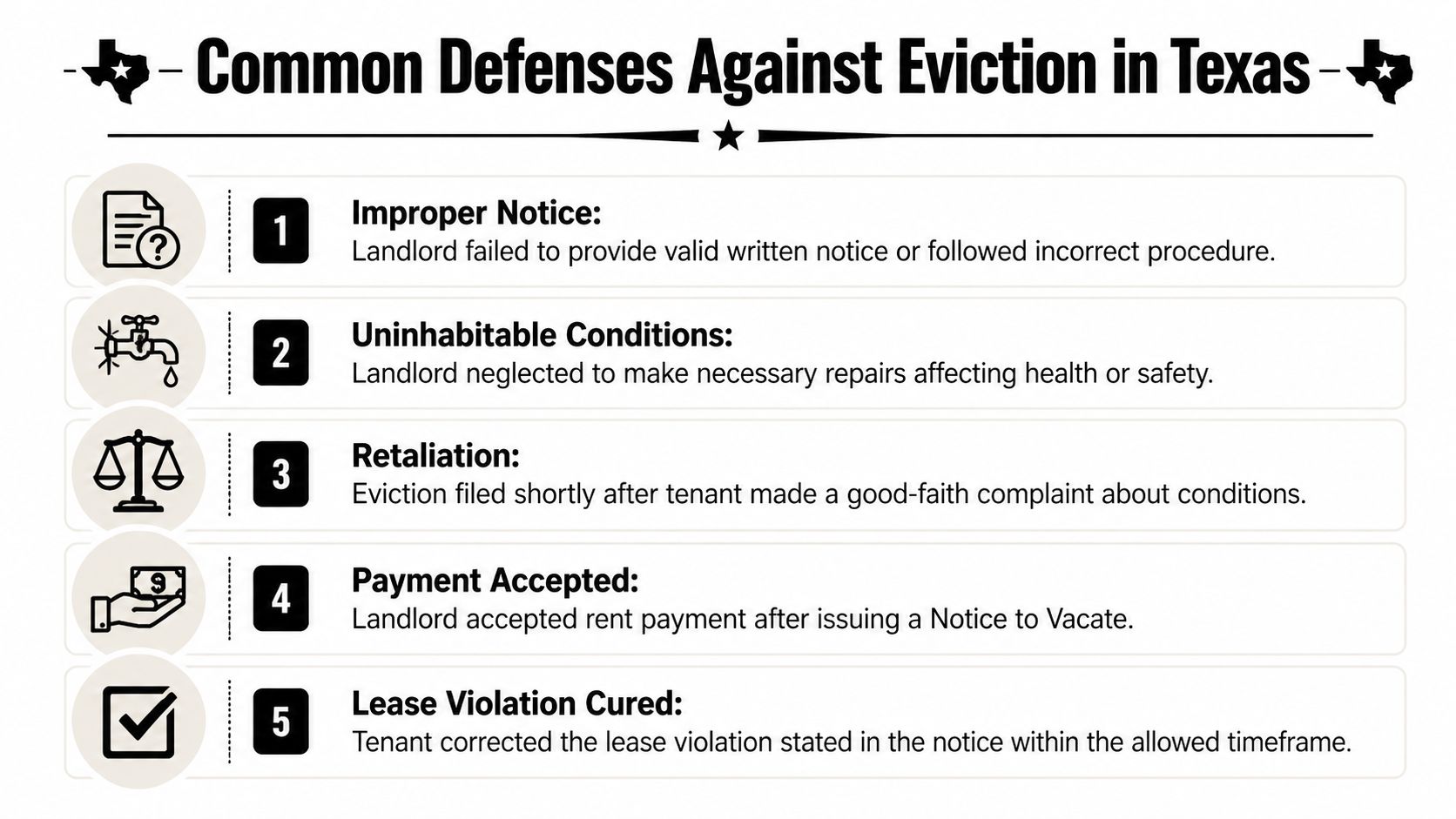
One of the most effective defenses is defective notice. According to the Texas law library eviction process guide, defective notices are a leading cause of the 20-30% of eviction cases that are dismissed, especially when notices are verbal or improperly posted, as summarized in the Texas eviction process guide.
Improper notice
This is often the first defense to investigate because it attacks the case at the foundation.
Examples include:
- The landlord gave only a verbal warning.
- The notice didn't clearly demand that you leave.
- The notice was delivered in a way that doesn't comply with the law.
- The landlord filed before the notice period expired.
- The notice claimed a breach before rent was due.
A practical example: your rent is due on the first, your lease has a grace-related structure, and the landlord posts a notice before the lease and facts support default. That can matter. So can a notice that says “pay or vacate” when the wording is unclear in context.
What to bring
- The notice itself
- Envelope or posting photos
- Lease terms about rent due date and notice
- Court filing date if available
- Screenshots showing when the landlord first contacted you
Landlord accepted payment after notice
Sometimes a landlord serves notice, then takes rent anyway. Depending on the facts and lease language, that can support a defense based on waiver or undercut the landlord's claim that possession was already demanded and fixed.
The key issue is not just whether money changed hands. It is what payment was accepted, when, and under what written terms.
A partial payment can help or hurt depending on the paper trail. If the landlord accepted money, save the receipt, portal confirmation, bank record, and any message describing what the payment was for.
Useful evidence
- Payment portal screenshot
- Receipt or ledger entry
- Text or email where the landlord accepted or requested payment
- Lease clause on non-waiver or partial payments
Retaliation
Texas law restricts retaliation in many landlord-tenant settings. In plain English, a landlord generally can't use eviction as punishment because you made a good-faith repair complaint, called a housing inspector, exercised a lease right, or asserted rights under the Texas Property Code.
This defense works best when timing and records line up.
For example, if you complained in writing about a dangerous leak or failed air conditioning, then shortly after received an eviction notice for a pretextual reason, the timeline may support a retaliation argument. The stronger your written complaint history, the stronger the defense tends to be.
Helpful proof
- Repair requests
- Inspection reports
- Emails or texts complaining about conditions
- Responses from management
- Timeline showing the complaint came before the eviction push
Habitability and serious repair issues
Habitability arguments are not a magic phrase. They work when the condition affects health or safety, the tenant followed the proper notice process, and the documents support the claim.
Common examples include sewage backups, unsafe electrical issues, water intrusion, broken exterior locks, or conditions that make the unit unsafe to occupy. If the landlord is claiming nonpayment, and your side of the story involves serious unaddressed conditions, your evidence needs to be organized and specific.
A judge is more likely to listen when you say, “On this date I reported the leak, on this date I sent follow-up notice, and these photos show the ceiling collapse,” than when you say only, “The place was bad.”
Lease violation cured
Not every eviction claim is about rent. Some are based on pets, guests, noise, parking, or housekeeping allegations. In some cases, the lease or landlord's notice gives an opportunity to correct the violation.
If you cured it, prove it.
Here are examples:
- The unauthorized pet was removed.
- The extra occupant moved out.
- The trash issue was corrected.
- The car was moved or registered as required.
A tenant who says, “I fixed it,” without documentation is asking the judge to guess. A tenant who brings dated photos, witness statements in person, and communications confirming compliance is doing something different.
Discrimination and selective enforcement
Discrimination cases can overlap with eviction defenses, especially where rules are enforced against one household but ignored for others, or where the dispute involves disability-related issues and accommodation concerns. These cases can be fact-intensive and usually benefit from legal help early.
Selective enforcement can also matter. If the landlord tolerated the same conduct from other tenants but targeted you after a complaint or conflict, that may strengthen the broader defense picture.
A defense map by problem type
| If the landlord says | Possible defense to explore | Best proof |
|---|---|---|
| You didn't pay | Improper notice, wrong ledger, payment accepted, waiver | Receipts, bank records, ledger errors |
| You violated the lease | Violation cured, selective enforcement, unclear lease term | Photos, texts, lease language |
| You must leave because term ended | Defective non-renewal notice or timing problem | Lease dates, notice dates |
| You caused the problem | Retaliation, habitability, landlord-caused default | Repair records, complaint history |
What works and what usually doesn't
Some defenses are strong because courts can verify them quickly. Others are emotionally compelling but legally weak if unsupported.
Usually stronger
- Bad notice
- Wrong dates
- Missing proof of delivery
- Accepted payment after notice
- Repair complaint followed by suspicious timing
- Clear lease language in your favor
Usually weaker without more
- “I lost my job”
- “I meant to pay”
- “The manager was rude”
- “I thought we had an understanding”
Hardship matters in real life. But if you're asking how to win an eviction case in texas, the courtroom answer is narrower. You need a defense the judge can apply to the legal elements of possession.
Navigating the Courtroom How to Present Your Defense
Most Texas eviction hearings happen in Justice of the Peace court. The setting is usually faster and less formal than many people expect, but that doesn't mean preparation matters less. It matters more, because the judge may have limited time and a crowded docket.

Walk in with your papers sorted, your dates straight, and your main point reduced to a few sentences. If English isn't your strongest language, or if a witness needs language access, planning ahead can prevent confusion. In some cases, language support isn't just helpful. It can affect whether the judge hears your side clearly, which is why resources on avoiding legal mistrials with interpreters can be useful when preparing for court.
What to bring and how to organize it
Think binder, not pile.
A simple courtroom packet should include:
- Section one, lease documents including renewals and addenda
- Section two, payment proof in date order
- Section three, notices from the landlord and court
- Section four, communications printed and highlighted
- Section five, photos with dates and short captions
- Section six, repair history with requests and responses
Bring copies if possible. One for you, one for the court, one for the other side if needed. Judges appreciate organized tenants because it makes the hearing easier to follow.
Keep your opening short. “Your Honor, my defense is that the notice was defective and the landlord filed too early. I have the notice, the lease, and the filing date.” That is far stronger than starting with every detail of the conflict.
How to speak in a way judges can use
Tenants often lose good points by presenting them in the wrong order. Start with the legal defect, then prove it. Save background facts for later if the judge asks.
A practical sequence is:
- State the issue.
- Identify the document.
- Give the date.
- Explain why it matters.
- Ask for the relief you want.
For example: “The landlord filed before the notice period expired. The notice is dated Monday, and the petition was filed before the required waiting period had run. I am asking the court to dismiss.”
Jury demands and leverage
In some eviction cases, a jury demand can change the tone of the dispute. The tenant can demand a jury trial by meeting the court's filing requirements and paying the jury fee or filing the proper inability paperwork. The jury fee is listed as $22, subject to verification in the materials provided. This isn't the right move in every case, but it can provide an advantage when the landlord's case is sloppy or when settlement is possible.
Why? Because some landlords are prepared for quick bench hearings, not for a more involved fight where weak records get more attention.
That doesn't mean a jury demand should be filed casually. It should fit a strategy.
The Texas Eviction Diversion Program
Not every win comes from trial. Sometimes the smartest route is creating time and a cleaner exit from the case record if both sides are willing to deal.
The Texas Eviction Diversion Program allows a 60-day pause in eviction proceedings so landlords and tenants can negotiate, often with rental assistance involved. Data discussed in the program materials shows it can lead to dismissal in over 40% of situations, according to this Texas Eviction Diversion Program discussion.
That matters because a negotiated dismissal can be better than a rushed hearing, especially when the dispute is driven by temporary arrears, pending assistance, or repair credits that can be documented.
A short explainer can help if you're preparing for the hearing process:
When settlement is better than “winning”
Sometimes “winning” means getting the case dismissed. Sometimes it means negotiating enough move-out time to avoid a harsher result. Sometimes it means using your defenses to reach a written agreement that protects you from an immediate writ.
One practical option among others is to get legal guidance from a Texas landlord tenant lawyer who handles notice review, hearing prep, settlement negotiations, and appeal deadlines. That can include private counsel, legal aid when available, or firms such as The Law Office of Bryan Fagan, PLLC, depending on your situation and county.
Court is part law and part presentation. The side that makes the judge's job easier often gains credibility.
After the Ruling Understanding Appeals and Next Steps
Losing in Justice Court is not always the end of the case. Texas gives tenants a narrow window to act, and that window closes fast.

If the court rules for the landlord, you generally have 5 calendar days to appeal, post the required bond or cash deposit, or file a Statement of Inability to Pay, and tenants who want to remain in possession during the appeal may also have to pay rent into the court registry under the applicable rules, as outlined in the earlier appeal guidance.
What an appeal really does
An appeal from Justice Court to county court gives you another chance to litigate possession. This is not just a request for the higher court to glance at the JP result and rubber-stamp it. The case proceeds again in county court, and preparation still matters.
That said, appeals are procedural minefields. Missing one filing or rent-registry requirement can destroy an otherwise valid appeal.
The main appeal paths
You generally have these avenues:
- Appeal bond if the court approves it and the requirements are met
- Cash deposit in the amount required by the court
- Statement of Inability to Pay if you cannot afford the bond
If your eviction involved nonpayment and you want to stay during the appeal, rent payments into the registry can become critical. A tenant can lose possession during appeal by failing to make required registry payments on time, even if the legal issues are still being fought.
The biggest post-judgment mistake is assuming that filing the appeal papers is enough. In many cases, the rent-registry step is what keeps the appeal alive in practice.
What is a writ of possession
If no appeal is perfected, or if the appeal fails, the landlord may request a Writ of Possession. This is the document that authorizes actual enforcement.
Before execution, the constable posts a 24-hour notice. That notice tells you when officers will return so the landlord can recover the unit. At that stage, the case has moved beyond warning letters and hearing dates. It becomes a physical possession issue.
A practical next-step table
| Situation | Immediate move |
|---|---|
| You lost but want to stay and appeal | Go to the court quickly, confirm filing and registry requirements |
| You lost and plan to move | Use the short window to protect your belongings and document move-out condition |
| You reached an agreement after judgment | Get it in signed writing before relying on it |
| The constable posted a notice | Treat the deadline as firm and get legal advice immediately |
If you're moving out
Even if you're not appealing, details still matter. Document the condition of the unit, remove your belongings, return keys properly, and keep records of any surrender agreement. This won't erase the filing, but it can reduce later disputes over property condition, possession date, and claimed charges.
A rushed move leads to missing property, utility confusion, and deposit fights. A documented move protects you better.
You Don't Have to Fight This Alone
Eviction defense in Texas is hard because everything happens at once. The deadlines are short. The court focuses on technical proof. The landlord may have a property manager, a ledger, and a filing system that makes their side look polished even when the facts are weak.
Tenants often wait too long because they think the case is simple. Then the hearing arrives, the documents are disorganized, the key defense isn't framed correctly, and the opportunity is gone. A calm legal review early in the process can spot notice defects, timing problems, payment issues, retaliation facts, and settlement advantages before those points get buried.
What a lawyer changes
A tenant-side eviction attorney doesn't just show up in court. Good legal help changes the case before court.
That can include:
- Checking whether the notice is legally valid
- Matching the landlord's allegations to the lease language
- Finding missing proof or inconsistent ledgers
- Preparing your exhibits in the order a judge can follow
- Negotiating dismissal, extra time, or diversion when that is the smarter route
- Handling the appeal quickly if the ruling goes against you
For many clients, the biggest benefit is clarity. You stop guessing and start making decisions based on rules, dates, and advantage.
Legal strategy and personal stress
Housing cases affect more than your court record. They affect sleep, work, parenting, and your ability to plan the next week of your life. Legal help and emotional support often need to work together. If the stress of an eviction or housing crisis is affecting your mental health, supportive local resources such as Interactive Counselling's Penticton guide can be a reminder that practical support matters alongside legal strategy.
If you're unsure whether your case is serious enough to hire counsel, this guide on when to hire a Texas rental lawyer can help you evaluate the risk.
When to get help
You should seriously consider speaking with a Texas landlord tenant lawyer if:
- You received court papers, not just a notice
- Your landlord accepted money but still filed
- Repairs, retaliation, or discrimination are part of the dispute
- You need to stay and may need to appeal
- You feel lost about what evidence matters
- English access, disability accommodation, or complex lease terms are involved
You do not need to wait until the night before court. In eviction cases, early advice is usually more useful than last-minute rescue.
The right legal strategy depends on your goal. Some tenants want to stay and fight. Some want a dismissal. Some want time, a cleaner record, or a safer exit. A good plan starts with naming that goal, then using the rules of the Texas Property Code and court procedure to pursue it.
If you need help with an eviction, lease issue, or rental dispute, contact The Law Office of Bryan Fagan, PLLC for a free consultation today.