You found the right space. The frontage works. The parking is good enough. The rent quote even looks manageable. Then the broker sends over the lease, and it’s dozens of pages of defined terms, cross-references, operating expense language, and remedies that sound harmless until you realize they control your cash flow for years.
That moment is where many Texas business owners make an expensive mistake. They skim for the monthly rent, check the term, and sign. A commercial lease is not just permission to occupy space. It is a long-term contract that shifts cost, risk, maintenance duties, and exit rights in ways that are easy to miss on a first read.
If you’re trying to learn how to read a commercial lease agreement, start with one rule. Read it like a business plan, not like a receipt. In Texas, commercial leases usually stand on the terms the parties agreed to. Unlike residential leasing, where Texas Property Code protections under Chapter 92 shape many landlord-tenant issues, commercial tenants generally don’t get the same built-in guardrails on pass-through costs, repair duties, or lease remedies.
That doesn’t mean you’re powerless. It means you need to read carefully, ask better questions, and negotiate before you sign. A good lease can support growth. A bad one can drain working capital, trap you in bad space, and expose you personally when the business hits a rough patch.
Your Commercial Lease is More Than a Handshake
A new business owner often reads a commercial lease in the wrong order. They start with the base rent, flip to the signature page, and assume the rest is boilerplate. That’s understandable. Business owners are trying to open the doors, hire staff, order inventory, and keep the project moving.
But the lease controls far more than the rent.
It tells you what space you’re paying for, who fixes the HVAC, whether the landlord can bill you for common area costs, when a late payment becomes a default, whether you can sell the business without landlord approval, and what happens if the location stops working for you. Those aren’t side issues. They shape whether the location is profitable.
Practical rule: If a lease clause can affect your monthly occupancy cost, your ability to keep operating, or your ability to leave, it deserves close review.
Texas business owners also need to keep one legal distinction in mind. Residential renters often hear about repair rights, notice rules, and other protections under Texas Property Code Chapter 92. Commercial tenants usually don’t get that same framework. In commercial leasing, the document itself does most of the work. If the lease says you pay a category of expenses, maintain a system, or meet a notice deadline, that language usually matters more than your assumptions about what seems fair.
A simple way to approach the first review is to separate the lease into three buckets:
- Money terms: base rent, additional rent, operating expenses, concessions, and escalation language
- Control terms: permitted use, hours, signage, alterations, assignment, subletting, and renewal rights
- Risk terms: repairs, insurance, indemnity, default, guaranties, and remedies
If you read with those categories in mind, the lease becomes much easier to understand. It stops looking like a wall of legal text and starts looking like a set of business decisions.
The Financial Foundation of Your Lease
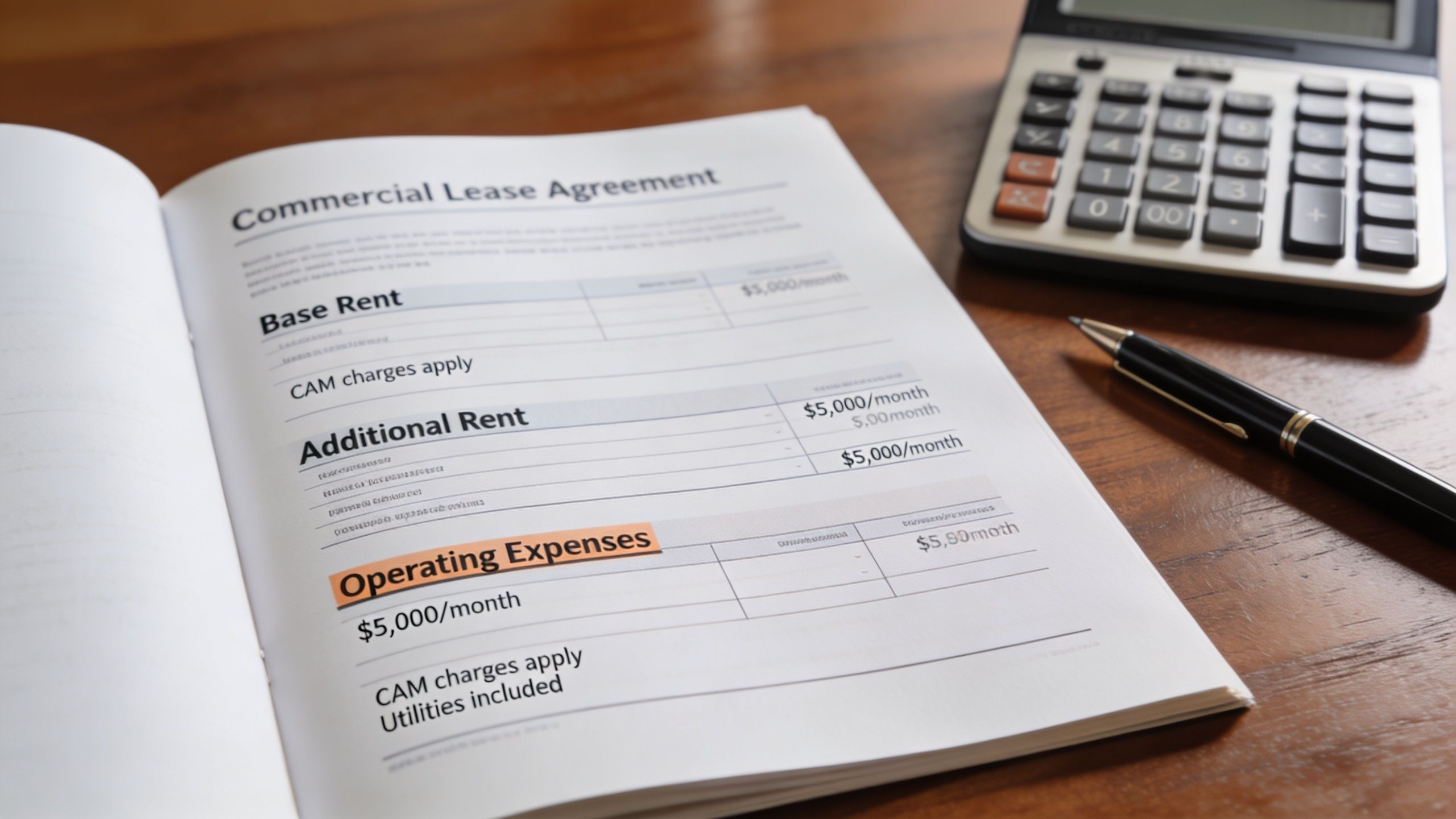
A first-time tenant in Texas often gets excited about one number: the quoted rent. Then the draft lease arrives, and the full monthly cost starts to spread across several sections. Base rent is only one part of the bill. The lease may also charge rent on rentable square footage instead of the space your business occupies, add annual increases, delay concessions until after opening conditions are met, and shift costs that never appeared in the broker flyer.
That is why I tell clients to stop asking only, “What is the rate?” Start with two harder questions: “What am I paying for?” and “What can this cost become by year three?”
Start with base rent and billed space
Base rent is the starting charge for the premises. In many office leases, and sometimes mixed-use projects, that rate is tied to rentable square feet rather than usable square feet. The difference matters because you are paying on a larger measurement than the area your staff or customers occupy.
Ask for the definition section and the floor plan at the same time. If the lease uses rentable square feet, ask for the load factor or add-on factor in writing. A small percentage spread can produce a meaningful increase over a multi-year term, especially once annual escalations apply to that inflated number.
For tenants who need a plain-English primer before they review the draft, this guide explaining what a triple net lease means for Texas tenants helps frame how square footage and pass-throughs work together.
Net effective rent is the only fair comparison
Face rent is the sticker price. Net effective rent is the actual economic deal after concessions are accounted for over the full term.
The formula is straightforward: total rent, minus concessions, divided by the lease term. Concessions usually include free rent, a tenant improvement allowance, or both. Those items can change the economics enough that the higher quoted rate becomes the cheaper deal.
A market analysis discussing Austin office concessions explains the same NER approach and notes that landlords in softer conditions may offer longer free-rent periods and larger TI packages, which can materially reduce the tenant’s effective occupancy cost (NER and concessions in projected Austin conditions).
One warning. Free rent is not always as generous as it sounds. Some leases postpone it until after you open for business, require you to be free of defaults, or apply it only to base rent while NNN charges and utilities continue. If the concession language is vague, ask for it to be rewritten.
Build a real occupancy cost sheet before you sign
A lease should be compared on total occupancy cost, not headline rent. That means putting every recurring and one-time economic term onto one page before you approve the letter of intent or final draft.
| Deal point | Space A | Space B |
|---|---|---|
| Base rent | stated in lease | stated in lease |
| Square footage used for billing | stated in lease | stated in lease |
| Annual rent increases | stated in lease | stated in lease |
| Free rent | stated in lease | stated in lease |
| TI allowance | stated in lease | stated in lease |
| Lease term | stated in lease | stated in lease |
| Operating expense structure | gross, modified gross, or NNN | gross, modified gross, or NNN |
| Net effective rent | calculate from actual concessions | calculate from actual concessions |
| Estimated first-year occupancy cost | calculate all recurring charges | calculate all recurring charges |
That sheet protects you from a common mistake. A lower asking rate with broad pass-throughs, weak concessions, and aggressive escalations can cost more than a higher rate with tighter expense language.
If you want an outside reference before you compare proposals, this article can help you compare triple net vs gross lease.
Red flags hidden in the economics section
These are the money terms I flag early in Texas leases:
- Undefined rentable square footage. If the lease states a billing number but does not explain how it was calculated, ask for the measurement method and the right to verify it.
- Free rent that excludes additional rent. In an NNN lease, “free rent” often means base rent only.
- TI allowance with landlord control and no deadline. Money that is hard to access has less value than the term sheet suggests.
- Automatic annual increases with no cap on expenses. Fixed bumps on rent plus uncapped pass-throughs can hit margins faster than expected.
- Commencement language tied to delivery, not usability. Rent should not start before the space is legally and practically ready for your build-out or operations.
- Vague “additional rent” wording. If the lease says other sums become additional rent, treat that as a warning sign and identify every category.
Questions and scripts that get useful answers
Use direct language. Landlords and brokers hear these questions every day.
- On square footage: “Please show me the usable square footage, the rentable square footage, and the load factor used to calculate rent.”
- On concessions: “Please confirm all free rent, TI allowance, and any conditions that must be met before those concessions apply.”
- On timing: “What date starts base rent, and what date starts NNN or other additional rent?”
- On escalations: “Do annual increases apply only to base rent, or do any management fees, admin fees, or other charges increase too?”
- On true cost: “Please give me the estimated first-year monthly occupancy cost, including rent and all recurring pass-throughs.”
A tenant who asks those questions early usually gets a cleaner draft and fewer surprises later. That is the goal. The financial section should tell you what the space costs in practice, not just what it costs in the marketing flyer.
Decoding NNN and Common Area Maintenance Costs
The lease type sets the tone for your financial risk. A gross lease usually means the rent includes most operating costs. A single net, double net, or triple net (NNN) lease shifts more of those costs to the tenant. In Texas retail and industrial leasing, NNN language is common, which is why you need to read the expense section as carefully as the rent section.
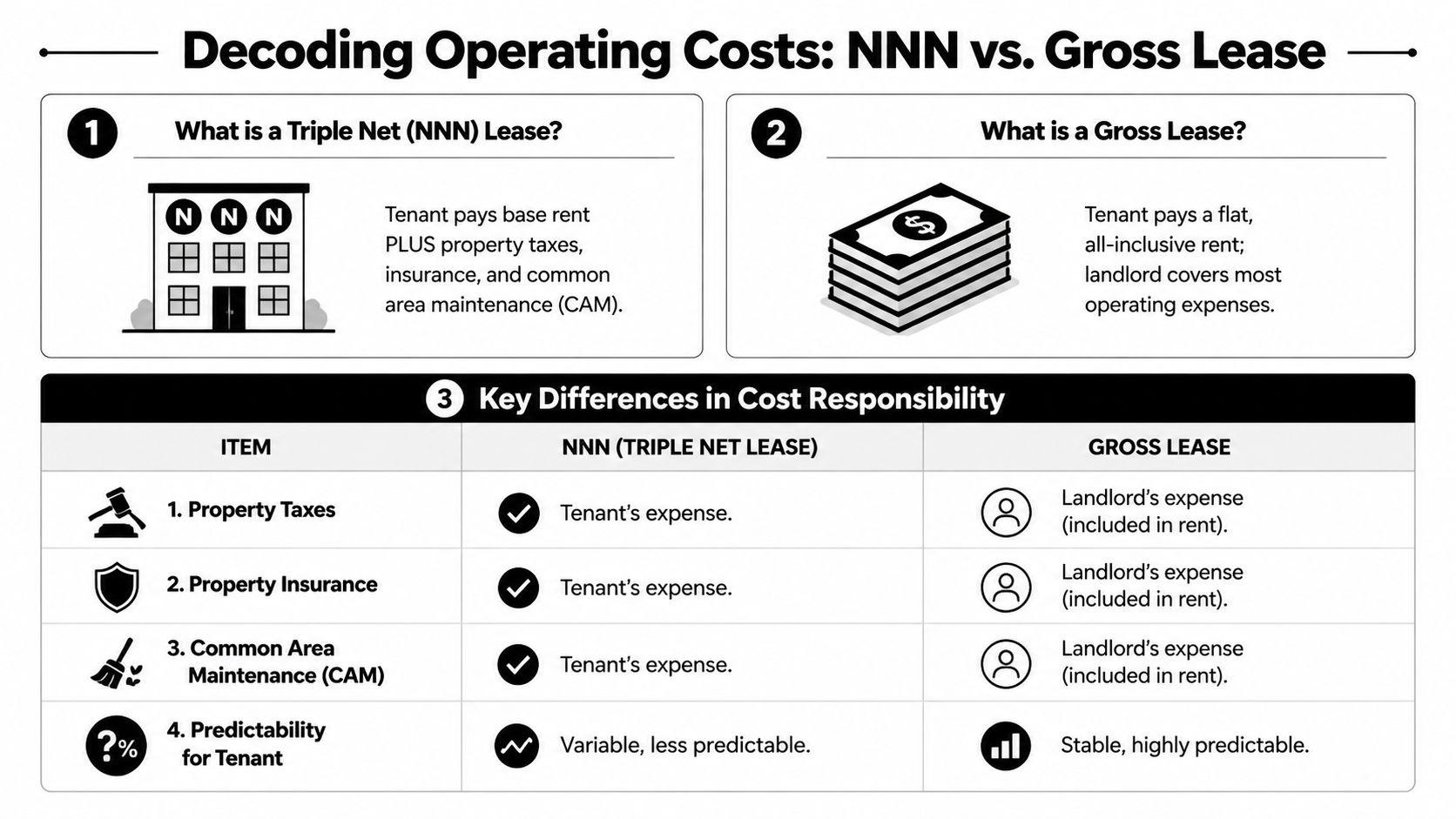
A Texas lease resource explains the cost difference clearly. In a 10,000-square-foot commercial space, a gross lease at $18 per square foot totals $180,000 annually. An NNN lease might show lower base rent at $14 per square foot, or $140,000 annually, but once you add $5 to $7 per square foot for taxes, insurance, and CAM, the total climbs to $190,000 to $210,000. That’s a potential 5% to 17% increase over the gross lease example, and operating expenses can make up 20% to 40% of annual occupancy costs (Texas lease types and occupancy cost examples).
If you want a plain-English outside comparison before reviewing a draft, this guide on how to compare triple net vs gross lease is a useful primer. For a Texas-specific overview, this explanation of what is a triple net lease helps put the terminology in context.
What CAM usually includes
CAM means Common Area Maintenance. In a shopping center or multi-tenant project, CAM often covers the shared spaces and shared services that keep the property functioning.
Typical CAM items often include:
- Parking area upkeep: striping, sweeping, lighting, and repairs
- Landscaping and exterior care: mowing, irrigation, and seasonal cleanup
- Security for common areas: patrols, cameras, gate systems, or guard service
- Shared utilities: lighting or water for common areas
- Management-related charges: if the lease allows them and defines them clearly
The problem isn’t that CAM exists. The problem is that many tenants treat it like a fixed line item when it is usually variable.
Red flags hidden in the expense clause
CAM language deserves a red-pen review. The lease should tell you what counts, what doesn’t, how your share is calculated, when you get billed, and whether you can verify the math.
Watch for these red flags:
- Vague definitions: If the lease says you pay “all operating expenses” without detail, the landlord has broad room to interpret.
- No cap on increases: Without a cap, your annual occupancy costs can rise in ways your budget didn’t anticipate.
- No exclusions: The lease should identify categories that shouldn’t be pushed to tenants.
- No reconciliation rights: You should be able to see year-end statements and challenge mistakes.
- No audit rights: If the landlord controls the books, you need a contractual right to inspect and verify charges.
Red flag: If CAM is described broadly but exclusions are missing, assume the landlord drafted it to preserve flexibility for the landlord, not predictability for you.
What to negotiate in a Texas NNN lease
Tenants often have more room than they think. Many landlord forms start broad. That doesn’t mean every clause is nonnegotiable.
Try asking for:
A detailed CAM definition
Ask the landlord to list included categories and define your proportionate share.Specific exclusions
Ask to exclude landlord overhead that doesn’t directly relate to common area operation, and costs that should stay with ownership rather than occupancy.An annual reconciliation process
The lease should say when estimates are trued up against actual costs.Audit rights
If the numbers look off, you need a path to inspect the backup.A controllable-expense cap
Even if the landlord won’t cap every category, they may cap some increases.
A practical script works better than a speech. Try this: “I understand this is an NNN deal, but I need the expense language narrowed so I can budget. Please add a detailed CAM definition, year-end reconciliation, audit rights, and a cap on controllable expenses.”
That request is ordinary. It’s not aggressive. It’s disciplined.
Defining Your Responsibilities and Protections
Once the money section is clear, look at the clauses that govern the physical condition of the space and your legal exposure if something goes wrong. Many first-time tenants assume the landlord handles major building issues and the tenant handles day-to-day interior upkeep. Sometimes that’s true. Sometimes the lease says something far broader.

A commercial lease guide reports that NNN leases are prevalent in 60% to 70% of U.S. commercial deals, and that vague operating expenses language leads to 25% of disputes. The same source states that 35% of tenants face surprise CAM pass-throughs exceeding 20% of base rent without caps, and that missing cure periods, often 5 to 30 days, can trigger eviction in 70% of cases when tenants fail to comply (commercial lease review pitfalls and dispute drivers).
Those numbers point to a simple truth. A commercial lease dispute often starts with unclear drafting, not dramatic misconduct.
Repairs are about risk allocation
Read the repair clause line by line. Don’t stop at the heading.
Look for who handles:
- Interior non-structural repairs
- HVAC maintenance and replacement
- Roof and foundation
- Plumbing and electrical serving only your space
- Glass, storefront, and doors
- ADA-related work after move-in
- Damage from casualty, flood, or other events
In many landlord drafts, the tenant gets broad responsibility for “all repairs to the premises,” which can be read more broadly than the tenant expects. If the space has older equipment, that matters a lot.
A fairer approach is usually to split duties clearly. The tenant handles interior upkeep and damage caused by its operations. The landlord keeps responsibility for the building structure and major shared systems, unless the tenant caused the problem.
Indemnity sounds technical but it is practical
An indemnity clause is a promise about who pays if someone makes a claim.
Take a common example. A customer slips on a freshly mopped floor inside your shop. If your employee created the hazard, it makes sense for your business and your insurance to respond. But many landlord forms go further. They try to make the tenant indemnify the landlord for claims tied to the property, even when the landlord or common area conditions contributed to the problem.
That’s why the better question isn’t “Is there an indemnity clause?” There almost always is. The key question is whether it is one-sided or mutual.
Ask for indemnity tied to fault or control. If the landlord controls the parking lot, roof, or common hallway, the landlord should stand behind claims arising from those areas.
A better way to read the insurance section
Insurance clauses should match the indemnity clause. If the lease makes you responsible for certain claims, the insurance section should tell you what coverage the landlord expects and whether that expectation is realistic for your business.
Use this checklist:
- Confirm who insures what: the building, your contents, your improvements, and liability claims
- Check whether policy requirements are specific: vague insurance language creates compliance problems later
- Review waiver and subrogation language: these provisions affect how insurers can pursue recovery
- Match notice requirements to your operations: if the lease requires certificates or renewals on short notice, make sure your broker can support that
For general reading on how legal duties in property law can evolve and why written compliance standards matter, this overview of Renters' Rights Act requirements is a useful comparison point, even though commercial leasing in Texas operates under a different framework.
Clauses worth revising before you sign
Some edits are especially valuable:
- Narrow broad repair language so you aren’t inadvertently taking on structural liability.
- Tie indemnity to fault, negligence, or control instead of accepting blanket responsibility.
- Clarify cure periods for nonmonetary defaults, because operational issues rarely get fixed overnight.
- Require written notice before the landlord can claim default.
- Define emergency entry rights so access is practical but not unlimited.
Commercial leases are often drafted to be landlord-favored. That’s normal. It is not a reason to ignore them.
Planning for Change Assignment Subletting and Default
Businesses change. Owners sell. Partners split. Headcount drops. A concept outgrows one location and needs another. A lease that works on opening day may not fit two years later. That’s why assignment, subletting, and default clauses deserve careful attention.

A lease process article reports that 95% of landlord-drafted templates create significant tenant risk. It also states that ignoring personal versus entity liability exposes 25% of small businesses to guarantor risk, ambiguous default definitions cause 40% of disputes, and attorney-involved reviews lead to 75% to 90% favorable term adjustments compared with 20% for tenants who represent themselves. The same source notes that 50% profit kickback clauses appear in 60% of drafts involving sublease consent rights (assignment, default, and review outcomes in commercial leases).
Assignment and subletting are not the same
An assignment usually transfers your lease to another party. A sublease usually means you remain on the hook while another occupant takes some or all of the space under you. That distinction matters because your exposure is different in each situation.
If you want a quick breakdown, this guide on lease vs sublease gives a practical overview.
Landlords often want broad control over both. They may require prior written consent, reserve the right to recapture the space, or demand a share of any profit from a transfer.
What works better than unrestricted landlord discretion
Try to avoid language that says the landlord may withhold consent “in its sole discretion.” That standard gives the tenant very little protection when business circumstances change.
A more balanced clause says consent cannot be unreasonably withheld, conditioned, or delayed. It should also carve out routine internal transfers, such as a transfer to an affiliate or a buyer of substantially all business assets, as long as the new party meets reasonable financial and operational standards.
Use a direct script: “I need assignment and subletting language that allows consent not to be unreasonably withheld, conditioned, or delayed, and I need an affiliate transfer carveout.”
That’s not unusual. It is business continuity planning.
Default clauses often reach beyond unpaid rent
Most tenants know that failing to pay rent is a default. Fewer realize that a lease can define default to include insurance lapses, unauthorized alterations, signage issues, missed reporting obligations, failure to maintain the space, or missing a notice deadline tied to an option or cure right.
Read these provisions carefully:
- Events of default: what triggers one
- Notice and cure periods: how much time you get to fix the problem
- Landlord remedies: lockout rights, termination, acceleration, fees, and possession remedies
- Cross-defaults: whether one breach under a related document triggers default here too
If the default clause is broad and the cure rights are narrow, the lease gives the landlord leverage long before the relationship truly breaks down.
Personal guarantees need special attention
If the tenant named in the lease is your company, that does not automatically protect you. Many commercial landlords require a personal guaranty, especially for newer businesses. That means your personal assets may be exposed if the business fails and the lease debt remains.
Before signing a guaranty, ask:
- Is the guaranty limited or unlimited?
- Does it burn off after a period of compliant payment?
- Does it end if the lease is assigned to an approved replacement tenant?
- Is it tied only to rent, or to every lease obligation?
The strongest negotiating position is before the lease is signed. After default, those terms are much harder to change.
Your Exit Strategy Termination Renewals and Exhibits
A tenant can run the business well, pay on time, and still lose money at the end of a lease. It happens when the renewal window is missed, the holdover rate spikes, or a bad exhibit changes what the tenant believed was agreed.
This part of the lease deserves the same attention as rent. In Texas, I often see the last pages create the most expensive surprises.
Renewal options help only if the option is usable
A renewal option has value only if the notice deadline, rent formula, and conditions are clear. If the lease says you must give notice 9 or 12 months before expiration, put that date on the calendar the day the lease is signed, not in the final year. Landlords rarely remind tenants that an option window is closing.
Read the renewal clause with these questions in mind:
- What is the exact notice window?
- How must notice be sent?
- Does any default, even a small one, cancel the option?
- Is renewal rent fixed, tied to fair market rent, or reset by a formula?
- Do tenant improvement rights, free rent, or refurbishment allowances disappear on renewal?
The money issue is easy to miss. A renewal at "market rent" may sound fair, but the real question is whether the lease gives a clean process to resolve a rent dispute. If the clause lets the landlord name the market rent with no meaningful check, the option is weak.
A practical tenant script is: "We want the renewal option to remain valid unless there is an uncured material default, and we want a clear fair-market-rent process with each side selecting a broker if we disagree."
Early termination rights are negotiated, not assumed
Many business owners ask whether they can end the lease if sales disappoint, the concept changes, or the location stops working. Usually they cannot unless the lease gives that right in writing.
Texas commercial leases are contract driven. If flexibility matters, ask for it before signing. The strongest termination rights are usually tied to a specific event, such as failure to deliver the space on time, major casualty, condemnation, co-tenancy failure in retail, or a one-time business termination right with a fee.
Trade-offs are real here. A landlord may agree to a termination option, but only with advance notice, repayment of concessions, and a termination fee. That can still be a good deal if the alternative is carrying dead rent for years.
Red flags:
- Termination is mentioned in the letter of intent but never appears in the lease
- The fee is undefined or left to future agreement
- The clause requires landlord consent at the time you try to terminate
- You must be free of any default, including minor paperwork defaults, to use the right
If you want a second set of eyes on these provisions, a Texas commercial lease attorney near you can usually spot whether the exit language is real or mostly cosmetic.
Holdover can become a hidden penalty
Holdover clauses are often treated as boilerplate. They are not. If the business stays in the space after expiration, even briefly, the rent often jumps hard and other risks follow.
Check three items closely:
- The holdover rent multiplier
- Whether the tenancy becomes month-to-month or only a temporary occupancy
- Whether you owe the landlord's damages if a replacement tenant cannot move in
The last point matters more than many tenants expect. If the landlord has already signed the next tenant and your move-out delay causes that deal to slip, the lease may try to pass those losses to you. That exposure can exceed the extra rent.
A useful revision request is: "Cap holdover rent at a reasonable increase, make holdover month-to-month unless either party ends it, and delete consequential or speculative damages tied to a future tenant."
Exhibits often hide the money terms
I tell clients to read the exhibits line by line. The main body may look acceptable while an exhibit changes the economics.
The back of the lease often controls:
- The exact square footage or floor plan
- The work letter and who pays for overruns
- The delivery condition of the space
- Sign criteria, parking rights, and operating rules
- The guaranty form
- The commencement date memorandum
- Any CAM, NNN, or operating-cost exclusions tucked into an addendum
This matters in Texas NNN leases because a vague exhibit can reopen cost exposure you thought was settled. For example, the lease may say CAM excludes capital repairs except as required by law or for cost savings, then an exhibit broadens that language or removes a cap. The same problem shows up in HVAC responsibility, roof penetrations, and after-hours HVAC charges.
Use a simple final checklist before signing:
- Do the exhibits match the business terms you negotiated?
- Do the notice addresses and deadlines match across the documents?
- Does the work letter clearly state who pays if bids exceed the allowance?
- Do any addenda change renewal, termination, CAM, or guaranty terms?
- Is every promised right written into the lease package?
Software can help organize version comparisons and flag changes across exhibits. For teams trying to streamline legal work with AI, that can save time. It does not replace reading the business points against the final lease set.
One missed exhibit can undo a good deal.
Protect Your Business with an Expert Lease Review
A commercial lease usually looks straightforward until you trace how the clauses interact. Base rent may look acceptable, but uncontrolled CAM can change the true cost. Assignment language may seem routine, but weak transfer rights can trap you if the business changes. A guaranty may be buried in an exhibit, yet it can expose you personally long after the location stops working.
That’s why learning how to read a commercial lease agreement means more than spotting legal jargon. You’re reading for hidden financial exposure, operational control, and future flexibility.
The three issues that deserve the closest attention are often the ones tenants rush past:
- Uncontrolled CAM and NNN charges that turn a lower asking rent into a more expensive deal
- Weak assignment and subletting rights that limit your options if you sell, downsize, or restructure
- Personal guarantees that can blur the line between business liability and personal risk
Technology can help organize lease review and document comparison. For businesses interested in process improvements, this article on how firms streamline legal work with AI offers a useful overview. But software doesn’t replace judgment on what a clause means under Texas practice or what revisions are worth pushing for.
If you’re reviewing a lease now, getting legal guidance before signing is usually far cheaper than trying to unwind a bad clause later. A focused review can flag what is market, what is one-sided, and what is likely to become a dispute. If you need help evaluating terms, comparing proposals, or negotiating revisions, these commercial lease lawyers near me resources can help you find the right next step.
If you need help with a commercial lease, tenant rights issue, landlord dispute, or eviction-related matter, contact The Law Office of Bryan Fagan, PLLC for a free consultation today. The firm helps Texas business owners, landlords, and tenants review leases, negotiate better terms, and protect their rights under Texas law with clear, practical guidance.