A rental dispute can start with something ordinary. A text about late rent. A request for repairs. A disagreement about entry for an inspection.
Then the pattern changes. The landlord keeps showing up. The tenant keeps circling the property. Messages turn threatening. Someone starts monitoring when the other person comes and goes. At that point, you may not be dealing with a normal property conflict anymore.
That’s where stalking laws in texas matter. They can apply inside landlord-tenant disputes when repeated conduct creates real fear, not just frustration. For tenants, that can mean protection from illegal entry, surveillance, and intimidation. For landlords, it can mean legal options when a tenant or former tenant starts targeting you, your staff, or your property.
Texas law gives people tools to respond, but timing and documentation matter. If you wait too long, delete messages, or treat repeated incidents as separate annoyances, you can make a serious case harder to prove. If you act early and keep clear records, you put yourself in a much better position to seek protection and enforce your rights.
When Harassment Crosses the Line in Your Rental Property
Your home should feel predictable. So should a rental relationship.
When one side starts using repeated contact, surprise visits, threats, or surveillance to control the other, the issue stops being only about lease enforcement or tenant rights. It becomes a safety issue.
A landlord might think repeated “check-ins” are just management. A tenant might think repeated visits to the leasing office are just persistence. But Texas criminal law looks at the pattern, the effect on the other person, and whether a reasonable person would feel threatened or intimidated.
That’s why it helps to separate three things:
- A routine dispute: disagreements about repairs, rent, or notices.
- Harassment: conduct that’s improper and disruptive, but may not yet meet the felony threshold.
- Stalking: repeated conduct that creates fear for safety, property, or serious emotional well-being.
If you’re already dealing with repeated unwanted contact in a rental setting, this overview of harassment in Texas can help you understand where civil problems may overlap with criminal ones.
Common rental situations that deserve attention
Some patterns come up often in practice:
- Repeated unannounced entries: A landlord uses keys or access codes without a valid reason and keeps appearing after being told to stop.
- Escalating communications: A tenant sends constant texts, emails, or voicemails that shift from complaints to threats.
- Monitoring behavior: One party watches the property, tracks arrivals, or uses cameras in a way that feels targeted rather than legitimate.
- Showing up outside normal channels: Contact moves from lease-related communication to home visits, workplace visits, or repeated drive-bys.
Practical rule: If the conduct keeps happening, serves no legitimate purpose in the way it’s being done, and leaves you altering your routine because you feel unsafe, treat it seriously early.
Fear is often what finally pushes people to ask for help. By then, the conduct has usually been going on for a while. The better approach is to start preserving evidence the moment the behavior becomes repeated and unwelcome.
What Legally Constitutes Stalking in Texas
Texas law doesn’t treat every unpleasant encounter as stalking. The statute requires more than one bad interaction.
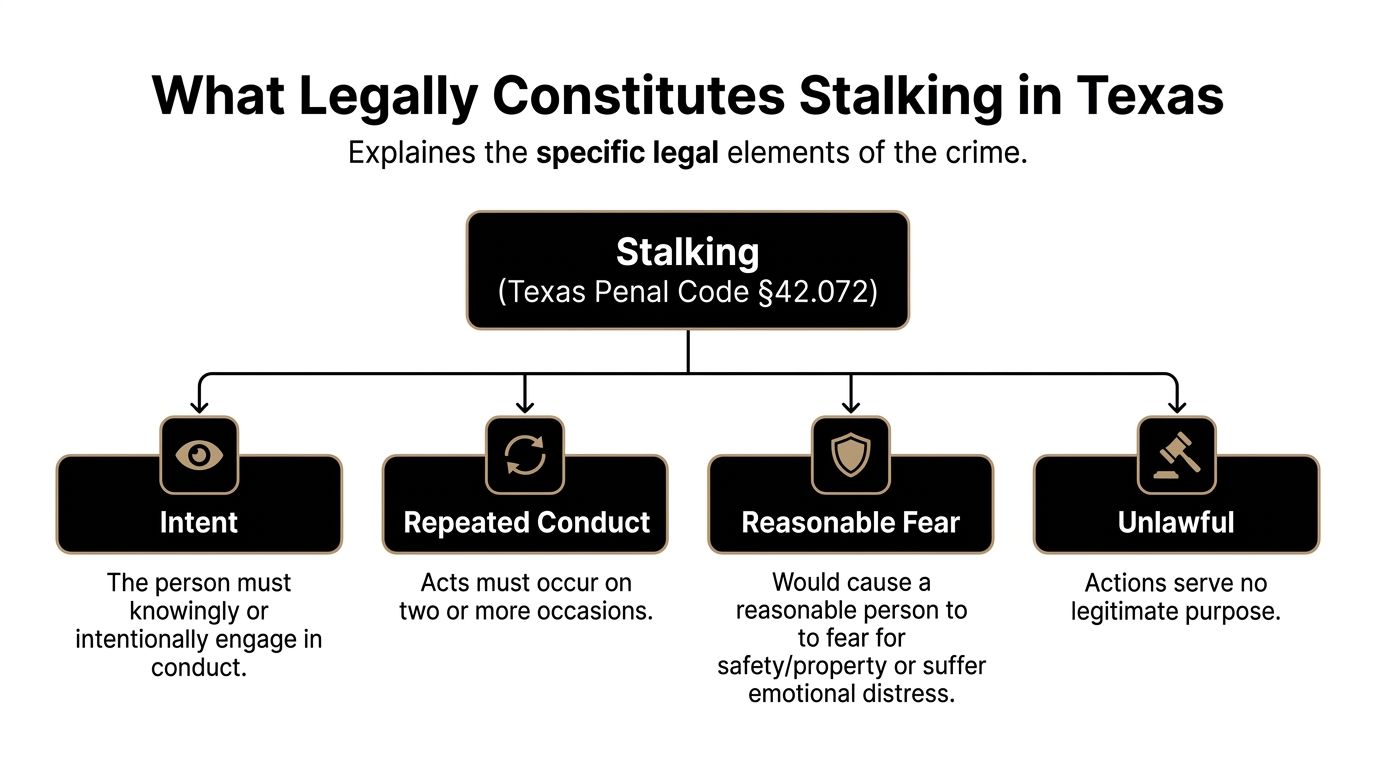
Under Texas Penal Code §42.072, stalking is a third-degree felony that requires prosecutors to prove a pattern of conduct, specifically two or more acts, that the person knowingly engages in and that would cause a reasonable person to fear bodily injury, death, or property damage, or to feel harassed, alarmed, or intimidated.
The four ideas that matter most
Think of stalking as a repeated course of conduct, not a single explosion of anger.
There must be repeated conduct
One ugly text usually isn’t enough. Two or more acts tied to the same person can be.The conduct must be knowing
The law focuses on whether the person knew, or reasonably should have known, the conduct would be taken as threatening or intimidating.The fear must be objectively reasonable
Texas doesn’t rely only on a person’s subjective reaction. The question is whether a reasonable person in the same situation would also feel fear, alarm, or intimidation.The conduct must be serious enough
The behavior must rise above ordinary conflict. Repeated unwanted appearances, threatening messages, surveillance, and conduct aimed at property can all matter.
Why the pattern requirement is so important
A useful way to think about it is this. A single rainstorm is a storm. A series of storms that keep returning and force you to change how you live is something else.
That’s how prosecutors and judges often view stalking claims. They look for a connected pattern. A text, then an uninvited appearance, then surveillance, then another threat is far more powerful evidence than one isolated argument.
The strongest stalking cases usually show repetition, escalation, and documentation. Without all three, cases become harder to prove.
Harassment vs. stalking in Texas at a glance
| Legal Element | Harassment (Misdemeanor) | Stalking (Felony) |
|---|---|---|
| Number of acts | May involve individual unlawful communications or conduct | Requires a pattern, meaning two or more acts |
| Targeted conduct | Often offensive, abusive, or repeated contact | Conduct directed at a specific person as part of the same course of conduct |
| Effect on victim | Annoyance, alarm, or disturbance may be enough for some charges | Must cause reasonable fear of harm, property damage, or serious intimidation/alarm |
| Severity | Generally handled as a lower-level criminal offense | Charged as a felony under Texas law |
Rental examples that may meet the definition
In a landlord-tenant setting, these situations raise concern:
- A landlord appears at the unit repeatedly after being told to stop, then sends messages implying the tenant will regret complaining.
- A tenant keeps returning to the property after move-out, waits outside, and leaves threatening notes for the manager.
- An ex-tenant contacts the landlord’s family, damages property, and sends warnings about “what comes next.”
By contrast, a single notice to vacate, a lawful repair visit, or a one-time heated lease dispute usually won’t qualify by itself.
The difference is repetition plus fear. That’s the center of stalking laws in texas.
Understanding the Severe Penalties for a Stalking Conviction
Texas treats stalking as a felony because repeated threatening conduct can escalate quickly.
A first-time stalking offense in Texas is a third-degree felony, punishable by 2 to 10 years in prison and fines up to $10,000, and repeat offenses become a second-degree felony with 2 to 20 years according to this summary of Texas stalking penalties.
Why the stakes are so high
These penalties tell you how seriously the state views stalking. This isn’t treated like ordinary bad behavior between two people who need to calm down.
For victims, that seriousness matters because it opens the door to stronger police response, protective orders, and felony prosecution. For anyone accused, it means the case can change your life even before trial through bond conditions, no-contact orders, and restrictions on where you can go.
The cost goes beyond prison
A felony stalking conviction can also create long-term problems that continue after a sentence ends. Depending on the facts of the case and any related orders, people may face:
- Housing trouble: landlords often screen for felony histories.
- Employment barriers: many employers hesitate to hire applicants with violent or threatening offense histories.
- Licensing issues: some professional paths become harder to enter or keep.
- Education consequences: federal student aid problems may follow certain convictions.
- Custody and family law effects: protective orders and criminal findings can affect parenting disputes.
That matters in landlord-tenant cases more than people expect. A property manager accused of stalking a tenant may face business and licensing fallout. A tenant convicted of stalking a landlord may find future housing much harder to secure.
What works and what doesn’t
What doesn’t work is assuming the case is “just personal drama” because no one was physically hurt. Texas law does not require physical injury before stalking becomes a felony issue.
What works is treating repeated threatening conduct as legally significant early. That means preserving evidence, avoiding retaliatory contact, and getting legal advice before the situation spirals into arrest, eviction, or both.
A stalking allegation can split into two cases at once. One criminal, one property-related. If you only focus on the lease and ignore the safety issue, you can lose control of both.
The Critical Link Between Stalking and Landlord-Tenant Rights
Rental housing creates repeated contact by design. Landlords need access for some purposes. Tenants need ways to report repairs, defend against wrongful charges, and communicate about the property.
That regular contact is exactly why boundary violations in housing can become so dangerous. Conduct that might look minor in isolation can feel coercive when it comes from someone who controls the locks, the notices, the cameras, or access to the building.
When a landlord’s conduct may become stalking
Persistent landlord harassment, including repeated illegal entries or surveillance, can qualify as stalking under Penal Code §42.072, and Texas law recognizes that as a valid basis for a tenant to break a lease early without financial repercussions, as explained in this guide on stalking-related tenant protections.
That principle matters because many tenants assume they must keep paying rent no matter what. That isn’t always true when personal safety is at risk.
Examples that deserve immediate legal review include:
- Repeated illegal entry: the landlord enters without proper reason and keeps doing it after written objections.
- Surveillance aimed at control: cameras, smart locks, or monitoring tools are used to track a tenant rather than secure the property.
- Threat-based communication: repeated messages tie housing access to intimidation instead of lawful notice procedures.
- Unwanted in-person appearances: the landlord begins showing up at the unit, workplace, or other locations unrelated to legitimate property management.
Tenants dealing with repeated privacy violations should also understand broader Texas Property Code tenant rights because illegal entry, retaliation, and stalking often overlap.
What the Texas Property Code means in real life
The Texas Property Code governs many parts of the rental relationship, including rights tied to possession, privacy, repairs, lockouts, and move-out issues. It does not give either side permission to use the lease relationship as a tool for intimidation.
For tenants, the practical point is simple. A lease does not cancel your right to personal safety.
For landlords, the point is just as important. Owning the property does not create unlimited authority to enter, monitor, or pressure a tenant. Lease enforcement has to follow lawful channels.
When a tenant or former tenant crosses the line
Landlords and property managers can also be targets.
A tenant may repeatedly file false complaints as a pretext for contact, wait outside the office, show up at an employee’s home, or send escalating threats after receiving a notice to vacate. A former tenant may continue to appear on the property or target staff after move-out.
Those cases often raise two tracks at once:
- Property track: notice, lease enforcement, removal from the property, and possible eviction if possession is still involved.
- Safety track: police reports, criminal complaints, and a possible protective order.
Trying to solve a stalking problem with lease notices alone usually doesn’t work. A notice to vacate may address possession. It does not stop a determined person from continuing unwanted contact.
Trade-offs people often miss
Tenants sometimes stay silent because they fear retaliation or think no one will believe them. Landlords sometimes avoid reporting because they worry it will complicate an eviction case.
Both instincts can backfire.
If you underreact, the conduct often escalates. If you overreact without evidence, your claim may look weaker than it is. The most effective response is usually a disciplined one: document, report, preserve records, and separate legitimate lease issues from repeated threatening conduct.
How to Get a Stalking Protective Order in Texas
A protective order is one of the most effective legal tools available when stalking has become a real threat.
It’s not just a warning on paper. It’s a court order that can require the other person to stay away, stop contacting you, and avoid your home, workplace, or other protected places.

A Texas Department of Criminal Justice resource states that protective orders are up to 80% effective in curbing violence and stalking once issued in its discussion of stalker supervision and protective-order effectiveness.
What a protective order can do
In practical terms, a stalking protective order can be used to:
- Block contact: texts, calls, emails, messages through other people, and physical approach.
- Protect places: your home, job, school, or other locations named by the court.
- Create enforceable consequences: if the person violates the order, police can act.
That last point matters. Many people confuse a protective order with an informal agreement or a civil demand letter. A protective order carries criminal enforcement power.
If someone ignores your request to stop, a judge’s order changes the situation. It turns future contact into a clearer enforcement issue, not just another argument about boundaries.
The basic process
Most cases follow a sequence like this:
Gather evidence of the pattern
Save messages, photos, call logs, camera footage, witness names, and prior police report numbers.File an application
You can often apply through the district attorney, legal aid, or private counsel. The Law Office of Bryan Fagan, PLLC handles protective-order matters as one available legal option for Texans dealing with stalking in rental and personal settings.Ask about immediate relief
In urgent cases, a court may consider temporary protection before the full hearing.Attend the hearing
The judge reviews your evidence and the respondent’s response, if any.Enforce the order if it’s violated
Once the order is entered, keep a copy and report every violation.
Here’s a short overview that may help if you’re trying to understand the process before speaking with counsel.
What works best at the hearing stage
Judges want specifics.
Bring organized records. Put incidents in date order. Match screenshots to a written timeline. If the stalking happened at a rental property, include lease documents, notices, access logs, maintenance records, or camera footage that help explain why the contact was not legitimate property management or not legitimate tenant communication.
The biggest mistake is showing up with a general statement like “this person keeps bothering me” and no clear chronology. The stronger approach is to show repeated acts, how they connect, and why they created reasonable fear.
A Practical Guide to Documenting and Reporting Stalking
Stalking cases often succeed or fail on documentation.
That’s especially true in rental disputes, where the other side may claim every contact had a legitimate reason. A landlord may say the visit was about maintenance. A tenant may say the messages were only about deposit money. Your records help separate lawful communication from a threatening pattern.
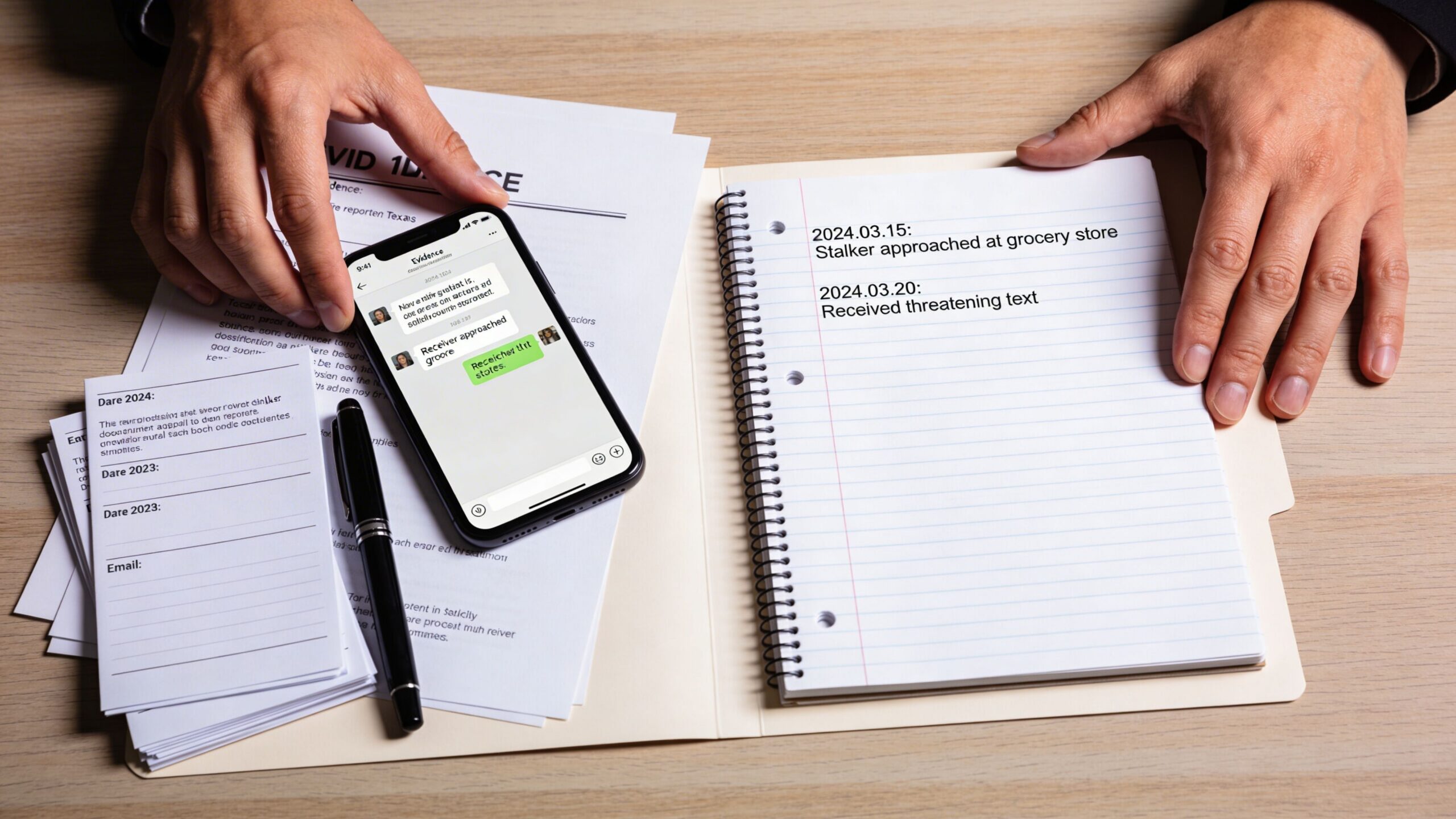
A discussion of Texas stalking prosecutions notes that in jurisdictions like Harris County, many stalking charges are reduced or dismissed when there isn’t enough proof of a pattern, which is why detailed evidence such as timestamps, surveillance footage, and witness statements matters so much in documenting a stalking case.
Build one timeline, not a pile of screenshots
Start a single incident log. Use a notebook, spreadsheet, or notes app, but keep it consistent.
Include:
- Date and time: exact if possible.
- What happened: keep it factual and short.
- Where it happened: unit door, parking lot, office, text, email, social media.
- Who saw it: neighbors, staff, delivery drivers, maintenance workers.
- What you saved: screenshot, voicemail, photo, video, police report number.
Don’t edit entries later unless you clearly mark the update. Clean, chronological notes are more persuasive than reconstructed memories.
Save digital evidence the right way
Keep original messages if you can. Don’t rely only on copied text in your notes.
Useful records include:
- Texts and emails
- Voicemails
- Doorbell or hallway video
- Smart-lock logs or access records
- Social media messages or posts
- Photos of notes, gifts, damage, or vehicles
If contact is happening online, you may also need to identify accounts connected to the person involved. In some cases, a practical starting point is learning how to find a person on social media so you can preserve the right profiles, usernames, and message sources before content disappears.
Save first, block second. If you block too early without preserving evidence, you may lose part of the pattern you need to prove.
Report each incident even if the first report goes nowhere
A single police report may not produce immediate action. That doesn’t make it useless.
Multiple reports show repetition. They also help establish that you took the conduct seriously when it happened, instead of only after the conflict got worse.
Try this sequence:
- Call law enforcement during urgent incidents: especially if the person is outside your home, making threats, or refusing to leave.
- Make non-emergency reports for documented contact: preserve the report number.
- Notify property management or ownership in writing: if the stalking affects the rental premises.
- Tell trusted witnesses what’s happening: they may later confirm your timeline.
Avoid mistakes that weaken good cases
Some reactions are understandable but costly.
- Don’t retaliate: angry replies can muddy the record.
- Don’t delete messages: even upsetting messages may become key evidence.
- Don’t rely on memory alone: details fade fast.
- Don’t compress incidents into a summary: list each event separately so the pattern is visible.
What works is discipline. Calm notes. Preserved files. Prompt reports. In stalking cases, that combination often makes the difference between a claim that sounds serious and one that can be proven.
Taking Control When You Need Legal Help
Some cases can be handled with a firm written boundary and better documentation. Others can’t.
You should stop trying to manage the situation alone when the conduct is escalating, when threats become direct or implied, when there’s physical following or unwanted entry, or when you need legal action tied to housing. That includes early lease termination, a protective order, eviction strategy, or defense against false allegations.
Signs it’s time to call a lawyer
Watch for these trigger points:
- The conduct is repeated and growing more aggressive
- Police reports exist, but contact continues
- The person appears at your home, unit, office, or job
- You’re afraid to stay in the property or to return to it
- The dispute now affects your lease, possession, or safety plan
In landlord-tenant cases, legal advice matters because the problem often moves on two tracks at once. You may need to protect your safety while also preserving your position under the lease and the Texas Property Code.
If you’re looking for help from a Texas rental lawyer, make sure the conversation covers both. Criminal exposure alone isn’t the whole story. Neither is the lease alone.
The strongest legal responses are usually the most organized ones. Keep your records together. Stop informal side arguments. Use one communication channel if communication is still necessary. Get advice before taking steps that could affect possession, notices, move-out obligations, or court filings.
Frequently Asked Questions About Texas Stalking Laws
What’s the difference between harassment and stalking in Texas
Harassment is generally a lower-level criminal issue involving unlawful or abusive contact. Stalking is more serious because it involves a repeated pattern of conduct that creates reasonable fear, alarm, or intimidation. In short, stalking usually requires connected acts, not one isolated incident.
Can a tenant break a lease if the landlord is stalking them
Yes, in some situations. When repeated illegal entry, surveillance, or similar conduct rises to stalking, Texas law may allow a tenant to end the lease early without financial penalties. The facts matter, so it’s important to document the conduct and get legal advice before moving out.
Can a landlord evict a tenant for stalking
A landlord may have grounds to pursue eviction if a tenant’s conduct violates the lease, threatens others, or interferes with safety at the property. But eviction may not be enough by itself. In serious cases, landlords should also consider police reports and protective-order options.
Do you need a family or dating relationship to get a stalking protective order
No. A stalking protective order does not require a family or romantic relationship. That’s important in rental settings, where the conflict may be between a landlord and tenant, property manager and resident, or owner and former occupant.
If you need help with an eviction, lease issue, or rental dispute, contact The Law Office of Bryan Fagan, PLLC for a free consultation today. If harassment at a rental property has crossed into stalking, timely legal action can protect your safety, your housing rights, and your next steps.