Getting served with a notice to vacate or an eviction petition can put your whole week into survival mode. A key question that arises quickly is: what works in Texas eviction court.
The short answer is this. In Justice Court, the defenses that hold up best are usually the ones you can prove with paper, dates, and procedure. Judges often have limited time, the hearings move quickly, and broad fairness arguments usually don't carry the day unless they connect to a real legal defense. For effective eviction court defenses Texas what works, concentrate on notice problems, filing mistakes, proof of payment, and any defense the law clearly recognizes under the Texas Property Code.
That doesn't mean tenants have no rights. They do. It means you need to present the right rights, the right way. For landlords, the same lesson applies in reverse. A case that looks simple can fall apart if notice, filing, or evidence is sloppy. A good Texas landlord tenant lawyer or eviction attorney usually wins these cases by mastering details, not drama.
Understanding the Texas Eviction Process
A tenant gets a notice to vacate on Friday, works all weekend, and plans to deal with it next week. By the time that tenant focuses on the papers, the case may already be close to a hearing. That is how Texas eviction cases catch people flat-footed.
Texas evictions are usually filed as forcible detainer cases in Justice Court. The court is deciding possession of the property, not every complaint either side has about the tenancy. That narrow focus matters in practice. A defense can be legally valid in a broader landlord-tenant dispute and still do very little for you in a fast Justice Court hearing if it does not affect possession, notice, payment, or the landlord's right to file.
What the case is really about
In most eviction hearings, the judge is looking at a short list of questions. Was the required notice given? Did the lease end or was it violated? Was rent unpaid? Does the landlord have the present right to possession?
That is why tenants often lose with facts that feel important to daily life but do not answer the court's main question. Bad communication, repair problems, disrespect, and financial strain may explain how the case got here. They usually do not win the possession fight unless they tie into a recognized defense with proof.
Practical rule: In Texas Justice Court, the defenses that work best are the ones you can prove quickly with documents, dates, receipts, lease terms, and clear testimony.
Why timing changes what works
Justice Court moves fast, and speed changes strategy. A defense that could be developed over months in district court may never get traction in an eviction docket where the judge has limited time and many cases to hear.
Here is the process in plain English:
| Stage | What it means for you |
|---|---|
| Notice to vacate | The landlord starts by demanding possession and giving the tenant a deadline to leave. |
| Eviction filing | If the tenant stays, the landlord files a forcible detainer case in Justice Court. |
| Hearing | The judge hears both sides, usually in a short setting focused on possession. |
| Appeal window | If the tenant loses, the deadline to appeal is short, which leaves little room for delay or disorganization. |
That short timeline creates a real trade-off. Some tenants want to spend their energy explaining the full history of the tenancy. Sometimes that background helps. More often, the better use of time is gathering the lease, payment records, texts, photos, notices, and anything showing the landlord missed a required step. If extra time is part of the goal, it helps to understand legal ways to delay an eviction in Texas before the hearing date is on top of you.
Landlords face the same pressure from the other side. Cases that look simple on paper can fail because the notice was defective, the records are incomplete, or the witness cannot clearly explain the right to possession. In this court, details usually decide the outcome faster than broad arguments do.
Your First Line of Defense Procedural Errors
The hearing is in two days. The tenant wants to explain the whole history with the property manager, the repairs that never got done, and why the missed rent happened. I understand that instinct. In Texas Justice Court, though, one of the first questions should be simpler. Did the landlord complete the eviction steps the way Texas law requires?
That is not a technicality in the casual sense. It is often the fastest real defense available in a possession case. A bad notice, a filing in the wrong precinct, or weak proof of delivery can be enough to stop the landlord from getting judgment that day. Sometimes the landlord just refiles and fixes it. That is the trade-off. Procedural defenses often buy time or force a reset. They do not always end the dispute for good.
What to inspect before the hearing
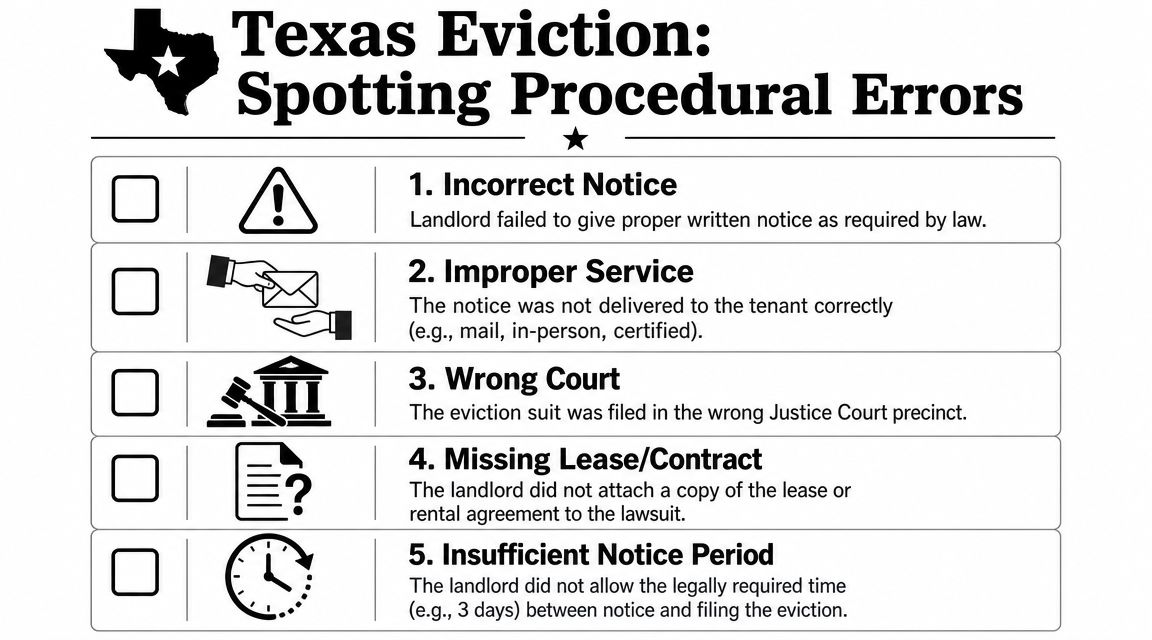
Start with the notice to vacate, then compare it to the petition and the lease. The goal is to see whether the papers line up and whether the timeline makes sense.
Check these points closely:
- Notice timing. Did the landlord wait the required period after the notice to vacate before filing?
- Notice delivery. Was the notice delivered in a method Texas law allows or the lease specifically permits?
- Court location. Was the case filed in the correct Justice Court precinct for the property?
- Names and capacity. Is the plaintiff the right party, and are the tenant names and unit details correct?
- Stated reason for eviction. Does the petition match the actual theory being alleged, such as nonpayment, holdover, or another claimed breach?
- Proof witness. Is the person appearing for the landlord able to testify from records and explain the file clearly?
Those details matter because Justice Courts move fast. Judges usually do not have time to sort out a sloppy file for the landlord. If the paperwork is unclear, inconsistent, or unsupported, that can matter more than a long speech about fairness.
What usually works, and what usually does not
The strongest procedural arguments are concrete and easy to verify. A defective notice works better than a general claim that the landlord acted unfairly. A mismatch between the lease, notice, and petition works better than a broad complaint about management. Clear date problems work better than emotional context standing alone.
Three procedural defenses come up often:
The notice was defective
The notice may give the wrong deadline, omit required information, or use a delivery method the lease and statute do not support.The case was filed or pleaded incorrectly
Wrong precinct, wrong party, or a petition that does not match the tenancy can create a real opening.The landlord cannot prove compliance
Some landlords have the right story but not the records or witness needed to prove notice, default, or possession.
I tell tenants to review the file like a bookkeeper, not a historian. Dates, addresses, signatures, delivery method, lease clauses, and ledger entries win more procedural fights than outrage does.
One caution matters. Some defenses sound important but do not usually decide possession in this setting. For example, disputes over accommodation requests or pet rules can matter in the right case, but they need facts, timing, and proof tied to the eviction claim itself. General online reading, including a landlord's guide to service animals, may help frame the issue, but it does not replace a close review of the notice, lease, and court papers in your case.
If the immediate goal is more time to prepare or relocate, review these legal ways to delay an eviction in Texas alongside your procedural defense checklist.
Arguing the Merits Substantive Defenses in Texas
The hearing starts, the landlord has the lease, the notice, and a witness. At that point, procedural mistakes may be off the table. The fight becomes whether the landlord has the right to possession under the facts the judge can confirm in a short Justice Court setting.
That is where tenants often lose traction. A defense can be legally available and still fail in practice because it is too broad, poorly documented, or disconnected from the reason stated in the eviction petition.
When a substantive defense can work
A substantive defense argues that the landlord should not win possession even if the filing steps look proper. In Texas eviction court, the defenses that get attention usually fall into a few categories: the alleged lease violation did not happen, the landlord accepted conduct that waived strict enforcement, the eviction is retaliatory, or the stated reason for eviction is covering a different unlawful motive.
The hard part is fit. The defense has to match the claim in the case.
If the landlord sued for nonpayment, a long explanation about bad conditions usually will not carry the day by itself. If the landlord sued for a lease violation, a tenant needs proof that the violation did not occur, was cured, or was enforced selectively in a way the law recognizes. If the issue involves disability-related requests, timing and records matter, and a general background piece like this landlord's guide to service animals can help frame the accommodation issue, but the judge still needs Texas-specific facts tied to the eviction.
What judges usually need to see
Justice Courts move fast. Judges are listening for a short, organized explanation supported by documents they can review quickly.
This basic comparison helps:
| Defense type | What it argues |
|---|---|
| Procedural | The landlord did not follow the legal steps correctly |
| Substantive | The landlord is not entitled to possession on these facts |
Substantive defenses usually require more than a tenant's testimony that something felt unfair. They work better when the tenant can show a timeline, written notices, text messages, photos, inspection reports, or other records that connect the legal theory to the eviction reason.
A waiver defense is a good example. If a landlord repeatedly accepted late rent without enforcing the lease term, that history may matter. But it is stronger when the tenant can show repeated acceptance, communications about it, and no clear warning that strict enforcement had resumed. A retaliation defense can also work, especially where repair complaints or code reports happened shortly before the eviction, but the sequence and documents have to be tight.
Tenants dealing with nonpayment issues should also review whether paying rent can stop an eviction in Texas, because the answer depends on timing, the lease, and what the landlord accepted.
Where tenants often misjudge the case
Poor conditions in the property matter. They just do not automatically defeat an eviction for rent or another lease breach.
I see tenants walk into court ready to describe mold, leaks, or broken air conditioning in detail, then lose because they cannot show the required repair notices, the dates, or how those facts create a defense to possession in that specific case. Some repair disputes belong in a separate claim or require a different remedy than stopping the eviction outright. The legal point may be real, but the courtroom use of it is limited if the proof is thin or the theory is not tied closely enough to the petition.
The same problem comes up with discrimination and accommodation arguments. These issues can be serious and sometimes case-changing. In Justice Court, though, they rarely succeed on general statements alone. Judges need a clear request, a clear response, and a timeline showing how that issue connects to the notice to vacate or the filing itself.
Some substantive defenses are valid on paper but hard to win in a fast Texas eviction docket. Clear records and a clean theory matter more than emotional force.
If you plan to raise one of these defenses, build it for a judge with limited time. Keep the explanation short. Put the documents in date order. Make sure every point answers one practical question: why does this landlord, on these facts, lack the right to possession today?
Proving Payment The Strongest Defense in Non-Payment Cases
In nonpayment cases, the cleanest defense is often the simplest one. You paid. But saying that isn't enough. You need proof that a judge can review quickly and trust.
Texas materials emphasize that the most effective evidence package in an eviction hearing is documentary and time-stamped, including rent receipts, bank statements, repair-request records, photos, and written notices. They also note that a tenant should be prepared to show proof of payment or show that the landlord failed to meet notice rules, as summarized in this discussion of defenses and evidence in Texas eviction hearings.
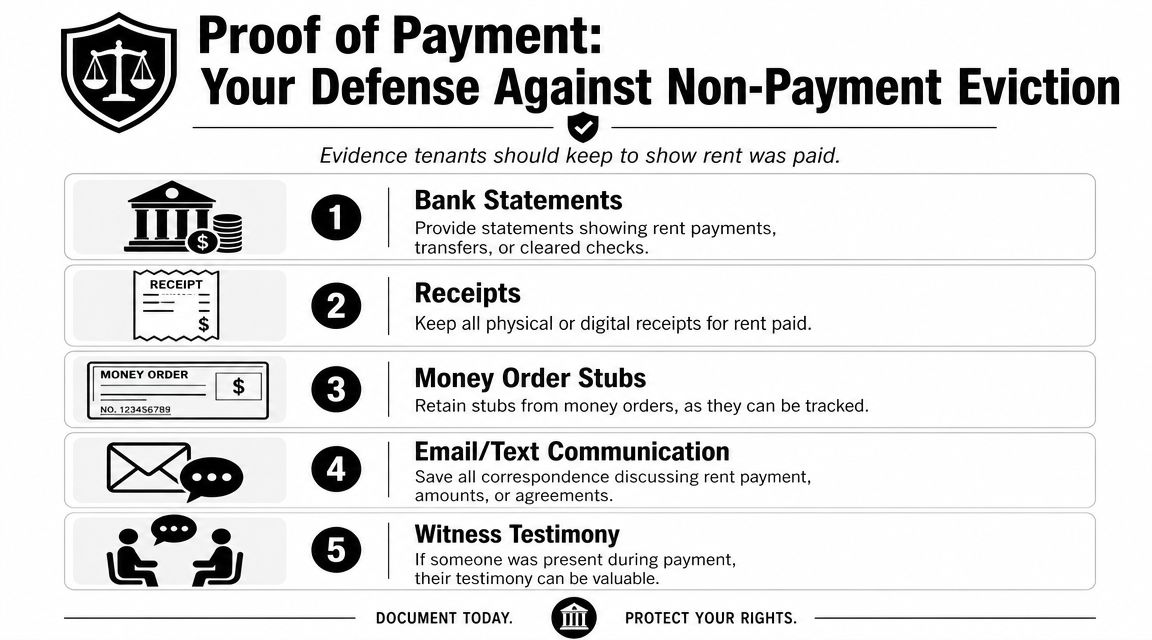
What proof looks strongest in court
Judges tend to trust records that are dated, consistent, and easy to follow. Build your payment defense like a file, not a story.
Useful proof often includes:
- Bank statements that show the transfer or cleared payment
- Rent receipts with dates and amounts
- Money order records if rent was paid that way
- Emails or text messages confirming the landlord received payment or discussed the balance
- A ledger of your own showing each payment and date, matched against supporting documents
If you paid in cash, the case gets harder but not impossible. Gather every related item you have, including receipts, text confirmations, photos of payment delivery, or witness testimony from someone who saw the transaction.
The timing problem many tenants miss
Once a proper notice to vacate has been served, Texas materials note that landlords may reject later rent tenders in some circumstances. That means post-notice payment attempts may not fix the case, even if the tenant is finally able to pay.
That is why pre-notice proof matters so much. It can show one of two things:
- The default never happened as claimed
- The landlord accepted payment in a way that changes the story being presented
If you're dealing with a nonpayment case and trying to understand whether paying now can still stop the process, this article on whether you can stop eviction by paying rent in Texas helps explain the practical limits.
Bring your payment evidence in a stack the judge can follow in order. If the judge has to hunt for your defense, you've made the hearing harder than it needs to be.
A tenant who walks in with screenshots scattered across a phone usually looks less prepared than a tenant with printed bank statements, receipts, and a short timeline. In Justice Court, organization isn't cosmetic. It's part of persuasion.
Why Hardship Arguments Usually Do Not Work in Court
A tenant walks into Justice Court with proof of a layoff, medical bills, and a child care crisis, but no rent ledger, no receipts, and no notice issue to point to. In that courtroom, those facts may explain the missed rent. They usually do not stop the eviction.
That result feels harsh because it is harsh. But in a Texas nonpayment case, Justice Court is usually deciding a narrow possession question, not whether the tenant had a good reason for falling behind. Judges hear hardship stories every week. What tends to change outcomes is a defense tied to the landlord's proof, the lease terms, or the required eviction steps.
Hardship alone usually fails for a practical reason as much as a legal one. These hearings move fast. A judge can act on proof of payment, a defective notice, inconsistent rent records, waiver, or another recognized defense. A judge usually cannot deny possession solely because the tenant's circumstances are sympathetic.
That is the split tenants need to understand before court:
| Argument | Usually effective in nonpayment eviction? |
|---|---|
| I fell behind because of hardship | Usually no, by itself |
| The landlord cannot prove the default | Often worth pursuing |
| The notice or filing was defective | Often worth pursuing |
| There is proof the rent was paid | Often worth pursuing |
I tell clients to separate explanation from defense. An explanation can help the judge understand the timeline and can help in settlement talks. A defense gives the judge a legal reason to deny or delay the eviction.
Hardship still has value, just usually outside the narrow merits of the possession case. It can support a request for a brief move-out agreement, help persuade a landlord to accept a payment plan, or make rental assistance discussions more productive. In some situations, it also helps frame why the parties should settle before judgment instead of forcing a ruling.
That distinction matters in real life. A tenant may lose the legal defense and still avoid a forcible move by negotiating extra days, an agreed dismissal, or a payment-backed resolution. In Justice Court, that is sometimes the best available result.
What usually does not work is building the whole hearing around fairness alone. If hardship is all you have, present it truthfully, but do not treat it as your main courtroom defense unless it connects to a recognized legal issue in the case.
Preparing Your Case Evidence and Courtroom Strategy
The hearing starts, the judge calls your case, and you may have less than five minutes to make your point. In Texas Justice Court, a defense that might work on paper can still lose if the judge cannot follow it quickly. Speed matters. Organization matters more than people expect.
File an Answer if you still can. It does not win the case by itself, but it helps frame your defenses early and reduces the chance that the hearing turns into a one-sided presentation from the landlord. Then build your evidence around one clear theory. If your best defense is payment, prove payment. If your best defense is defective notice, put the notice and the timeline at the center of your file. Trying to argue every grievance at once usually weakens the points that could hold up.
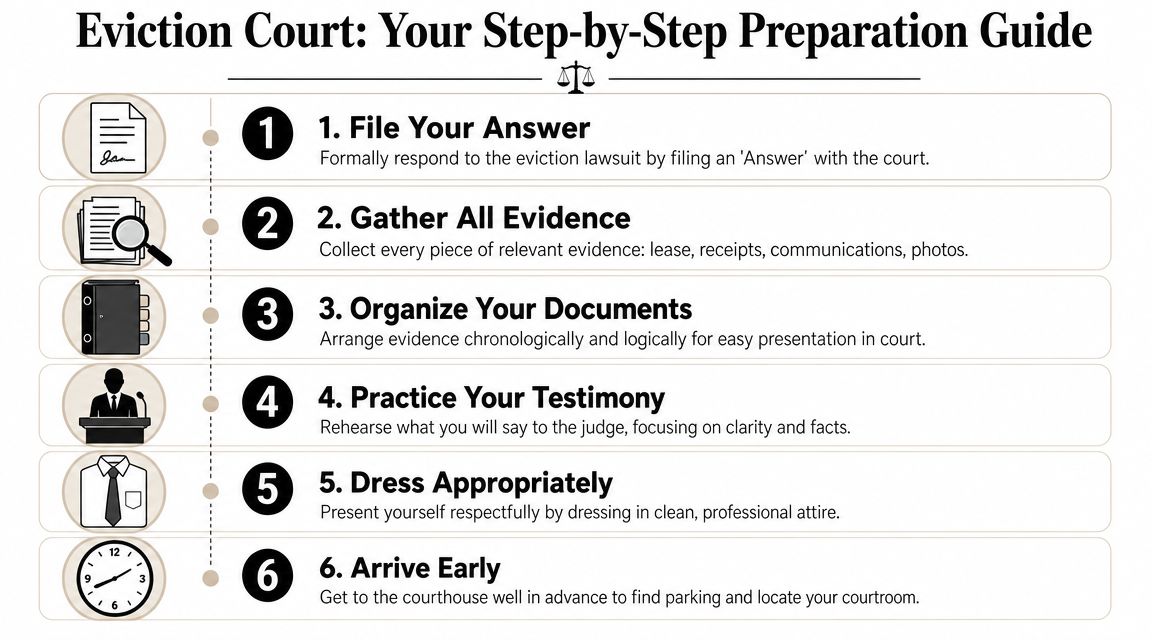
Build a hearing file the judge can follow
Bring a simple packet, in order, with the strongest documents first.
A useful hearing file usually includes:
- The lease or rental agreement
- The notice to vacate
- The petition and citation
- Proof of payment such as receipts, bank records, money order stubs, or screenshots tied to dates
- Photos, repair requests, and written complaints if conditions relate to a legal defense
- Texts, emails, and letters sorted by date
- A one-page timeline listing the key events in sequence
Make copies if you can. Label the pages. Highlight the line you want the judge to see. These small steps matter in a fast docket because judges often decide credibility in part by how easy it is to verify your story.
Do not bring irrelevant papers just because they feel important. Old disputes, personal insults, and long text chains about side issues usually waste time unless they prove a defense the court recognizes.
How to present yourself in the hearing
Start with the legal point, not the full history.
A practical order is:
State the defense in one sentence
Example: "The rent listed as unpaid was paid on these dates," or "The notice to vacate did not give the time required by the lease."Show the document that proves that sentence
Hand up the receipt, ledger, notice, lease clause, or dated message.Explain the timeline briefly
Keep it chronological and factual.Answer the judge's questions directly
Short answers usually carry more weight than speeches.Ask what happens next before you leave
If you lose, the deadlines after judgment come fast.
That last point is practical, not dramatic. Tenants often focus so hard on the hearing that they miss the next deadline.
A good courtroom strategy also means knowing when trial is not your best option. If your proof is thin, but you can offer a realistic move-out date or payment backed by documents, settlement may produce a better result than forcing a weak defense. Justice Court moves quickly, and judges are used to parties resolving possession cases in the hallway when both sides understand the risks.
If the case is getting more complicated than a simple payment dispute or notice problem, speaking with a Texas eviction defense attorney near you can help you decide whether to fight, settle, or prepare for appeal.
When You Need a Texas Eviction Defense Attorney
Some eviction cases are manageable without counsel. Others are risky from the start.
You should seriously consider hiring a Texas eviction attorney if the landlord already has counsel, if your defense involves retaliation or discrimination, if the facts involve habitability and repair-remedy issues under the Texas Property Code, or if the case overlaps with claims for damages outside simple possession. These aren't impossible cases to handle alone, but they are easy cases to mishandle alone.
The risk also rises sharply after a loss in Justice Court. The appeal deadline is short, and the procedural requirements can be unforgiving. If you think the judgment was wrong, waiting a few days to "think about it" can cost you options.
A lawyer can help by:
- Spotting missed defenses hidden in the notice, pleadings, or service
- Framing your argument in terms the court is used to hearing
- Protecting the record if an appeal may be necessary
- Negotiating a better exit or settlement when trial isn't the best path
If you're trying to find counsel quickly, this directory-style resource for a Texas eviction attorney near you can help you start that search.
The practical truth is simple. Self-representation works best when the issue is narrow and the proof is clean. Once the case becomes fact-heavy, legally layered, or urgent, legal help stops being a luxury and starts being a strategy.
If you need help with an eviction, lease issue, or rental dispute, contact The Law Office of Bryan Fagan, PLLC for a free consultation today.