Adding someone to a deed often starts with a simple goal. You got married and want the house in both names. You own a rental and want to bring in a partner. You want an adult child involved in the property so things feel easier later.
In Texas, that step can be straightforward, but it isn't casual. A deed changes legal ownership. Once you change ownership, you may also change who has to sign for a sale, who can claim an interest in the property, how a mortgage lender reacts, and how clearly you can prove ownership if a tenant dispute ends up in court.
For landlords, that last point matters more than people expect. If your name on the deed and your role as the person collecting rent don't line up cleanly, tenant notices, lease enforcement, and eviction filings can get messy fast. Texas Property Code rules don't disappear because the ownership paperwork was handled informally.
Why Add Someone to Your Texas Property Deed
A common Texas scenario looks like this. One spouse bought a house before marriage. After the wedding, both spouses want the title to reflect how they live and pay for the home now. Another version involves a parent who owns a rental and wants to add an adult child to "keep things simple" later. Landlords also do this when they bring in a family member or investor to help manage a property.

The reason usually sounds practical. Share ownership. Help with estate planning. Add a spouse. Formalize a business arrangement. None of those goals is unreasonable.
What changes is the legal effect.
Common reasons people add someone to a deed
People usually make this change for one of these reasons:
- Marriage or remarriage: A spouse wants the public record to match the family's ownership expectations.
- Estate planning: A parent hopes adding a child now will avoid conflict or probate later.
- Rental property investment: A landlord adds a partner, sibling, or co-investor to a house or small portfolio.
- Divorce cleanup or family restructuring: A former owner needs to come off title, or a new family arrangement needs to be reflected in writing.
Each of those situations raises a different set of questions. A married couple may care most about survivorship and community property treatment. A landlord may care more about control, liability, and proving authority under the Texas Property Code if a lease dispute surfaces.
Practical rule: A deed should match your long-term plan, not just your short-term relationship.
Why this choice affects more than ownership
When you add someone to a deed, you aren't just giving them a name on paper. You're giving them a legal interest in real property. That can affect:
- Decision-making: A future sale, refinance, or settlement may require another person's signature.
- Landlord operations: If the property is rented, ownership changes can complicate notices, management authority, and proof of standing.
- Estate consequences: The wording on the deed can shape what happens at death.
- Financial exposure: Mortgages, tax treatment, and third-party claims may become more complicated.
Texas owners often focus on "How do I add someone to a deed?" The better question is, "What rights am I creating, and what problems am I inviting if this relationship changes?"
That is where careful drafting matters. A deed can solve a problem cleanly. It can also create years of confusion if the ownership structure, property description, and recording steps aren't handled correctly.
Choosing the Right Deed and Ownership Structure
A common Texas scenario goes like this. The owner wants to add a spouse, child, or business partner to title on a rental house because "it is just paperwork." Then the tenant stops paying, the property needs repairs, or the lender asks questions after seeing a transfer in the county records. The deed choice made at the start now affects control, liability, and who has authority to act.
Before signing a new deed, settle two separate questions. What deed will transfer the interest, and how will the co-owners hold title after the transfer? Those are different decisions, and each one affects rights in a different way.
The deed form and the ownership structure do different jobs
The deed form answers a title question. What, exactly, is the current owner conveying, and with what promises, if any?
The ownership wording answers a control and inheritance question. After the transfer, do the co-owners own equal undivided interests, separate shares, or survivorship rights?
Owners often blur those issues together and use a generic form they found online. That is where trouble starts. A deed can transfer an interest and still leave the parties in a poor ownership structure for a mortgaged property or a rental property.
A quitclaim deed transfers whatever interest the grantor has, if any, without title warranties. A warranty deed includes stronger promises about title. For a closer look at that distinction, this explanation of a Texas warranty deed is a useful starting point.
Texas Deed and Ownership Options at a Glance
| Feature | Quitclaim Deed | Warranty Deed | Joint Tenancy (WROS) | Tenants in Common |
|---|---|---|---|---|
| Main purpose | Common for non-sale transfers between people who already trust each other | Common when stronger title assurances are needed | Ownership structure with survivorship rights | Ownership structure where each owner holds an interest that can pass separately |
| Title warranties | No | Yes | Not a deed type | Not a deed type |
| Typical use | Adding a spouse, family member, or co-owner outside a sale | Transfers where the recipient wants more protection | People who want the surviving owner to take the deceased owner's share | Co-owners who want flexibility for separate interests |
| Effect at death | Depends on the ownership wording in the deed | Depends on the ownership wording in the deed | Surviving owner usually takes the interest if drafted correctly | Deceased owner's interest does not automatically pass to the other co-owner |
| Risk if drafted loosely | Higher chance of later title questions | Better title assurances, but still needs precise drafting | Confusion if survivorship language is unclear | Greater chance of later disputes over sale, possession, or partition |
When a quitclaim deed works, and when it causes avoidable problems
A quitclaim deed can work for a family transfer where everyone already knows the title history and accepts the risk. It is simple, and in the right setting, simplicity has value.
But simple is not always safe.
Texas title companies often scrutinize quitclaim deeds more closely because they do not contain title warranties. That can matter later if the new co-owner wants to refinance, sell, or prove marketable title. For a property with an existing mortgage, a poorly chosen deed can also invite lender attention without giving the new owner much protection in return.
Rental property owners need to be even more careful. If the property is leased, adding a new owner changes more than the title record. It can affect who gives notices, who signs lease renewals, who is entitled to collect rent, and who may be drawn into a tenant dispute under the Texas Property Code. A bare-bones deed may add a name to title while leaving everyone unclear about management authority.
That confusion shows up fast in real life. One co-owner wants to keep the tenant. Another wants to terminate the lease. A third party manager does not know whose instructions control. The deed does not answer every landlord question, but sloppy deed drafting creates the argument.
Picking the ownership structure
The ownership language inside the deed matters as much as the deed form. It determines what each owner holds after the transfer.
Joint tenancy with right of survivorship
This structure is meant to pass the deceased owner's interest automatically to the surviving owner. It appeals to spouses and some family members because it can avoid a probate issue for that property.
The language has to be clear. Texas courts and title companies do not fill in missing survivorship terms because the parties probably meant them. If survivorship is the goal, say it plainly and draft it correctly.
For a rental house, survivorship solves only one problem. It addresses what happens at death. It does not settle who handles repairs, security deposits, notices to tenants, or day-to-day leasing decisions while both owners are alive.
Tenants in common
This structure gives each owner a separate interest that can pass by will or intestacy rather than automatically going to the other owner. It often fits siblings, unmarried co-owners, investors, and situations where contributions are unequal.
It also creates more room for disagreement. One owner may want to sell, another may want to hold, and a third may want to keep renting the property. If the property is occupied by tenants, those disagreements can spill into landlord operations very quickly.
That is why I usually tell co-owners of rental property to address management in writing at the same time they change title. The deed handles ownership. A separate agreement should address rent collection, repairs, leasing authority, and what happens if one owner wants out.
Community property considerations for spouses
For married couples in Texas, deed wording should line up with community property rules and the couple's estate plan. Adding a spouse to title is not just a courtesy change. It can affect characterization, survivorship planning, and the signatures required for a later sale or refinance.
Spouses who own rental property should also consider who will act as landlord. If both spouses are on title, both may have a practical stake in lease enforcement, habitability issues, and decisions about deposits and notices. Clear ownership language reduces the risk of inconsistent positions later.
If you are adding a spouse to title on a mortgaged or leased property, the deed should match both the family-property plan and the property's day-to-day use.
What usually works best in practice
The right structure depends on the relationship, the mortgage status, and whether the property is owner-occupied or rented.
- Spouses adding one another to a home: survivorship planning and community property treatment usually deserve close attention.
- Parents adding an adult child: the parent often gives up more control than expected, especially if the property may later be sold or borrowed against.
- Landlords adding a co-investor: title should be paired with a written agreement about rent, repairs, notices, leasing authority, and exit rights.
- Family members sharing inherited property: tenants in common often reflects reality better than survivorship, but it also increases the need for clear rules about possession and sale.
The best deed is the one that fits the actual deal. The best ownership structure is the one that still makes sense after a death, a refinance, a tenant dispute, or a disagreement between co-owners.
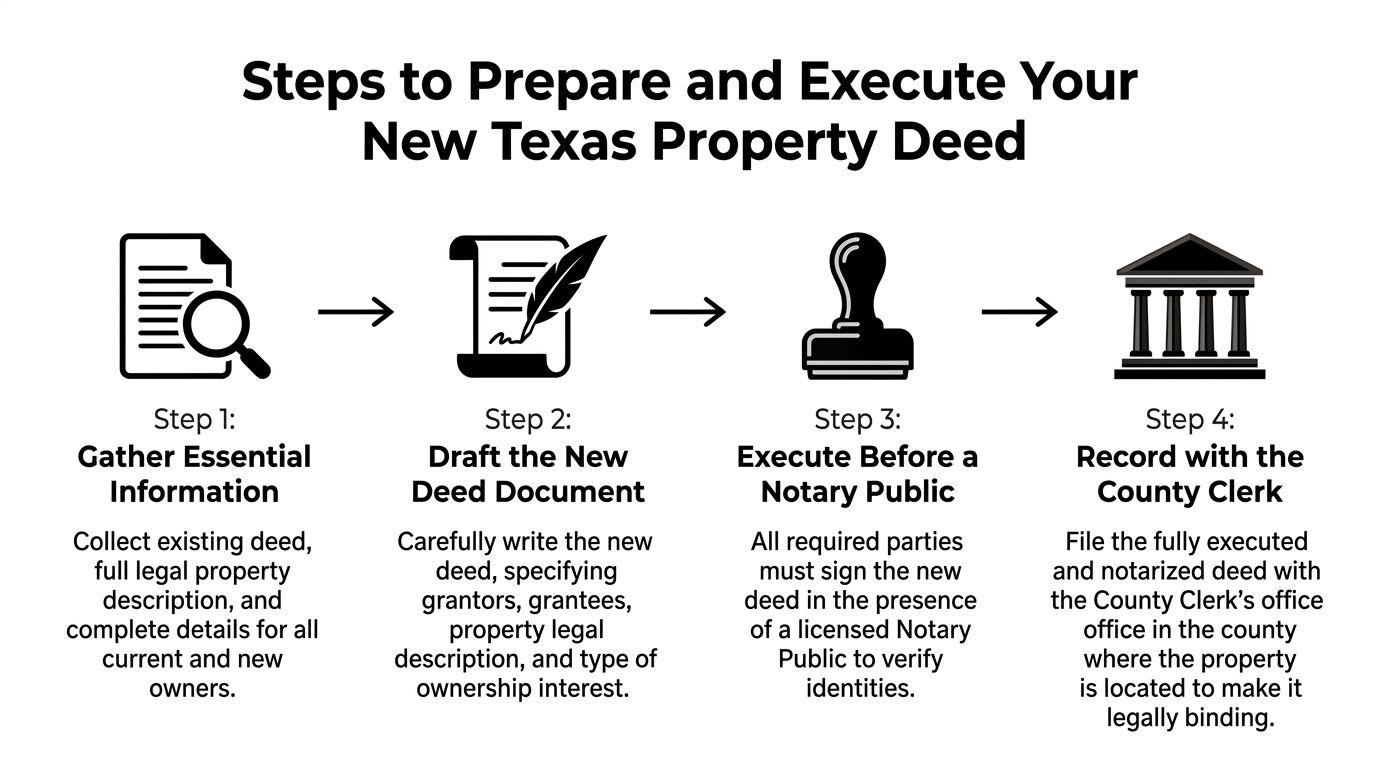
Preparing and Executing the New Property Deed
Precision matters here. A Texas deed can look simple on the page and still fail because one field is wrong, one signature is missing, or the legal description doesn't match the prior records.
Start with the right source document
The legal description must come from the existing recorded deed or another reliable title source. Do not use only the street address.
That is one of the most common errors in do-it-yourself transfers. A mailing address tells people where the house is. The legal description tells the county exactly what parcel is being conveyed.
Step one: gather the required information
Before drafting the new deed, collect:
- The current recorded deed so you can match names and legal description accurately.
- The full legal description copied carefully from the existing record or title documentation.
- The grantor's name exactly as it appears in title records.
- The grantee's name and mailing address because mailing addresses are required for recording.
- Your ownership wording that states how the new co-owners will hold title.
A deed can be rejected or create downstream title issues if any of those pieces are incomplete.
Step two: identify the parties correctly
The current owner transferring the interest is the grantor. The person being added is a grantee. If the current owner is staying on title and adding another person, the new deed usually transfers from the current owner to the current owner and the new co-owner together.
That sounds awkward, but it is normal.
For example, if Maria owns the property alone and wants to add David, the deed may transfer from Maria as grantor to Maria and David as grantees, using the chosen ownership language.
Drafting insight: Names on the new deed should match the prior title record closely enough to avoid confusion in the chain of title.
Step three: choose the vesting language carefully
Many future disputes begin here. The deed should clearly state how the grantees hold title.
Use wording that matches the legal result you want. If the plan is survivorship, say so clearly. If the parties want separate shares, the deed should reflect that. If the property involves spouses and marital property concerns, the language should be aligned with that reality rather than copied from a generic online form.
For landlords, deed wording should also fit property management reality. If two owners will make decisions together, the lease file, management agreement, and notice practices should reflect that. If one person is the manager and the other is only an investor, document that separately. The deed alone won't resolve every operational question.
Step four: sign before a notary
Texas requires notarization for the deed to be valid for recording. The grantor must sign before a notary public.
No notary, no clean recording. That isn't a technicality.
Signatures should be complete and consistent. If more than one current owner is conveying the property, each required grantor needs to sign. If title is currently in multiple names and one person doesn't sign, you may end up with an incomplete transfer and a partly changed ownership structure that nobody intended.
Step five: review the deed before filing
Before anyone heads to the county clerk, check these items line by line:
- Legal description: Does it match the prior recorded deed exactly?
- Grantor and grantee names: Are they complete and spelled consistently?
- Ownership wording: Does it state the intended survivorship or co-ownership structure clearly?
- Mailing addresses: Are all required grantee mailing addresses included?
- Notary acknowledgment: Is it complete and legible?
A short review at this stage can prevent a rejected filing or a title headache later.
A practical example for a rental property
Suppose you own a duplex in your name only. You want to add your brother because he has started contributing money and helping manage tenants.
The deed may add him successfully, but you still need to think beyond the transfer itself. Who signs lease renewals? Who approves repairs? Who appears in court if an eviction becomes necessary? Who receives rent?
If those questions are left unwritten, ownership and management can drift apart. In a dispute, that gives an advantage to the other side.
What works better than form copying
Many owners search "add someone to a deed" and download the first form they find. That approach often fails because deed work is less about the paper and more about the fit between the paper, the title history, and the intended legal effect.
What usually works best is a clean drafting process:
- Pull the exact legal description from the official title record.
- Match owner names carefully.
- State the ownership type with precision.
- Sign in front of a notary.
- Review before recording.
That sequence sounds simple because it is. It just isn't forgiving.
The Final Step Recording Your Deed in the County Records
A client signs a deed, puts it in a file, and assumes the transfer is done. Then a tenant asks for proof that the person demanding rent or serving notices owns the property. That is when an unrecorded deed stops being a paperwork issue and becomes a practical problem.
In Texas, recording puts the world on notice of the ownership change. Under Texas Property Code §13.002, an unrecorded deed can still be effective between the people who signed it, but it does not protect the new owner against later purchasers or creditors who had no notice of the transfer. For rental property, that gap matters. Ownership questions can spill into lease renewals, security deposit disputes, repair requests, and eviction filings.
Recorded county records often become part of the paper trail that supports a landlord's authority. Owners who rent property should also understand what counts as reliable proof of ownership before a dispute starts.
How recording works in practice
Record the deed in the county where the property sits. Bring the signed, notarized original, not a draft and not an incomplete copy. The clerk will expect a deed that is recordable on its face, including the grantee mailing address and a legal description that matches the property being conveyed.
There is also a cost to file. Recording fees are usually modest, but they vary by county and by the number of pages. As noted earlier, county clerks commonly charge filing fees for recording deed documents, so it makes sense to confirm the amount before you go.
For an owner of a rental house, duplex, or small apartment property, I recommend recording promptly after signing. Delay creates avoidable confusion about who has authority to act as landlord, who should receive rent, and who may need to appear in court if a tenant defaults.
What to keep after the deed is recorded
Once the clerk accepts the deed, keep more than the stamped copy. Keep a clean ownership file.
For a Texas rental property, that file should usually include:
- The recorded deed
- Current leases and renewals
- Any property management agreement
- Written instructions showing which owner handles tenant notices, repairs, and rent collection
- Contact information for each owner
- Tax records and any notice of delinquency or claim that could affect title, including issues related to a tax lien certificate
That last point gets overlooked. A deed change does not erase title problems, unpaid taxes, or management confusion. It only changes who holds the ownership interest.
Common recording problems
County clerks reject deeds for ordinary reasons.
A missing or defective notary acknowledgment is a common one. So is an incomplete legal description, or a description that does not match the prior deed. Filing in the wrong county causes trouble too, especially if the property touches more than one county line.
The clerk's acceptance also is not a ruling that your deed solved every legal issue. A recorded deed can still create later disputes if the names are inconsistent, the ownership shares are unclear, or the transfer conflicts with how the property is being managed.
That is why I treat recording as the final mechanical step, not the final legal step. Once the deed is in the public record, the ownership change is much easier to prove. For landlords, that public record also supports the day-to-day authority to deal with tenants under the Texas Property Code.
Navigating Mortgages Taxes and Other Financial Hurdles
The hardest problems in deed transfers usually aren't the signatures. They're the financial consequences people didn't see coming.

Mortgage clauses can turn a simple transfer into a serious risk
Many owners assume they can add a spouse, child, or partner to title and deal with the lender later. That assumption can be dangerous.
According to the verified guidance available from MacDonald Illig on adding someone to a deed, adding a co-owner can trigger a due-on-sale clause under the federal Garn-St. Germain Act, and while certain transfers to relatives are exempt, non-exempt transfers risk the lender accelerating the entire loan balance. That risk matters even more in a high-rate environment, with the same source noting an average 2026 mortgage rate at 6.8% as a projection.
For a landlord, this can hit at the worst time. The property may already be carrying tenants, repairs, and insurance costs. A deed change that disturbs the loan can put the entire property operation under stress.
What to check before changing title on a mortgaged property
Before you add someone to a deed, review these points:
- Your loan documents: Look for transfer restrictions and due-on-sale language.
- The relationship of the new owner to you: Some transfers may be treated differently under federal law.
- Refinancing reality: If lender approval becomes necessary, current rates may make a refinance unattractive.
- Rental cash flow: On an investment property, a lender issue can affect repairs, reserves, and lease operations quickly.
If the property is rented, ownership changes can also create practical notice issues. Tenants need to know who owns the property, who manages it, and where legal notices should go. Confusion here can feed later disputes over deposits, repairs, access, and authority under the Texas Property Code.
Tax issues are often quieter, but they last longer
People tend to focus on gift tax questions first, but basis and future sale consequences are often the more painful issue. Property owners also need to think about liens, creditor exposure, and whether another person's financial problems could attach to the property interest they now own.
For readers sorting through delinquent tax questions and title problems generally, this explanation of a tax lien certificate gives helpful background on how tax-related claims can affect property rights in some contexts.
Here is the practical point. Once another person owns part of the property, that share doesn't live in a vacuum. Their creditors, legal disputes, and financial instability may become part of the property's story.
Rental properties bring an extra layer of risk
A deed transfer on a homestead is one thing. A transfer on a rental property is different because landlord duties continue while ownership changes.
Lease enforcement
If the wrong person signs notices, appears in court, or communicates with the tenant as "the owner," the tenant may challenge authority.
Security deposits and accounting
Ownership records should line up with who receives rent, who holds deposits, and who answers for move-out deductions.
Repairs and habitability
Under Texas landlord-tenant rules, tenants often care less about title theory than about who is responsible for the property. If co-owners disagree over repair spending, tenants still expect the property to be maintained.
This video gives a plain-language overview that many owners find useful before changing title on real estate:
A better way to think about the decision
Don't treat the deed transfer as an isolated event. Treat it as one part of a larger property system.
Ask:
- Will the lender allow it?
- Will this create tax consequences later?
- If the property is rented, who will have authority over tenants and records?
- What happens if the new co-owner is sued, divorced, or wants out?
When owners slow down and answer those questions first, they usually avoid the most expensive surprises.
Avoiding Common Mistakes That Create Future Legal Battles
Most deed fights don't start with bad intentions. They start with shortcuts.
One owner copies a legal description from an appraisal notice instead of the recorded deed. Another signs outside the notary's presence. A parent adds a child to title without realizing that ownership and estate planning are not the same thing. Years later, the family is dealing with a sale dispute, a tax problem, or a partition case.
The mistake people regret most later
A major trap involves tax basis. According to Legacy Assurance Plan's discussion of deed-transfer risks, adding a non-spouse to a deed as a gift gives that person the original owner's cost basis, which can create 40% higher capital gains tax exposure compared with inheriting the property and receiving a stepped-up basis.
That is why adding an adult child to title as a shortcut can backfire. It may feel like estate planning, but the tax result can be worse than doing nothing and planning properly.
Other mistakes that regularly cause conflict
Unclear ownership language
If the deed doesn't clearly say how the co-owners hold title, one person's assumption about survivorship may not match the legal result.
Informal landlord operations after the transfer
A rental property needs more than a changed deed. The lease file, rent instructions, repair authority, and notice practices should also make sense after the ownership change.
Treating deed planning as a substitute for estate planning
A deed can transfer a present ownership interest. It does not replace a broader plan for incapacity, inheritance, and control.
For a broader estate-planning checklist, this resource on wills and LPAs is a helpful reminder that property ownership and decision-making authority are related, but not identical.
One hard lesson: If your goal is to avoid probate without giving away present ownership now, a transfer-on-death strategy may fit better than adding a child or other relative immediately.
Texas owners who are considering that route often look at a lady bird deed in Texas as part of the comparison.
What usually prevents litigation
The safest pattern is not complicated:
- Use the exact legal description from the title record
- Make sure every required grantor signs properly before a notary
- State the ownership structure with precision
- Think through mortgage, tax, and landlord-operational consequences before filing
- Choose the deed that fits the goal instead of the fastest form online
This is one area where a little prevention matters far more than cleanup later. Once co-ownership is created, undoing it can require negotiations, new deeds, lender involvement, tax analysis, or even litigation.
If you need help deciding how to add someone to a deed, especially for a mortgaged home or rental property, contact The Law Office of Bryan Fagan, PLLC for a free consultation today. If you're dealing with an eviction, lease issue, ownership dispute, or other Texas Property Code problem, a Texas landlord tenant lawyer can help you protect your rights before a deed mistake turns into a larger conflict.