
An eviction filing can turn into a housing emergency fast. You apply for a new apartment, the leasing office runs a screening report, and suddenly an old case you thought was over is back in front of you.
If you're searching can eviction be removed from record Texas, the honest answer is often narrower than desired. In most cases, the court record itself isn't something Texas lets you erase or seal through a standard process. But that doesn't mean you're powerless. The most practical work often happens somewhere else: on the tenant screening report or credit-related report that future landlords typically use.
That distinction matters. A lot.
Texas landlord tenant disputes move quickly, and so do eviction cases under the Texas Property Code and related court rules. If you understand which record you're dealing with, what a future landlord is likely to see, and what can still be corrected, you can make better decisions now instead of wasting time on options that don't exist.
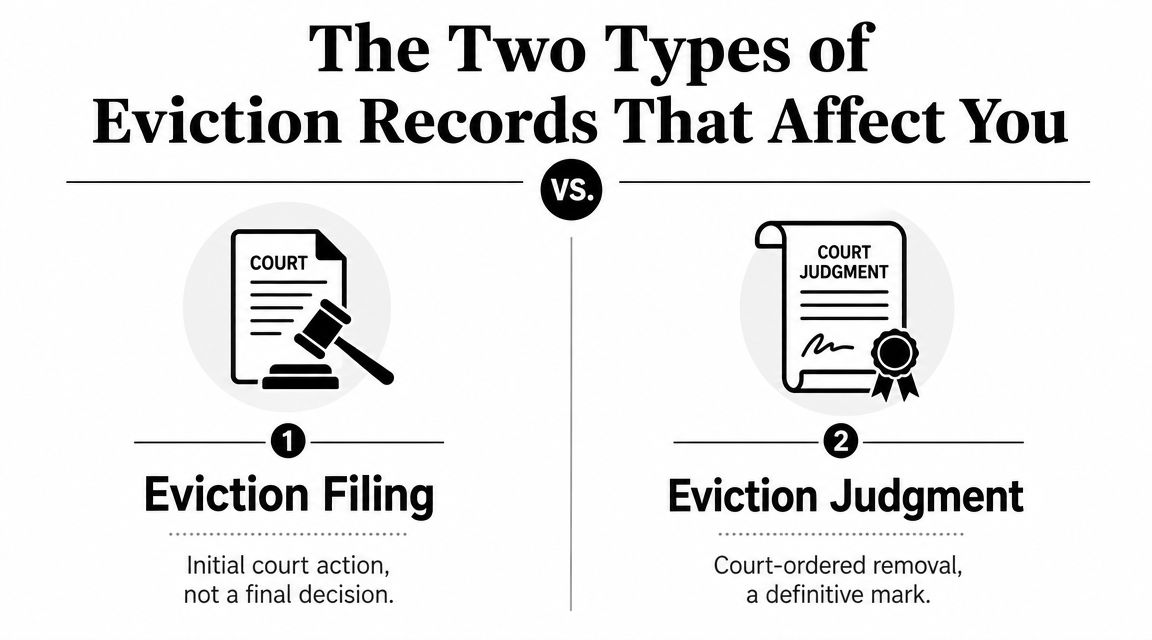
The Two Types of Eviction Records That Affect You
When people talk about an “eviction record,” they usually mean two different things.
The first is the public court record. That starts when a landlord files an eviction case in court. The second is the consumer reporting side, which includes tenant screening reports and sometimes credit-related reporting used by landlords when they review an application.
The court record
The court file is the official case record. In Texas, an eviction filing generally becomes a public court record when it's filed, and Texas doesn't provide a standard statutory process to expunge or seal that record, according to TexasLawHelp's discussion of the impact of eviction on credit and future housing.
That means the filing itself can exist even if the case later ends in your favor.
A lot of tenants assume that if they paid, moved out, settled, or won, the whole event disappears. That's usually not how it works. The court keeps a record of the lawsuit having been filed.
The screening report
A screening report is different. It's a consumer report created by a private company and used by landlords, apartment complexes, and property managers. Those reports may pull data from court filings, debt information, or prior rental history. They can also contain mistakes.
That's why this article doesn't stop at “no.” The filing may remain in the courthouse record, but the screening report is often where tenants still have room to act.
Here's the practical split:
| Record type | Who keeps it | Main concern |
|---|---|---|
| Court record | Court system | Whether the filing and case outcome remain visible |
| Screening report | Private reporting or screening company | Whether the report is accurate, current, and presented fairly |
Practical rule: Don't treat every “eviction record” as the same problem. The court file and the screening report follow different rules, and your strategy should too.
Why this difference changes your next step
If your goal is to rent again soon, your immediate obstacle may not be the courthouse website. It may be the screening report that flags your application before a human ever calls you.
That's why it helps to learn whether evictions show up on credit reports. The answer is more nuanced than many tenants expect, and the details affect how you should respond.
Texas Property Code issues still matter here. If the original dispute involved repair problems, notice issues, lockouts, retaliation, or a lease termination defense, those facts may help you contest how the matter is described later, even if they don't erase the filing itself.
Eviction Filings vs Eviction Judgments What Landlords See
Not every eviction-related entry carries the same weight.
A filing means the landlord started a case. A judgment means the court ruled and entered a result, often in the landlord's favor. Both can matter, but landlords usually read them differently.

Why a filing still causes trouble
A filing can raise concern because it signals conflict over possession, rent, or lease compliance. Even if the tenant later wins or the case is dismissed, some landlords see the filing and stop there.
That's frustrating, but it's common in practice. Screening systems often reduce complicated facts into a simple flag. A case that should require explanation gets treated as a risk marker.
Why a judgment is worse
A judgment usually hits harder because it suggests the landlord proved the case or the tenant didn't successfully defend it. If there's also money awarded, that can create additional collection or reporting problems.
For landlords reviewing applicants, a judgment often looks more final. It can also connect to later enforcement issues. If you're trying to understand how court judgments can affect collection and reporting, this overview of a Texas abstract of judgment helps explain that broader picture.
A filing says, “there was a dispute.” A judgment often reads as, “the tenant lost.”
A real-world comparison
Consider two renters applying for the same apartment.
Renter A had an eviction case filed after a dispute over lease timing and move-out terms. The case was later dismissed.
Renter B had an eviction case filed for nonpayment, didn't respond in time, and the landlord got judgment.
Those two histories don't look the same, even if a database labels both with the word “eviction.”
A careful landlord may ask follow-up questions. A rushed screening process may not.
What tenants should focus on
If you're currently in a pending case, your goal shouldn't just be “avoid court.” It should be avoid the worst possible outcome on the record.
That may mean:
- Responding early so you don't end up with a default judgment.
- Bringing documents that show payment, notice defects, repair problems, or other defenses.
- Exploring settlement if it leads to dismissal or a cleaner final case status.
- Correcting later reports if the screening company describes a dismissal like a loss.
Texas Property Code disputes often involve more than unpaid rent. Some cases grow out of repair and habitability issues, security deposit disputes, or disagreements over whether a lease was properly ended. Those details won't always stop a filing, but they can matter a great deal when the case outcome is being shaped.
Can a Texas Eviction Court Record Be Sealed or Expunged
For most tenants, the direct answer is no.
In Texas, eviction court records are generally not removable or sealable, and they can remain visible in public court records indefinitely. The Texas State Law Library explains that court records are presumed open to the public under Rule 76a of the Texas Rules of Civil Procedure, and that landlords may find them through background checks, court searches, or tenant-screening services in its guidance on eviction record removal in Texas.
Why the answer is usually no
Rule 76a starts from a public-access principle. Court records are presumed open. That means a tenant generally can't file a routine request and have an eviction case wiped away just because it is old, unfair, embarrassing, or has made housing harder.
That's the part many online summaries miss. They imply that “record removal” is mostly a paperwork issue. It isn't.
In everyday Texas practice, the harder truth is that the public filing often stays put.
The narrow exception people still hear about
Some tenants have heard about the Texas Eviction Diversion Program and assume it still offers a broad way to remove an eviction. It doesn't operate as a general, current fix for most cases. The Texas State Law Library notes that a major exception existed during the COVID-era program, but that program is over, and outside that narrow context Texas does not currently provide a general process to expunge or seal eviction records.
That's why old advice can be misleading. It may describe a program that no longer solves today's problem.
If someone promises to “erase” a Texas eviction filing in the ordinary case, be cautious. That usually isn't a remedy Texas law provides.
What this means in practice
If the public court record likely remains, your energy is usually better spent on questions like these:
| Better question | Why it matters |
|---|---|
| Was the case dismissed or won? | The outcome can still shape how landlords interpret the filing |
| Was the report accurate? | Screening companies sometimes misstate the result |
| Is there related debt reporting? | Consumer reporting can create separate barriers |
| Can the case result still be improved? | Some judgments can still be challenged depending on timing and facts |
This is also where the Texas Property Code matters in a practical way. Code sections affecting notice, lease termination rights, repairs, lockouts, retaliation, and security deposits can shape your defenses and the final case result, even if they don't create a general right to seal the file later.
The takeaway is simple. If you're asking can eviction be removed from record Texas, the court-file answer is usually no. The smarter question is what can still be corrected, improved, challenged, or explained.
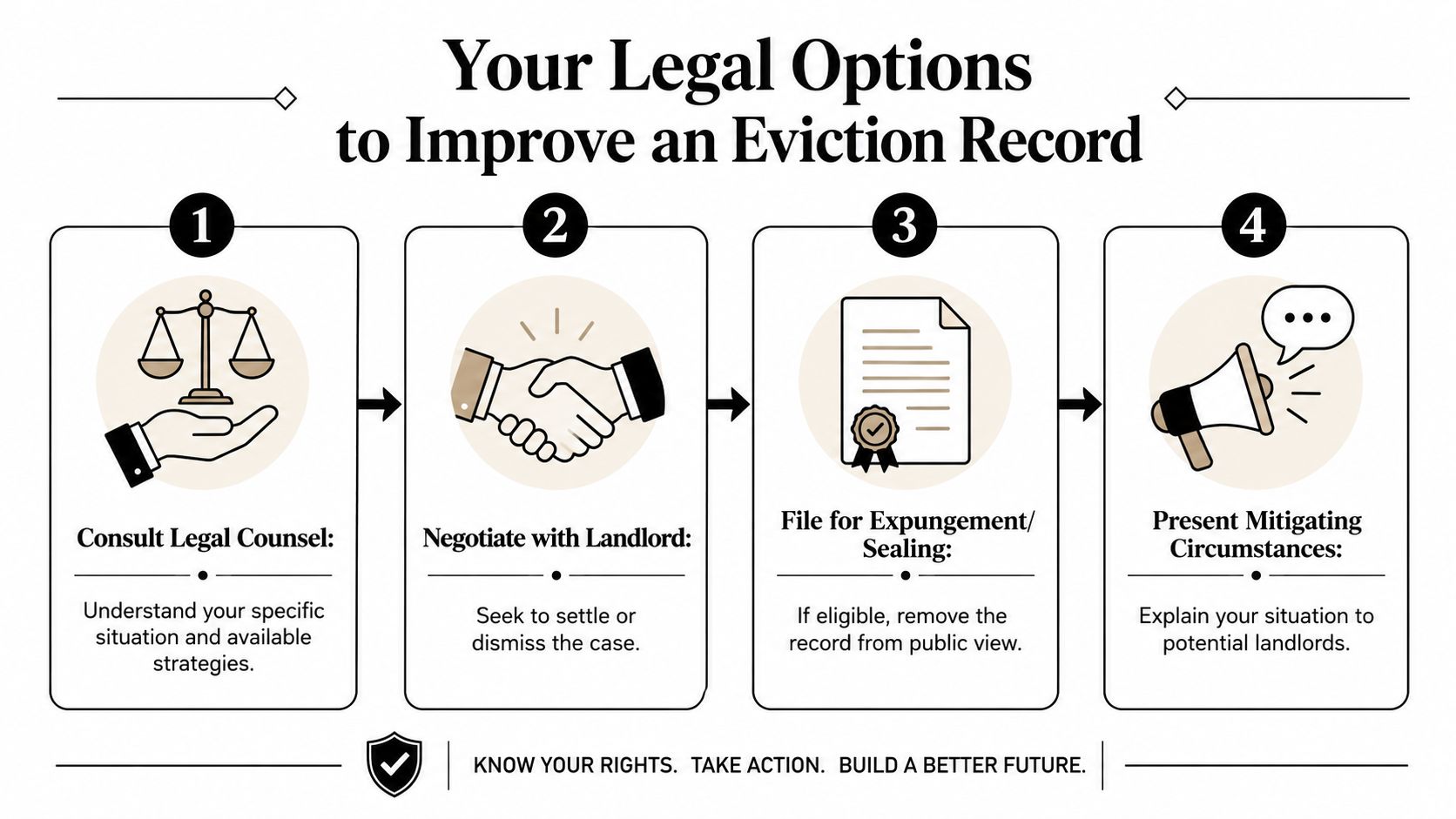
Your Legal Options to Improve an Eviction Record
You may not be able to erase the filing, but you can often improve what the record says about you. That difference matters when a future landlord decides whether to keep reading your application or reject it.
The strongest move is usually to act before a bad result hardens into a final judgment.
Try to change the outcome, not the existence of the filing
The National Low Income Housing Coalition reports that about 3.6 million people per year experience an eviction filing in the United States, and only 10 jurisdictions had enacted some form of eviction record sealing or expungement law or program at the time of its toolkit. Those jurisdictions were Arizona, California, Colorado, the District of Columbia, Indiana, Minnesota, Nevada, Oregon, Texas, and Utah. The same toolkit notes that Texas is the only state in that group to have created these protections through administrative means rather than broad legislation, which shows how narrow the Texas remedy is in practice. Those points appear in the coalition's eviction record sealing and expungement toolkit.pdf).
This legal environment is why tenants need to focus on the case result itself.
A dismissed case is usually easier to explain than a judgment. A negotiated move-out with agreed terms is often better than a default. A corrected judgment is better than an inaccurate one sitting unchallenged.
Options that may help
Some paths depend on timing. Others depend on whether the landlord will work with you.
- Negotiate a dismissal. If the issue is unpaid rent, a move-out date, or a lease misunderstanding, the parties may be able to reach an agreement and ask the court to dismiss the case.
- Fight the case on the merits. If the landlord didn't follow proper notice rules, if the amount claimed is wrong, or if there's a serious defense under the lease or the Texas Property Code, appearing in court and presenting proof can change the result.
- Challenge a default judgment. If you missed court and judgment was entered without your side being heard, there may still be ways to attack that result depending on the facts and deadlines.
- Appeal when appropriate. If the court ruled incorrectly, fast action matters. Eviction timelines are short in Texas.
For tenants dealing with a fresh judgment, this guide on how to appeal an eviction is a useful starting point.
Here's a short walkthrough that can help clarify the sequence:
A practical example
Suppose a tenant fell behind after a job interruption, then caught up most of the balance before the hearing. If the landlord's main goal is possession and turnover, the parties may agree to a move-out plan and dismissal rather than push through to judgment.
That doesn't erase the filing. It does change the story.
Instead of “tenant was evicted,” the later court paperwork may show something closer to “case was dismissed” or “matter resolved by agreement.” In screening and application conversations, that difference can be meaningful.
Case strategy matters most before the file becomes a final problem. Waiting until the next apartment denial is usually the expensive way to handle an eviction record.
Where legal help fits
A tenant can handle some of these steps alone, but legal help often changes the quality of the outcome. A Texas landlord tenant lawyer can review the lease, the notice to vacate, payment history, text messages, repair complaints, and hearing documents to see whether a dismissal, negotiated order, post-judgment motion, or appeal makes sense.
One option for tenants or landlords needing that kind of review is The Law Office of Bryan Fagan, PLLC, which handles Texas landlord-tenant disputes and eviction-related matters.
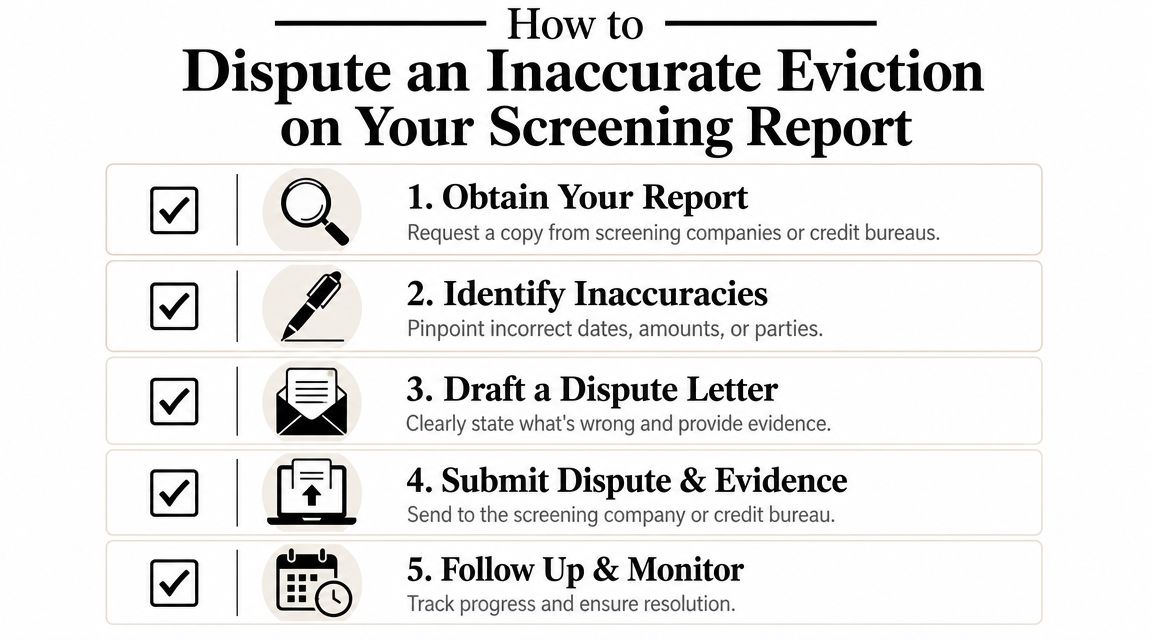
How to Dispute an Inaccurate Eviction on Your Screening Report
This is the part many tenants can do something about.
Even when the court filing stays public, the screening report may still be inaccurate, outdated, incomplete, or misleading. A dismissed case may be reported like a judgment. A debt may still appear after it should no longer be reported. Another person's case may even be mixed into your file.
Start with the report, not your memory
You need to see exactly what the landlord or screening company is using.
Order a copy of the tenant screening report if you can identify the company. If credit-related information is involved, obtain the relevant consumer reports too. Don't dispute in the dark. Small wording differences matter.
The practical retention window often splits in two. The court filing may remain visible indefinitely, while eviction-related information on a credit report or tenant-screening report is commonly retained for up to 7 years under federal credit-reporting rules and Texas consumer-reporting guidance, as explained in this discussion of how long eviction stays on record in Texas.
What to look for
Review the report line by line.
- Wrong outcome. A dismissed case is shown as a judgment.
- Wrong person. The report matches you to someone else with a similar name.
- Wrong dates. Filing dates, move-out dates, or judgment dates are off.
- Old debt reporting. A listed balance remains even though the reporting window should no longer apply.
- Missing context. A settlement, vacated judgment, or corrected court order isn't reflected.
Bring the court paperwork into the same folder as the report. Your dispute is much stronger when every correction request matches a document.
How to write the dispute
Keep the letter short, specific, and document-driven. Don't write a long emotional history unless it helps identify the exact error.
A useful structure looks like this:
- Identify yourself clearly with full name, current address, date of birth, and report reference number if available.
- Identify each disputed item precisely.
- State what is inaccurate.
- State what the report should say instead.
- Attach proof such as the docket sheet, dismissal order, judgment, payment ledger, lease, or settlement papers.
- Request correction or deletion of the inaccurate entry.
Sample language:
I dispute the eviction entry listed on my tenant screening report. The report states that an eviction judgment was entered against me. The attached court records show the case was dismissed. Please reinvestigate this item and correct or delete the inaccurate entry.
If the issue is an outdated debt entry, say that directly. If the issue is mixed files, say the case does not belong to you and include identifying proof.
Keep the paper trail clean
Send the dispute in a way you can document. Save the report, letter, attachments, proof of delivery, and every response. If a future landlord denies you, ask which company supplied the information.
If the online footprint of the case keeps surfacing in search results and is hurting you beyond the application process, broader reputation cleanup can also matter. This guide on remove negative search results explains practical digital cleanup approaches outside the courthouse and reporting process.
A few Texas-specific reminders
Texas Property Code disputes often create the facts behind the screening issue. Maybe the landlord failed to make serious repairs. Maybe the lease was ended under a legal right. Maybe the amount claimed included charges the tenant disputes. Those details can support your correction request if the report oversimplifies the outcome.
Don't assume “paid” equals “removed.” Don't assume “dismissed” is being reported correctly either. Verify both.
Take Control of Your Record with a Texas Tenant Lawyer
An eviction filing in Texas can feel permanent because, in many ways, the public court piece is. But the effect of that filing isn't fixed forever. A lot turns on the case outcome, the accuracy of the tenant screening report, and how quickly you respond.
That's where calm legal analysis helps. A Texas landlord tenant lawyer can review whether the landlord followed the Texas Property Code, whether the notice and court process were proper, whether a judgment can still be challenged, and whether a screening report should be corrected. For landlords and property managers trying to avoid preventable disputes in the first place, resources like this overview of essential legal guidance for letting agents can also help frame best practices around documentation and compliance.
If you're dealing with a recent filing, act quickly. If you're dealing with an old denial tied to a screening report, get the report and compare it to the court paperwork. That's often where the most useful advantage is.
If you need help with an eviction, lease issue, or rental dispute, contact The Law Office of Bryan Fagan, PLLC for a free consultation today.