You walked out of court, or maybe you're still sitting in your car outside the Justice Court, trying to figure out what just happened. The judge ruled against you. Your landlord got possession. Now the questions come fast. Do you have to leave today? Can you appeal? What happens to your things? Is there any realistic reason to fight, or is it smarter to move out now?
If you're searching for what happens if you lose eviction case Texas, the most important thing to know is this. A loss in court is serious, but it is not the same thing as immediate physical removal. Texas law gives you a short window to make smart decisions. That window is measured in days, not weeks.
Texas landlord-tenant cases move quickly under the Texas Property Code and related court rules. For tenants, that means every hour matters after judgment. For landlords, it means the process has to be followed carefully. If you understand the next steps, you can still protect your tenant rights, reduce damage to your record, and make a better decision about whether to appeal or move.
Losing an Eviction Is Stressful But It Is Not the Final Word
Losing an eviction case can feel like the end of everything at once. You may be worried about your home, your children, your job, your belongings, and whether an eviction attorney can still help after the judge has ruled. That reaction is normal. What matters now is not panic. What matters is sequence.
The court's judgment starts a new phase. It doesn't instantly put you on the curb. After the judgment, Texas law creates a narrow timeline that controls possession, appeals, and removal. If you act early, you may still be able to stay temporarily, challenge the result, or leave on your own terms instead of waiting for a constable.
Practical rule: Treat the first two or three days after judgment as decision time, not recovery time.
In practice, tenants usually face two immediate paths.
- Appeal the judgment: This can give you another hearing in county court, but it may require quick paperwork and money-related steps to keep the appeal alive.
- Plan an organized move-out: This can sometimes reduce disruption, protect your belongings, and help you avoid the worst version of a forced removal.
- Negotiate while time remains: Some landlords will discuss a move-out date, return of property, or account balance if you respond quickly and respectfully.
A calm response works better than denial. Calling the landlord to argue about fairness usually doesn't stop the process. Ignoring paperwork never helps. Waiting to “see what happens” is often the mistake that creates the harshest outcome.
If you're trying to understand your rights under the Texas Property Code, think in terms of deadlines, documents, and consequences. You need to know what the judgment says, whether an appeal makes financial sense, and how soon a writ of possession could reach your door.
Understanding the Eviction Judgment Against You
You walk out of court knowing the landlord won, and the first question is usually simple. Do I need to fight this, or do I need to start packing? You cannot answer that well until you know exactly what the judgment says.
An eviction judgment in Texas often decides two separate issues. The first is possession, which is the right to take back the unit. The second is money, which can include rent, court costs, and other amounts the judge awarded. Those parts matter in different ways, and the right move in the next 24 to 72 hours depends on which one you are facing.

Possession means the landlord won the right to retake the unit
A judgment for possession means the court ruled that the landlord can recover the property. That is the part of the case that puts your housing at immediate risk. It also starts the short post-judgment window where tenants have to make a hard practical decision. Spend time and money on an appeal, or use that same time to secure a better move-out plan.
By the time a case reaches hearing, the risk is already high. Texas Housers' reporting on observed Harris County eviction hearings noted that many tenants did not leave court with a dismissal. That matches what tenants see in real life. Once judgment is entered, delay usually makes your position worse, not better.
If you want to read the judgment the right way, start with one question. Did the court award possession only, or possession plus money? Then confirm the date the judgment was signed, because deadlines are counted from that point. If you are comparing options, it also helps to understand the Texas writ of possession process and timeline so you can measure how much time you likely have before forced removal becomes a real possibility.
Money judgment is different from who gets the property
A money judgment does not automatically mean the landlord proved every dollar requested. It means the court awarded a specific amount, and that amount should be listed in the judgment. Read it carefully. Tenants often assume, incorrectly, that losing possession means they now owe everything claimed in the petition.
That mistake affects strategy.
If the amount awarded is small and the main problem is housing, an appeal may not make financial sense unless there is a strong legal error or a realistic path to staying current. If the money judgment is large, or plainly wrong, that changes the analysis. In some cases, the better move is to protect your record, challenge the award, or negotiate the balance while you still have some time and bargaining power.
Why the judgment matters beyond this week
The judgment affects more than where you sleep tonight. It can also affect screening for your next rental, what the landlord may try to collect, and whether it is worth paying for an appeal bond, filing fees, or legal help.
This is where tenants need a sober cost-benefit analysis. If the judge made a real legal mistake, or if staying in the unit for even a short period would prevent a larger loss, an appeal can be worth pursuing fast. If the judgment is legally sound and the costs of appeal will only buy a little time, an organized move-out is often the better business decision. I often tell clients to treat this like triage. Protect housing if you can. Protect cash if you need to. Protect your record whenever possible.
The worst response is guessing. Get the judgment, read every line, and base your next step on what the court ordered.
The Countdown Begins The Writ of Possession Timeline
You lose in court on Monday. By the end of the week, the case can shift from a courtroom problem to a move-out problem.
That is why the first 24 to 72 hours matter so much.
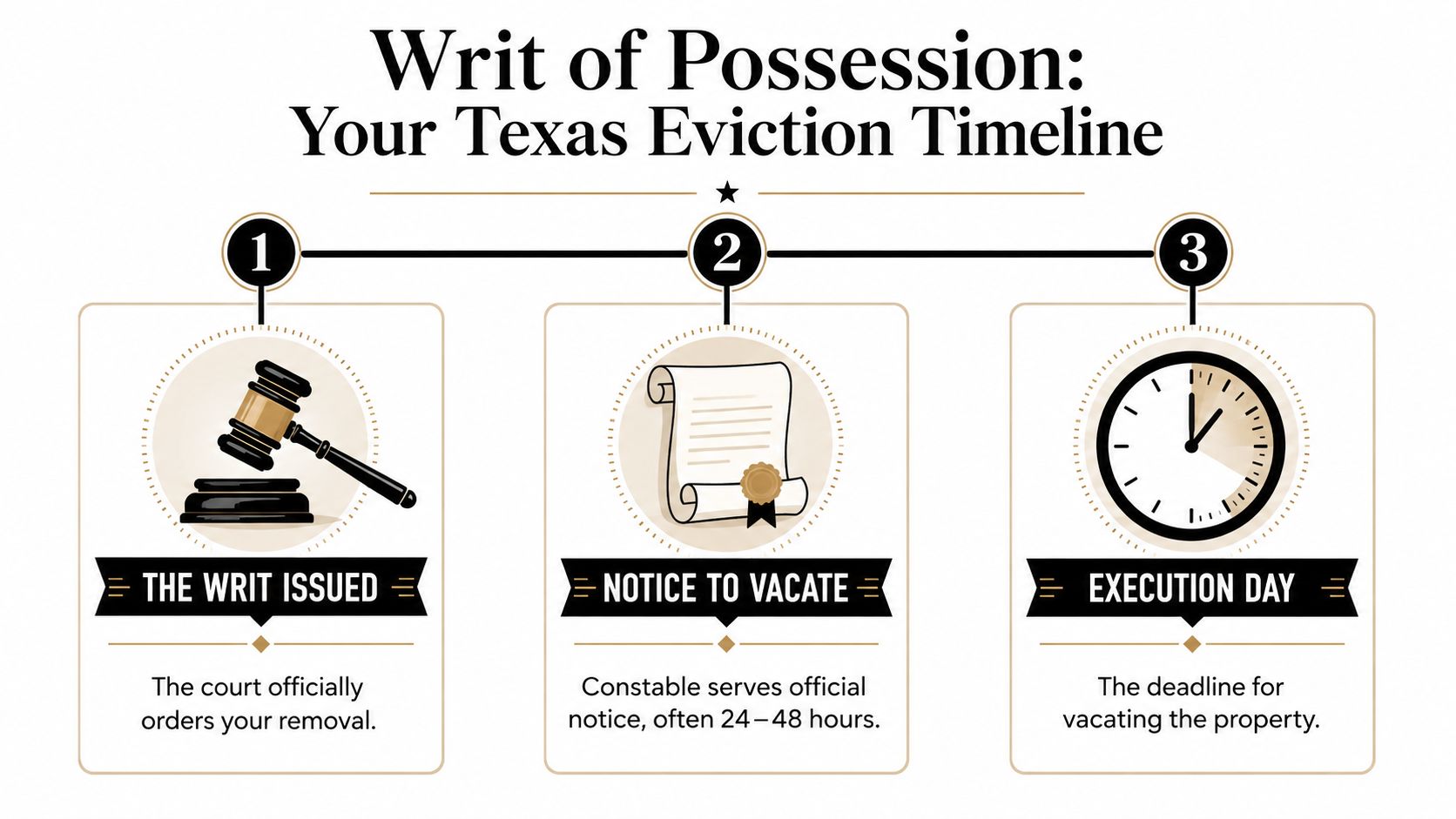
The writ of possession is the order that lets a constable or sheriff enforce the landlord's right to take back the unit. Once that process starts, your choices narrow fast. If you need the mechanics, review the Texas writ of possession process so you know what document to watch for and what service typically looks like.
The timeline is short, and strategy matters
Under the Texas State Law Library eviction process guidance, a landlord can request a writ of possession after the post-judgment waiting period runs. Once the writ is served, the tenant usually gets only 24 hours before enforcement can begin.
For practical planning, that means two things.
First, do not treat the time after judgment as open-ended. Second, do not wait for a constable's notice before deciding whether you are appealing or leaving. By then, the legal question is usually behind you, and the logistics are taking over.
What usually happens next
The sequence is straightforward:
- The court signs the judgment for possession.
- The short waiting period runs.
- The landlord requests the writ.
- A constable or sheriff serves or posts the writ.
- The 24-hour notice period starts.
- If you have not left, law enforcement can carry out the removal.
That timeline is why I tell tenants to make a business decision early. If there is a real basis to appeal, act immediately and do it correctly. If there is not, use the same window to protect your property, your cash, and your next housing option.
Waiting usually costs more than deciding.
What the writ means in real life
A writ of possession does not give the landlord personal authority to put you out on their own schedule. It authorizes law enforcement to enforce the judgment after notice. That distinction matters if the landlord is making threats, changing locks improperly, or trying to pressure you before formal enforcement.
It also matters for planning. Once the writ is posted, packing under pressure gets harder. Work shifts, school pickups, medications, pet care, storage, and transportation stop being routine tasks and become same-day problems. Tenants who use the earlier window usually spend less, lose fewer belongings, and avoid the chaos of a forced set-out.
The hard truth is simple. If you know you are not appealing, the best time to move your records, medicine, valuables, electronics, and anything irreplaceable is before the writ ever appears on the door.
Your First Big Decision Appealing the Eviction Judgment
You lost the hearing. By tonight or tomorrow, you need to decide whether to spend your time and money on an appeal or put that same energy into getting out on your own terms.
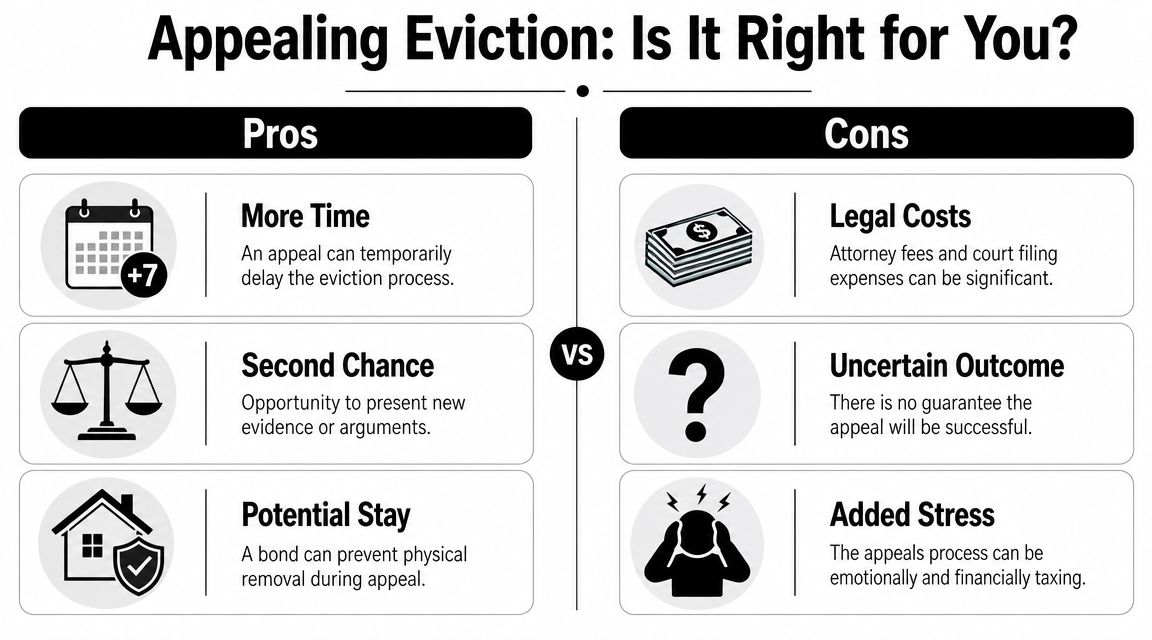
That decision should be made like a cost-benefit analysis, not out of panic. An appeal can buy time and give you a new hearing in county court, but it also brings filing requirements, payment obligations, and strict deadlines. If the case against you was weak or the court process was flawed, that cost may be justified. If the case was strong and the money is not there, using these next few days to protect your belongings and secure your next place is often the better move.
The appeal deadline is immediate
Texas eviction appeals move fast. As noted earlier, the deadline is generally very short, and a timely appeal sends the case to county court for a new trial rather than a simple review of what the justice court already did.
That point matters because tenants sometimes assume an appeal is just a request for the same judge to change course. It is a new round, with new preparation, new deadlines, and usually new costs. If you are even considering that route, treat the first 24 to 72 hours after judgment as decision time.
If you need the filing steps, forms, and timing in one place, review how to appeal an eviction in Texas right away.
Make the decision by weighing likely benefit against likely cost
Here is the question I ask clients. If you spend money and effort on an appeal, what are you realistically trying to gain?
Sometimes the answer is strong. You may have a real defense, a notice problem, proof the landlord sued the wrong person, rent records that were ignored, or a serious reason you missed court. In those cases, an appeal may be worth the filing pressure because there is a genuine path to changing the result or at least improving your position.
Sometimes the answer is time. Time can matter if you need a short window to line up housing, protect medical equipment, keep children in school, or avoid losing property in a rushed move-out. That is a legitimate factor. But time is not free. Depending on the case, keeping the appeal alive may require a bond, cash deposit, rent payments into the court, or paperwork showing you cannot afford costs.
A practical comparison looks like this:
| Option | Likely benefit | Likely cost or risk |
|---|---|---|
| Appeal | New trial in county court and possible delay in immediate removal | Fast deadline, paperwork, and possible bond, deposit, or rent payments |
| Move out promptly | More control over packing, storage, transportation, and valuables | Loss of the chance to challenge possession |
| Negotiate while preparing for one path | Possible extra move-out time or better terms | Deadlines still run unless a proper appeal is filed |
When an appeal usually makes financial and legal sense
An appeal usually makes more sense when the expected benefit is concrete, not just emotional.
- You have a defense that could change the outcome: defective notice, payment proof, retaliation issues, or a problem with who filed the case.
- You can meet the short-term cost: filing requirements and any ongoing payment obligation will not collapse the appeal a few days later.
- Extra time has a clear value: avoiding a job interruption, protecting a child's school arrangement, safeguarding health needs, or preventing the loss of important property.
When moving out is often the better business decision
I say this plainly because clients need a straight answer. If the nonpayment claim is accurate, the paperwork was proper, and you do not have money to maintain an appeal, paying to fight may only make the week more expensive.
In that situation, the better use of the next two or three days is usually practical, not legal. Move records, medications, cash, identification, electronics, work tools, and anything irreplaceable first. Confirm where you are going. Arrange help, transportation, pet care, and storage before the situation gets tighter.
A good appeal has facts, documents, and a payment plan behind it. A rushed appeal with no legal footing often costs more than it helps.
Make the choice quickly, but do not make it blindly. If there is a real legal issue and you can support the appeal, act at once. If there is not, protect your property and leave in a controlled way while you still can.
Beyond the Appeal Are There Other Legal Options
Not every tenant can pursue a full appeal. Some can't gather funds fast enough. Others learn about the judgment too late. Some need a narrower tool because the main problem was procedural, not the merits of the case itself.
That doesn't mean there are never alternatives. It means the available options are more specialized and more fact-dependent.
Motion for new trial and similar relief
In some situations, a tenant may ask the court for a new trial. This is not a routine second chance. It usually depends on a specific reason, such as a serious procedural issue or a failure that can be legally explained and supported.
This kind of request is strongest when tied to a concrete court problem, not just disagreement with the result. “The judge was unfair” usually isn't enough by itself. Documents, timing, and a clear explanation matter.
Statement of inability to afford costs
For lower-income tenants, cost is often the biggest barrier to acting quickly. Texas courts may allow fee-related relief through paperwork that shows inability to afford court costs. People sometimes call this a pauper's affidavit or statement of inability to pay.
That option can be critical because, as Texas Law Help explains in its eviction appeal guidance, an appeal can move the case to county court, but tenants may still need to pay at least a monthly rent amount during the process, and a supersedeas bond may be required for higher-court review to remain in the home. The same guidance notes that if a tenant loses the appeal, the court should give 10 days to move, but the tenant may still owe costs and rent.
Use the right tool for the right problem
A quick way to think about these options:
- Appeal: Best when you have a real challenge to the judgment and can act fast.
- Cost-waiver paperwork: Best when your obstacle is filing expense, not lack of legal grounds.
- New trial request: Best when something specific went wrong in the court process.
Don't treat these as interchangeable. They solve different problems. A good Texas landlord tenant lawyer or eviction attorney will ask two questions right away. What legal error exists, and what can you sustain over the next several days?
Practical Next Steps Retrieving Belongings and Moving On
After judgment, daily life becomes the issue. Kids still need school clothes. You may need medicine, IDs, work tools, chargers, passports, lease records, and bank paperwork. If your belongings are still inside the unit, don't wait until the last minute to think about them.
A common Texas scenario goes like this. The tenant loses in Justice Court, hopes the landlord will wait, and focuses on arguing about the case instead of preparing. Then the writ process starts. Now the tenant is trying to recover essentials under pressure, with limited transportation and almost no time to sort property.

What to move first
Don't pack in emotional order. Pack in legal and survival order.
- Start with documents: Identification, Social Security cards, birth certificates, tax records, court papers, banking records, and your lease.
- Pull daily-life essentials next: Medication, school supplies, uniforms, phones, chargers, keys, and pet items.
- Take irreplaceable property early: Family photos, keepsakes, small valuables, and anything tied to your work.
If your landlord has already changed the locks outside the normal eviction process, review your rights about a Texas landlord changing locks without notice because lockout rules can differ from a formal writ of possession situation.
How to handle property access
Keep communication short, polite, and documented. Ask for a specific pickup time. Confirm who will be present. If a constable is involved because the writ has been executed, follow law enforcement instructions closely and focus on retrieving critical property first.
Bring boxes, trash bags, medication lists, phone chargers, and a written checklist. Stress makes people forget what matters most.
A practical moving checklist can help if you're trying to get organized quickly. Even though it's written for a broader audience, 10 crucial steps for moving is useful for prioritizing utilities, address changes, and basic relocation tasks when you have very little time.
Think past this week
There's also the longer view. An eviction filing can affect future applications, and landlords screening tenants often focus on court history. That means your next move should include damage control.
Try to leave a paper trail that shows responsibility. Save texts and emails. Keep proof of move-out, key return, and any payment agreement. If you apply for new housing, be ready to explain the situation briefly and consistently. A short, truthful explanation usually works better than a long defensive one.
You should also separate emotional goals from practical goals. Proving the landlord was unpleasant may not help you secure your next apartment. Showing that you moved out responsibly, communicated, and stabilized your finances often helps more.
When You Need a Texas Eviction Attorney on Your Side
After an eviction loss, people often assume they have only two choices. Panic or give up. In reality, the better choice is usually to get a fast legal read on the case before you commit to either an appeal or a full move-out plan.
Texas timelines are short. The appeal deadline is short. The writ timeline can move quickly. And once removal is close, your options narrow. A tenant who gets advice early may spot a viable appeal issue, avoid a paperwork mistake, or decide quickly that moving out is the safer financial choice.
A good Texas landlord tenant lawyer also helps landlords and tenants see what works. Angry messages don't work. Delay without a plan doesn't work. Last-minute scrambling usually makes things worse. Clear advice, fast document review, and a realistic strategy do work.
If you know you're moving, outside logistics still matter. A general planning tool like this comprehensive UK moving checklist can help you think through storage, inventory, and utility tasks so you don't miss basics while dealing with court stress.
When your housing, record, and money are all on the line, getting advice from an eviction attorney isn't overreacting. It's risk management. Whether you're a tenant trying to protect your tenant rights or a landlord trying to enforce a judgment correctly under the Texas Property Code, speed and accuracy matter.
If you need help with an eviction, lease issue, or rental dispute, contact The Law Office of Bryan Fagan, PLLC for a free consultation today.