Dealing with a rental dispute is stressful enough. Then you learn a contractor, lender, or other claimant has placed a lien on the property. That can freeze a sale, delay refinancing, complicate a move-out, or turn a security deposit disagreement into something much larger.
For Texas landlords and tenants, the phrase release of liens definition isn't just legal vocabulary. It describes the document that proves a debt tied to property has been cleared. If you're trying to protect your home, your lease position, or your financial records, that document matters.
A lien issue doesn't always mean you've done something wrong. Sometimes the work was completed but paperwork never got finished. Sometimes a lender was paid off but the county records still show an old claim. Sometimes a repair dispute between a landlord and vendor spills into a tenant's life. The good news is that Texas law gives you tools to fix it.
Your Guide to Property Liens in a Landlord-Tenant Dispute
A landlord gets ready to sell a rental house after a tenant moves out. The title company pulls the records and finds a lien tied to repair work done months earlier. The bill may already be paid, but the public record still shows a claim against the property.
A tenant can run into a similar problem from a different angle. The landlord hires someone to address plumbing, electrical, or habitability complaints. Later, payment disputes start. The tenant didn't hire the contractor, but the property becomes tangled in a fight over money and paperwork.
That kind of problem creates real pressure fast.
Why liens feel so disruptive
A lien is a legal claim attached to property because someone says they're owed money. In rental situations, that can affect:
- Landlords trying to lease or sell the property without old repair claims following them
- Tenants disputing deductions from a security deposit after move-out repairs
- Owners in eviction or habitability disputes who need clear records showing bills were paid
- Property managers handling vendors who want proof a job is closed out properly
A paid bill and a cleared title aren't always the same thing. The public record has to reflect the payoff.
Why this matters under the Texas Property Code
Texas landlord-tenant disputes often involve repairs, security deposits, habitability complaints, and lease enforcement under the Texas Property Code, including provisions such as Section 92.001 and related rules that shape the landlord-tenant relationship. If repair work sits in dispute, a lien issue can become part of a much broader conflict.
A release of lien helps close that loop. It gives you a paper trail that says the debt tied to the property has been resolved. That can protect a landlord's investment and help a tenant challenge unsupported charges.
If you're looking for a plain-English release of liens definition, start here: it's the document that removes a property-based claim after the underlying obligation has been satisfied.
What a Release of Liens Means in Texas
The easiest way to understand a lien is to think of it as a legal sticky note on title. It tells the world that someone claims a right to payment connected to that property.
A release of lien removes that sticky note.
The simple definition
In plain English, a release of liens is an official document showing that a recorded lien no longer has force because the debt was paid, settled, or otherwise resolved. Once properly signed and recorded, it clears the claim from the public record.
For many clients, I describe it as the property-law version of a paid-in-full receipt. But unlike an ordinary receipt, this one matters because title companies, buyers, lenders, and courts may rely on it.
What the document usually needs to do
A useful release should clearly tie back to the original claim. It typically identifies:
- The property affected by the lien
- The lienholder who had the claim
- The original lien or debt being released
- The statement of satisfaction showing the obligation is no longer outstanding
If any of that is vague, the release may not fix the problem cleanly.
Why landlords and tenants should care
In landlord-tenant matters, liens often show up through repair work, loan payoffs, or disputes over who paid for what. A landlord may need proof that a contractor no longer has a claim. A tenant may need evidence that repair deductions were tied to legitimate, completed, paid work rather than loose bookkeeping.
Texas law also sets strict timelines in some lien contexts. Under Texas Finance Code §343.108, a mortgage servicer must deliver a release of lien within 60 days after the loan is paid off, and that can shorten to 30 days if the mortgagor makes a written request within the first 20 days after payoff, as stated in Texas Finance Code Section 343.108.
Practical rule: If the debt is paid, don't stop at proof of payment. Make sure the release gets prepared and recorded.
Full release and partial release
Not every release works the same way.
A full release removes the entire lien because the full debt has been satisfied. A partial release removes only part of the property or part of the claim. That can matter with larger tracts or phased work, though most rental readers are dealing with full releases.
This is why details matter. The release of liens definition sounds simple. The risk comes from using the wrong document or leaving the county records unchanged.
Lien Release vs Waiver vs Satisfaction
A rental dispute often turns on one bad assumption. Someone sees "paid" in an email thread and believes the property record is clean. Then a refinance, sale, insurance review, or judgment search shows the claim is still there because the wrong document was signed.
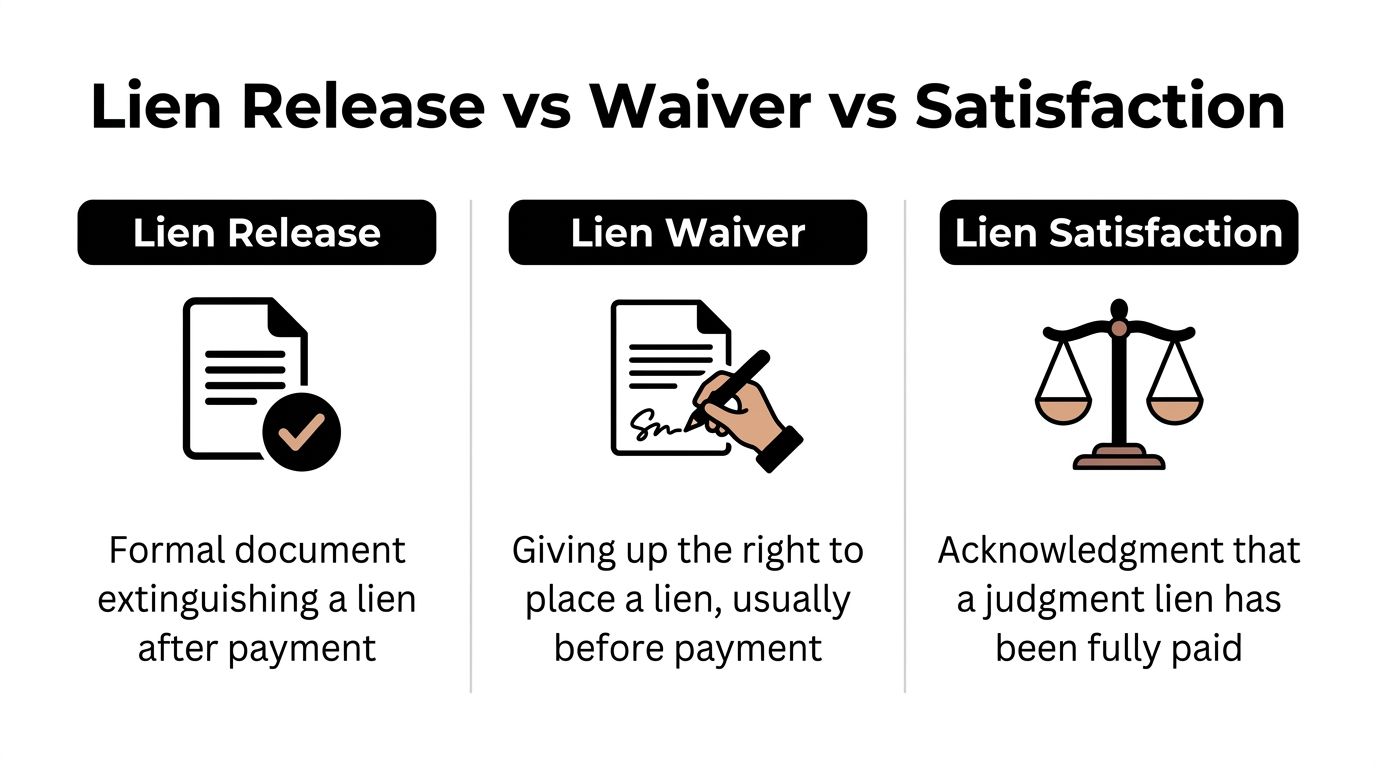
For Texas landlords and tenants, these terms matter for different stages of the same problem. A waiver helps prevent a future lien claim. A release clears a lien that already exists. A satisfaction confirms a debt has been paid, usually in a loan or judgment setting. If you use the wrong one, you may settle the money dispute and still leave a title problem behind.
The side-by-side difference
| Term | When it is used | What it does |
|---|---|---|
| Lien waiver | Before a lien is filed, often during progress or final payment | Gives up lien rights for the amount and work covered by the document |
| Lien release | After a lien already exists or has been recorded | Removes the existing lien claim from the property record |
| Satisfaction | After a secured debt or judgment is fully paid | Confirms the underlying debt has been paid in full |
Waiver prevents future trouble. Release fixes an existing record problem
Timing controls the answer.
If a contractor has not filed a lien, a waiver may protect the landlord against a later claim for the amount paid. If the lien has already been filed, a waiver usually does not clear county records. The property owner needs a release signed by the claimant and, in many cases, recorded in property records.
That distinction shows up in ordinary rental conflicts, not just construction draws. A landlord pays for emergency plumbing after a tenant complaint. The vendor cashes the check, but a dispute remains over extra charges. If the vendor has already filed a lien affidavit, the landlord's file needs more than proof of payment. It needs a release that removes the claim.
Where satisfaction fits
"Satisfaction" usually appears with mortgages, deeds of trust, and judgment liens rather than routine repair invoices. The document confirms the debt itself has been paid. That matters because payment alone does not clear the public record quickly or automatically.
In landlord-tenant disputes, satisfaction issues often surface when a rental property owner is dealing with an old judgment that still clouds title or affects collections. If that is the problem, this overview of a Texas abstract of judgement explains how judgment-related claims can attach to property records.
Match the document to the stage of the dispute. That is how you protect title and avoid paying twice to fix the same record problem.
What to ask for in real life
Use a waiver when payment is being made and the claimant still has the right to file a lien.
Use a release when a lien has already been filed, recorded, or otherwise asserted against the property.
Use a satisfaction when the debt being cleared is a loan or judgment, and the record needs formal proof that the obligation has been paid.
Texas readers should also be careful with security deposit disputes. Under Texas Property Code § 92.109(c), a landlord who wrongfully withholds a security deposit can face statutory damages, court costs, and reasonable attorney's fees. That is not a lien rule, but it is a good example of why labels and paperwork matter. Calling something "settled" does not make the legal exposure disappear.
Common mistakes
- Signing a waiver after a lien was already filed and assuming that clears the record
- Treating a paid invoice as the same thing as a release
- Accepting a satisfaction of debt when the county records still show a separate lien filing
- Relying on emails or text messages instead of the signed document that matches the legal issue
- Failing to confirm whether the release or satisfaction was recorded where it needs to be
The trade-off is simple. Quick paperwork may close the immediate argument, but precise paperwork protects the property. In my experience, landlords and tenants both do better when they slow down long enough to ask one question first: are we preventing a lien, removing a lien, or proving a debt was paid?
When Lien Releases Matter for Landlords and Tenants
Many people associate liens with large construction projects. In practice, they can surface in very ordinary rental disputes.
A leaking shower turns into a plumbing invoice. Emergency electrical work follows a tenant complaint. A landlord uses a contractor after move-out damage. If payment and paperwork don't line up, the property can end up carrying the consequences.

Repair disputes after habitability complaints
Say a tenant reports serious water intrusion. The landlord hires a plumber and a restoration company. The work gets done, but a payment dispute breaks out with one of the vendors.
The tenant may assume the issue is over because the repair happened. It isn't always over. If the contractor records a mechanic's lien, the property now carries an active claim. That can complicate a sale, a refinance, or even the owner's ability to prove the repair issue was responsibly handled.
Texas mechanics lien rules are strict. A lienholder must provide a full release within 10 days of receiving full payment, according to this explanation of Texas lien release timing. That source also notes this quick turnaround matters in fast-moving rental markets like Houston and Dallas-Fort Worth.
Security deposit fights and paid repair work
Move-out disputes often come down to proof.
A landlord withholds part of a security deposit because of wall damage, flooring damage, or cleanup work. The tenant asks for documentation. Paid invoices help, but a release can matter too if a lien or lien threat entered the picture.
For landlords, this is about showing the matter was handled completely. For tenants, it's about testing whether the claimed repair costs were real, settled, and tied to actual work rather than inflated estimates.
Authorized tenant repairs
Some tenants, especially in urgent habitability situations, coordinate repairs with the landlord's approval. If reimbursement follows, everyone should want clean paperwork from the contractor.
That protects the tenant from being pulled into a later "we never got paid" argument. It also protects the landlord from paying twice or facing a public-record problem after the underlying work was supposedly resolved.
Good repair documentation closes loops. Bad documentation leaves people arguing months later over work everyone thought was finished.
Common rental situations where releases matter
- Turnover work between tenants when a landlord needs clear vendor records before releasing the unit
- Commercial lease repairs where tenant improvements may involve outside contractors
- Insurance-related restoration after storms, leaks, or fire damage
- Sale or refinance of rental property where old repair claims suddenly reappear in title review
A Texas landlord tenant lawyer or eviction attorney often sees these issues only after they have already delayed a larger goal. The practical move is earlier. If repair work creates lien exposure, get closure in writing and make sure the paper trail matches the payment trail.
How to Get and Record a Lien Release in Texas
A landlord pays a contractor after a turnover repair. A tenant settles a disputed charge tied to emergency work. Everyone assumes the problem is over. Then a sale, refinance, or title review turns up the old lien because nobody finished the last step.
That is fixable, but only if the paper trail is handled correctly.
Start with proof the debt was resolved
Before you ask for a release, confirm exactly what was paid, who was paid, and what claim is supposed to come off the record. In landlord-tenant disputes, that point gets muddied fast. A tenant may have reimbursed a repair bill. A landlord may have paid only part of an invoice under a settlement. A vendor may claim the payment covered one job but not another.
Pull together:
- Proof of payment, such as cleared checks, wire confirmations, or settlement receipts
- The recorded lien information, including the filing details if you have them
- The property description, ideally matching the county record
- Any written settlement terms showing whether the payment was full satisfaction or a compromise
If the dispute grew out of repair or improvement work, the rules in Texas Property Code Chapter 53 for mechanic's and materialman's liens often affect what document you need and whether the wording is broad enough to protect the property.
Request the release in writing
A phone call is not enough.
Send a dated written demand asking for a signed release that identifies the original lien, the property, and the fact that the debt has been discharged. Email can work. Certified mail is often better if you expect resistance. The goal is simple. Create a clean record showing that payment was made and a release was requested.
For residential mortgage liens, Texas law sets deadlines for providing and recording a release after payoff. Those timing rules matter if an old home-equity or other residential lien is clouding title in a rental dispute, especially when a landlord is trying to close, refinance, or prove that a claimed debt was already satisfied.
Texas also has a procedure for clearing certain stale liens through an affidavit under Texas Property Code Section 12.017. That statute is narrow and technical. Use it carefully, because an affidavit is not a substitute for a proper release when the lienholder is available and willing to sign.
Review the release before you file it
I have seen people get a signed release, record it, and still have title trouble because the document was sloppy.
Check the release against the original lien line by line:
- Property description
- Owner name
- Lender or claimant name
- Recording information for the original lien
- Clear release language
- Signature and notarization if the county requires it for recording
One wrong lot number can create a second problem instead of solving the first.
This walkthrough may help you visualize the process before you file:
Record it with the county clerk
Recording is what clears the public record. Keeping the release in a folder only proves you have a document.
File the release in the county where the property is located. Then get a file-stamped copy or other recorded confirmation for your records. For landlords, this protects a future sale, refinance, or insurance claim. For tenants, it can matter when a landlord tries to pass through costs tied to a lien that should have been released already.
If the county record still shows the lien, a buyer, lender, or title company may treat it as active until someone proves otherwise.
A practical order of operations
Confirm the payoff or settlement terms
Make sure the payment resolved the claim being released.Send a written request for the release
Keep proof of delivery.Compare the release to the original lien
Check names, dates, recording data, and legal description.Record the signed document with the county clerk
Do not assume the lienholder handled this for you unless you have proof.Save the full file
Keep the payment proof, correspondence, signed release, and recorded copy together.
That extra follow-through saves landlords and tenants from a lot of expensive cleanup later.
Common Pitfalls and How to Protect Yourself
A landlord settles a repair bill, or a tenant proves a charge was paid, and everyone assumes the problem is over. Then a refinance, sale, deposit dispute, or title review brings the old lien back to life because the paperwork never closed the claim.
I see this more often than outright fraud. The trouble usually starts with an incomplete release, a missing filing, or a document that says less than the parties thought it said. In the landlord-tenant context, that can affect much more than title. It can shape who pays for repairs, whether a deposit deduction holds up, and whether a property owner can move forward without a stale claim hanging over the record.
The most common errors
Relying on proof of payment alone
A paid invoice, cleared check, or email saying "resolved" does not remove a lien from the public record.Using the wrong document
A waiver, a release, and a satisfaction are not interchangeable. If the lienholder signs the wrong form, the dispute may continue even after money changed hands.Signing before funds are final
If payment is by check, installment, or settlement with conditions, timing matters. The release should match the actual status of the obligation.Ignoring old claims because they seem harmless
Stale mortgage, judgment, tax, mechanic's, or vendor-related claims can disrupt a later transaction at the worst possible time.
A hard truth about "final" paperwork
The word "release" on the page is not enough. Read the actual language. Some documents release only part of a claim, release rights only through a certain date, or tie the release to conditions that have not happened yet.
That is especially important in Texas rental disputes involving repairs or turnover charges. A landlord may have paid a contractor after emergency work at the property. A tenant may be fighting a pass-through charge or security deposit deduction tied to that same work. If the lien paperwork is incomplete, both sides can end up arguing over a debt that should have been closed.
An unconditional release is usually the cleaner result once final payment has cleared.
If the lienholder refuses to cooperate, a bond may be one possible tool in some cases, but cost depends on the claim, underwriting, and the facts of the dispute. Treat any online premium example as a general illustration, not a Texas rule. Before spending money on a bond, compare that option against a direct demand, negotiated release, or court order.
When delay is the strategy
Some lienholders stall on purpose. They know an unresolved claim can pressure a sale, loan, or settlement. In that situation, polite follow-up has a limit.
A formal written demand often comes first. If the record still is not corrected, court action may be necessary. In title-focused disputes, a quiet title action in Texas can be the right step when the county records continue to show a claim that should no longer cloud the property.
An old lien does not become safe just because the parties are tired of discussing it.
Protective habits that help
The strongest protection is routine, disciplined follow-through:
Keep written proof of every payment and agreement
Save invoices, checks, confirmations, settlement terms, and emails in one file.Compare the release to the original lien
Names, dates, recording details, and legal description should match.Ask for clear final-release language
If you are paying the claim in full, the document should say so plainly.Check the county record after filing
Do not assume the other side, the title company, or the contractor finished the job.Get help organizing the file if the dispute is document-heavy
Services such as Hire Paralegals can assist with document organization and workflow, alongside legal review where required.
These habits protect property value for landlords and preserve evidence for tenants. In real cases, that paper trail often decides whether a repair charge stands, whether a deposit deduction survives scrutiny, and whether an old lien can still interfere with the property.
Get Expert Help Protecting Your Property Rights
A lien can make you feel stuck, but the right document changes the position completely. A proper release tells the record, the other side, and any future buyer or lender that the claim has been resolved.
For landlords, that can protect a rental property's title and support your position in a repair or deposit dispute under the Texas Property Code. For tenants, it can help you challenge charges that don't match the actual paperwork or payment history. The details matter, and small mistakes can keep an old dispute alive.
If you're trying to organize records before litigation or a settlement review, practical support can help. Some clients also use outside administrative help such as Hire Paralegals to assist with document organization and workflow, alongside legal review where required.
The Law Office of Bryan Fagan, PLLC handles Texas landlord-tenant disputes involving leases, evictions, repairs, security deposits, and property-related conflicts. If a lien issue is interfering with your rights or your next step, get legal advice before the problem spreads.
If you need help with an eviction, lease issue, or rental dispute, contact The Law Office of Bryan Fagan, PLLC for a free consultation today.