Dealing with a renovation at your rental property can feel like progress. The units are finally coming back online. Contractors are wrapping up. Tenants are asking for move-in dates. You expect the hard part to be over.
Then a notice arrives from a company you never hired. It says they supplied materials to your job, they have not been paid, and they may assert a lien against your property. At that point, many owners ask the same question. How can someone I never signed a contract with make a claim against my building?
That is where texas property code chapter 53 matters. It is the part of Texas law that governs mechanic’s, contractor’s, and materialman’s liens. For landlords, investors, and property managers, it is not just construction law. It is title risk, payment risk, and project management risk all at once. If you are renovating a rental house, repairing storm damage at an apartment building, or updating a commercial space, Chapter 53 affects how you should contract, pay, document, and respond.
A Texas landlord tenant lawyer often sees the same pattern. The owner focuses on bid price and project timing, but not on lien compliance. That works until payment breaks down somewhere below the general contractor. Then the owner can face delayed leasing, refinancing problems, and a dispute over whether they must pay twice for the same work.
A Property Owner’s Nightmare A Surprise Lien on Your Property
A landlord in Texas hires a general contractor to renovate several units after water damage. The work looks complete. The contractor gets paid. A week later, the owner receives a certified letter from a plumbing supplier the owner has never heard of.
The supplier says its invoices remain unpaid. It claims it furnished materials to improve the property and warns that a lien may follow. The owner checks the file and realizes there is no organized record of subcontractor notices, no clean set of lien waivers, and no clear holdback.
That situation is common because construction payment chains are layered. Owners pay the original contractor. The original contractor pays subs. Subs pay suppliers. If money stops moving anywhere in that chain, the dispute can land on the property itself.

Why landlords get caught off guard
Most owners do not expect strangers to have legal rights tied to their property. But Chapter 53 was built to protect people who furnish labor or materials that improve property. If they meet the statute’s requirements, they may assert lien rights even when the owner never dealt with them directly.
That catches landlords during the worst possible moment. They are trying to re-lease units, close on a refinance, or stabilize occupancy after repairs. A lien claim can cloud title and force the owner to stop and investigate before moving forward.
For some owners, the confusion gets worse if the project involves a residence with homestead issues. Different rules can apply in that setting, and owners should understand the added formalities involved. If that may affect your property, review these Texas homestead laws.
Practical takeaway: If you own the property, do not assume your only risk is the contractor you hired. Under Chapter 53, payment disputes lower in the chain can become your problem too.
What owners usually regret
Owners rarely regret over-documenting a project. They do regret informal payment practices.
The most expensive mistakes usually look ordinary at the time:
- Paying too fast: Releasing money before confirming who has supplied labor or materials.
- Trusting verbal assurances: Accepting “everyone’s been paid” without backup.
- Ignoring notices: Treating a notice from an unknown subcontractor or supplier as someone else’s dispute.
- Using a thin contract: Failing to set payment conditions, waiver requirements, and retainage handling in writing.
A good response starts with understanding what a mechanic’s lien is and why Texas law gives claimants that remedy.
What Is a Mechanic’s Lien Under Texas Law
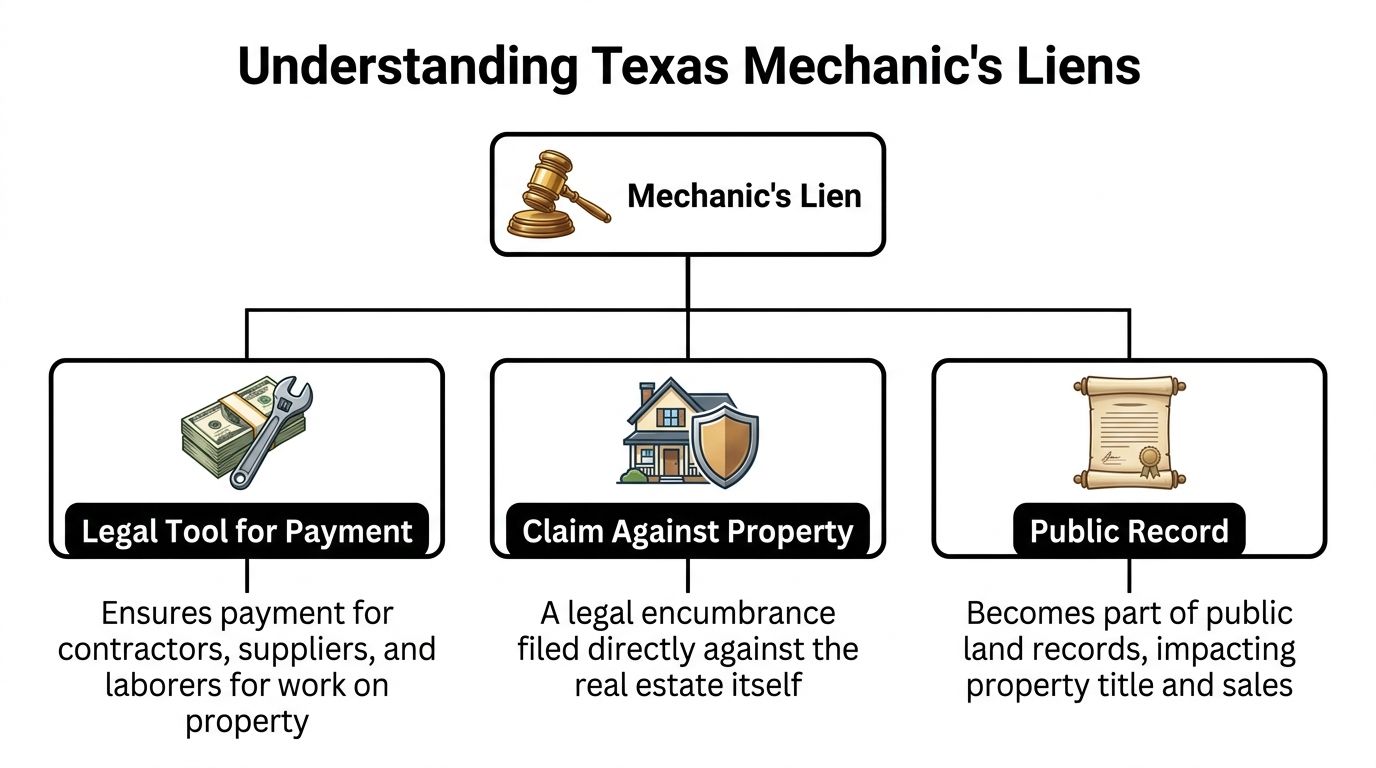
To secure payment for work or materials, Texas law allows a legal claim called a mechanic’s lien to attach to the property itself. For an owner, that means a payment dispute can become a title problem.
Chapter 53 sets the rules for creating and enforcing many of these lien rights. The remedy also has constitutional roots under Article XVI, Section 37 of the Texas Constitution. The practical point is simple. If the claimant follows the statute closely enough, the property can be pulled into a dispute even when the owner already paid someone on the job.
Who Chapter 53 protects
Owners and landlords often assume lien rights belong only to the general contractor. Chapter 53 reaches much further than that.
Depending on the project and the claimant’s role, lien rights may extend to subcontractors, laborers, material suppliers, and certain design professionals covered by the current statute. That is why renovation risk often shows up from a company the owner never hired and may never have spoken with. A drywall supplier, electrician, roofer, or surveyor can become part of the owner’s problem if payment breaks down in the contracting chain.
That is the first trap.
An owner may pay the original contractor in full and still face claims from parties lower in the chain if notice and filing requirements were met.
Why a lien matters to an owner
A mechanic’s lien can stall a sale, delay a refinance, complicate a title review, and force money to stay tied up while the dispute is sorted out. On rental property, that can hit at the wrong time. Unit turns, lender deadlines, and leasing plans do not pause because a contractor dispute surfaced in county records.
The pressure is not just legal. It is operational. Owners often have to gather contracts, draw requests, change orders, proof of payment, notices, and waiver documents quickly because a title company, buyer, or lender wants answers now.
For landlords, the usual pressure points look like this:
| Issue | Why it matters |
|---|---|
| Refinancing | Lenders commonly require lien issues cleared or bonded around before closing |
| Sale timing | Buyers and title companies may delay funding until the claim is addressed |
| Tenant work | Renovation schedules and turnover plans can slip while the dispute is investigated |
| Cash flow | Owners may need to hold reserves or spend legal fees before the merits are resolved |
Constitutional and statutory lien rights
Texas lawyers separate statutory liens from constitutional liens for good reason. The distinction affects who may claim a lien and what rules apply.
A statutory lien depends on compliance with Chapter 53. Notices must go to the right parties. Affidavits must contain the required information and be filed in the right county records on time. Small defects can create large arguments.
A constitutional lien is narrower and is usually discussed when the claimant contracted directly with the owner. Owners should not treat that as a comfort. In practice, the safest approach is the same in either setting: get the contract right, track notices, verify who remains unpaid, and keep clean payment records. Those documents often decide whether a claim can be removed quickly or turns into a longer fight.
Deadlines create pressure
Chapter 53 rewards the party that keeps up with the calendar. Owners who ignore an early notice often lose time they could have used to freeze payments, demand backup, or correct paperwork before the title issue hardens into a recorded claim.
Original contractors, subcontractors, and suppliers do not all work under the same deadlines, and the date can turn on whether the project is residential or nonresidential. Owners do not need to memorize every deadline. They do need a system that treats each notice as a prompt to review the payment file, contract status, and retainage position immediately.
That is how owners avoid the second trap. A lien is rarely just a form filed at the end of the job. It is usually the result of earlier notice rights, payment decisions, and recordkeeping failures that gave the claimant room to act.
Your Shield Statutory Retainage and Notices
A landlord hires a general contractor to renovate several units, pays draws on time, and assumes the job is under control. Then a supplier the landlord has never met sends notice that it has not been paid. If the owner has already released too much money, that routine renovation can turn into a title problem and a double-payment dispute.
Chapter 53 gives owners one of the few practical tools that still works after a payment chain breaks. Statutory retainage under Section 53.101 requires the owner to hold back 10% from payments on covered projects. If the owner does that correctly, the retained fund can cap exposure to downstream lien claims. If the owner does not, the owner may lose that protection, as discussed in this explanation of owner liability and mechanics lien claims under Section 53.101.
What retainage protects
Retainage is more than a contract term. It is a reserved fund that protects against unpaid subcontractors and suppliers who may never have had direct contact with the owner.
That point matters most on renovation work. Owners and property managers often know the general contractor and maybe one or two visible trades. They do not always know every supplier, lower-tier subcontractor, or labor broker on the job. The retainage fund gives the owner a controlled pool of money to address claims that surface late, after work is in place and before final payment should be released.
The common mistake is simple. Owners treat the last payment as a relationship issue rather than a legal risk issue. Paying in full before retainage questions are cleared can cost far more than the amount withheld.
Notices change what a careful owner should do next
A notice is not background paperwork. It is a warning that someone in the payment chain claims they are unpaid and may assert rights against the property or against funds still in the owner's hands.
Some notices trigger fund-trapping issues. In practical terms, they tell the owner to stop sending money downstream until the payment file is checked. That does not mean every notice is valid. It does mean every notice deserves a prompt review of the contract balance, the draw history, prior waivers, and what the contractor says is still owed.
Owners who manage multiple properties should treat lien notices the same way they treat physical condition reports. A standardized intake process prevents details from getting lost, much like a property inspection checklist for landlords helps track recurring issues unit by unit.
A workable response process includes:
- Record the receipt date immediately
- Confirm the notice matches the correct property and scope
- Check how much remains unpaid under the prime contract
- Request supporting records from the contractor
- Hold disputed funds until the facts are sorted out
- Get legal review if the notice, waiver file, or payment history does not line up
One overlooked risk deserves emphasis. If a notice identifies a trade or supplier that never appeared in your payment records, the problem may be your documentation, not the notice.
Releasing retainage too early is where owners get hurt
Holding retainage helps only if the money stays in reserve long enough. Owners often understand the 10% rule and still make the costly mistake of releasing it too soon.
Chapter 53 ties the release of reserved funds to claim timing and resolution. The safe practice is to hold retainage until the statutory period has run and any pending claim has been resolved. Early release can wipe out the protection the owner expected to have.
That is one reason I tell owners to separate project completion from payment finality. The contractor may say the work is done. The lien risk file may say otherwise.
Waivers help, but only inside a disciplined payment system
Lien waivers are useful evidence. They are not a substitute for retainage, notice tracking, or payment verification.
A waiver signed by the wrong entity does little good. A waiver collected without checking who supplied labor or materials can create false confidence. On renovation jobs with frequent change orders, phased turnover, or work spread across multiple buildings, waiver review needs to match the payment trail line by line.
That is also where good cost controls help. Owners using tools such as Exayard construction estimating software often do a better job tying scope changes, draw approvals, and backup documents to the same payment record. Better records do not eliminate disputes, but they make it much easier to freeze the right funds and challenge weak claims.
A key trade-off
Contractors want prompt payment and quick release of holdback. Owners want the job closed. Both goals are understandable.
The legal risk does not disappear because the project feels finished. Statutory retainage slows final payout, and some contractors will push back on that. Owners who ignore the requirement can end up paying once to the contractor and again to an unpaid claimant. From a risk-management standpoint, that is a bad trade.
Owners usually avoid the worst Chapter 53 problems when they do three things consistently: hold the required retainage, treat every notice as a live payment issue, and refuse to release final funds until the paperwork and timing both support it.
A Compliance Checklist for Every Construction Project
Owners do better with a checklist than with a stack of statutes. Chapter 53 punishes casual administration. It rewards routine.
Start every project with one file, one payment log, and one person responsible for tracking notices. If your renovation budget is moving across multiple units or buildings, that discipline matters even more.
Before work starts
The best time to avoid a lien dispute is before the first invoice.
Use a written contract that identifies the property, the scope, the payment schedule, who handles change orders, and what paperwork must be delivered before each draw. If the project budget is still developing, many owners pair their contract review with a cost-tracking tool such as Exayard construction estimating software so scope changes and payment approvals are documented in one place.
Also decide early who will collect and review project paperwork. On small landlord jobs, that is often the owner. On larger jobs, it may be a manager, bookkeeper, or outside counsel. What matters is that someone is accountable.
A useful pre-job list includes:
- Confirm ownership details: Make sure the contracting party matches the property owner or authorized entity.
- Define payment conditions: Require invoices, supporting detail, and waiver paperwork before money goes out.
- Plan document storage: Keep contracts, notices, draw requests, and correspondence in one organized file.
- Think about inspections: A strong inspection process helps tie completed work to payment decisions. This property inspection checklist for landlords can help owners build that habit.
During construction
The middle of the project is where most owners drift into risky habits.
A contractor asks for a draw. The owner sees visible progress and approves payment. Later, a supplier claims it was not paid. That pattern is common because visible progress does not prove the payment chain is healthy.
Keep a running job ledger. Each payment should match a draw request, supporting paperwork, and any required waiver forms. If new trades appear on site that were not part of the original understanding, note them. If notices arrive, freeze the payment conversation until you understand the issue.
Here is a practical rhythm:
- Review the draw request carefully. Match it to completed work.
- Check whether any notices have arrived. If yes, stop and investigate before releasing more money.
- Collect current waivers. Make sure they line up with the entities involved.
- Update your retainage records. Keep the statutory holdback separate and visible in your accounting.
- Track change orders in writing. Verbal changes are where billing confusion grows.
Owners who want a simple visual overview of project controls may find this walkthrough useful before their next renovation.
Key habit: Never let urgency from tenants, vacancy pressure, or contractor demands override your documentation process. Fast payment without clean records is usually what creates the second payment fight later.
After substantial work is done
The end of a project feels like the time to clear the file. It is the time to slow down.
Before final release, confirm what claims or notices are still outstanding. Make sure your file shows what was paid, to whom, and against what work. If there is any mismatch between the contractor’s story and the notices you received, resolve that conflict before treating the project as closed.
A short closing checklist helps:
| Closing step | Why it matters |
|---|---|
| Reconcile the contract and change orders | Prevents final invoices from drifting beyond the agreed scope |
| Collect final paperwork | Reduces the chance of later payment surprises |
| Review all notices received | Helps identify unresolved lower-tier claims |
| Hold funds until safe to release | Avoids losing statutory protection by paying too soon |
The owners who stay out of trouble are not always the most astute. They are the most consistent.
Common Lien Disputes and Strategic Remedies
Even organized owners can end up in a Chapter 53 dispute. The difference is that prepared owners usually have options.
A lien claim is not self-proving just because it was filed or threatened. The owner’s first job is to slow down, preserve records, and ask whether the claimant followed the statute. The second job is to choose a remedy that fits the business goal. Sometimes that means negotiating. Sometimes it means challenging the lien. Sometimes it means clearing title first and fighting later.

Dispute one you get a notice from someone you never hired
This is the classic owner reaction. “I do not know this company, so this cannot be my problem.”
Under Chapter 53, that response can be costly. A subcontractor or supplier may still have rights even without a direct contract with the owner. The smart move is to compare the notice to your payment log, your contract, and any waiver file you have maintained.
Ask practical questions first:
- Was this company involved in the work?
- Did the contractor list them in any pay application or backup?
- Was the notice timely and tied to this property?
- Is there still money in the owner’s hands that should be withheld?
Many disputes shrink once the paperwork is lined up. Others expand because the owner realizes payments were released without enough controls.
Dispute two the sham contract problem
Some cases involve a deeper issue. The owner and the supposed original contractor are so closely connected that the arrangement looks suspect.
Texas addresses that in Section 53.026, often called the Sham Contract Statute. Under that rule, a subcontractor dealing with a purported original contractor who is controlled by the owner can be treated as an original contractor for lien perfection purposes, giving that subcontractor more favorable deadlines, as discussed in this review of Texas Property Code Section 53.026 and the sham contract statute.
For owners and managers, the lesson is clear. Do not use related entities casually on construction projects. If ownership, management, or control overlaps in a way the statute targets, lower-tier claimants may gain stronger lien timing rights than you expected.
Dispute three a filed lien clouds title during a sale or refinance
Sometimes the owner does not have time to wait for a full merits fight. A pending closing, refinance, or lease transaction puts pressure on title clearance.
In that setting, one strategic option may be to obtain a bond to remove the lien from the property while the dispute continues separately. Owners often call this “bonding around” the lien. It can be a useful business solution because it clears the title issue without conceding that the claimant is right.
That is also where related title remedies may come into play. If your broader concern involves judgments affecting property records, it may help to understand how a Texas abstract of judgement can affect real estate risk.
Strategic point: Not every lien dispute should be fought the same way. If title speed matters more than immediate courtroom advantage, a bond remedy may make sense.
When owners should challenge the lien directly
Some liens should be attacked, not paid.
Common grounds for challenge include missed deadlines, defective notices, incorrect property descriptions, unsupported amounts, or claims that do not fit Chapter 53 at all. Owners should gather the contract, change orders, draw history, notices, waiver forms, and completion records before choosing that path.
A strong challenge usually depends on records created long before the dispute. That is why prevention and remedy are linked. Owners who run loose projects often have weak defenses later, even when the claimant made mistakes.
How 2022 Legislative Changes Affect You
Owners who rely on old lien checklists can make current projects harder than they need to be. Important changes took effect through HB 2237 on January 1, 2022.
The broad idea behind the amendments was simplification. In practice, the revisions did simplify some parts of the law and complicated others.
What became clearer
The amendments introduced mandatory lien waiver forms under Subchapter L and added new notice rules. They also broadened definitions in Chapter 53 so that “improvement” can include designs, plans, and surveys by licensed professionals, and “labor” can include related professional services, as summarized in this analysis of changes to the Texas Mechanics and Materialman’s Liens Act effective January 1, 2022.
For owners, that means two practical things.
First, more participants on a project may fall within the lien framework than some older forms and habits assume. Design-side contributors are not always outside the conversation now.
Second, standardized forms can help reduce confusion if everyone uses them correctly. That is an improvement over improvised waiver language and uneven notice practice.
What remains messy
The 2022 changes did not remove every trap. One major area of continuing concern is the treatment of reserved funds, sometimes discussed using older retainage terminology.
The amendments left ambiguity about deadlines for claims on reserved funds, creating potential conflicts in the statute. That uncertainty means owners should be conservative rather than aggressive when deciding whether funds are safe to release. If your team is relying on an old deadline chart without checking whether it still fits post-2022 projects, that is a real risk.
How owners should adjust
The right response is not panic. It is an updated process.
Use current forms. Review contracts and payment procedures for projects that began after the amendments took effect. Train whoever receives mail, emails, and notices so they do not miss a legally significant communication because it looks unfamiliar.
A simple adjustment list helps:
- Update forms and templates: Old waiver language may not match current law.
- Review professional service roles: Architects, engineers, and surveyors may matter more than your older checklist assumes.
- Treat reserved-fund timing cautiously: Do not rush release decisions where the statute remains unsettled.
- Get project-specific advice when facts are unusual: Mixed-use projects, related-party contracts, and delayed notices deserve closer review.
Bottom line: The 2022 revisions made Chapter 53 more accessible in some respects, but they also increased the risk of owners using outdated assumptions on current jobs.
Protect Your Investment with an Experienced Attorney
Chapter 53 is not hard because the idea is confusing. The idea is simple. People who improve property need a path to get paid. The hard part is compliance. Deadlines, notices, waiver forms, retainage handling, and title strategy all need to line up.
For landlords and managers, the biggest risk is usually not one dramatic mistake. It is a series of small ones. A draw gets approved without backup. A notice sits unopened. A final payment goes out before the file is clean. Then a routine renovation turns into a lien dispute that delays leasing or clouds title.
A careful attorney helps at two stages.
Before work starts, legal review can tighten your contract, payment process, and recordkeeping. After a notice or lien appears, legal review can test whether the claim is valid, whether funds must still be withheld, and whether the best move is negotiation, a direct challenge, or a title-clearing remedy.
If you are dealing with tenant rights concerns, repairs after damage, an eviction attorney issue tied to construction work, or broader Texas Property Code compliance, it helps to get advice before the problem gets expensive.
If you need help with a mechanic’s lien, lease issue, renovation dispute, eviction, or another Texas Property Code problem, contact The Law Office of Bryan Fagan, PLLC for a free consultation today. A Texas landlord tenant lawyer from the firm can help you protect your property, respond to lien notices, and build a practical strategy that fits your goals.