Dealing with a property title dispute can be stressful — but understanding your rights under Texas law can make all the difference. You bought the property, you pay the taxes, and you believe it's yours. But now, a legal question mark is hanging over your investment, creating a "cloud" that stops you from selling, refinancing, or feeling secure in what you own.
This is where a quiet title action becomes your most powerful legal tool. It’s a specific type of lawsuit designed to clear up confusion, remove competing claims, and solidify your ownership rights once and for all.
What Is a Quiet Title Action in Simple Terms?

Think of your property’s title as a clear, undisputed story of ownership. It proves the property is yours, free and clear.
But sometimes, that story gets messy.
A "cloud" appears on the title—an old lien, a surprise claim from an heir, or a paperwork error from decades ago. Suddenly, your ownership is in question. You can’t sell the property, you can’t refinance it, and you can’t be certain it’s truly yours.
A quiet title action is the legal tool you use to fix this. It’s a lawsuit designed to silence—or “quiet”—anyone else’s claim to your property, once and for all.
It's a Lawsuit, Not Just Paperwork
Filing a quiet title action means you are asking a Texas court to step in and make a final ruling on who the true owner is. You and your attorney will present your evidence—your deed, your payment history, your proof of possession—to a judge. The court then notifies anyone and everyone who might have a competing claim, giving them a chance to make their case.
If they can’t prove their claim is stronger than yours, the judge issues an order that legally wipes their claim off the map. Your title becomes marketable again, meaning it’s clear, secure, and ready for you to sell or borrow against without any trouble.
Why You Might Need to Quiet Your Title
Hidden title issues can pop up when you least expect them, often during a sale or refinance. These problems are frequently discovered during a detailed records review. To protect your investment, it's crucial to understand What Is a Title Search in Real Estate and how it uncovers these "clouds." A title search is almost always the first step.
With real estate fraud on the rise—a recent survey showed 63% of real estate professionals were aware of title fraud in their markets—clearing your title has never been more important.
Common problems a quiet title action can solve include:
- Old Liens: A mortgage or contractor's lien that was paid off but never officially removed from the public record.
- Breaks in the Chain of Title: A deed was recorded incorrectly, forged, or is missing entirely, creating a gap in the ownership history.
- Surprise Heirs: Relatives of a past owner appear and claim they have a right to the property.
- Boundary Disputes: A neighbor insists a piece of your land is actually theirs.
This is a very different process from other real estate lawsuits. For instance, it’s not the same as a partition action, which is used to divide property between co-owners. If you’re a co-owner wanting to go your separate way, you might need to understand what a partition action is.
A quiet title action provides certainty. It replaces confusion and disputes with a court-ordered declaration of ownership that protects your rights as a landlord, tenant, or property owner in Texas.
Common Scenarios Requiring a Quiet Title Action

So, how do you know if you’re facing a problem that needs a quiet title action? This isn’t a tool for settling minor disagreements. It's a powerful legal solution for serious ownership challenges—the kind that can freeze a property sale or put your rights as an owner on shaky ground. For landlords, a clouded title makes it impossible to sell. For tenants, it could even mean their lease is invalid if the person they're paying rent to isn't the legal owner.
Recognizing the warning signs is the first step. Here are some real-world scenarios that often require a quiet title action in Texas.
You Bought Property at a Tax Sale
Buying a property at a Texas tax auction feels like a win. You get a deed, and you might think the property is all yours. But it’s not that simple.
The Texas Property Code grants the previous owner, their heirs, or even a mortgage company a legal "right of redemption." This means they can still reclaim the property by paying off the tax debt, even after you've bought it. This right casts a long shadow over your new investment.
A quiet title action is the only way to officially cut off those lingering redemption rights. It gives you a final court order that solidifies your ownership. Without it, you can't confidently sell, finance, or even rent out the property without the risk of someone else coming back to claim it.
There Are Unreleased Liens or Mortgages
Real-World Scenario: You're a landlord preparing to sell a rental property. During the title search, you discover a contractor's lien from a roof repair done ten years ago. You paid the bill in full, but the contractor never filed the official release paperwork.
That old, forgotten lien now acts like a legal anchor on your property's title.
Even if the debt was satisfied, that unreleased lien is a massive red flag. No lender will finance the property, and no buyer will touch it. A quiet title lawsuit is designed to fix this by getting a judge to legally declare the lien void and remove it from the record for good. The same goes for old mortgages that were paid off but never formally released by the bank.
The Chain of Title Is Broken or Unclear
A property's “chain of title” is its ownership history, like a family tree of deeds. When there's a break in that chain, it creates chaos.
Suddenly, no one is sure who the rightful owner is. These breaks happen for all sorts of reasons:
- A Forged or Fraudulent Deed: Someone may have illegally created a deed, making a past transfer invalid.
- A Clerical Error: A county clerk might have misfiled a document or made a typo in the property’s legal description years ago.
- An Ambiguous Transfer: A poorly written will left the property to heirs without clearly stating who gets what, leaving ownership in limbo.
A quiet title lawsuit cuts through the confusion. It asks a judge to examine the evidence and issue a definitive ruling on who legally owns the property, effectively repairing the broken chain. This is critical for landlords who inherit property and need to prove they have the authority to manage it.
Sometimes, these title disputes can even open the door for squatters. While you're working to clear the title, you may also need to know how to evict squatters in Texas.
Common Reasons to File a Quiet Title Action in Texas
| Title Problem | What It Means | Why It Requires a Quiet Title Action |
|---|---|---|
| Boundary Disputes | You and your neighbor disagree on the exact property line. | A quiet title action can have a court officially establish the legal boundary. |
| Unreleased Liens | A previous debt (like a mortgage or contractor lien) was paid, but the lien was never removed from the title. | The court can order the old, invalid lien to be legally removed, clearing the title. |
| Adverse Possession Claims | Someone is trying to claim ownership of your property by openly using it for a long period (squatter's rights). | You can file a quiet title action to defeat their claim and confirm your superior ownership. |
| Errors in Public Records | A clerical mistake in a deed or public filing has clouded the ownership history. | A judge's order can correct the public record and clarify the chain of title. |
| Fraudulent Conveyances | A deed was forged, signed under duress, or otherwise created illegally. | The court can declare the fraudulent deed void and restore ownership to the rightful party. |
| Competing Claims from Heirs | After an owner's death, multiple heirs claim ownership due to a vague will or no will at all. | A quiet title action resolves the inheritance dispute by determining the legal owner. |
Each of these problems creates a "cloud" on your title, making it impossible to sell, refinance, or sometimes even lease your property without risk. A quiet title action is the definitive legal process to remove that cloud and secure your rights.
The Quiet Title Process in Texas: A Step-by-Step Guide
Navigating the Texas court system on your own can feel overwhelming. A quiet title action isn’t random—it follows a clear, logical path. Understanding the steps will show you why having a seasoned Texas property lawyer is essential to getting the outcome you need. Here's how to resolve the issue, from start to finish.
Step 1: Filing the Petition to Quiet Title
This is where it all begins. Your attorney will start by filing a lawsuit. They’ll draft a formal document known as a Petition to Quiet Title. This isn’t a simple form; it’s a strategic legal argument that lays out your entire case for the judge.
It tells the court:
- The exact legal description of your property.
- Why your claim to ownership is stronger than anyone else's.
- A complete list of every person or entity who might also have a claim (these are the "defendants").
This petition gets filed in the district court for the county where the property sits. At the same time, your lawyer files a Notice of Lis Pendens in the public records. This notice is a big red flag to the world, warning everyone that this property is part of an active lawsuit. It effectively freezes any attempts to buy or sell the property until your case is resolved.
Step 2: Notifying All Potential Claimants
This next step is absolutely critical. Texas law demands you give formal notice to every single person or entity with a potential claim. This is called "service of process."
Proper service isn't optional. If you fail to notify even one potential claimant according to the strict rules of the law, a judge could throw out your entire case—even after you’ve won.
Getting this right involves a few key actions:
- Personal Service: For people you can find, a professional process server or a sheriff's deputy will physically hand them a copy of the lawsuit papers.
- Service by Publication: What about that long-lost heir from 50 years ago? For unknown or hard-to-find defendants, the law allows you to notify them by publishing a notice in a local newspaper.
Your attorney will manage this entire tedious process, making sure every detail is handled correctly to protect the integrity of your lawsuit.
Step 3: Litigation and Securing a Judgment
Once everyone has been properly notified, the clock starts ticking for them to respond. If nobody objects to your claim, the path is clear for a relatively quick win through a default judgment.
But if a defendant files a response and decides to fight, the lawsuit moves into the discovery phase. This is the formal, evidence-gathering stage. Your eviction attorney will use powerful legal tools to build an airtight case for you, including:
- Depositions: Questioning the other side and any witnesses under oath.
- Requests for Documents: Demanding access to deeds, contracts, emails, and other critical records.
- Interrogatories: Sending formal written questions that the other party is legally required to answer in writing and under oath.
This is where your legal team digs for the facts and evidence needed to build an argument based on the Texas Property Code. While many disputes are settled out of court through negotiation, we prepare every case as if it's going to trial. The final goal is to get that court order in your hands—the one that declares you the rightful owner, once and for all.
Understanding the Costs and Timeline of a Quiet Title Lawsuit
When you're facing a title dispute, two questions jump to the front of your mind: "How long is this going to take?quot; and "What's this going to cost me?quot; The answer to both depends on one key factor: whether or not someone decides to fight you in court.
An uncontested action, where no one objects to your claim, is the fastest and most affordable route. But if another party disputes your claim, it becomes a contested case. That means more time, more legal work, and a bigger financial investment.
Breaking Down the Expected Timeline
Every property situation is different, but we can map out a general timeline for how these cases usually play out in Texas.
- Uncontested Quiet Title Action (3–6 months): If no one challenges your ownership, the path is pretty clear. After filing the lawsuit and properly notifying everyone (including unknown heirs), we can ask the court for a default judgment to make your ownership official.
- Contested Quiet Title Action (12+ months): If someone files a response and fights your claim, the lawsuit turns into a full legal battle. The timeline stretches out to include discovery, depositions, negotiations, and potentially even a trial.
This infographic shows the basic flow of any quiet title action, contested or not.
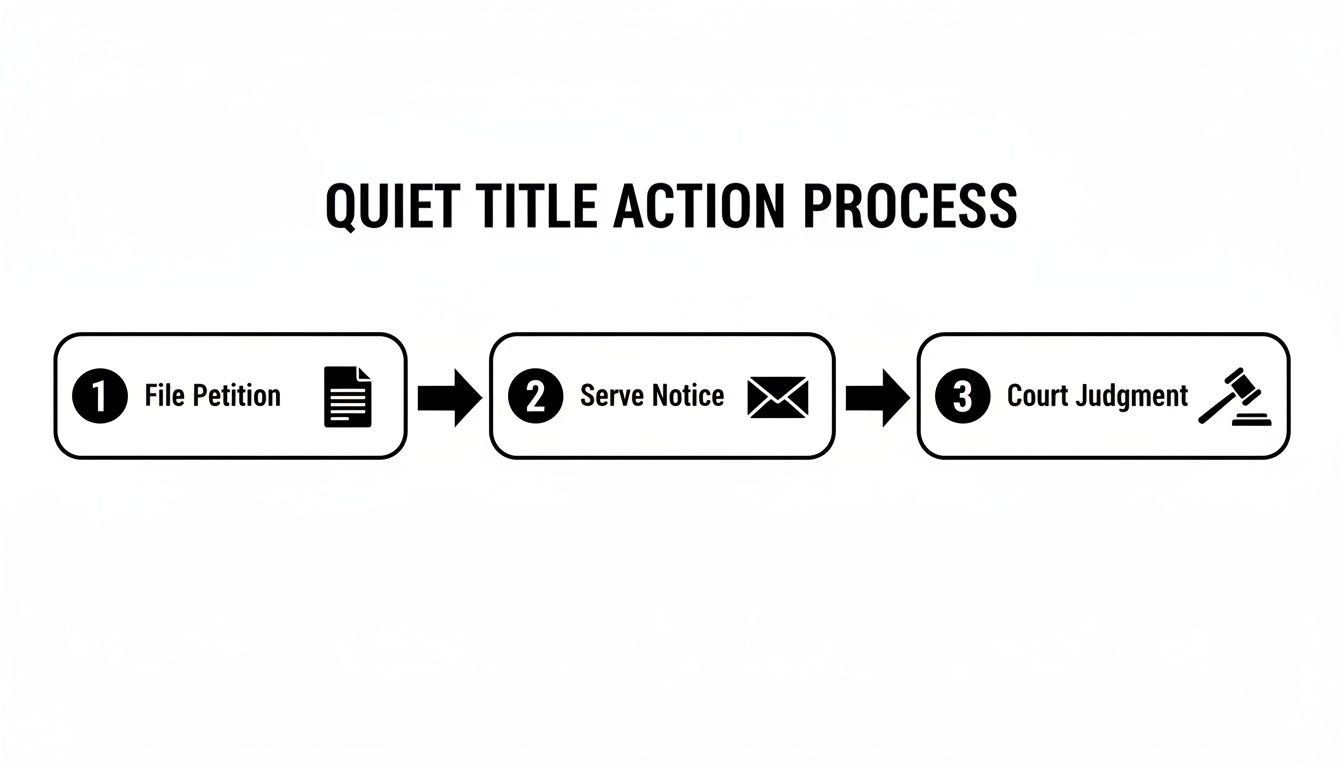
These three steps—filing, serving, and judgment—are the core of the process. The time it takes to get from one to the next is what separates a simple case from a complex one.
What Are the Costs of Filing a Quiet Title Lawsuit?
The money needed to clear your title also depends heavily on whether the case is contested. Uncontested actions are naturally more affordable. Based on current legal data, you can expect an uncontested quiet title action to cost between $2,000 to $5,000. Contested cases will almost always cost more due to the extensive work required.
Your total investment is made up of a few key expenses:
- Attorney Fees: This is the biggest piece of the puzzle. A skilled Texas property lawyer handles everything from drafting the initial petition to fighting for you in court. For a general idea of how fee structures work, it's helpful to understand how much a lawyer costs.
- Court Filing Fees: Every county in Texas charges a fee to open a new lawsuit. This typically runs between $300 and $500.
- Title Search Costs: Before filing, we must run a comprehensive title search to find every person or entity with a potential claim.
- Service Fees: The law requires you to formally notify all known defendants, which involves paying a process server. For unknown defendants, we must pay to publish a notice in a local newspaper.
While the costs can feel substantial, a quiet title action is an investment in certainty. The final court order gives you a clear and marketable title, protecting your property rights for good.
That final order is the goal. We have a detailed article that explains more about how a Texas Abstract of Judgment works to make a court's decision legally binding.
How a Texas Property Attorney Ensures Your Success

It’s tempting to think you can handle a property dispute on your own. But a quiet title action isn't a simple form you fill out—it's a formal lawsuit with incredibly strict legal requirements. One mistake, one missed deadline, and your entire case can be thrown out, forcing you to start over.
This is where an experienced Texas property attorney isn't just helpful—it's critical. At The Law Office of Bryan Fagan, PLLC, our job is to take the confusion and complexity off your shoulders. We turn a messy legal fight into a clear, strategic path forward, all designed for one purpose: to secure your undisputed ownership.
Building Your Case on a Rock-Solid Foundation
A winning quiet title action starts with undeniable evidence. Your attorney’s first job is to dig in and build that case. This is a deep, investigative dive into your property’s entire history.
Our process starts with:
- A Forensic Title Examination: We order and meticulously analyze a comprehensive title report to identify every single person, heir, or company that could possibly have a claim against your property.
- Gathering the Proof: We collect all the documents needed to prove your ownership is superior. This includes deeds, mortgage records, surveys, lien releases, and tax payment records—everything needed to build an ironclad case.
- Crafting the Legal Argument: With the evidence in hand, we build a powerful argument based on the Texas Property Code. We show the court exactly why your title is valid and all other potential claims are not.
Navigating the Lawsuit’s Most Dangerous Steps
One of the easiest ways to lose a quiet title lawsuit is by failing to notify potential claimants correctly. Texas law is crystal clear: every potential claimant—known or unknown—must be legally served notice. This is where most DIY cases fall apart.
If even one potential claimant isn't notified according to the strict rules of legal service, a judge can throw out the entire quiet title judgment, making it completely worthless.
A skilled Texas landlord tenant lawyer from our firm handles this with absolute precision. We make sure every party is served correctly, whether that means using a personal process server or publishing a notice in a newspaper for unknown heirs. Getting this step right is what makes your final judgment permanent and legally binding.
Your Advocate in Negotiation and in Court
Whether your case is uncontested and straightforward or becomes a heated battle, your attorney is your voice and your shield. We handle all the tough conversations and negotiations with the other side, always aiming for an efficient and favorable resolution.
But if the other party won't settle, we are always prepared to fight for you in court. We’ll present the evidence, make the arguments, and stand up for your rights before a judge. Partnering with an experienced lawyer is the single most effective way to cut through the complexities of a quiet title action and get a final, binding judgment that solidifies your property rights.
Your Quiet Title Questions, Answered
When you’re facing a dispute over who really owns a piece of property, you’re bound to have questions. Here are the straight answers to some of the most common questions we hear from Texas property owners, tenants, and landlords.
Can I Sell My Property if There Is a Cloud on the Title?
In short? No. It’s practically impossible.
Buyers and their lenders want a clean, marketable title. A "cloud"—like an old lien, a boundary line argument, or an heir's unresolved claim—creates legal risk. That risk is enough to scare off almost any serious buyer and kill the deal.
A quiet title action is the only definitive legal tool to remove that cloud. By getting a court to issue an order declaring you the clear and undisputed owner, you make your property sellable again.
Is a Quiet Title Action the Same as a Warranty Deed?
Not at all. They do two very different jobs.
- A warranty deed is a document used to sell property. The seller gives it to the buyer, guaranteeing—or "warranting"—that the title is clear of any problems.
- A quiet title action is the lawsuit you file to create that clear title in the first place. It’s the legal repair work you do before you can confidently hand over a warranty deed.
Think of it this way: a quiet title action is the pressure washer that scours the title clean. A warranty deed is the written promise that it’s already spotless.
What Happens if Someone Fights My Quiet Title Lawsuit?
This is where having an experienced attorney is crucial. If another person files a formal response and challenges your ownership claim, the lawsuit becomes a contested fight in court.
When a quiet title action is contested, both sides will present evidence, make legal arguments, and call witnesses. The judge listens to both sides and then makes a final ruling on who holds the superior legal claim to the property.
This is exactly why you need an experienced Texas landlord tenant lawyer in your corner from day one. A contested case isn’t a DIY project. It requires a sharp legal strategy to handle court procedures, dig up the right evidence, and argue your case effectively. Your attorney is there to make sure your rights under the Texas Property Code are fought for and protected every step of the way.
If you need help with an eviction, lease issue, or rental dispute, contact The Law Office of Bryan Fagan, PLLC for a free consultation today. We are here to help you protect your rights and secure your property.