You may be sitting at a kitchen table right now, trying to do something generous. Maybe you want to give your home to your son. Maybe you want to put a rental house into your daughter’s name. Maybe you’re trying to keep property “in the family” and avoid a mess later.
That instinct is understandable. It’s also where many Texas families get into trouble.
A house isn’t like handing over a pickup title or adding someone to a bank account. Real estate transfers change control, tax consequences, liability, and sometimes family power dynamics overnight. If the property is rented, the transfer can also affect who collects rent, who handles repairs, and who has the legal right to enforce the lease under the Texas Property Code.
I’ll give you the direct answer. Gift deeds in texas can work well, but only when the deed language, the timing, and the financial consequences are all handled correctly. If you get casual about it, you can create title disputes, tax issues, Medicaid problems, and landlord-tenant confusion that costs your family far more than the property transfer was supposed to save.
Giving Property in Texas Can Be More Than a Simple Gift
A common Texas scenario goes like this. A parent owns a paid-off house. One child has been helping with care, bills, or maintenance. The parent wants to “just put the house in that child’s name” and move on. Nobody wants probate. Nobody wants conflict. Everyone thinks a simple signed paper will handle it.
Sometimes the property is a rental. The parent is tired of managing tenants, late rent, and repair calls. So they decide to give the property to an adult child who will take over as landlord. On paper, that sounds neat and clean.
In real life, it rarely stays that simple if the transfer is done without careful planning. Other heirs may later claim the gift was never valid. The person receiving the property may not understand they’re now responsible for taxes, insurance, and lease obligations. A tenant may keep paying the wrong person because nobody clearly documented who owns the property now.

Practical rule: If you’re transferring Texas real estate to a family member, treat it like a major legal event, not a family favor.
That’s especially true if money is tight, long-term care is a concern, or the property has tenants in it. Stress about property and family finances can push people toward quick fixes. Quick fixes are exactly what create lawsuits and tax surprises later.
A gift deed can be useful. It can also be the wrong tool. The right move depends on whether you want to transfer ownership now, keep control during life, protect a lease, or avoid creating a bigger problem for your family down the road.
What Exactly Is a Texas Gift Deed
A parent signs a deed to “give” a rental house to an adult child, then keeps collecting rent for six more months. Later, a sibling says the transfer was never real, the tenant is confused about who the landlord is, and the family is now fighting over title. That mess starts with one basic misunderstanding. A Texas gift deed is not a family gesture. It is a present transfer of real property ownership.
A gift deed is a deed that transfers real estate without payment in return. The owner, called the grantor, gives the property to the recipient, called the grantee, as a gift. In Texas, the deed must show a clear intent to make a present gift, not a promise to do something later. Texas law on conveyances starts with Property Code § 5.021, which requires a written, signed instrument to convey real property, and the Texas Constitution and statutes are available through the Texas Constitution and Statutes website.
A gift deed means ownership changes now
This is the point families get wrong.
If you sign a valid gift deed and deliver it properly, ownership passes during your lifetime. The recipient does not wait until you die. If your goal is to keep full control for life and decide who gets the property at death, a gift deed is usually the wrong document.
That is also why a gift deed is different from a will and different from a Texas warranty deed used in a sale or other transfer for consideration. A warranty deed often goes with a sale. A gift deed is supposed to show a true gift, with no purchase price and no confusion about whether title passed immediately.
The legal idea is simple. The real-world risk is not.
Texas courts look at donative intent, delivery, and acceptance. In plain English, the owner must mean to give the property now, must take steps that hand over the deed as a present transfer, and the recipient must accept it. Language such as “love and affection” often appears in gift deeds because it helps show the transfer was a gift rather than a sale.
Wording matters more than families expect. If the deed reads like a sale, or sounds like the property changes hands only after death, you are inviting a title dispute. I have seen families rely on copied forms that create the worst of both worlds. The parent thinks they kept control. The child thinks they own the property. The county records then become the battlefield.
The two people who matter most
Every gift deed has two key parties:
- Grantor: the current owner giving the property
- Grantee: the person receiving it
That sounds obvious, but the consequences are not. Once the transfer is valid, the grantee may step into serious responsibilities tied to the property, including taxes, insurance, maintenance, and landlord duties if tenants are living there.
So do not treat a gift deed like a ceremonial document. Treat it like what it is. A tool that can transfer a valuable Texas asset right now, with immediate legal and financial consequences for everyone involved.
Key Legal Requirements for a Valid Gift Deed in Texas
Texas does not let people transfer real estate through vague promises or half-finished paperwork. A valid gift deed must satisfy the legal basics, and every one of them matters.
According to this explanation of valid Texas gift deed requirements, a deed under Property Code § 5.021 must be in writing, signed by the grantor, include a precise legal description, and be delivered to the grantee. The same source notes that courts, including Gordon v. W. Hous. Trees, Ltd., look closely at whether the language shows an immediate transfer, and wording that sounds like a sale, such as “$10 and other valuable consideration,” can reclassify the transaction.
The four requirements you cannot skip
Here is the checklist I want clients to follow:
It must be in writing
A spoken promise is worthless for this purpose. “I told my daughter the house was hers” won’t transfer title.The grantor must sign it
The property owner has to execute the deed. If multiple owners hold title, you have to evaluate who must sign before anything is recorded.The deed needs the legal description
A street address is often not enough. The deed should use the property’s legal description from prior deed records or other reliable title documents.The deed must be delivered
Delivery means more than placing the deed in a drawer. The transfer has to be handed over or otherwise completed in a way that shows immediate passage of title.
Acceptance and intent matter too
A grantee’s acceptance is usually presumed unless someone rebuts it. But don’t rely on assumptions when family property is involved. Clean paperwork beats family testimony every time.
The wording must also show present donative intent. That means the document should make clear this is a gift now, not a gift later and not a disguised sale.
| Requirement | Why it matters |
|---|---|
| Writing | Real estate transfers need a written instrument |
| Grantor signature | Shows the owner actually approved the transfer |
| Legal description | Identifies exactly what land is being conveyed |
| Delivery | Confirms title passes immediately |
Notarization and recording are not “extra”
The deed should be signed before a notary, then filed with the county clerk where the property is located. Recording gives public notice of the transfer and helps prevent later disputes over ownership.
It also protects the people involved in practical ways. Once the transfer is public, tax records can be updated and everyone can see who owns the property. If you want to understand how deed protections differ by document type, review this page on a Texas warranty deed.
A deed that sits unsigned, unnotarized, or unrecorded is exactly the kind of document that creates family litigation.
Gift Deeds vs Other Texas Property Transfer Methods
A gift deed is only one tool. It is not the default answer for every family transfer, and I don’t recommend treating it that way.
The better question is this: What outcome do you want? Immediate transfer? More title protection? Probate avoidance while keeping control during life? Those are different goals, and Texas uses different documents for them.
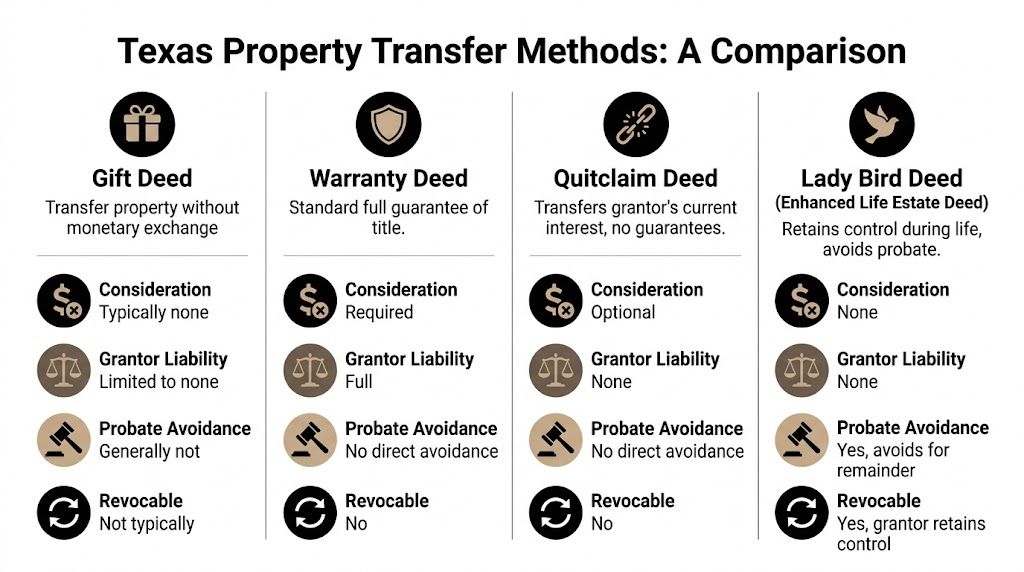
Gift deed compared with warranty deed and quitclaim deed
A gift deed transfers property without payment. It can be drafted with strong language, but its defining feature is the absence of monetary consideration and the clear intent to gift.
A general warranty deed is different. It is built around title promises. The grantor gives broad assurances about ownership and title defects. That is why warranty deeds are common in standard sales and more formal transfers.
A quitclaim deed is the opposite end of the spectrum. It transfers whatever interest the grantor has, if any, without title guarantees. That may sound convenient in a family setting, but it often creates more uncertainty than it solves.
Here’s the plain-English version:
- Gift deed works when the owner wants to give the property away now.
- Warranty deed fits when title assurances matter and the parties want cleaner protection.
- Quitclaim deed may be fast, but it can leave the grantee holding a title problem.
Gift deed compared with a will or transfer on death planning
Families often make a critical and expensive error. They want a property transfer at death, but they use a document that transfers ownership during life.
A will does not transfer ownership right away. It speaks at death and may require probate.
A gift deed transfers ownership immediately if it is valid. The giver loses control because ownership has already changed.
If your real concern is avoiding probate while keeping control for life, you may need a different strategy, such as a Texas Lady Bird deed. In some estate-planning situations, families also compare deeds with trust planning, and this overview of irrevocable trust pros and cons can help you understand how that approach differs from an outright gift.
Which method fits which goal
| Goal | Better fit |
|---|---|
| Give the property away now | Gift deed |
| Sell with strong title promises | General warranty deed |
| Transfer uncertain interest with no promises | Quitclaim deed |
| Keep control during life and avoid probate | Will not do that alone, and a gift deed may be the wrong choice |
If you still want to live in the home, collect rent, refinance, or change your mind later, don’t assume a gift deed matches your goal. It often doesn’t.
That’s why one-size-fits-all deed forms are a bad idea. The right document depends on control, taxes, tenant issues, and family dynamics. A gift deed is powerful precisely because it is immediate. That same strength is what makes it dangerous when people use it for the wrong reason.
The Hidden Financial and Legal Consequences of Gift Deeds
Many articles stop after explaining how to sign and record a deed. That’s not enough. The paperwork is only part of the problem.
The primary danger with gift deeds in texas is that families often focus on transfer mechanics and ignore what the transfer triggers.

Federal gift tax rules still matter
Texas does not have a state gift tax, but federal rules still apply. As of 2024, an individual may gift up to $18,000 per recipient annually, and married couples can gift $36,000 through gift-splitting without filing a gift tax return. Amounts above that count against the $13.61 million lifetime exemption, according to this summary of Texas and federal gift tax rules.
That does not mean the majority will owe immediate tax. It does mean you should stop saying, “Texas has no gift tax, so there’s nothing to think about.” There is plenty to think about.
One of the biggest long-term issues is basis. In a gift transfer, the recipient generally takes the donor’s basis. If the recipient later sells, that can create capital gains consequences that families never saw coming.
Property taxes and homestead issues
After the transfer, the new owner assumes ownership responsibilities. That includes property taxes and insurance. A transfer can also affect homestead-related planning, so if the property is your residence, review how ownership changes interact with Texas homestead laws.
People also miss the practical side. The minute ownership changes, the old owner may no longer be the right person to insure, manage, or make decisions about the property.
The tax question is rarely “Can I sign a gift deed?” The better question is “What tax position am I creating for my family after I sign it?”
Medicaid can be the harshest surprise
This is the trap that blindsides older Texans and their children. A gift deed can affect Medicaid eligibility because of the 5-year look-back period.
If someone gives away a home and later needs Medicaid-funded nursing care, that transfer can trigger a penalty period. Families then learn the hard way that a well-meant transfer created a benefits problem at the worst possible time.
A short overview may help if you're weighing the issue in a practical context:
Creditor and dispute risks
Another problem is motive. If someone transfers property while facing debts, lawsuits, divorce pressure, or business trouble, the transfer can attract scrutiny. Creditors may argue the transfer was improper or designed to put assets out of reach.
I’ll be blunt. If your plan is “I’ll just deed the house to my child so nobody can touch it,” that is not legal strategy. That is a setup for litigation.
How Gift Deeds Affect Landlords and Tenants in Texas
Deed law often collides with real life. If the gifted property is a rental, the transfer affects more than title. It changes the landlord-tenant relationship.
Say a mother owns a rent house in Harris County and gives it to her son. The lease doesn’t vanish. The tenant doesn’t lose rights because ownership changed. The property still has a valid lease, a person collecting rent, repair obligations, and likely a security deposit sitting somewhere.
If you are the old owner
If you are the grantor and current landlord, don’t assume signing the deed ends your involvement cleanly. You need a documented handoff of practical responsibilities.
That includes questions like:
- Rent collection who receives rent after the transfer
- Repair requests who the tenant should contact
- Security deposit handling who is holding it and who will account for it
- Notice issues who can send lease notices or eviction notices
If those details are sloppy, you create confusion fast. A tenant may pay the wrong person or ignore the new owner because nobody gave proper notice of the ownership change.
If you are the new owner
Once you receive the property, you step into a legal role, not just a family role. You are now the person responsible for running the property in compliance with the lease and the Texas Property Code.
For landlords learning the practical side of rental operations, this legal guide for renting out property gives a useful overview of management issues that often arise when ownership changes.
A tenant’s lease usually remains in place after a valid transfer. New ownership does not erase existing lease duties.
If you are the tenant
Tenants often panic when they hear the property was “gifted” to someone. Usually, the tenant’s immediate concern is simple and fair: Who is my landlord now, and where do I send rent?
The answer should be clear in writing. The new owner should identify themselves, explain payment instructions, and confirm where maintenance requests go. If an eviction becomes necessary, the party filing it must have legal authority tied to actual ownership or legal management rights. That point matters under landlord-tenant law, including the framework tied to Texas Property Code § 92.001 and related provisions.
When ownership changes, the smartest move for both sides is clarity. Tenants need written direction. Landlords need a clean record trail.
Steps to Complete a Gift Deed and Common Pitfalls to Avoid
A father signs a deed to “help” his daughter. Six months later, the tax bill goes to the wrong address, the insurance carrier questions coverage after a claim, and a sibling starts asking whether the transfer was ever valid. That is how gift deed problems usually start in Texas. Not with fraud or drama at the signing table, but with sloppy paperwork and no plan for what happens after title changes.
If you are giving away Texas real estate, handle the deed like a legal transfer with real financial consequences. A gift deed changes ownership. It can also change tax exposure, insurance obligations, landlord duties, and family expectations overnight.
The basic steps
Use this order and do not skip any part:
Draft the deed with clear gift language
The deed must identify the grantor and grantee, state that the transfer is a present gift, and avoid language that makes the transfer sound like a sale or future promise.Use the full legal description of the property
Pull it from the last recorded deed or a reliable title record. A street address is not enough. A bad legal description can create a title problem that costs far more to fix than the deed did to prepare.Sign and acknowledge the deed before a notary
The grantor signs. The notary acknowledgment matters because the county clerk will expect a recordable document, and you may need that acknowledgment later if ownership is challenged.Deliver the deed properly
A gift deed is not complete just because it was signed. The deed must be delivered and accepted in a way that shows ownership passed now, not at some vague point in the future.Record the deed in the county where the property is located
Recording puts the world on notice. It also helps prevent later disputes over competing claims, inheritance arguments, or confusion about who owns the property. For filing details and county recording requirements, review the Texas county clerk guidance published by the Texas Association of Counties County and District Clerks' Association.
Common mistakes that cause expensive problems
The signing itself is usually the easy part. The mistakes come from treating the transfer like a family favor instead of a property transaction.
Using vague or sentimental wording
“I want my son to have the house” is not deed language. The document has to transfer title with precision.Copying a form that does not fit the property or the goal
A deed pulled from the internet may leave out reservations, marital status issues, or homestead concerns. That is how people create title defects they do not discover until a refinance, sale, or probate fight.Failing to update taxes, insurance, and exemptions
Once title changes, the paperwork outside the deed matters. Property tax correspondence, homestead questions, hazard coverage, and mortgage notices need immediate attention.Ignoring possession and control issues
If the giver keeps acting like the owner, paying expenses, collecting rent, or making unilateral decisions, that conduct can fuel later disputes about whether a real transfer happened.Forgetting the rental side of the property
If tenants live there, ownership may have changed on paper while the day-to-day operation did not. That gap causes missed rent, deposit disputes, repair confusion, and avoidable conflict.
The Medicaid trap deserves special attention
Families under financial pressure often use a gift deed because it feels fast and generous. That instinct can backfire hard if the person giving the property may need long-term care.
A transfer for less than fair value can create Medicaid eligibility problems. Texas families need to consider the five-year look-back before they sign away a home, as discussed in this explanation of gifting a homestead in Texas.
Stop there and get advice first.
That is especially important if the property is a homestead, the owner is elderly, or the transfer is part of a last-minute attempt to protect assets. I have seen families save a filing fee and walk straight into a much larger care-cost problem.
My recommendation
If you plan to use a gift deed, do it with a checklist and a strategy. Confirm the legal description. Confirm the exact ownership names. Confirm what happens to taxes, insurance, exemptions, occupancy, leases, and future care planning before anyone signs.
The Law Office of Bryan Fagan, PLLC handles Texas property and landlord-tenant issues and is one option for reviewing ownership transfers that affect leases, rent obligations, and possession rights.
Pay for clean advice on the front end. That is cheaper than fixing a title dispute, a tax problem, or a family lawsuit after the deed is already recorded.
Protect Your Property and Your Family with a Texas Attorney
A gift deed can solve a real problem. It can also create three new ones if you use it carelessly.
The hard truth is that most families are not dealing with “just a deed.” They are dealing with inheritance expectations, tax consequences, possible Medicaid exposure, and sometimes a rental property with active tenants. That combination calls for judgment, not a fill-in-the-blank form.
If your goal is to protect your child, keep peace in the family, preserve tenant rights, or avoid a fight over ownership later, get the legal strategy right before you transfer anything. That means choosing the correct document, using proper language, recording it correctly, and understanding what ownership changes mean in practice.
A Texas landlord tenant lawyer can also help when the property is occupied and the transfer affects lease enforcement, security deposits, repairs, or the right to file an eviction. If you’re a tenant, don’t assume a deed transfer wipes out your tenant rights. If you’re a landlord or property owner, don’t assume a gift deed gives you a clean exit without follow-through.
The safest path is the one that matches your real objective, not the one that looks quickest on paper.
If you need help with a gift deed, ownership transfer, lease issue, or rental dispute, contact The Law Office of Bryan Fagan, PLLC for a free consultation today. Whether you need guidance from a Texas landlord tenant lawyer, help protecting tenant rights, or advice from an eviction attorney on how a property transfer affects your case under the Texas Property Code, you can get clear answers and a practical strategy before you make a costly mistake.