Dealing with a move, a job change, or a tenant who wants someone else in the property can get stressful fast. Hearing lease and sublease often leads to the assumption that their difference is minor. In Texas, it isn't.
The choice affects who pays rent, who can be evicted, who answers for damage, and who stays legally exposed when things go wrong. If you're a tenant trying to leave early, or a landlord trying to keep control of your property, understanding lease vs sublease can save you from a costly dispute under the Texas Property Code.
Understanding Your Rental Options in Texas
A common Texas scenario starts like this. A tenant signs a one-year apartment lease, then gets transferred to another city halfway through the term. Breaking the lease may trigger fees or a fight over what is still owed. So the tenant asks, “Can I just find someone to take over?”
A landlord faces a similar version of the same problem. The rent is being paid now, but the current tenant wants a new occupant in the home. The landlord wants to keep the unit occupied, but doesn't want an unknown person in the property without clear rules.
That is where people usually run into the lease vs sublease question.
A standard lease is the direct agreement between landlord and tenant. A sublease is different. The original tenant makes a second agreement with a new occupant, while the original lease still sits underneath it.
That sounds simple, but the legal effect is very different. In one setup, the landlord deals directly with the occupant. In the other, the original tenant stays in the middle.
For some Texans, another option may exist depending on the current agreement, the timing, and the landlord's willingness to negotiate. If you're dealing with a flexible rental arrangement already, it helps to understand how month-to-month tenancy works in Texas before deciding whether a sublease is even necessary.
Some rental problems aren't really about occupancy. They're about choosing the wrong legal structure for the change you're trying to make.
If you're a tenant, the key question is whether you want temporary flexibility or a cleaner exit. If you're a landlord, the key question is whether you want continued control over the original tenant or a fresh direct relationship with the replacement occupant.
The Legal Foundation of Leases and Subleases in Texas
A lease creates the basic landlord-tenant relationship. The tenant gets the right to occupy the property, and the landlord gets the right to enforce the lease terms directly against that tenant. That direct connection matters.
A sublease adds another layer. The original tenant becomes the person making an agreement with the subtenant. The landlord is still tied to the original tenant under the main lease, not automatically to the subtenant.

What Texas law requires
Texas law gives landlords strong control over this decision. Tex. Prop. Code § 91.005 requires landlord consent for subleases and lease assignments unless the lease says otherwise, and standard Texas Association of Realtors residential lease forms generally prohibit subleasing without written approval, as discussed in this overview of Texas subleasing consent rules.
That means a tenant usually can't lawfully sublet first and ask forgiveness later. Written consent should come first.
This rule exists for a practical reason. Landlords have a legitimate interest in knowing who will occupy the property, whether that person can pay, and whether that person is likely to follow the lease.
How the legal relationships differ
The easiest way to understand the legal structure is to look at who owes what to whom.
| Relationship | Standard lease | Sublease |
|---|---|---|
| Landlord and occupant | Direct legal relationship | Often no direct legal relationship |
| Rent obligation | Tenant owes landlord directly | Original tenant still owes landlord |
| Property rules | Landlord enforces against tenant | Original tenant often must enforce against subtenant |
| Occupancy approval | Built into the lease itself | Usually requires landlord consent first |
That middle layer creates risk. If the subtenant pays late, damages the unit, or violates a no-pets rule, the landlord usually still looks first to the original tenant.
If you're reviewing the contract language itself, this guide on Texas lease agreement laws is a useful starting point because many sublease fights begin with vague lease wording, not dramatic misconduct.
Why this matters in real disputes
People often focus only on whether a subtenant can move in. The better question is what happens after move-in if something breaks down.
For example, habitability disputes are easier to understand when you compare state-specific rules. If you want a plain-English example of how another state frames landlord repair duties, California's warranty of habitability is a helpful contrast. Texas handles many landlord-tenant issues differently, but the comparison shows why the original contract and state law both matter.
Practical rule: If a Texas tenant wants someone else in the property, the first document to read is the signed lease. The second is the written consent from the landlord. If either one is missing, the risk goes up quickly.
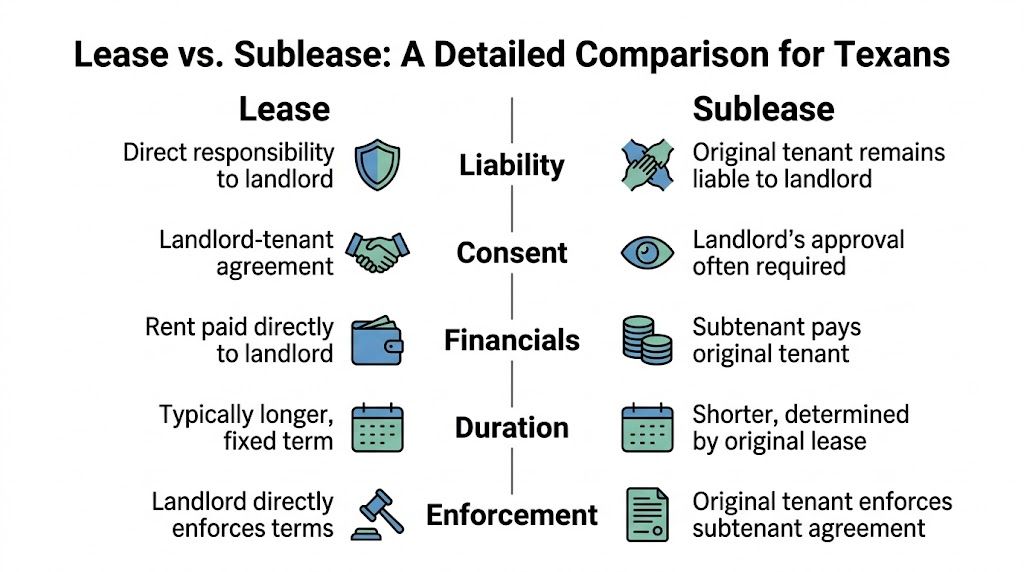
Lease vs Sublease A Detailed Comparison for Texans
The biggest mistake people make with lease vs sublease is treating them as two labels for the same arrangement. They aren't. They shift control, liability, and enforcement in different ways.
Here is the quick version.
| Feature | Standard Lease | Sublease |
|---|---|---|
| Who contracts with the landlord | The tenant | The original tenant remains tied to the landlord |
| Who pays the landlord | The tenant | Usually the original tenant remains responsible |
| Who controls approval of occupancy | Landlord and tenant directly | Landlord approval is usually required first |
| Who bears ongoing legal exposure | The direct tenant | The original tenant, even after moving out |
| Who handles problems with the occupant | Landlord directly | Original tenant often has to deal with the subtenant first |
Liability is the biggest dividing line
In Texas, a sublease leaves the original tenant on the hook. A lease assignment is different. It transfers the remaining lease interest to a new tenant, who then has the direct legal relationship with the landlord. Texas Real Estate Research Center guidance explains that in a sublease, the original tenant remains primarily liable, while in an assignment the liability typically shifts to the assignee and the landlord can enforce directly against that new party in this discussion of subleases and assignments.
That single difference changes almost everything else.
The original tenant in a sublease can end up paying the landlord and then chasing the subtenant for reimbursement. That is the core risk.
If you're a tenant, that means moving out doesn't necessarily end your financial exposure. If you're a landlord, that means a sublease may preserve a second layer of protection because the original tenant is still responsible.
Consent is not a side issue
A standard lease starts with landlord approval built into the leasing process. A sublease usually needs a second round of approval because the actual occupant is changing.
This creates a practical screening issue. Landlords often want to review the proposed subtenant's income, rental history, intended use, and whether the subtenant will follow the same property rules. That isn't overkill. It's part of protecting the premises and reducing avoidable disputes.
For tenants, informal arrangements are where trouble starts. A text message that says “should be fine” is not the same as a signed written consent.
Financial structure changes too
With a standard lease, the rent stream is simple. The tenant pays the landlord directly.
With a sublease, the subtenant often pays the original tenant, and the original tenant remains responsible for making sure the landlord gets paid in full. That means the original tenant now has collection risk.
This also creates practical bookkeeping problems. If the rent is late, if utilities are split poorly, or if a security deposit isn't documented well, everyone starts pointing at someone else. That is why subleases need clear written terms on payment dates, delivery method, late charges if permitted by the agreement, and responsibility for damage.
Duration and control are different
A standard lease usually covers the full rental term directly between landlord and tenant. A sublease only lasts as long as the original tenant still has rights under the main lease.
That matters more than people think. If the master lease ends, the sublease usually can't outlive it.
In practical terms:
- A lease works better when the occupant is meant to stay for the full term and deal directly with the landlord.
- A sublease works better when the original tenant expects to return, needs temporary relief, or wants to keep some control over the arrangement.
- An assignment may work better when the original tenant wants a cleaner break instead of ongoing exposure.
Enforcement gets more complicated
Enforcement is usually straightforward in a standard lease. The landlord deals directly with the tenant on rent, notices, rule violations, and possession.
A sublease adds friction. The landlord may still proceed based on the original lease, but the original tenant often has to enforce the sublease terms against the subtenant. That can create delays, confusion, and more paperwork.
If the subtenant damages the property, refuses to leave, or stops paying the original tenant, the original tenant is suddenly managing a problem they did not expect to become “their” legal problem.
What usually works and what usually fails
Some approaches consistently reduce risk.
- What works for tenants: Written landlord consent, a sublease that incorporates the master lease, and careful screening of the subtenant.
- What works for landlords: Written approval conditions, clear occupancy rules, and preserving the original tenant's obligations in writing.
- What fails for both sides: Verbal deals, rushed move-ins, and agreements that never address rent flow, property damage, or move-out inspection.
If the paperwork doesn't clearly say who pays, who enforces, and what happens on default, the dispute is already half-built.
Pros and Cons for Texas Tenants and Landlords
The right choice depends on your role in the deal. A sublease can solve a real problem, but it can also create one.

In the commercial world, the pressure to sublease can rise quickly when the market shifts. In early 2021, the Dallas-Fort Worth commercial market had sublease availability peak at over 9 million square feet, which showed how economic changes can push tenants toward subleasing while forcing landlords to sort through a much wider range of occupant risk, according to D Magazine's reporting on Dallas sublease activity. The same logic appears in smaller residential situations too. People use subleases when plans change faster than the original lease term.
For tenants
A sublease can be a lifeline when you need to move before the lease ends. Students leaving for the summer, workers taking a temporary assignment, and families relocating before the school year ends often look for this option.
The upside is flexibility. You may avoid a direct early-termination fight and keep the unit occupied while you're away.
The downside is that you become the middle party. That is a hard role if you chose the subtenant casually.
Consider the tenant who lets a friend move in for convenience. The friend pays late, annoys neighbors, and leaves damage behind. The landlord still expects performance under the original lease. The original tenant may now owe money and have to chase the friend for repayment.
A few tenant-side advantages and risks stand out:
- Potential relief from unused rent: A subtenant may cover part or all of the rent while you're gone.
- Control over who occupies your space: You may choose someone you trust, but that only helps if you screen carefully.
- Continuing liability: If the subtenant fails, the landlord may still look to you first.
- Recordkeeping burden: You need proof of rent payments, deposits, notices, and move-in condition.
For payment records, a simple paper trail goes a long way. If you're handling money between tenant and subtenant, a professional rent receipt template can help document who paid what and when.
For landlords
A landlord may see a sublease request and immediately want to deny it. Sometimes that's the right call. Sometimes it isn't.
Allowing a sublease can keep the property occupied and preserve the original tenant's liability. That can be useful when the alternative is a vacant unit or a tenant who abandons the lease.
But the risks are real. The landlord may end up with an occupant they never would have approved on the front end. There can also be confusion over maintenance requests, rule enforcement, and communication.
Policy takes precedence over instinct.
- Benefit of continued occupancy: Someone is in the property, which may reduce vacancy-related problems.
- Extra layer of accountability: The original tenant usually remains responsible under the main lease.
- Screening risk: The proposed subtenant may not be as financially stable or reliable as the original tenant.
- Operational complexity: Property managers may now deal with two different people who each think the other is responsible.
A careful approval process helps. Landlords who approve subleases selectively, require written rules, and confirm who remains liable usually avoid the worst disputes.
A short explainer can help if you're weighing those trade-offs in practice.
When a sublease makes sense
Subleases tend to work best when the arrangement is temporary, the replacement occupant is screened carefully, and everyone agrees in writing on the chain of responsibility.
They tend to fail when the original tenant wants a total exit but chooses a sublease instead of negotiating an assignment or other release.
A sublease is a flexibility tool. It is not a liability eraser.
How to Create and Approve a Texas Sublease Agreement
A Texas sublease should be handled like a legal transaction, not a favor between friends. If the documents are thin, the dispute usually gets thick.
If you need a starting point for the basic document itself, this overview of what a sublease agreement is in Texas can help frame the moving parts before you draft or approve one.
Checklist for tenants who want to sublet
Start with the master lease. Read the sections on occupancy, assignment, subletting, default, notices, deposits, and landlord consent.
Then move in this order:
Review the lease language carefully
Look for any clause that bans subleasing or requires written consent. Don't rely on memory.Send a written request to the landlord
Include the proposed subtenant's name, planned move-in date, term of occupancy, and whether the subtenant will occupy the full unit or only part of it.Wait for written approval
This is not optional. If approval is verbal or vague, ask for a signed written consent.Screen the subtenant like a landlord would
Check income, rental history, references, and whether the person can carry the financial obligation.Draft a written sublease that matches the master lease
The sublease should say that the subtenant must follow the original lease rules. If the master lease bans pets or smoking, the sublease should repeat that.Document condition at move-in
Use photos, a checklist, and a signed acknowledgment of the unit's condition.Set up payment records
Specify where rent goes, when it is due, and what happens if the subtenant pays late.
Checklist for landlords reviewing a sublease request
Landlords shouldn't treat every request the same. But the review process should be consistent.
Confirm the lease allows consent-based subleasing
If the lease prohibits it outright, the analysis may end there unless you choose to make an exception in writing.Require full information on the proposed occupant
Ask for the same basic screening materials you would want in a direct lease.State conditions in writing
Approval can be conditioned on compliance with the master lease, occupancy limits, pet rules, insurance obligations, and move-out procedures.Preserve the original tenant's liability
If you approve a sublease, your written consent should make clear that the original tenant remains bound unless another written agreement says otherwise.Clarify communication channels
Decide whether maintenance requests, notices, and rent issues must still go through the original tenant.
Clauses that should be in the sublease
A usable Texas sublease usually includes these points:
| Clause | Why it matters |
|---|---|
| Names of all parties | Prevents confusion about who signed what |
| Start and end date | Keeps the sublease within the main lease term |
| Rent amount and payment method | Avoids later fights about missed payments |
| Security deposit terms | Clarifies who holds it and who may deduct from it |
| Incorporation of master lease | Makes the subtenant follow the same property rules |
| Damage and repair reporting | Reduces finger-pointing when problems happen |
| Move-out obligations | Helps with possession and condition disputes |
Drafting note: The sublease should never promise rights the original tenant doesn't actually have under the master lease.
Common Disputes and How a Texas Lawyer Can Help
Most sublease disputes aren't caused by the idea of subleasing itself. They come from poor approval practices, weak documents, or misunderstandings about who is still legally exposed.
One of the most common fights is nonpayment. The subtenant stops paying. The original tenant still owes rent under the main lease. The landlord wants payment now, not after the original tenant finishes arguing with the subtenant.
Another frequent problem is property damage. A subtenant may leave the unit in worse condition, but the landlord often still looks to the original tenant for recovery because the original lease remains in force against that tenant.
A third problem is possession. The subtenant won't leave when the arrangement ends, or the original tenant tries to remove the subtenant informally instead of using the proper legal process. That mistake can turn one dispute into two.
Texas sublease disputes can become especially messy because the subtenant often has no direct legal relationship with the landlord, leaving the original tenant exposed on rent, eviction-related issues, and damage claims. One source discussing this area also states that disputes of this kind rose by 25% in major Texas metro areas in recent years in its overview of subletting and subleasing risks in Texas.
Problems legal counsel can solve early
A Texas landlord tenant lawyer can often reduce damage before a case gets expensive.
- Unauthorized sublease disputes: Review the lease, assess whether a breach occurred, and prepare notices that match Texas requirements.
- Rent and damage claims: Identify who remains liable under the documents and what evidence supports recovery.
- Holdover occupant issues: Choose the right path to regain possession without creating extra exposure.
- Security deposit conflicts: Sort out who holds the money, what deductions may be defensible, and how to document the condition dispute.
Why timing matters
People usually call a lawyer after the problem gets expensive. Earlier is better.
A short review of the lease, consent paperwork, and payment records can reveal whether you're dealing with a true sublease, an assignment, an unauthorized occupant, or a plain lease violation. Those are not the same thing, and they shouldn't be handled the same way.
If three people are arguing about one rental unit, the first job is identifying which contract actually controls the fight.
If you're a tenant, legal help can protect you from paying more than you owe or missing a valid defense. If you're a landlord, legal help can tighten notice strategy, preserve your claims, and avoid procedural errors that slow down enforcement.
FAQs About Texas Leases and Subleases
Is a sublease the same as a lease assignment
No. A sublease keeps the original tenant in the chain of liability. A lease assignment transfers the entire remaining lease interest to the assignee, who then has the direct legal relationship with the landlord. Texas Law Help explains that an assignment typically severs the original tenant's liability unless the agreement says otherwise in its article on subleases and subtenants in Texas.
Can a landlord charge for approving a sublease
That depends on the lease language and the approval terms being negotiated. Texas leases often address administrative approvals by contract. The safest approach is to check the signed lease first and get any approval conditions in writing before anyone moves in.
Who pays if the subtenant damages the property
As a practical matter, the original tenant is often the first person exposed under a sublease because that tenant remains bound by the master lease. The original tenant may then try to recover from the subtenant under the sublease agreement.
Do commercial properties follow the same basic rules
The same core concepts apply, but commercial leases are often more detailed and negotiated more heavily. Consent clauses, recapture rights, expense pass-throughs, and use restrictions can make the analysis more technical. Commercial tenants should read the transfer provisions closely before assuming a sublease is allowed.
If you need help with a lease issue, sublease dispute, eviction, or tenant rights problem, contact The Law Office of Bryan Fagan, PLLC for a free consultation today. A Texas landlord tenant lawyer can help you review the lease, protect your position under the Texas Property Code, and build a practical strategy before the dispute gets more expensive.