A notice on the door can change the tone of a day fast. For a landlord, it may feel like the last reasonable step before court after missed rent, broken lease terms, or a tenant who won’t leave. For a tenant, it can feel like the ground just shifted under your feet.
The problem is that the notice is often read emotionally first and legally second. That’s understandable, but in Texas, the legal details matter. A lot. One missed step, one wrong delivery method, or one notice period that doesn’t match the lease can change the outcome of the case.
Texas Property Code 24.005 is the rule that starts the eviction process in most Texas cases. If you’re a landlord, this statute tells you when notice is required and how to give it in a way that holds up in court. If you’re a tenant, it tells you what to examine before assuming the notice is valid. That first document often decides what happens next.
In practice, I’ve seen the same pattern over and over. Landlords lose time because they moved too quickly. Tenants lose options because they ignored a paper that should have been reviewed carefully the day it arrived. The law gives both sides structure. It also gives both sides opportunities to make mistakes.
The good news is that §24.005 is not impossible to understand once you strip away the formal language. You need to know when a written notice to vacate is required, how long the tenant must get, how delivery works, and where the exceptions show up. If you understand those points, you’re in a much better position to protect your property, your housing, and your rights.
The Stress of a Property Dispute and Your First Step
A common Texas landlord problem looks like this. Rent hasn’t come in. The tenant has gone quiet, or maybe they’ve promised payment twice and missed both dates. The landlord wants the unit back and assumes the next step is filing in Justice Court.
A common tenant problem looks different, but it feels just as urgent. You come home, see a notice taped up or handed to someone at the property, and start wondering whether you have days, hours, or no options at all. You may also wonder whether the landlord can change the locks, turn off utilities, or force you out before a judge says anything.
Both sides usually want the same thing in that moment. Clarity.
The first legal move usually is not court
In most ordinary eviction situations in Texas, the first serious legal step is the notice to vacate governed by texas property code 24.005. This is the point where the dispute shifts from frustration and informal texts into a formal process with rules.
That matters because people often act too soon. A landlord may file before giving a proper notice. A tenant may move out without checking whether the notice is defective. Neither move is strategic.
Practical rule: Treat the notice to vacate as the document that sets the tone for the whole case. If it’s right, the case can move forward cleanly. If it’s wrong, the dispute often gets delayed or reshaped.
What control looks like in a tense situation
For landlords, control means slowing down enough to comply with the statute, the lease, and the proof requirements you’ll need later. For tenants, control means reading the notice carefully, preserving evidence, and deciding whether the issue is payment, lease violation, holdover, retaliation, or something else.
A short checklist helps in the first day or two:
- Landlords should pull the signed lease, confirm the exact lease language on notice, and document the delivery method.
- Tenants should keep the notice, photograph where and how it was delivered, and compare the notice period to the lease.
- Both sides should stop relying on assumptions about “what everybody knows” and start relying on the actual statute and written documents.
That first step doesn’t solve the dispute by itself. But it tells you whether you’re standing on solid ground or heading toward an avoidable mistake.
What Is Texas Property Code 24.005
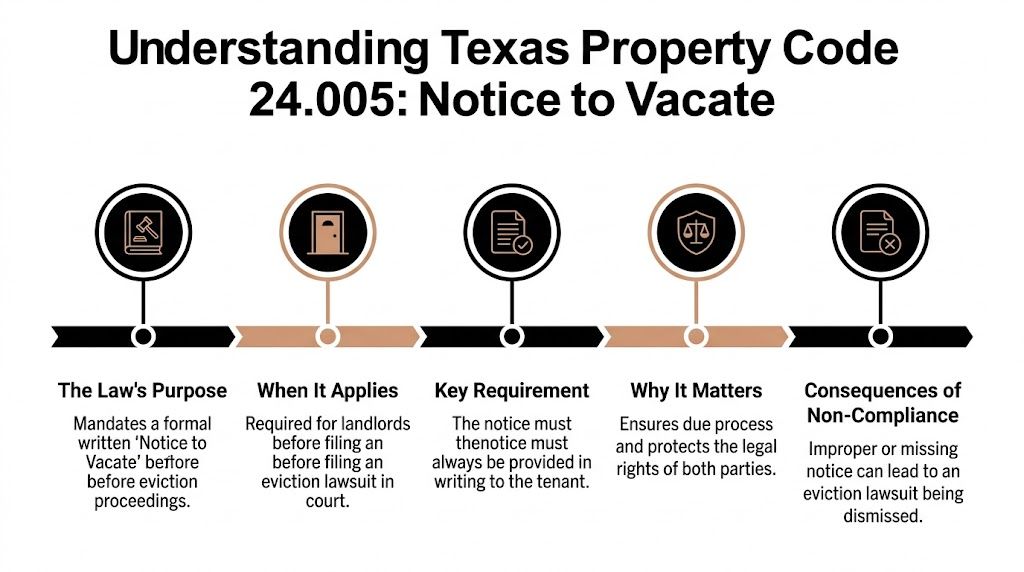
Texas Property Code 24.005 is the statute that tells a landlord when a notice to vacate must come before an eviction case. In plain English, it is the required warning before a landlord files a forcible detainer case to recover possession.
The key point is simple. A landlord generally cannot skip straight to eviction court. Texas law requires a written notice first in the situations covered by the statute.
According to the Texas eviction packet published through the court system, Texas Property Code Section 24.005 mandates a minimum 3-day written notice to vacate for tenants who default on rent or hold over beyond the lease term, serving as the foundational prerequisite before a landlord can file a forcible detainer eviction suit. That same guidance explains that the rule balances a landlord’s right to recover possession with the tenant’s right to fair warning and due process.
What the law is really doing
Think of the notice as a mandatory final warning. It is not a court order. It is not a lockout notice. It is not permission for a landlord to remove a tenant personally. It is the formal step that tells the tenant the landlord is terminating possession and will proceed if the property is not surrendered.
That protects both sides.
For landlords, it creates a clean starting point and a record that the tenant was told to leave. For tenants, it prevents sudden removal without process and gives them a chance to act, whether that means moving, negotiating, checking the lease, or preparing a defense.
When it usually applies
Section 24.005 commonly appears in these situations:
- Nonpayment of rent: The tenant has defaulted and the landlord is ending the right to remain.
- Holdover after lease end: The lease has expired or been terminated, but the occupant is still in possession.
- Other possession disputes: The landlord is focused on getting the property back, not collecting damages in that same eviction suit.
One point often gets missed. The eviction case is mainly about possession. It is not the full courtroom for every money dispute between landlord and tenant.
The lease can change the notice period
The statute provides at least 3 days’ written notice in the usual default or holdover situation, but the lease can set a shorter or longer period. That means the lease and the statute must be read together.
Preventable errors are common. A landlord uses a standard 3-day notice even though the lease requires more time. Or a tenant assumes every notice must always be 3 days when the lease says otherwise.
Here’s the practical takeaway:
| Issue | What to check |
|---|---|
| Default rule | Texas law generally requires 3 days’ written notice |
| Lease override | The lease may require a shorter or longer period |
| Court focus | Eviction court decides right to possession |
| Risk of error | A bad notice can derail the case before the merits are heard |
If you want a broader overview of landlord and tenant rules that interact with this statute, review this guide to the Texas Property Code landlord tenant framework.
Why this statute matters so much in practice
A lot of eviction disputes are not lost because one side had no argument. They’re lost because the opening step was sloppy. If the notice is missing, unclear, or noncompliant, the rest of the case gets harder.
That’s why experienced landlords don’t treat the notice as a formality, and informed tenants don’t treat it as automatic proof the landlord has done everything correctly.
A Landlords Checklist for a Compliant Notice to Vacate
Landlords usually get into trouble with §24.005 in two ways. The first is writing a notice that is vague. The second is using a notice that might be acceptable in another state, another lease, or a general internet template, but not in the actual case in front of them.
A strong notice is plain, specific, and consistent with the lease. It should read like a business record that a judge can understand quickly.

What the notice should say
At a minimum, your written notice should clearly identify the tenant, the property, and the demand to leave. Don’t force the court to guess what you meant.
Use this checklist as a working draft standard:
- Name the tenant clearly: Use the tenant’s full name as it appears in the lease when possible.
- Identify the property: Include the full rental address, including unit number if there is one.
- State the demand to vacate: Say directly that the tenant must vacate and surrender possession.
- Give the deadline: State the exact date by which possession must be surrendered.
- State the basis in plain terms: If the issue is nonpayment, holdover, or another lease default, say so plainly.
- Date the notice: A dated notice helps show when the time period began.
- Sign it or identify the sender: Make it clear the notice comes from the landlord or authorized property manager.
What doesn’t work well is vague language such as “please contact us immediately” or “this is your final warning” without a clear demand to vacate. Those messages may be useful as communication, but they are not a substitute for a legal notice.
Match the lease before you send anything
The lease often answers the most important timing question. If the lease changes the standard notice period, the lease controls that issue.
That means your review should happen in this order:
- Read the lease notice clause.
- Confirm the ground for termination.
- Draft the notice to match the lease and statute.
- Decide how you’ll prove delivery before you deliver it.
A lot of DIY landlords reverse that order. They send first and verify later. That’s backwards.
The strongest notice is the one that can be proven line by line with the lease in one hand and a delivery record in the other.
What landlords should avoid
Some mistakes show up repeatedly in eviction files:
- Using threatening language: You are giving legal notice, not trying to intimidate the tenant.
- Demanding things the statute doesn’t require for possession: Keep the notice focused.
- Giving the wrong deadline: A notice period that doesn’t match the lease can become a real problem.
- Mixing cure language with vacate language carelessly: If you give options, make sure they are consistent with your strategy and lease terms.
- Relying on text alone: A text may help document communication, but it should not replace a compliant written notice.
This practical explainer can help if you want a quick visual summary before drafting:
A simple drafting model
A compliant notice is usually straightforward. It doesn’t need dramatic wording. It needs clean wording.
A practical model often includes these ideas:
| Part of notice | Purpose |
|---|---|
| Tenant name and address | Identifies who must vacate |
| Date of notice | Marks when notice was issued |
| Reason for termination | Explains why possession is ending |
| Vacate demand | Makes clear that possession must be surrendered |
| Deadline | Tells the tenant when the occupancy must end |
| Sender information | Shows who issued the notice |
What works better than generic templates
What works is using a notice tied to the lease in front of you. If you manage multiple properties, use a repeatable review process before any notice goes out. Property managers often build a file that includes the lease, ledger, draft notice, and proof-of-delivery plan before the notice leaves the office.
What doesn’t work is grabbing a random template online, changing the tenant’s name, and assuming the rest is close enough. In eviction work, “close enough” often means delay.
How to Legally Deliver the Notice in Texas
Even a well-written notice can fail if it wasn’t delivered the right way. This is one of the most common practical problems in Texas eviction cases. Landlords focus on what the notice says, but the court also cares how it got to the tenant.
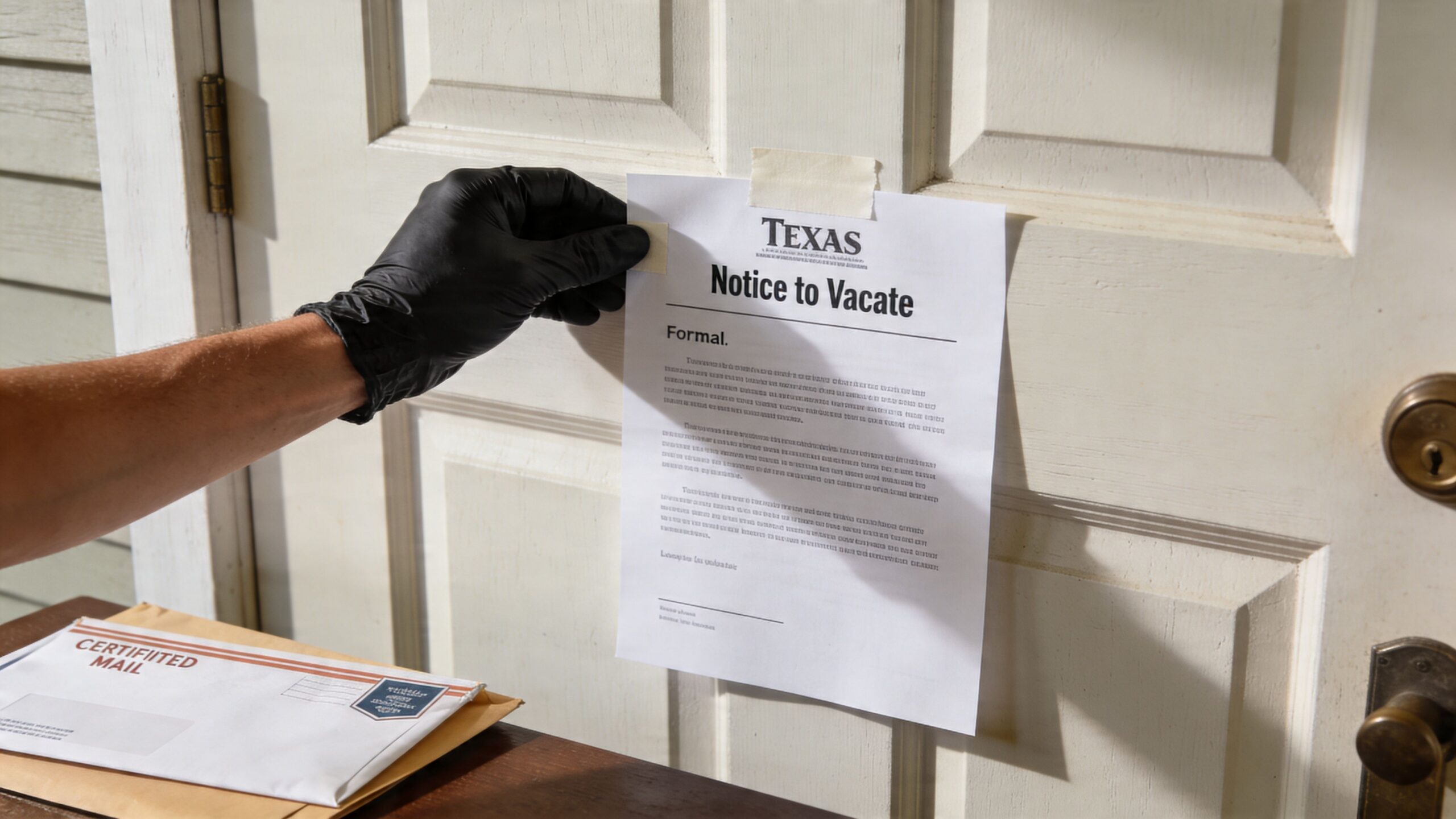
Under Texas Property Code §24.005(f)-(f-1) as discussed here, the recognized delivery methods include personal delivery, inside door posting, or mail. Outside posting is limited to specific safety-related or access-related circumstances, and the 2016 amendment narrowed when that outside posting method can be used.
The standard delivery methods
In ordinary cases, landlords usually have three main options.
- Personal delivery to the tenant or someone at least 16 years old at the premises: This is often the cleanest method when available.
- Affixing the notice to the inside of the main entry door: This is allowed when done correctly.
- Mailing the notice to the premises: Regular mail is one of the methods recognized under the statute.
Each method has strengths and weaknesses. Personal delivery creates a direct witness point. Mail creates a paper trail. Inside-door posting can work well when access is available and done properly.
The exception for outside posting
The outside of the door is not the first option in a normal case. The statute limits that method to particular conditions, such as when entry is blocked by a keyless bolting device, alarm system, or dangerous animal, or where harm is reasonably anticipated.
That matters because landlords sometimes assume any posting on the door is good enough. It isn’t. The details of where and why the notice was posted can become the whole fight.
A landlord should never choose outside posting for convenience alone. If the statute requires more, convenience won’t save the case.
How to prove delivery
Judges don’t just hear that a notice was served. They look for proof that the chosen method matched the law. Good practice usually includes preserving the documents and the facts immediately.
Useful proof often includes:
- A copy of the exact notice served
- A dated photo of where it was posted, if posting was used
- A mailing record if it was mailed
- A written statement from the person who delivered it
- Any property notes showing why outside posting was necessary
A practical comparison of delivery choices
| Delivery method | Best use | Main risk |
|---|---|---|
| Personal delivery | Direct contact is possible | Poor documentation afterward |
| Inside main entry door | Access is available | Incomplete proof of placement |
| You want a paper trail | Delay or dispute about receipt | |
| Outside posting under exception | Access or safety issue exists | Using it without meeting the statutory conditions |
What tenants should watch for
Tenants should not assume every posted paper is valid notice under §24.005. If the landlord used an unusual delivery method, pay attention to where the notice was left, who received it, and whether the method matches the circumstances.
Evidence is paramount. If you received a notice in a way that seems questionable, preserve it and document the scene as it existed when you found it.
Receiving a Notice Your Rights as a Tenant
If you’ve received a notice to vacate, don’t ignore it and don’t panic. Those are the two reactions that usually hurt tenants most. The better approach is to treat the notice as a legal document that may or may not be valid.
That distinction matters because proper notice often drives the case. According to this Texas eviction process guide, 70-80% of eviction suits hinge on proper notice, and tenants can challenge defective delivery or content while landlords risk dismissal and attorney fees for non-compliance.

Read the notice like a checklist
Start by asking basic questions, not emotional ones.
- Who is named: Does the notice identify the right tenant and property?
- What is demanded: Does it clearly demand that you vacate?
- When: Is the deadline clear?
- Why: Does it state the reason in a way that makes sense?
- How was it delivered: Was it handed to you, mailed, or posted in a way that appears lawful?
Then compare the notice with your lease. A lot of tenants never do this, and they miss one of the strongest defenses in the file. If your lease requires a different notice period than the landlord gave, that can matter.
Defects that can matter in court
A tenant defense doesn’t have to be dramatic to be effective. Sometimes the best defense is simple: the notice was wrong.
Potential issues include:
| Problem with notice | Why it matters |
|---|---|
| Wrong notice period | The landlord may have moved too quickly |
| Improper delivery | The notice may not satisfy §24.005 |
| Unclear demand | The notice may fail to terminate possession properly |
| Lease mismatch | The landlord may have ignored controlling lease language |
This doesn’t mean every typo defeats a case. It does mean tenants should stop treating the first notice as untouchable.
Your next moves should be deliberate
If you believe the notice is defective, preserve every piece of evidence. Keep the paper. Save texts and emails. Photograph where the notice was found. Pull your lease. If the issue involves payment, gather receipts, bank records, payment portal screenshots, or written agreements.
You should also prepare as if the case may still be filed. A bad notice can help you, but only if you show up and present the issue.
If you need a practical roadmap for what to do after notice arrives, review this guide on how to respond to an eviction notice in Texas.
Examples tenants often overlook
A landlord sends only a text saying you must be out tomorrow. That may feel threatening, but it still has to satisfy the legal requirements that apply to your situation.
A landlord gives a notice period that doesn’t match the lease. That may not look dramatic on day one, but it can become a strong procedural issue in court.
A landlord delivers the notice in a questionable way and assumes the tenant won’t know the difference. Tenants who document the method carefully often protect themselves better than tenants who solely argue they were treated unfairly.
The law doesn’t require you to surrender your rights just because a notice was served. It requires you to respond wisely.
Special Scenarios Forcible Entry and Foreclosure Notices
§24.005 is often considered the nonpayment or holdover notice statute. That’s true most of the time, but not all of the time. Two less common situations change the usual analysis. One involves unauthorized occupants. The other involves foreclosed property.
Under Texas Property Code §24.005 as summarized here, forcible entry cases may allow oral or written notice to vacate immediately, while post-foreclosure residential tenants who are current on rent are entitled to a 30-day notice.
Forcible entry cases move on a different track
A forcible entry situation is not the same as an ordinary tenant default. This usually involves an occupant who gained possession without consent or who is tied to someone who did. In those cases, the law can allow an immediate demand to vacate, and the notice may be oral or written.
That difference matters because landlords sometimes use regular tenant forms in situations involving unauthorized occupants, and tenants sometimes assume they always get the same notice period as a normal renter. Neither assumption is safe.
Here is the practical trade-off:
- For owners: Immediate action may be available, but classification matters. Calling someone a squatter does not automatically make it so.
- For occupants: If you had lawful possession at some point, the owner may still have to follow the ordinary possession rules instead of the shortcut they want to use.
Foreclosure changes the notice period for some tenants
Foreclosure adds another layer. A new owner after foreclosure may want possession quickly, but a residential tenant who is current on rent may have stronger protection than people expect. In that scenario, the law requires a 30-day notice before removal efforts begin.
This is one of the most overlooked parts of texas property code 24.005. Tenants often think a foreclosure wipes out every right overnight. It doesn’t. New owners often assume all occupants are immediate holdovers. That can be a costly mistake.
A foreclosure sale changes ownership. It does not erase the statute’s notice requirements for every occupant in every case.
Property condition can complicate these disputes
These cases also come up when a property has been badly damaged, left vacant, or caught in an insurance and possession dispute. If a fire, severe damage, or unsafe condition is part of the background, owners and occupants often need practical repair information alongside legal advice. In those situations, a resource on fire restoration services can help people understand the recovery side of the problem while the possession issue is being sorted out.
What works in these edge cases
The best approach is classification first, action second. Is this forcible entry, a holdover tenancy, a post-foreclosure tenant in good standing, or a mix of issues? The answer determines the notice rule.
What fails most often is oversimplifying. These are the cases where labels get thrown around, facts get blurred, and the wrong notice goes out.
When You Need an Experienced Texas Eviction Attorney
Some notice disputes are straightforward. Many are not. Once the facts get messy, the difference between a clean strategy and an expensive detour usually comes down to whether someone has identified the legal issue correctly at the start.
For landlords, the warning signs are easy to spot if you know what to watch for. The tenant stays after notice. The lease language is unusual. The occupant claims the notice was defective, retaliatory, or discriminatory. The property is commercial. The occupancy started informally through family, a roommate, or a side agreement that never made it into the written lease.
Landlord situations that usually need counsel
You should strongly consider calling a Texas landlord tenant lawyer when:
- The tenant won’t leave after notice: At that point, your next steps have to be documented and procedural.
- The delivery method may be challenged: If service was unusual, get legal eyes on it before filing.
- There are multiple occupants: Possession cases can get complicated when not everyone signed the lease.
- The case involves more than simple nonpayment: Property damage, lease violations, and commercial terms can change strategy.
A lot of landlords spend more money correcting a preventable filing problem than they would have spent getting the notice right in the first place.
Tenant situations that usually need counsel
Tenants should get help from an eviction attorney when the notice arrives together with pressure tactics, lockout threats, utility issues, or harassment. Legal help is also important if you believe the eviction is retaliation for repair complaints, if the lease terms are being ignored, or if the property has changed hands through foreclosure.
Some tenants also benefit from reading comparative legal material to understand how possession disputes are handled more broadly. For a general outside perspective, this overview of landlord and tenant solicitors can help frame the role lawyers play in rental disputes, even though Texas procedure has its own rules.
A lawyer’s value is not just courtroom appearance
Good legal help often matters before the hearing. It can mean spotting a notice defect early, choosing the right delivery proof, identifying whether the lease overrides the default rule, or preventing a case from being filed on weak facts.
It also means understanding the timeline. Even when the opening notice is proper, the full process involves filings, hearings, service rules, and deadlines that move quickly. This guide on how long the eviction process takes in Texas is useful if you’re trying to understand how the possession case unfolds after notice.
The notice to vacate looks simple on paper. In practice, it often decides whether the rest of the eviction process runs smoothly or starts with a problem.
If you’re dealing with disputed delivery, a lease conflict, a foreclosure issue, a commercial tenancy, or a tenant-rights defense, that’s usually the point where self-help analysis stops being efficient. A short legal review can save weeks of delay and a lot of avoidable stress.
If you need help with an eviction, lease issue, or rental dispute, contact The Law Office of Bryan Fagan, PLLC for a free consultation today.